
Top 10 Red Flags When Sourcing Brake Pads From China
Summary:
Evaluating a Chinese brake pad manufacturer requires spotting critical red flags before you order. This guide reveals the top 10 warning signs, from missing IATF 16949 certification to inconsistent copper content, that separate reliable partners from high-risk suppliers. Learn how to conduct a proper factory audit and verify essential documentation to protect your supply chain and brand reputation.
Top 10 Red Flags When Sourcing Brake Pads From China
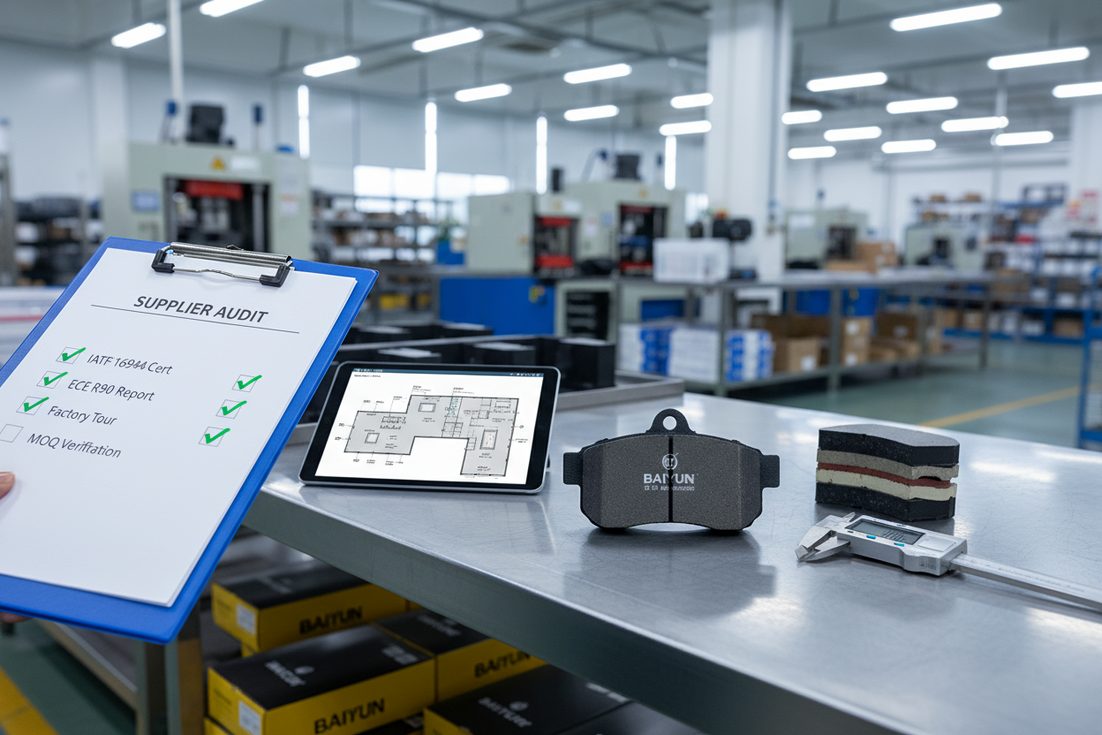
You've probably seen the price lists. Sourcing brake pads directly from Chinese manufacturers can look incredibly attractive on paper, with per-unit costs sometimes 40-60% lower than domestic suppliers. But that initial quote rarely tells the whole story. For every importer who builds a profitable, sustainable business, there's another who ends up with a warehouse full of noisy, underperforming, or even unsafe products that damage their brand reputation.
The difference usually comes down to due diligence. Spotting the warning signs early can save you from costly recalls, customer complaints, and legal liabilities. We've compiled the most common—and costly—mistakes buyers make, based on nearly five decades of manufacturing and working with global distributors.
What Certifications Should a Reliable Chinese Brake Pad Factory Have?
This is your first and most critical filter. Any legitimate manufacturer serving international markets will have their certifications front and center. IATF 16949 isn't just a quality badge; it's the automotive industry's specific technical specification for quality management systems. It mandates continuous improvement, defect prevention, and reduction of variation and waste in the supply chain. If a supplier can't show you a valid IATF 16949 certificate with an audit date within the last three years, walk away. They're not operating at the level required for consistent, safe OEM-grade production.
ECE R90 approval is equally non-negotiable for markets in Europe and many others that adopt its standards. This regulation requires rigorous dynamometer testing to verify performance doesn't degrade under heat. A genuine ECE R90 approval comes with a specific number (e.g., E1 90R-02A1234) that can be verified. Ask for the test report. At BAIYUN Brake, our quality assurance process is built around these certifications, not an afterthought.
Red Flag #1: Vague or missing IATF 16949 and ECE R90 documentation is the single strongest indicator of a high-risk supplier.
How Do You Spot Inconsistent Material Quality and Formulation?
Brake pads are a composite material, and the recipe matters. A manufacturer cutting corners might use inconsistent raw material batches or substitute cheaper, non-compliant ingredients. The global push to reduce copper content is a perfect example. Regulations in Washington State (USA) and others now mandate copper content be 5% or less by weight. A supplier who isn't proactively reformulating their compounds likely isn't keeping up with other critical standards either.
Always request a Material Safety Data Sheet (MSDS) and a published friction code (like FF or GG per SAE J866). The MSDS should list all major components. The friction code gives you a baseline for expected performance—cold friction (first letter) and hot friction (second letter). Be wary of suppliers who only quote a single friction coefficient number; real-world performance varies with temperature.
You can learn more about the nuances of different compounds in our understanding brake pad materials guide. It breaks down the trade-offs between ceramic, semi-metallic, and low-metallic formulas.
Why Is a Factory Audit More Important Than a Fancy Website?
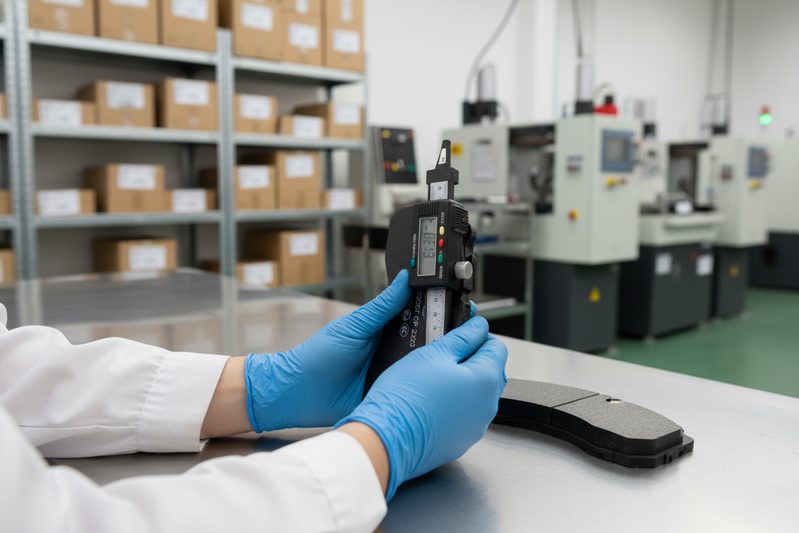
A sleek website with perfect English can be outsourced for a few thousand dollars. A modern, organized, and well-equipped factory cannot. This is where many importers get fooled. They communicate with a smooth-talking sales agent but never verify the actual production facility. Insist on a virtual or in-person factory audit. Look for the age and maintenance of core equipment like mixers, presses, and curing ovens. Is the production floor clean and organized? Can they show you documented workflow procedures?
Check their factory photos and ask for specific videos of the production line for your product type. A credible manufacturer like BAIYUN Brake is proud to show our automated batch mixing systems and precision grinding processes. If a supplier is hesitant to provide visual proof of their facility, it's often because the reality doesn't match the brochure.
Red Flag #2: Resistance to a transparent factory audit or providing specific production line videos suggests there's something to hide.
What Are the Most Common Misconceptions About Sourcing from China?
Misconception: All Chinese manufacturers produce low-quality, cheap goods.
Reality: China's manufacturing ecosystem is tiered. While low-end workshops exist, top-tier factories like BAIYUN Brake produce OE-quality parts for global brands, investing heavily in R&D and holding the same certifications as Western counterparts. The key is identifying and vetting these top-tier suppliers.
Misconception: The lowest price always wins.
Reality: In brake components, an abnormally low price almost always signals compromised materials, skipped testing, or lack of certification. The brake maintenance cost analysis shows that premature wear or failure leads to higher total cost of ownership through returns, warranty claims, and lost customer trust.
Misconception: Sample quality guarantees production batch quality.
Reality: Some suppliers maintain a "sample room" with perfect, hand-made units that are not representative of mass production. Always request samples from a regular production run, and consider third-party testing on bulk order samples before full container shipment.
How Can You Verify Technical Support and Documentation Before Ordering?
Think beyond the sale. What happens when your customer has an installation question or a technical issue? A professional supplier provides comprehensive support documentation. This includes detailed installation instructions with torque specifications, a trouble-shooting guide, and accessible technical support.
Test their responsiveness before you buy. Send a technical question via email. A reliable manufacturer should have a dedicated support engineer who can respond with accurate information within 24 hours. Ask for their brake pad installation guide or brake lining installation guide as an example. Sparse or poorly translated documentation is a major red flag for future support headaches.
Red Flag #3: Lack of professional, readily available technical documentation and slow support response times indicate a sales-only operation, not a true manufacturing partner.
Frequently Asked Questions for Brake Pad Importers
Q: What's the minimum order quantity (MOQ) I should expect from a reputable Chinese brake pad manufacturer?
A: It varies by factory size and product type. For standard passenger car brake pads, a credible manufacturer's MOQ for a new customer might range from 500 to 2,000 sets per SKU to justify production setup. Be very wary of suppliers offering no MOQ or extremely low MOQs (like 50 sets), as this often means they are reselling generic stock, not manufacturing to your specifications.
Q: How do I check if a supplier's ECE R90 certificate is authentic?
A: First, the certificate should have a unique approval number issued by a recognized technical service (like TÜV, IDIADA, or UTAC). You can cross-reference the manufacturer's name and address on the certificate with their business license. Secondly, ask for the full test report behind the certificate. A real report will be dozens of pages long with detailed graphs of friction coefficient vs. temperature, wear rates, and noise test results.
Q: Should I be concerned about intellectual property when providing my own branding or designs?
A: Yes, protection is crucial. Only work with suppliers who are willing to sign a formal Non-Disclosure Agreement (NDA) and a Manufacturing Agreement that clearly states they will not replicate your designs or sell your branded products to others. Reputable factories respect IP and see it as part of a long-term partnership. Always conduct due diligence on their business reputation.
Q: What packaging standards should I specify to prevent damage during sea freight?
A: Insist on export-grade packaging. Each brake pad set should be in a sealed box, with sets then packed in a master carton. Cartons should be double-walled corrugated cardboard, and the container should be palletized and securely strapped. Request photos of the packed pallets before shipment. Poor packaging is a common cost-cutting area that leads to crushed boxes and damaged friction material upon arrival.
Q: How can I assess a supplier's R&D capability for developing a custom formulation?
A: Ask specific questions: Do they have an in-house R&D lab with a dynamometer? Can they share case studies of custom projects? Request a tour of their technology center. A supplier with true R&D muscle will discuss technical parameters like target friction curves, compressibility, and shear strength, not just price and delivery time.
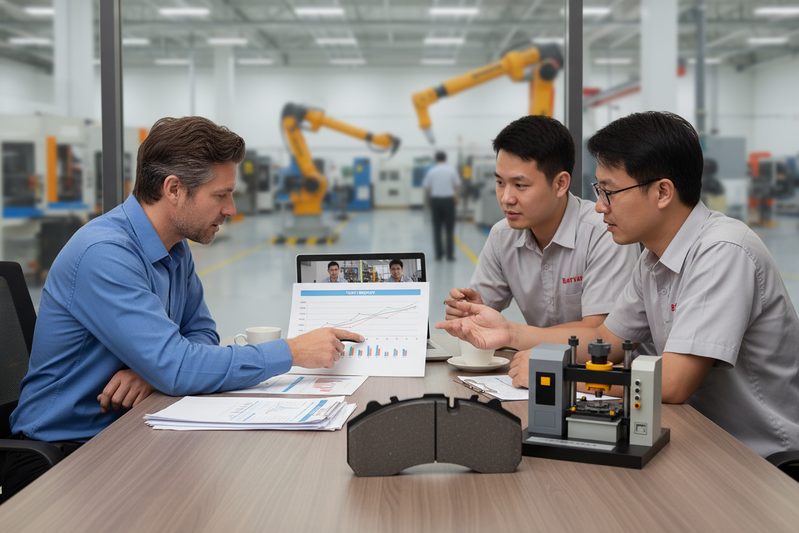
Sourcing from China isn't about finding the cheapest supplier; it's about finding the most capable and reliable partner. The market is vast, and the disparity between top-tier and bottom-tier manufacturers is significant. Your due diligence process must be rigorous, going beyond price comparisons to validate certifications, production capability, and quality systems.
The right manufacturer becomes an extension of your business. They provide consistency, support your branding, and help you navigate regulatory changes. The wrong one creates a cascade of problems that can take years to recover from. Focus on the fundamentals: verifiable certifications, transparent operations, and a proven track record.
Ready to evaluate a supplier with a proven history? BAIYUN Brake operates an IATF 16949 certified facility and holds full ECE R90 approvals. We provide complete documentation, from material data sheets to dynamometer test reports. Request a quote and our certification portfolio today to compare what a truly qualified manufacturer offers.
Was this article helpful?
Average Rating: 5/5 (1921)