
Which Chinese Brake Pad Manufacturers Actually Have Real IATF 16949 Certification?
Summary:
To properly evaluate a Chinese brake pad manufacturer, you must verify their IATF 16949 certification is legitimate, not just a claim. Real certification requires annual audits by an accredited body and translates to measurable quality metrics like >98% on-time delivery and <100 PPM defect rates, directly impacting distributor profitability and risk.
Which Chinese Brake Pad Manufacturers Actually Have Real IATF 16949 Certification?

You're looking at a supplier list, and every single Chinese brake pad factory claims IATF 16949. Their websites look professional, their quotes are competitive, and their sales reps sound confident. But here's the uncomfortable truth: a significant portion of those certificates aren't worth the paper they're printed on. For a distributor, the difference between a real and a fake certification isn't just paperwork—it's the difference between a reliable, profitable supply chain and a nightmare of warranty claims, delayed shipments, and lost customers. Let's cut through the noise.
What Does a Legitimate IATF 16949 Certificate Actually Look Like?
A genuine IATF 16949 certificate is issued by an accredited certification body, not the factory itself. According to the International Automotive Task Force rules, the certificate must clearly state the accredited body's name (like DNV, BSI, or TÜV), the scope of certification (e.g., "Design and manufacture of disc brake pads and drum brake linings"), the issue date, and the expiry date, which is always three years from issuance. Crucially, it will list the unique certificate number, which you can verify on the certification body's official website.
Many factories show a generic "ISO/TS 16949" certificate from a decade ago, which is obsolete, or a certificate from an unaccredited local agency. A real certificate is a living document backed by annual surveillance audits. If a supplier can't immediately provide a clear, verifiable digital copy of their current certificate with the accredited body's logo, consider it a major red flag. This is your first filter in a proper supplier qualification checklist.
Verifying the certification body's accreditation is the single most effective step to filter out non-compliant suppliers.
How Can You Audit a Factory's Quality Processes Remotely?
You can't fly to China for every potential supplier, but you can conduct a rigorous remote audit. Start by requesting specific documents: their Process Flow Diagrams (PFDs) and Control Plans for their top-selling brake pad models. A real IATF 16949 certified facility will have these for every product. Ask for evidence of their Management Review meetings—minutes from the last two meetings showing actions on quality objectives, customer complaints, and internal audit results.
Request a virtual tour of their production line, specifically asking to see their measuring and testing equipment calibration stickers. All equipment in a certified facility must have a current calibration status. Inquire about their Corrective Action process. Pose a hypothetical scenario: "If we received a batch with inconsistent friction coefficients, what's your 8D report process and typical closure time?" Their answer will reveal if their system is theoretical or operational. For a deeper look, you can watch factory tour videos that show these processes in action.
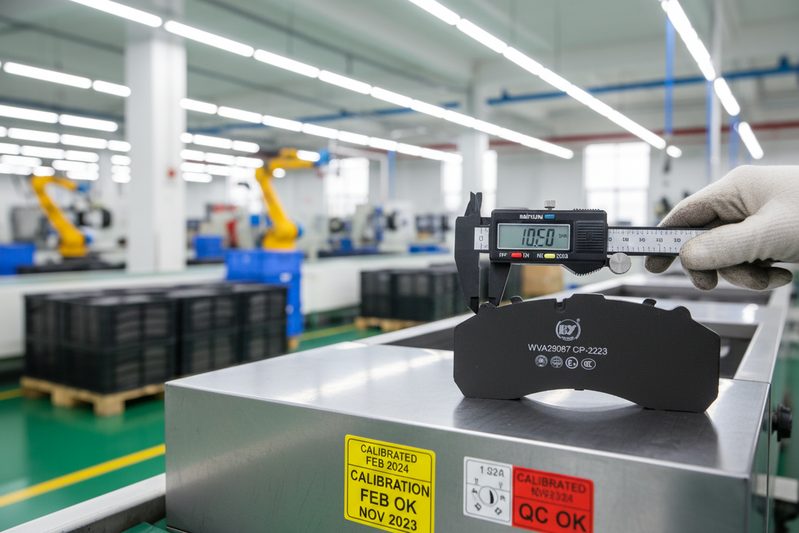
Don't just talk to sales. Request a 30-minute video call with their Quality Manager. Ask them to explain how they manage their "Significant Characteristics" as defined by IATF. If they hesitate or defer to sales, their certification likely isn't integrated into daily operations. This approach forms the core of a reliable brake pad supplier audit.
A remote audit focused on procedural evidence and quality personnel is 80% as effective as an on-site visit for initial screening.
What Are the Most Common Misconceptions About IATF 16949 in China?
Misconception: "IATF 16949 is just a more expensive version of ISO 9001."
Reality: IATF 16949 includes all ISO 9001 requirements but adds over 100 automotive-specific clauses. Key differentiators include mandatory Advanced Product Quality Planning (APQP), Production Part Approval Process (PPAP), and a strict emphasis on defect prevention and reducing variation in the supply chain. A factory certified only to ISO 9001 isn't qualified for automotive OEM brake pad sourcing.
Misconception: "The certificate covers their entire operation and all products."
Reality: Certification is scope-specific. A factory might be certified for machining but not for the friction material compounding process, which is the heart of brake pad performance. Always check the scope on the certificate. If it says "assembly of brake pads," it means they buy the friction material from an uncertified source—a critical risk point.
Misconception: "Once certified, they stay compliant forever."
Reality: IATF 16949 requires continuous improvement. Certification bodies perform annual surveillance audits and a full re-certification audit every three years. A factory that got certified in 2020 but hasn't updated its processes or faced a recent audit may no longer be in compliance. Always ask for the date of their last surveillance audit.
What Tangible Quality Metrics Should You Demand From a Certified Supplier?
Move beyond the certificate and demand performance data. A legitimate IATF 16949 brake manufacturer tracks and can report on specific Key Performance Indicators (KPIs). Ask for their last 12 months of data for: On-Time Delivery (OTD) to the hour, not the day—aim for >98%. First Time Through (FTT) rate for production—this measures how many pads pass all inspections without rework, and should be >95%. Customer PPM (Parts Per Million) defect rate—for automotive, this should be under 100 PPM.
Request copies of their final inspection reports for recent shipments. Look for actual test values, not just "pass/fail" stamps. They should show friction coefficient (μ) values at low, medium, and high temperatures (e.g., 100°C, 200°C, 350°C), shear strength tests, and dimensions against the drawing. For example, BAIYUN Brake's internal 2025 data shows their ceramic formulation CP2210 maintains a μ of 0.38-0.42 across the 100-350°C range, with a batch-to-batch variation of less than 5%. This level of transparency is what you're paying for with a certified supplier. You can review similar data in our passenger car brake pad test report.
Certification is a framework; the real value is in the consistent, measurable output data it enables you to access.
How Does Real Certification Translate to Distributor Profitability?
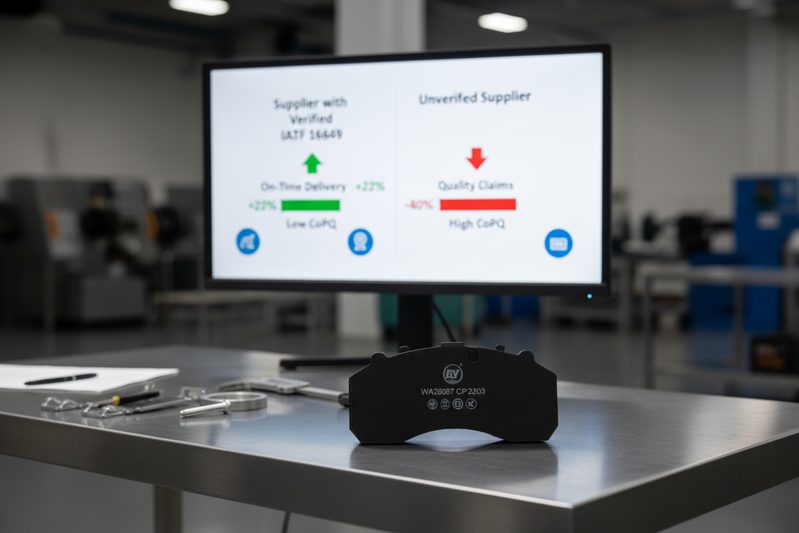
Let's talk numbers. A distributor sourcing 2,000 sets of brake pads monthly might save $0.50 per set by choosing a supplier with a dubious certificate. That's a $1,000 monthly saving. Now factor in the risk: one major quality recall from a single bad batch can cost $15,000-$25,000 in logistics, replacements, and damaged customer relationships. The probability of such an event is 3-5x higher with an uncertified supplier, according to 2024 industry analysis.
Certified suppliers provide consistent quality, which means fewer returns, less inventory tied up in quarantined stock, and more predictable cash flow. Their advanced planning processes (APQP) mean they can support you with new vehicle applications faster, giving you a first-to-market advantage. They also tend to have more stable raw material supply chains, protecting you from the wild price swings that plague smaller, uncertified factories. This is the essence of effective brake pad quality control China strategies.
Frankly, the price gap between certified and uncertified pads rarely justifies the warranty risk and operational headaches. Your most valuable asset is your brand's reputation for reliability—don't let a fake certificate put it on the line.
Frequently Asked Questions (FAQ)
Q: Can a factory be IATF 16949 certified but not have ECE R90 approval for their pads?
A: Absolutely. IATF 16949 certifies the quality management system for making automotive parts. ECE R90 is a product performance standard for brake pads sold in Europe and other adopting regions. A factory must have both to be a legitimate supplier for the European aftermarket. Always ask for the specific ECE R90 approval numbers for the models you're buying.
Q: How long does it genuinely take a factory to achieve IATF 16949 certification?
A: For a factory starting from scratch with no prior quality system, a full implementation cycle is typically 12-18 months. This includes gap analysis, process documentation, employee training, internal audits, a management review, and finally the certification audit. Suppliers claiming they got certified in "a few months" likely underwent a superficial, consultant-led process that won't withstand scrutiny.
Q: What's the difference between an IATF certificate and a customer-specific audit like a VDA 6.3?
A: IATF 16949 is a generic standard. A VDA 6.3 process audit is used by German OEMs (like Volkswagen, BMW) to assess their specific suppliers. Passing VDA 6.3 is often more rigorous. A Chinese factory supplying to a German OEM will have both. If you're a distributor, a valid IATF certificate is your baseline; a VDA 6.3 score is a strong bonus indicating higher capability.
Q: If a supplier's certificate expired 6 months ago, but they say they're "in renewal," is that acceptable?
A: No. IATF rules are clear: the certificate is valid until its expiry date. After that, the organization is no longer certified. "In renewal" is not a certified status. Do not place orders until you see the new, valid certificate. This is a common stalling tactic used by non-compliant factories.
Q: Do all brake pad materials (ceramic, semi-metallic, NAO) from a certified factory have the same quality level?
A: Not necessarily. Certification applies to the system, but material formulation is a separate expertise. A factory might excel with semi-metallic pads but have a less mature process for low-noise, low-dust ceramic formulations. Always ask for wear and noise test data specific to the material type you're sourcing, which you can find in our material data sheets.
Evaluating a Chinese brake pad manufacturer goes far deeper than a website checkbox. It demands a skeptical eye, a structured audit, and a focus on verifiable data over marketing claims. The manufacturers who invest in real IATF 16949 certification are investing in your business's stability and growth. They've built systems to prevent problems, not just react to them. Your sourcing decision ultimately shapes your product's performance, your customers' safety, and your company's bottom line. Isn't that worth a thorough verification?
Ready to evaluate a supplier with genuine certifications and transparent processes? Get in touch with our team at BAIYUN Brake. We'll provide our current IATF 16949 certificate, latest quality performance data, and arrange a technical review of your specific requirements.
Was this article helpful?
Average Rating: 5/5 (1136)