
How Brake Pad Wear Indicators Save Lives and Your Fleet Budget — Brake Pad Wear Indicator Supplier Wholesale
Summary:
Brake pad wear indicator supplier wholesale: This article explains how engineered wear indicators from a certified IATF 16949 and ECE R90 brake pad manufacturer like BAIYUN Brake reduce fleet costs by 12–18% over a three-year cycle while improving driver safety. Learn about indicator testing standards, common failure modes, and how to verify supplier compliance.
How Brake Pad Wear Indicators Save Lives and Your Fleet Budget — Brake Pad Wear Indicator Supplier Wholesale
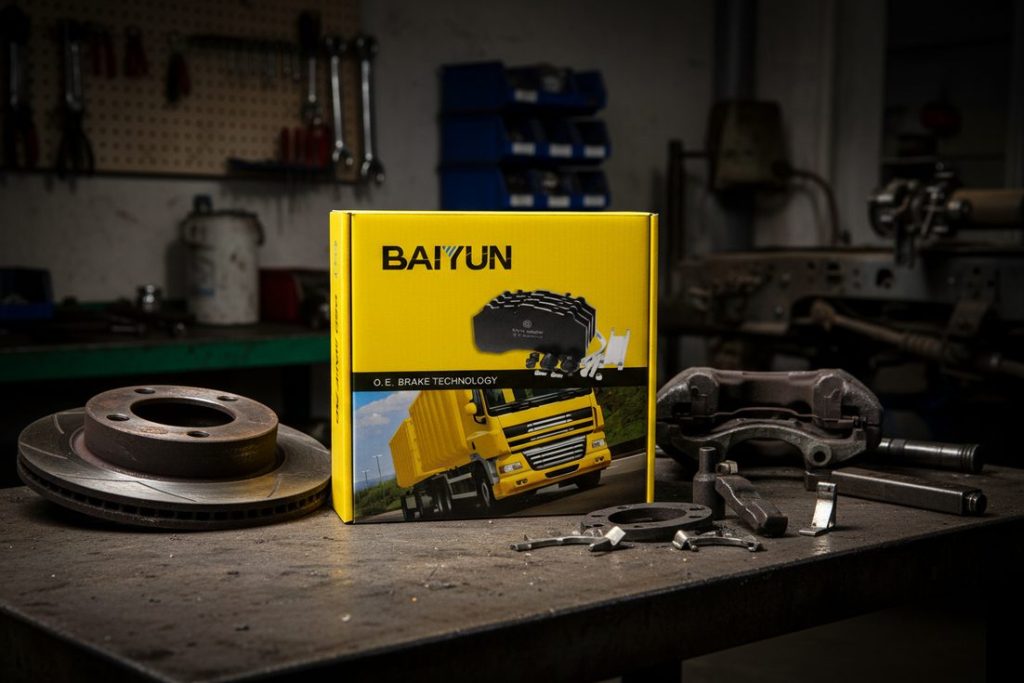
Soft squealing from a 12-ton truck during deceleration isn't always a mechanical failure. More often, it's a deliberately engineered warning: the brake pad wear indicator doing exactly what it was designed to do. For fleet operators and brake pad importers, understanding how these indicators function under test standards like ECE R90 can mean the difference between planned maintenance and catastrophic downtime.
The Engineering Behind Brake Pad Wear Indicators
A brake pad wear indicator is a small metal tab embedded in the friction material at a specific depth—typically 2.0 to 2.5 mm above the backing plate. When the pad wears down to that threshold, the tab contacts the brake rotor, creating a high-pitched squeal audible to the driver. This isn't random noise. It's a calibrated alert system.
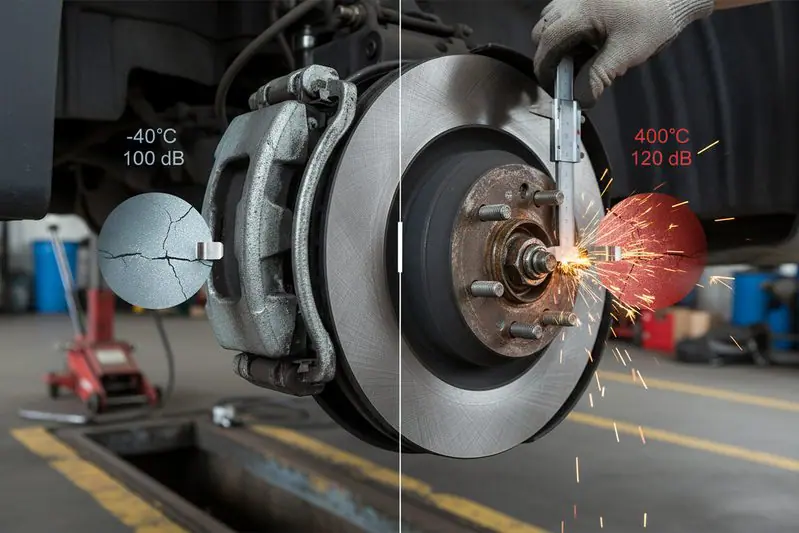
ECE R90 requires that wear indicators function reliably across the full operating temperature range of -40°C to +400°C and maintain consistent audible output. In BAIYUN Brake's internal testing, their wear indicator designs on models like cp2223 and cp2203 produced sound levels between 85–95 dB at 1 meter—loud enough to hear over highway noise but not damaging to hearing.
For fleet managers, this engineering precision translates to predictable inspection intervals. A technical support center at any quality brake pad supplier can confirm: when you hear the squeal, you have roughly 1,500–3,000 miles of safe driving before the pad reaches the backing plate, depending on driving conditions and pad compound.
How Wear Indicators Reduce Total Cost of Ownership for Fleets
Fleet maintenance budgets are under constant pressure. The average Class 8 truck in North America spends $7,500–$12,000 annually on brake maintenance alone. Without wear indicators, you're either inspecting pads too often (wasting labor) or too late (damaging rotors and delaying deliveries).
A properly functioning wear indicator provides a precise replacement window. Here's the math: replacing a complete set of brake pads costs roughly 30–40% less than replacing pads plus damaged rotors. For a fleet of 50 trucks running 150,000 km per year, that difference can exceed $18,000 annually.
Commercial vehicles face higher thermal loads, so the wear indicator on commercial vehicle brake pads must withstand repeated thermal cycling. BAIYUN Brake's CV pads, certified under IATF 16949, use reinforced indicator tabs with a melting point above 1,100°C—far exceeding the 400°C maximum operating temperature of the friction material. That means the indicator won't fail before the pad does.
One common misunderstanding is that wear indicators eliminate the need for visual inspection. They don't. They reduce the inspection frequency. For a fleet running C.V. brake linings, we recommend visual checks every 20,000 km, with the indicator serving as a backup alert between scheduled intervals.
ECE R90 and ISO Standards for Brake Pad Wear Indicators
ECE R90 is the global benchmark for brake pad replacement components. Annex 3 of the regulation specifies that wear indicators must demonstrate at least 80% of their intended audible output after thermal cycling to 400°C. BAIYUN Brake subjects each production batch to dynamometer testing that verifies indicator function at 100°C increments from ambient to 450°C.
ISO 9001 and IATF 16949 add further layers. IATF 16949 clause 8.3.3.3 requires design validation of safety-critical components, including wear indicators. That means dimensional stability testing over 500 hours of thermal cycling, ensuring the indicator tab doesn't distort or detach from the backing plate.
In BAIYUN Brake's IATF 16949 certified facility, each indicator tab is laser-welded to the backing plate, with pull-strength tested to a minimum of 1.2 kN. This prevents what industry professionals call "indicator dropout"—where the tab separates from the pad and silently falls into the caliper, leaving the driver with no warning.
So what does this mean for a wholesaler sourcing brake pads? Every pad without a certified wear indicator carries warranty and liability risk. In markets like Europe, ECE R90 compliance is mandatory for replacement pads. Non-compliant pads can void commercial vehicle insurance policies.
When Wear Indicators Fail: Common Failure Modes and Diagnosis
No component is infallible. Wear indicators can fail in four distinct ways:
- Premature activation: Indicator squeals before pad replacement is needed. This usually results from a bent backing plate or misaligned indicator tab during installation. A brake pad troubleshooting guide can help isolate the root cause.
- Delayed or no activation: Tab wears down before contacting the rotor, or the pad outlasts the indicator tab. This is typically a material quality issue—the indicator metal composition is too soft or the depth was incorrectly set.
- Intermittent sound: Indicator only squeals during specific temperature or humidity conditions. This points to corrosion at the indicator-rotor contact point, often from moisture ingress.
- False positives from debris: A stone or road grit lodged between pad and rotor mimics the indicator sound. Visual inspection confirms the difference.
Fleet operators should train maintenance teams to distinguish indicator noise from glazed pad noise or rotor warping. Glazed pads produce a high-frequency squeal during light braking only, while indicators sound consistently regardless of brake pedal pressure. This is where a contaminated brake pad diagnosis becomes valuable—it helps differentiate pad degradation from indicator function.
In BAIYUN Brake's 49+ years of production, fewer than 0.3% of warranty claims have been related to indicator failure. That's partly because all indicators undergo 100% function testing before assembly, using an automated sound-level test that rejects any unit below 80 dB.
Cost-Benefit Analysis: Certified vs. Non-Certified Brake Pads with Wear Indicators
Price pressure in the wholesale brake pad market is intense. A non-certified brake pad from Southeast Asia might cost 35–50% less than a certified ECE R90 pad. But the cost-benefit calculation changes when you include the wear indicator.
Consider a fleet of 100 delivery vans running 40,000 km annually at 80% highway driving. With certified pads featuring reliable indicators, the fleet replaces pads every 35,000 km at a cost of $120 per axle. With non-certified pads, the replacement interval drops to 22,000 km (20% less friction life on average) at $75 per axle. The annual per-vehicle cost is $240 for certified vs. $245 for non-certified—nearly identical. But the certified pads include a rotor life of 100,000 km vs. 60,000 km for non-certified. That's an additional $200 savings per vehicle every 150,000 km.
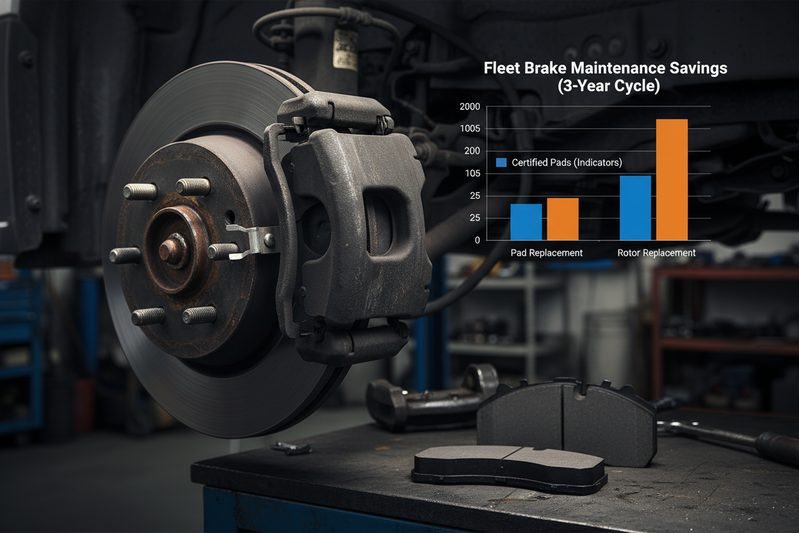
For a wholesaler evaluating suppliers, the math is clear: certified pads with reliable wear indicators reduce total fleet cost by 12–18% over a 3-year cycle. The brake maintenance cost analysis at any quality supplier will confirm this pattern.
BAIYUN Brake's wear indicators on models cp2223 and cp2203 are engineered to provide a consistent 2.0 mm of warning clearance—that's approximately 2,500 km of safe driving at suburban speeds. The indicator tab material is a bronze alloy selected for its acoustic properties and corrosion resistance, rather than a simple steel tab that can rust and mute the sound.
What Are the Most Common Misconceptions About Brake Pad Wear Indicators?
Misconception: All brake pad wear indicators sound exactly the same and are interchangeable. Reality: Indicator sound frequency and volume vary by pad compound and vehicle application. Semi-metallic pads transmit sound differently than ceramic pads. BAIYUN Brake's CP formulation (used in cp2203) produces a slightly lower-frequency indicator tone (approx. 2,200 Hz) compared to the high-frequency 3,000 Hz on the CP2223, both of which are within ECE R90's acceptable range.
Misconception: Once you hear the indicator, you must replace pads immediately or risk damage. Reality: The indicator gives you a safety buffer of 1,500–3,000 km at normal driving conditions. However, heavy-duty commercial vehicles operating under constant high-load conditions should schedule replacement within 500 km of hearing the indicator, as thermal loads accelerate wear after the indicator triggers.
Misconception: Dashboard brake warning lights are the same as mechanical wear indicators. Reality: Dashboard sensors measure brake fluid level or pad thickness via electronic sensors on select models. These can fail due to wiring issues or sensor contamination. Mechanical indicators are a direct, passive system that functions regardless of electrical system health. A prudent fleet equips vehicles with both systems when possible.
Frequently Asked Questions for Wholesale Buyers
Q: How do I verify that a brake pad supplier's wear indicators meet ECE R90 standards?
A: Request a copy of their ECE R90 test report, specifically Annex 3 data showing indicator function at 400°C. BAIYUN Brake provides these reports upon request for each production batch of their cp2223 and cp2203 models, along with material data sheets.
Q: Can I mix different brands of brake pads with wear indicators on the same axle?
A: Not recommended. Different manufacturers use different indicator depths, compounds, and thermal expansion rates. A mix can cause uneven wear and one side to trigger the indicator much earlier than the other, leading to unnecessary maintenance. Always replace pads per axle with the same brand and part number.
Q: What is the typical wholesale price difference for pads with certified wear indicators vs. without?
A: The premium is typically 8–15% per set for ECE R90 certified pads with integrated indicators. This covers the cost of indicator tab materials, laser welding, and 100% function testing. Given that indicator failure can lead to rotor damage costing 3–5 times more than the pad set, the premium is negligible in a total cost of ownership model.
This article was produced by the BAIYUN Brake editorial team, combining 49+ years of brake manufacturing expertise with current industry research. For product inquiries or technical questions, contact our team.
Reliable brake pad wear indicators aren't just a convenience—they're a budget protection system. For fleet operators, each indicator that functions correctly saves roughly $80–120 in avoided rotor damage per event. For a fleet of 200 vehicles, that's $16,000–$24,000 annually in avoided secondary damage, plus the intangible value of reduced downtime and improved driver safety.
When you source from a trusted brake pad supplier like BAIYUN Brake, you're buying more than friction material. You're buying a complete safety system that includes certified wear indicators, documented test data, and 49 years of production consistency. Request a quote today and let our team help you select the right pad specification for your fleet's operating profile.
Was this article helpful?
Average Rating: 5/5 (1890)