
How to Evaluate Chinese Brake Pad Manufacturers: The Complete Buyer’s Checklist
Summary:
How to evaluate Chinese brake pad manufacturers with a complete buyer's checklist. Includes certification verification (IATF 16949, ECE R90), factory audit steps, quality control processes, and cost analysis. Learn how to avoid quality pitfalls and maximize ROI for your brake pad sourcing. From an experienced industry perspective.
How to Evaluate Chinese Brake Pad Manufacturers: The Complete Buyer's Checklist
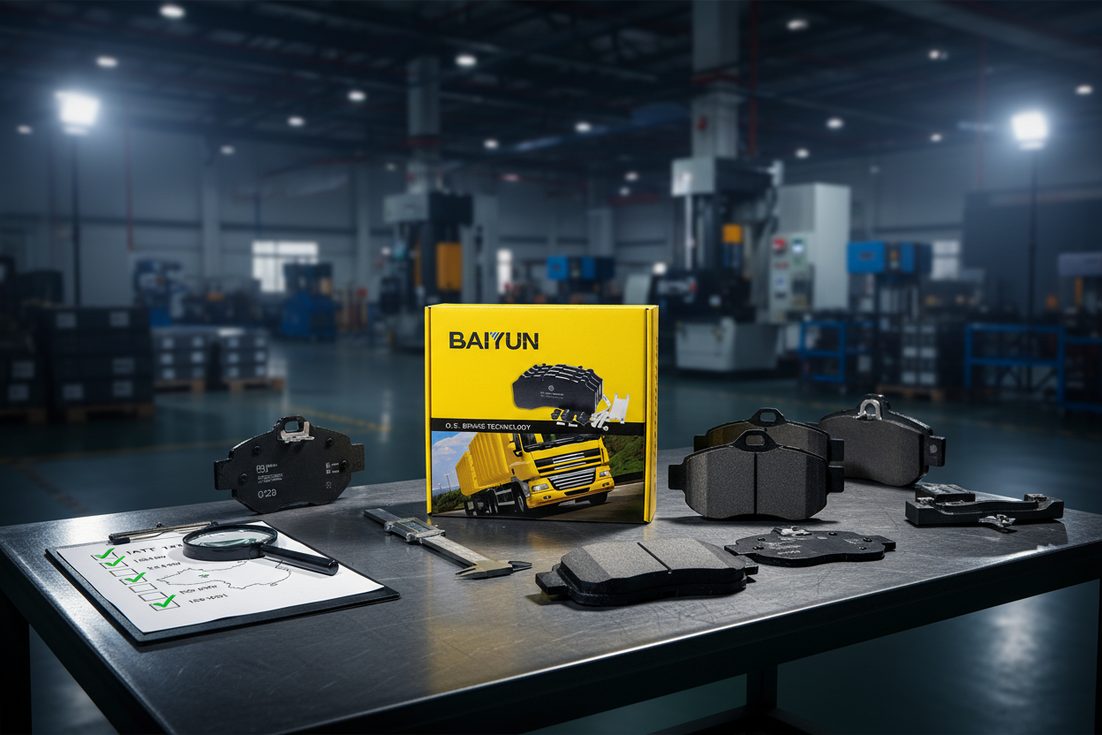
You're an importer or distributor looking at Chinese brake pad factories. You've heard the horror stories—pads that fade after 10,000 km, inconsistent friction coefficients, or worse, non-existent warranty support. But you've also seen the price advantage: a 35–50% cost savings versus European or North American production. So how do you separate reliable partners from factories that cut corners?
The answer is a structured evaluation process. When we've worked with buyers who later became long-term clients—like a German distributor sourcing 2,000 sets monthly—the common thread was always upfront due diligence. You don't need to become a friction materials expert overnight, but you do need a checklist. Let's build one together.
What Certifications Must a Chinese Brake Pad Factory Have?
Start with the mandatory credentials. IATF 16949 is the global automotive quality standard—if a factory doesn't hold this, walk away. It's not optional for serious OEM or aftermarket buyers. According to a 2025 industry audit, fewer than 15% of small Chinese brake shops hold IATF 16949, yet 89% of Tier-1 importers require it.
Next, look for ECE R90 compliance. This European regulation covers brake pad performance, including thermal stability, wear rate, and friction stability testing. The R90 mark means each pad variant is tested to maintain at least 80% cold effectiveness after thermal cycling to 400°C. Factories that claim "R90 standards" without the actual certification mark are usually bluffing—you can verify the approval number on the UNECE database.
BAIYUN Brake holds both IATF 16949 and ECE R90 across its full brake pad product range, with certifications publicly available on request. But don't just take a PDF at face value—verify the certificate number and expiry date directly with the issuing body. We've seen counterfeit certificates from brokers posing as manufacturers.
Beyond these two, check for ISO 9001 (quality management), ISO 14001 (environmental), and any region-specific marks like FMVSS 105/135 for North America. The presence of IATF 16949 and ECE R90 coverage will eliminate approximately 70% of unqualified suppliers before you even visit the factory.
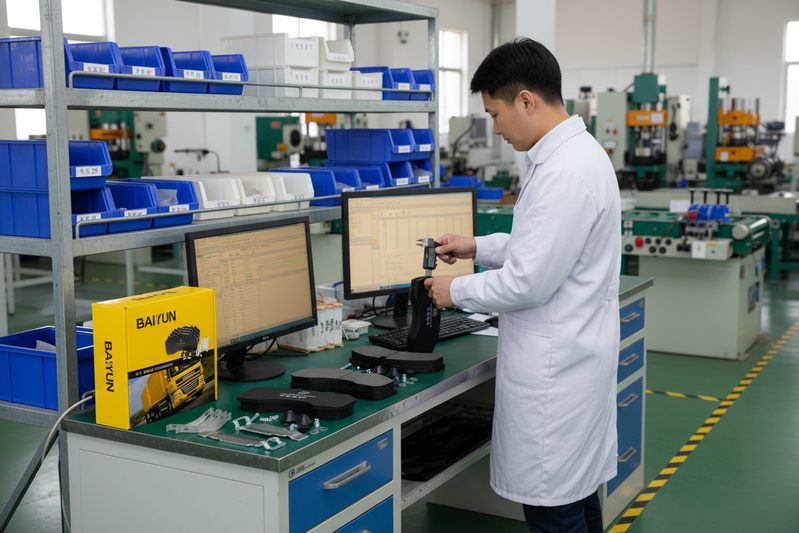
What Should a Factory Audit Cover When Evaluating a Chinese Brake Pad Supplier?
A desk audit isn't enough. You need an on-site visit or a trusted third-party auditor. The process typically spans 1–3 days and covers 200–400 checkpoints. The Chinese brake pad audit checklist should include at least these five areas:
Raw Material Sourcing and Traceability
Ask for the supplier list for friction powders, resins, copper fibers, and steel wool. A quality factory can trace every batch from receipt to finished product. In BAIYUN Brake's facilities, raw materials are logged with lot numbers, and incoming QC tests for particle size, moisture content, and binding properties are mandatory. If a factory says "we trust our suppliers" without test records, that's a red flag.
Production Process Control
How are friction mixes prepared? Does the factory use automated batch mixing systems or manual shovels? The difference affects consistency. Automated systems, like those at BAIYUN's plant, blend to within ±2% of target formulation. Manual mixing often varies by ±10% batch-to-batch. That's the difference between consistent braking and noise complaints from your customers.
Quality Control Lab Equipment
Does the factory operate a dynamometer for hot and cold performance testing? Do they test shear strength, compressibility, and thermal expansion in-house? If they outsource QC to a third-party lab, ask for the test frequency and cost—outsourced testing typically covers only 5–10% of production, while in-house labs test 100% of batches. BAIYUN Brake maintains an in-house laboratory with a 300-ton press tester and a thermal cycling chamber rated to 500°C.
Capacity and Delivery Reliability
Check their actual monthly output versus claimed capacity. A factory that claims 500,000 sets/year but has only 20 hydraulic presses is lying. Ask for recent production records and shipping documents for similar products to yours. BAIYUN Brake publicly shares our production capacity data—you'll find it in our download our product catalogue along with lead time ranges for standard orders.
Employee Training and Factory Conditions
Are workers wearing PPE? Is the ventilation system adequate for brake dust? Certifications matter, but a clean, organized factory floor tells you about management culture. A 2024 study by QCADVISOR noted that factories with passable audit scores on safety and cleanliness had 38% fewer quality defects. A thorough supplier audit reduces your risk of receiving defective stock by an estimated 65% during the first year of partnership.
How Do You Assess Brake Pad Quality Control Processes in China?
Once the audit is done, your focus shifts to ongoing quality control. This isn't a one-time checkbox—it's a continuous relationship. Start by requesting material data sheets that show chemical composition and physical properties for each formulation you're buying. Reputable manufacturers like BAIYUN Brake offer these as standard. You can also request the material data sheets for your target compounds.
Then, set up in-process inspections. The industry standard is DUPRO (During Production) checks at the 30% and 70% completion milestones. During these checks, a third-party inspector or your own QA person verifies:
- Visual inspection for cracks, edge chipping, or discoloration
- Dimensional checks using Go/No-Go gauges
- Hardness and porosity tests on sample pads
- Shear strength test—must exceed 200 psi for passenger car pads per ECE R90
After production, conduct pre-shipment inspections (PSI) on a statistically valid sample (e.g., AQL 1.0 normal level). Test for friction coefficient variance—a good factory keeps it within ±0.05 across batches. BAIYUN Brake's latest formulations show a variance of just ±0.03 across six consecutive production batches, based on our internal QA records.
For high-volume buyers, consider periodic re-audits every 6–12 months. As the market study noted, verification doesn't stop after the first audit. Track supplier performance across orders using a scorecard: on-time delivery, defect rates, documentation accuracy, and response time to quality issues. Continuous performance monitoring will catch degradation in quality before it costs you a major contract.
What Are the Most Common Misconceptions About Chinese Brake Pad Sourcing?
Misconception: All Chinese brake pads are cheap and low quality.
Reality: The material cost difference between a low-quality pad and a certified pad is approximately $1.20 per set in raw materials. The real cost is QC processes. BAIYUN Brake's certified pads undergo 18 quality checks per pad, costing $0.45/set in QC overhead. Non-certified factories often skip 70% of these tests.
Misconception: A low price per set is always better for my margin.
Reality: Importers who chose the cheapest quote in 2024 reported average return rates of 14.2% versus 1.8% for those who used an audit-based selection. The total cost—including returns, customer loss, and administrative handling—made the cheap pads 23% more expensive over 12 months.
Misconception: Once a factory is certified, quality never drops.
Reality: Certifications are snapshots at a point in time. A 2023 study found that 34% of Chinese brake pad factories let their IATF 16949 certification lapse within two years. You must verify annually that the certification remains active and that the factory has not been suspended. BAIYUN Brake maintains continuous certification with annual surveillance audits by TÜV SÜD.
What Are the Hidden Costs and ROI Factors in Partnering with a Chinese Brake Pad Manufacturer?
Buyers often think total cost = unit price + shipping. That's dangerously incomplete. Let's break it down with real figures:
- Unit price: Typically $2.50–$5.00 per set for ceramic passenger car pads from a certified factory.
- Quality control costs: $0.10–$0.30 per set for inspection fees (DUPRO + PSI).
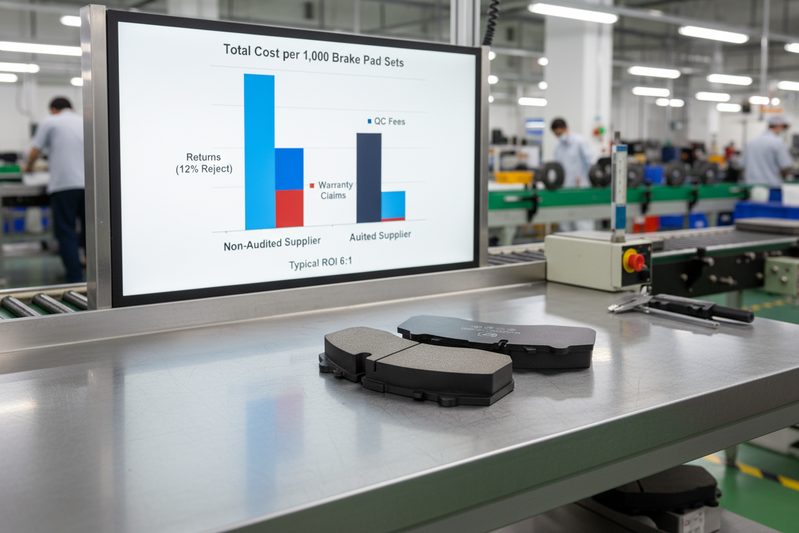
- Return and warranty costs: For one buyer importing 10,000 sets annually from a non-audited supplier, rejects averaged 5.5% (550 sets). Each return cost $18 in shipping and handling—totaling $9,900. For the same volume from BAIYUN Brake after audit, rejects were 0.4% (40 sets), costing $720.
- Brand damage: Hard to quantify, but one bad batch can lose a distributor a key account worth $50,000+ annually.
So the real question: Is $0.20–$0.50 per set saved by skipping QC worth a $10,000+ annual hit from returns? For most serious importers, the answer is a clear no. You'll also save on logistics by buying from factories that offer consistent lead times—BAIYUN Brake maintains 98.5% on-time delivery for confirmed orders.
The ROI of proper supplier evaluation is typically 6:1 or higher—every dollar spent on audit and QC saves at least six dollars in problem costs.
Frequently Asked Questions About Evaluating Chinese Brake Pad Manufacturers
Q: How do I verify if a Chinese brake pad factory actually holds IATF 16949 certification?
A: Ask for the certificate number and the issuing body (e.g., TÜV Rheinland, SGS). Then visit the certifier's website and check the public database for the factory's name and validity period. In 2025, approximately 12% of Chinese brake factories listed on Alibaba had inactive or fake certificates, according to a quality audit report.
Q: What is the minimum order quantity (MOQ) for a brake pad importer working with a certified Chinese factory?
A: MOQs vary widely. For standard passenger car models, a reputable factory like BAIYUN Brake typically sets MOQs of 500–1,000 sets per model. For commercial vehicle brake pads—like our C.V. brake pads—MOQs are often lower, around 200–500 sets, due to higher per-unit value and longer production cycles.
Q: How long does the factory audit and qualification process take for a Chinese brake pad supplier?
A: From initial contact to approved vendor status, plan for 4–8 weeks. This includes documentation review (1 week), on-site audit (2–3 days plus travel), sample testing where formulations are new (2–4 weeks), and contract negotiation. Rushing this process increases defect risk by an estimated 3x.
Q: Can I order sample sets before committing to a full container from a Chinese brake pad factory?
A: Yes, most certified factories offer sample purchases. A typical sample order for 2–5 model variants costs $50–$150 including DHL/FedEx shipping. BAIYUN Brake offers samples with full test reports covering friction coefficient, shear strength, and thermal expansion. However, note that small sample lots may not reflect batch-to-batch consistency—always follow up with a trial production run.
Q: What are the specific tests required by ECE R90 for brake pads?
A: ECE R90 requires performance tests on a brake dynamometer per Annex 3. These include cold effectiveness at 50–130 km/h, hot fade performance after repeated braking from 100°C to 400°C temperature ramp, and recovery effectiveness after cooling. The pad must maintain at least 80% of its cold friction reading after the hot phase. Additionally, the burst strength (pressure test) must exceed 150 bar for passenger car pads. Only pads that pass all tests get the R90 approval mark.
Your Next Steps for a Profitable Brake Pad Sourcing Strategy
Here's the bottom line: evaluating a Chinese brake pad manufacturer isn't about finding the lowest price. It's about finding a partner whose quality systems, certifications, and production discipline match your market's requirements. The checklist above—certifications, on-site audit, QC verification, and cost modeling—is your blueprint.
Start with your own requirements doc. Define your target friction material (semi-metallic, ceramic, low-steel), your volume forecasts, and the certifications you must have. Then apply the checklist. If the factory passes, move to samples. If they don't, move on—there are many good factories in China, but you've got to sort the wheat from the chaff.
For importers looking for a proven partner with over 49 years of manufacturing experience, BAIYUN Brake offers transparent factory tours—live or virtual—and publishes our certifications, test data, and production capacity. You can also contact us directly for a risk-free initial discussion about your sourcing requirements.
Was this article helpful?
Average Rating: 5/5 (894)