
EV Brake Pads: Why Regenerative Braking Changes Everything for Distributors
Summary:
Brake pads for electric vehicles represent a fundamental shift for distributors, driven by regenerative braking technology. This change demands a focus on technical specifications, corrosion resistance, and strict compliance with standards like ECE R90. Sourcing from a certified manufacturer with proven EV formulations is critical to meet the unique performance and durability requirements of the growing global EV market.
EV Brake Pads: Why Regenerative Braking Changes Everything for Distributors
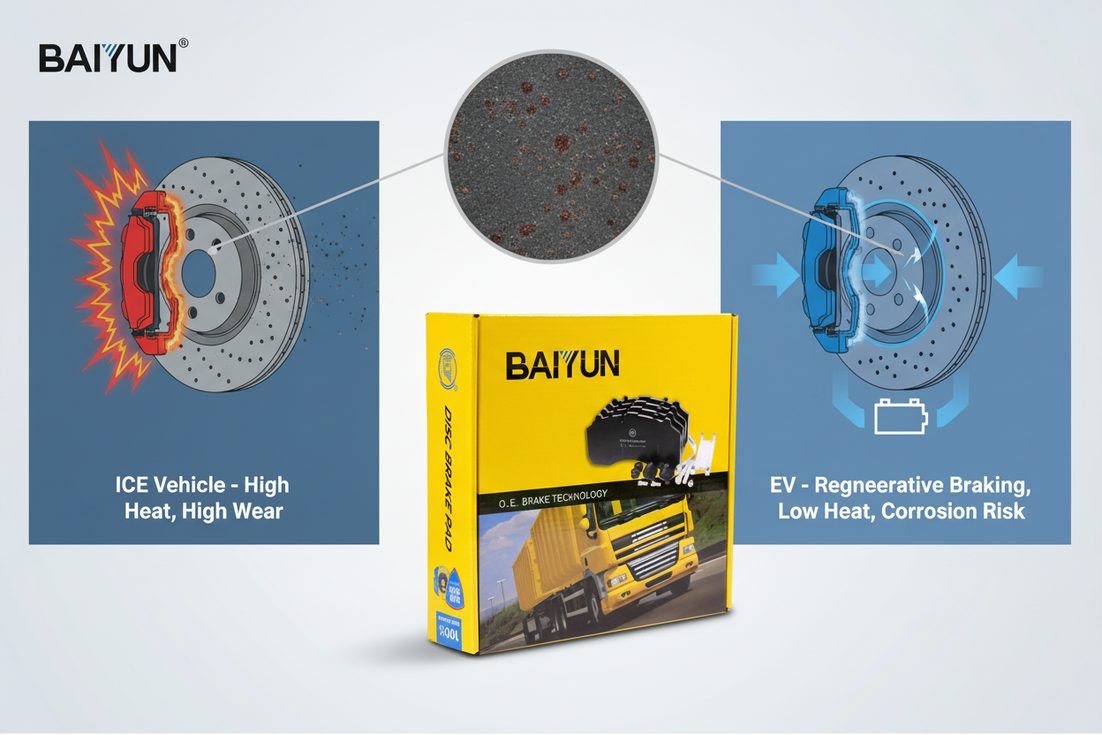
You're probably seeing more electric vehicles roll into your customers' shops. The global EV market is projected to hit 45 million units by 2030, and that's not just a sales opportunity—it's a fundamental shift in the parts you need to stock. The biggest change? The brakes. Regenerative braking doesn't just recharge the battery; it completely rewrites the rulebook for brake pad performance, wear patterns, and technical compliance. If you're still sourcing pads based on ICE vehicle specs, you're missing the mark on durability, safety, and profitability.
An EV can be 20-30% heavier than its gasoline counterpart, yet its friction brakes might only handle 10-30% of the total deceleration work. That sounds like less wear, but it creates a unique set of problems. Corrosion, not abrasion, becomes the primary failure mode. Low-use pads sitting against a rotor in wet conditions can develop surface rust that compromises the friction layer. The pads you supply need to be engineered for this new reality, not just repurposed from an existing line.
So what does that mean for your sourcing strategy? You need a supplier who understands the material science behind low-dust, corrosion-resistant formulations and can provide the test data to prove it. This isn't about finding a cheaper pad; it's about finding the right pad that protects your reputation and meets the stringent OEM-equivalent standards these vehicles demand.
The Technical Shift: How Regenerative Braking Alters Pad Requirements
Regenerative braking systems can recover up to 70% of the kinetic energy lost during stopping. That energy goes back to the battery, not into heat on the rotor. Consequently, traditional brake pads on an EV often operate below 100°C, a temperature range where many conventional semi-metallic formulations are inefficient and prone to noise. The friction material must be stable and effective from cold, sometimes as low as 0°C, all the way up to moderate temperatures, with minimal fade.
This low-temperature operation is a double-edged sword. While it reduces thermal stress, it eliminates the "burn-off" cycle that cleans light corrosion from pads and rotors on ICE vehicles. In coastal or high-humidity markets, this leads to pad surface glazing and rust jacking—where corrosion builds under the pad lining, causing uneven wear and potential detachment. The pad backing plate requires superior anti-corrosion coatings, and the friction material itself needs additives to resist moisture absorption.
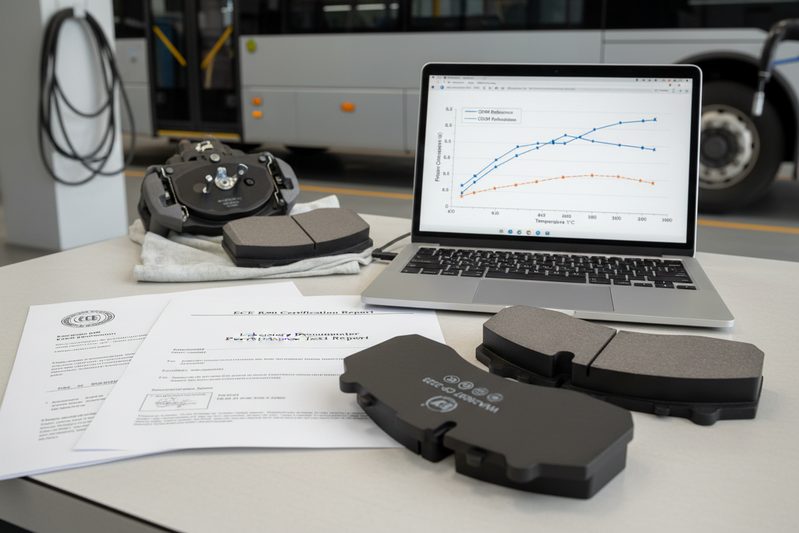
For distributors, this translates to a need for pads with specific technical documentation. You should be asking for dynamometer test reports showing performance curves from 50°C to 350°C, not just peak hot performance. Look for data on shear strength and compressibility at low temperatures, which are critical for the pedal feel EV drivers expect during that occasional hard stop.
Compliance and Certification: Navigating the EV Brake Pad Landscape
There's no single global "EV brake pad standard," but that doesn't mean it's a free-for-all. Original Equipment for EVs is designed to meet specific performance envelopes, and replacement parts must match that intent. The most relevant benchmark remains ECE R90, which sets the baseline for safety-critical replacement brake components in over 50 countries. For a part to be ECE R90 certified, it must match or exceed the OEM part's performance across a battery of tests, including effectiveness, fade, recovery, and wear.
Why does this matter more for EVs? Because the braking system is integrated with regenerative braking and vehicle stability controls. A pad with an inconsistent friction coefficient can confuse the vehicle's electronic brake distribution system, leading to unpredictable regenerative blending and longer stopping distances. Sourcing from an IATF 16949 certified facility is your first assurance of process control, but the product itself needs the R90 mark to validate its performance equivalence.
At BAIYUN Brake, our EV-focused formulations undergo the full ECE R90 test sequence. We document the friction coefficient (μ) must stay within a tight band, typically ±0.05 of the OEM reference, across the entire temperature range. This level of consistency is non-negotiable for modern vehicle electronics. Don't just take a supplier's word for it—request the actual passenger car brake pad test report for the specific part number.
Material Formulations: Ceramic, Low-Metallic, and the Low-Dust Imperative
EV owners are notoriously attentive to vehicle maintenance and cleanliness. Brake dust is more than an aesthetic issue on EVs; it can contain conductive metallic particles that potentially interfere with nearby sensors. This has driven OEMs toward ceramic and specialized low-metallic NAO (Non-Asbestos Organic) formulations. These materials offer stable low-temperature performance, produce significantly less dust (often 50-70% less than semi-metallics), and generate less high-frequency noise—a common complaint labeled as NVH (Noise, Vibration, Harshness).
However, not all ceramics are equal. A true ceramic formulation for EVs balances ceramic fibers, non-ferrous fillers, and binding agents to achieve a specific wear rate and rotor friendliness. The goal is a pad that wears evenly with the rotor, preventing the disc scoring that can happen when a hard pad meets a soft rotor. For distributors, understanding this balance is key. A pad that's too aggressive on the rotor will lead to premature disc replacement and customer comebacks, erasing any profit from the initial pad sale.
Our R&D team has spent years refining these balances. You can see the results in our ceramic brake pad production video, which details our precision mixing and curing processes. The outcome is a product line where technical specs, like compressibility and shear strength, are predictable batch-to-batch. That predictability is what lets you warranty your parts with confidence.
The Distributor's Checklist for Sourcing EV Brake Pads
What should you verify before adding an EV brake pad to your catalog? Start with the physical specs. Many EVs use larger calipers and thicker pads to manage the vehicle's mass, so dimensional accuracy is critical. A mismatch can cause immediate installation issues or, worse, a pad that doesn't fully contact the rotor. Next, review the material data sheet. It should explicitly mention compatibility with regenerative braking systems and list the temperature range of optimal operation.
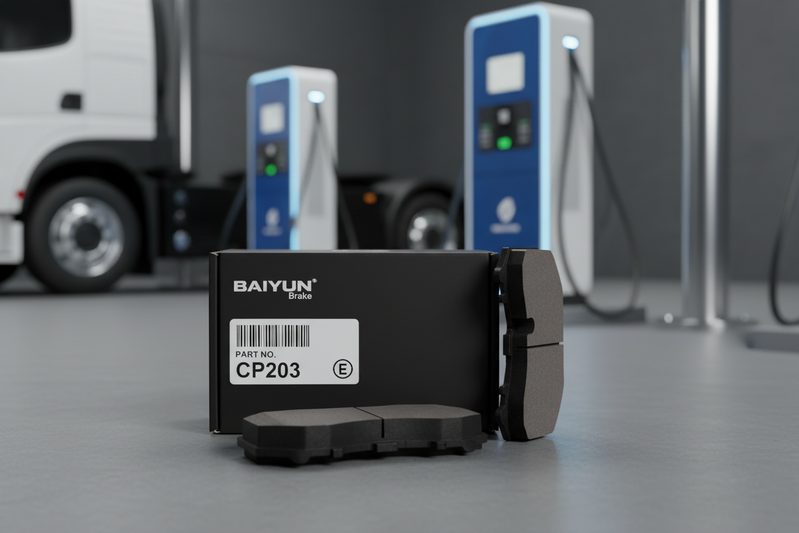
Then, move to compliance. Does the packaging carry the ECE R90 'E' mark? Can the supplier provide the test certification from an approved laboratory? Finally, consider the commercial terms. EV pads may have a longer shelf life due to slower turnover initially, so you need a supplier with reliable lead times and batch consistency. You don't want to sell a perfect pad for a Tesla Model Y in January only to find out the June shipment has a subtly different formulation that causes noise.
Building a relationship with a technical manufacturer pays off here. Instead of just sending a PO, use their technical support center. Ask them to explain the wear characteristics of their EV pad versus their standard ceramic pad. A knowledgeable supplier will have the answers and the data to back them up, saving you from costly field failures.
FAQ: EV Brake Pads for Distributors and Importers
How often do EVs actually need brake pad replacements?
It varies wildly by driver and climate, but the interval is typically 2-3 times longer than a comparable ICE vehicle. We've seen data suggesting 80,000-120,000 km is common. However, in humid, salty environments, corrosion can force replacement well before the pad is worn out. This makes pad composition and anti-corrosion features more important than pure wear life.
Do I need to stock completely different pads for every EV model?
Not necessarily, but you can't assume cross-compatibility. While some platforms share components (e.g., VW Group's MEB platform), many EVs use bespoke brake hardware. Your best strategy is to work from a brake pad catalog PDF from a full-line supplier who is actively developing EV applications. Focus on stocking pads for the top 5-10 EV models in your region first.
What's the biggest technical risk with aftermarket EV brake pads?
Inconsistent friction coefficient (μ-value). If the pad's friction level fluctuates too much with temperature or wear, it can disrupt the vehicle's brake-by-wire and regenerative braking calibration. This may trigger dashboard warnings, reduce energy recovery efficiency, or create a spongy pedal feel. Always source pads with published μ curves that match OEM specs.
Are there special installation procedures for EV brake pads?
Yes, often. The process usually requires putting the vehicle into a "service mode" via the dashboard menu to fully retract the electronic parking brake actuator. Forcing the piston back can damage the motor. A good supplier will provide or link to a detailed brake pad installation guide for specific models. Providing this to your installer customers adds tremendous value.
How does BAIYUN Brake ensure quality for EV applications?
With 49+ years of manufacturing experience, we've built our EV line on the same IATF 16949 quality management system used for our OEM business. Each EV formulation is validated on a dynamometer against the original part's ECE R90 performance profile. We also conduct real-world corrosion testing, subjecting pads to salt spray chambers for hundreds of hours to validate coating and material resilience. You can download material data sheets for all our EV compounds.
The shift to electric vehicles isn't coming; it's here. For brake distributors, this represents a strategic pivot. The volume of pad replacements per vehicle may drop, but the technical requirements and value per unit increase. Stocking the right pad—one engineered for corrosion resistance, low-dust performance, and certified compatibility—protects your customers' vehicles and your brand's reputation.
It's about moving from a commodity mindset to a technical partnership. The suppliers who will thrive are those who can provide the engineering data, compliance documentation, and formulation expertise that the EV era demands. Your customers will rely on you to guide them through this transition.
Ready to future-proof your brake pad inventory? Explore our technical specifications for EV-compatible formulations. Contact us to discuss your market's specific needs and request samples backed by full ECE R90 test documentation.
Was this article helpful?
Average Rating: 5/5 (2012)