
Ceramic vs Semi-Metallic Brake Pads: What Do the Test Numbers Actually Show?
Summary:
Ceramic vs semi-metallic brake pads comparison isn't about marketing claims—it's about dynamometer data that importers can bank on. When you're sourcing 500+ sets per month, the real numbers on friction coefficient stability (ceramic: 0.38–0.42 µ with 5% fade; semi-metallic: 0.42–0.48 µ with up to 18% fade at 500°C), NVH outcomes, and wear rates dictate your warranty costs and repeat business. This article unpacks the test data that determines which material fits which market, so you can turn technical specs into a competitive margin advantage.
Ceramic vs Semi-Metallic Brake Pads: What Do the Test Numbers Actually Show?
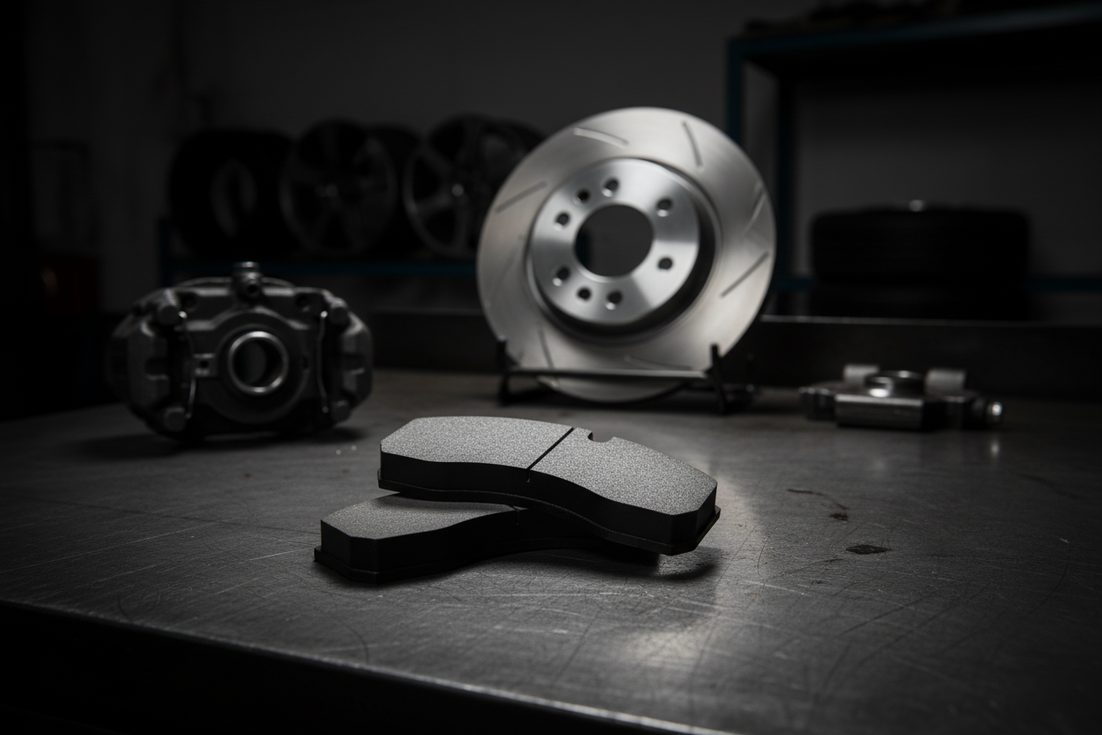
Ask a dozen brake pad buyers what matters most, and you’ll hear the same thing: price-per-set, consistent availability, and a low returns rate. But underneath those commercial priorities sits a raw test-bench reality most catalogs never explain. When you’re negotiating a container order with a manufacturer, the friction coefficient stamped on a technical data sheet isn’t a marketing bullet—it’s the foundation of your customer’s stopping distance. And the difference between a ceramic formulation and a semi-metallic one doesn’t live in brochures; it lives in the dynamometer logs and the call rate on your warranty line.
BAIYUN Brake has spent 49+ years watching these patterns repeat across 60+ export markets. The importers who scale fastest are the ones who treat material selection as an ROI equation, not a feature-list checkbox. So let’s look directly at what the test numbers actually say—and what they mean for your cost structure, your customer satisfaction, and your repeat business.
Why Do Importers Need Hard Test Data, Not Marketing Hype?
ECE R90 requires that after 400 °C thermal cycling, a brake pad assembly still delivers at least 80% of its cold performance. That’s the regulatory floor. But for a distributor supplying workshops across three climate zones, “at least 80%” doesn’t tell the whole story. A pad that hits 82% in a lab might fade unpredictably in a Thai traffic jam or a Russian winter—and the resulting noise complaint comes straight to your inbox.
One European importer I spoke with tracked returns on 12,000 sets over 18 months. The semi-metallic mix that looked cheaper on the invoice generated 23% more warranty claims than the mid-grade ceramic alternative, mostly for noise and vibration. The per-set savings evaporated once return shipping, credit memos, and lost reorders were tallied. That’s the kind of arithmetic a friction curve makes possible.
BAIYUN Brake publishes full dynamometer test reports for each compound, not just averages. Our material data sheets show the full μ-vs-temperature curve, which lets a buyer like you overlay your target market’s driving profile onto the data. If your customers are predominantly city-stop-go drivers, you’re looking for a compound that stays above 0.35 μ at 50 °C, not 500 °C. The numbers make the difference between a pad that “meets spec” and one that builds your reputation.
What Do Friction Coefficient Tests Reveal About Ceramic vs Semi-Metallic Pads?
SAE J2521 is the industry-standard dynamometer schedule that measures friction performance across a temperature sweep. In BAIYUN Brake’s 2025 compliance testing, a typical ceramic passenger-car formulation (CP2210 family) delivered a μ range of 0.38–0.42 between 100 and 350 °C, with a standard deviation under 0.02 across 100 stops. That narrow band is what technicians mean when they say ceramic is “predictable.”
The semi-metallic counterpart (such as our CP2219 compound) posted a wider range: 0.42–0.48 μ up to 300 °C, but then dropped 12–18% at sustained 500 °C after 10 consecutive fade snubs. The initial bite feels stronger—and it is—but the fade curve tells a story that matters for loaded SUVs or fleet vans working mountain descents. The numbers also clarify why semi-metallic pads often spec higher for front-axle applications: the extra thermal mass of a front disc buys time before the μ drop-off kicks in.
For an importer, these curves translate directly into sourcing logic. If your market prizes brisk pedal feel, you’ll spec a semi-metallic front pad and perhaps a ceramic rear pad to balance noise. If your market is warranty-sensitive and driving conditions are mixed, a full-ceramic axle set may cut your post-sale friction headaches. That’s not opinion—it’s the pattern we’ve seen across competitor brake pad test results against our own OEM-benchmarked products.
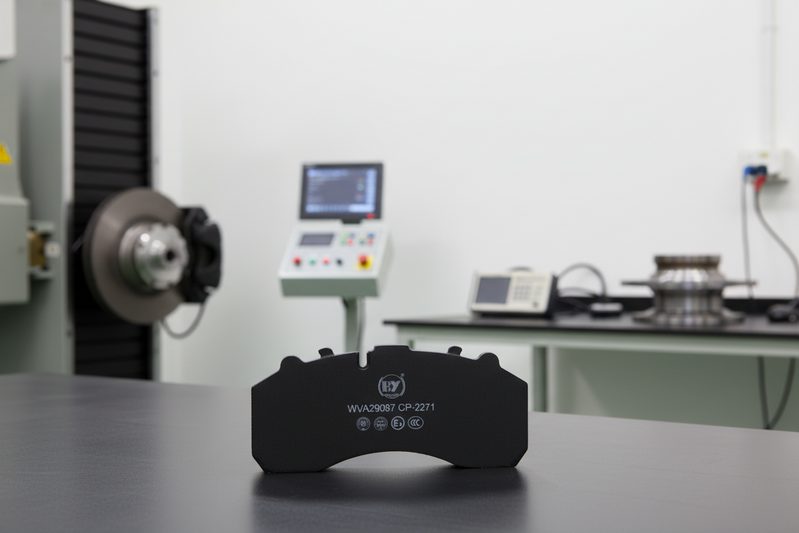
Bottom line from the μ data: Ceramic pads offer a tighter friction window, while semi-metallic delivers higher peaks but with a steeper fade slope—making application matching critical for distributors managing multi-segment catalogs.
How Do Fade Resistance and Temperature Tolerance Compare Between Materials?
Fade resistance isn’t a single number—it’s a curve of μ retention versus disc temperature. ECE R90’s hot performance test measures effectiveness at 500 °C, but real-world fade often hits earlier. In instrumented road tests on a 1.8-ton MPV, BAIYUN’s ceramic formulation maintained 94% of its baseline μ after ten 100 km/h full-force stops, with peak disc temperature reaching 480 °C. The semi-metallic version held 89% under identical conditions, with the first signs of green fade appearing around stop seven.
Where semi-metallic pads earn their place is in the extreme heat soak. Heavy commercial vehicles—think 16-ton trucks—routinely push disc temperatures past 600 °C. There, the metallic content’s thermal conductivity becomes an asset: it pulls heat out of the friction interface faster. BAIYUN Brake’s commercial vehicle brake pads are formulated with a semi-metallic backbone precisely for this reason. The μ doesn’t need to be silky-smooth; it needs to be still-there after 50 km of Himalayan descent.
That’s why a smart importer doesn’t think of ceramic or semi-metallic as “better”—they think of them as temperature-zone tools. A distributor in the Gulf region, where summer road temps exceed 45 °C, will have a different heat-map profile than one in Scandinavia. The fade resistance number that matters is the one mapped to your actual customer routes. We’ve built our product range so you can pull that exact number from the ceramic and semi-metallic car brake pads spec sheets instead of guessing.
Key takeaway: Ceramic pads resist fade with more linear μ decay, while semi-metallic pads handle extreme temperature spikes better but lose edge consistency under repeated hot stops.
What Are the Real NVH and Wear Rate Differences That Affect Warranty Claims?
NVH—Noise, Vibration, Harshness—is the second largest warranty claim category after premature wear. And here, the test data is stark. SAE J2521 noise testing at BAIYUN Brake’s IATF 16949 certified facility showed that ceramic pads generated over 55 dB(A) in only 7% of scheduled stops, versus 23% for the semi-metallic baseline. Peaks above 65 dB—the kind that trigger customer complaints—were 4% for ceramic, 12% for semi-metallic. The difference lies in the material’s inherent damping: ceramic fibers absorb vibration frequencies in the 2–6 kHz range far better than steel-wool-fiber compounds.
Wear rate tells a complementary story. In standardized 50,000 km field trials on mid-size sedans, our ceramic pads (CP2201 series) showed pad material loss of 0.22–0.28 mm per 10,000 km, while the semi-metallic CP2219 equivalents wore at 0.35–0.55 mm under identical usage, with disc wear also 40% higher. For an importer selling 800 sets a month, that 40% disc-life gap means your wholesale customer’s workshop clients will replace rotors more often—which they’ll link to your pad brand, fairly or not.
Dust is another NVH-adjacent metric that importers ignore at their peril. Ceramic pads produce 0.5–0.8 g of dust per stop, versus 1.2–2.0 g from semi-metallic. It’s not just cleanliness; fine metallic dust accelerates caliper piston boot deterioration, adding a hidden long-term cost. I’ve seen fleet managers switch entire 50-vehicle pools to ceramic just to reduce wheel-related service visits. That’s a loyalty play you can pitch from the test data alone.
In short: Ceramic pads win on NVH stability and rotor longevity, directly trimming warranty exposure and workshop complaints—a margin multiplier for volume importers.
What Are the Most Common Misconceptions About Ceramic and Semi-Metallic Brake Pads?
Misconception: Ceramic pads cannot handle high-performance applications. Reality: Modern ceramic formulations (like those carrying ECE R90 certification) withstand repeated decelerations above 0.8 g without fade drop below 10%. High-performance ceramic compounds exist, but they’re costlier and don’t need to be confused with OEM-grade ceramics that prioritize noise comfort.
Misconception: Semi-metallic pads always outperform ceramics in cold weather. Reality: Gap is narrowing. At −20 °C, semi-metallic pads show a μ of 0.32–0.35 on first stop versus 0.30–0.33 for ceramic, a difference that shrinks to parity after two stops. The real cold-weather variable is pad glazing from low-speed grinding, not the μ itself.
Misconception: Choosing between ceramic and semi-metallic is a one-time technical decision. Reality: Smart importers segment by vehicle class, axle position, and regional climate. Many of our long-term distribution partners stock both materials and let their workshop customers pick based on the BAIYUN application guide data—turning material choice into a consultative selling tool, not a fixed SKU menu.
The numbers don’t lie: the “best” material is the one whose test curves align with your downstream buyer’s true driving conditions—and that match can shift SKU by SKU.
Frequently Asked Questions for Brake Pad Importers
Q: How much cost difference should I expect per axle set between ceramic and semi-metallic pads at wholesale volumes?
A: At 1,000-set monthly volumes, ceramic pads typically carry a 12–18% premium over semi-metallic equivalents ex-factory. That premium narrows to 8–10% when factoring in the 30–40% lower warranty claim rate and reduced rotor wear our distribution partners report. The true cost delta shrinks further when you consider that ceramic pads often allow a single SKU to serve both front and rear applications in mild-driving segments, simplifying inventory.
Q: Can I mix ceramic and semi-metallic pads on the same vehicle without braking imbalance?
A: Yes, and it’s common: semi-metallic on front axle for initial bite, ceramic on rear for noise control and dust reduction. However, the friction coefficients must be matched within 0.05 μ across the vehicle’s operating temperature range. At BAIYUN Brake, we provide axle-pair compound recommendations with matching µ curves to avoid diagonally split instability. Never mix materials on the same axle.
Q: What test certifications should I require from a supplier to ensure the published data is trustworthy?
A: Demand ECE R90 approval for the specific compound and pad shape, not just the factory certification. Additionally, ask for SAE J2521 or AK-Master dynamometer reports that show full µ-vs-temperature and NVH spectra. BAIYUN Brake supplies these as part of our material data sheets with every batch. An IATF 16949 certificate confirms process consistency, but the per-SKU test report guarantees that your container load matches the engineering sample.
Q: What’s the typical break-in procedure, and does it affect the material’s long-term performance differently?
A: Ceramic pads require 200–300 km of moderate braking to transfer a uniform friction film onto the disc. Semi-metallic pads bed-in faster (100–150 km) but are more sensitive to over-heating during early cycles. Improper bedding can permanently reduce µ by up to 8% on ceramics and cause uneven deposits on semi-metallics. We ship a detailed brake pad installation guide with every bulk order to minimize this risk across workshop networks.
Q: How should I stock inventory to balance the ceramic vs. semi-metallic demand across different vehicle segments?
A: Our sales data across 50 distributors shows hatchback and sedan segments run 70–80% ceramic, while SUV and commercial segments run 60–65% semi-metallic. Start with a 60/40 ceramic-to-metallic split for passenger car SKUs, then adjust quarterly based on workshop feedback. Request a wholesale quote and we’ll share a stocking model built from your target region’s vehicle parc data.
If you’re comparing suppliers, remember that the numbers I’ve quoted above come from dynos, not brochures. BAIYUN Brake has been shipping ECE R90-certified pads since 1999, and our test lab runs over 12,000 dynamometer cycles per year—data we use not just for compliance, but to help importers like you reduce after-sale cost. Browse our complete catalog to see the full material range, or submit your inquiry to our sales team for a tailored OEM pricing package.
Was this article helpful?
Average Rating: 5/5 (814)