
Why Friction Coefficient Consistency Matters More Than Peak Numbers for Fleet Buyers
Summary:
This brake pad friction coefficient guide explains why consistency across temperature ranges is more critical than peak numbers for fleet buyers. Importers often focus on high SAE J866 codes like HH, but unpredictable friction leads to uneven wear, rotor damage, and up to 40% higher maintenance costs. Learn how to verify true performance through dynamometer data and certifications like ECE R90.
Why Friction Coefficient Consistency Matters More Than Peak Numbers for Fleet Buyers
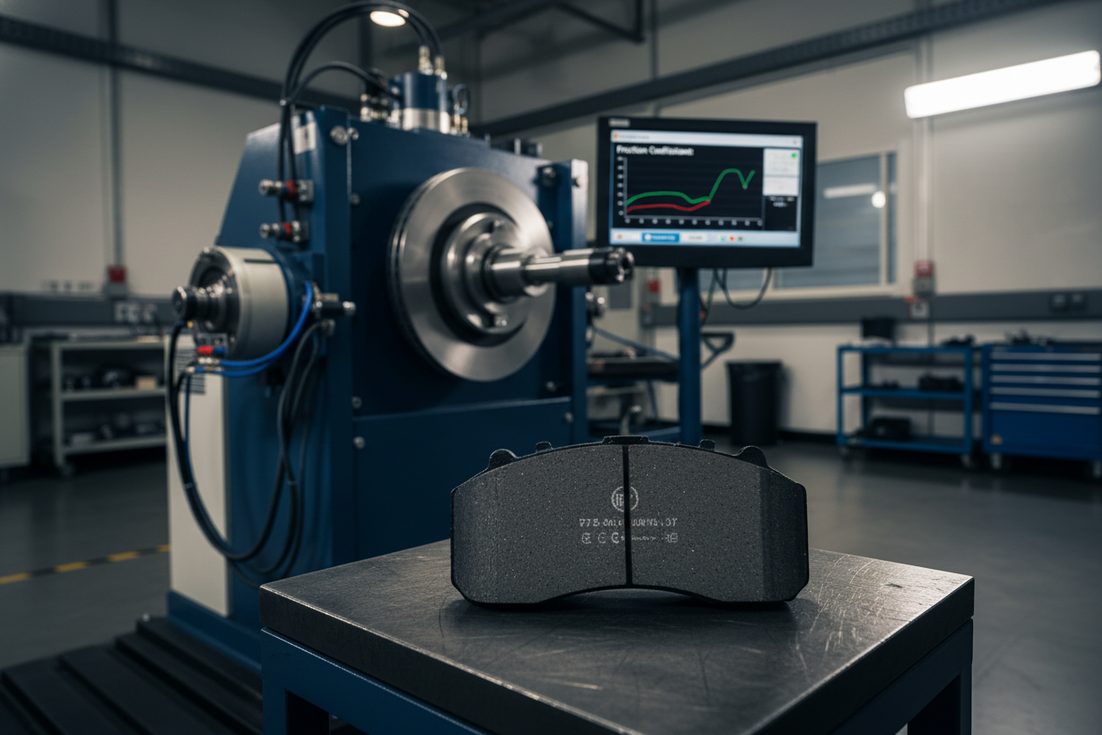
You've probably seen the two-letter code stamped on a brake pad's edge. An importer might get excited about a supplier offering "HH" rated pads at a bargain. But here's the hard truth many learn too late: that peak "H" rating (0.55-0.70 mu) is almost meaningless for a delivery van making 200 stops a day. What destroys your profit margin isn't a lack of peak power; it's a pad that performs brilliantly cold but fades to a dangerous whisper when the brakes get hot on the third downhill run. Consistency is the unsung hero of fleet economics.
What Does a Brake Pad Friction Code Actually Tell You (And What Does It Hide)?
SAE Standard J866 mandates that friction performance for street-legal pads is expressed as a two-letter code. The first letter indicates cold friction (tested at 200-400°F / 93-204°C), and the second indicates hot friction (tested at 300-650°F / 149-343°C). Each letter corresponds to a friction coefficient range: C (≤0.15), D (0.15-0.25), E (0.25-0.35), F (0.35-0.45), G (0.45-0.55), H (0.55-0.70). An "FF" code, common for many OEM passenger car pads, means the pad performs in the 0.35-0.45 mu range at both low and high temperatures.
The code's fatal flaw for buyers is its simplicity. It shows two data points, not a curve. A pad can be rated "GG" but have a massive, unpredictable dip in friction at 250°C that isn't captured by the test. We've seen competitor pads with a nominal 0.48 mu that plummet to 0.28 under sustained braking—a 40% drop that turns predictable stopping into a gamble. That's why savvy importers always ask for the full dynamometer test graph, not just the code. You can download our passenger car brake pad test report to see what complete data looks like.
The friction code is a compliance label, not a performance guarantee for real-world fleet duty cycles.
How Does Inconsistent Friction Destroy Your Fleet's Bottom Line?
Let's talk numbers. A regional distributor we work with switched from a low-cost "FG" pad to our consistent "FF" pad for a fleet of 50 light trucks. Their annual brake-related costs fell by 22%. The reason wasn't magic; it was physics. Inconsistent friction creates a cascade of expensive problems.
First, it causes uneven pad wear. If friction fluctuates, one pad in a caliper might wear 30% faster than its partner. You're not just replacing pads more often; you're throwing away half-used pads. Second, it dramatically accelerates rotor wear. A pad with a friction coefficient that spikes and dips acts like sandpaper, creating hot spots, grooves, and premature disc thickness variation. Rotor replacement is often 2-3 times the cost of a pad set. Third, and most dangerously, it leads to brake judder and vibration. Drivers complain, vehicles go into the shop for diagnostics, and you're paying for labor to chase a problem that started with a poorly formulated friction material. For a deep dive into managing these costs, our brake maintenance cost analysis breaks down the math.
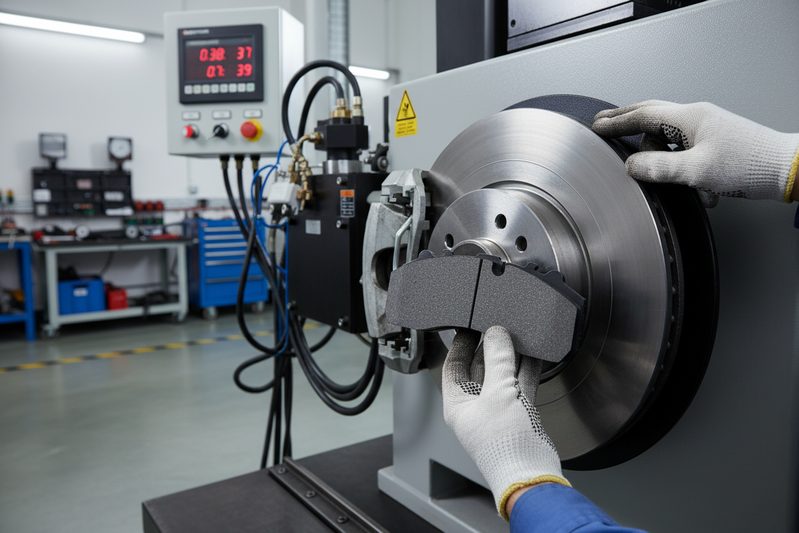
Inconsistent friction doesn't just wear out parts faster; it multiplies labor costs and vehicle downtime.
What Are the Most Common Misconceptions About Brake Pad Friction?
Misconception: A higher friction letter (G or H) always means better, safer braking performance.
Reality: A higher coefficient means more grip, but it must be matched to the vehicle's brake system design. An overly aggressive "H" pad on a light car can lock wheels prematurely under ABS, increase noise, and cause excessive rotor wear. The ideal pad matches the vehicle's original design intent for pedal feel and system balance.
Misconception: If two pads have the same friction code (e.g., FF), their performance and wear life will be identical.
Reality: The SAE J866 test is a baseline. Two FF pads can have completely different friction curves between the tested temperature points. One might hold steady at 0.40 mu, while another might peak at 0.44 and drop to 0.36. Their wear rates, noise characteristics, and rotor friendliness can vary by over 50%. Certification to standards like ECE R90 is a stronger indicator of consistent quality, as it requires testing across a defined temperature cycle.
Misconception: Friction coefficient is the only important performance metric.
Reality: It's one of several. Compressibility, shear strength, thermal conductivity, and recovery after fade are equally critical. A pad with perfect friction that cracks under thermal stress is a liability. That's why our quality assurance process tests for a full suite of mechanical and thermal properties, not just mu values.
How Can Importers Verify Consistency Before Placing a Large Order?
You don't have a dynamometer in your office. So how do you protect yourself? Start by demanding more than a spec sheet. Ask the manufacturer for third-party test reports aligned with recognized standards. ECE R90 testing, for instance, requires pads to maintain effectiveness after a severe thermal fade and recovery cycle. A supplier with nothing to hide will provide these documents.
Next, scrutinize the friction coefficient graph. Look for a flat, stable line across the entire temperature range (typically 100°C to 350°C for passenger cars, higher for performance). A line that looks like a rollercoaster is a red flag. Pay attention to the recovery phase—does the friction coefficient return to its original value after cooling? If it doesn't, the pad has suffered permanent fade, and that batch will underperform in the field.
Finally, audit the manufacturer's process control. Consistency in performance starts with consistency in production. Are raw materials batched with precision? Is the curing process tightly controlled? At BAIYUN Brake, our IATF 16949 certified facility uses automated mixing and pressing to ensure that the 10,000th pad in a run performs identically to the first. You can watch our production process to see this control in action.
Verifying consistency requires looking beyond marketing claims to raw test data and manufacturing discipline.
Why Do Certifications Like IATF 16949 and ECE R90 Act as a Proxy for Consistency?
These aren't just badges for a website footer. IATF 16949 is the automotive industry's premier quality management standard. It mandates rigorous process control, traceability, and continuous improvement. For a brake pad maker, it means every batch of friction material can be traced back to its raw components, and every production variable is monitored. This systemic approach is what prevents the friction coefficient drift that plagues uncertified factories.
ECE R90 is a product performance regulation. It doesn't just test a single sample; it requires type approval for a formulation. The tests simulate real-world abuse: multiple fade cycles, recovery, and effectiveness checks. A pad that earns ECE R90 approval has proven it can maintain a minimum level of performance (at least 80% of its cold effectiveness) after being put through hell on a dyno. For an importer, sourcing ECE R90 certified pads is one of the most effective ways to de-risk a purchase. It's an independent verification that the product does what the manufacturer claims, batch after batch. Explore our full brake pad product range, all manufactured under these stringent protocols.
Certifications provide an auditable framework that forces manufacturers to build consistency into their DNA, not just hope for it.
Frequently Asked Questions (FAQ)
Q: As an importer, should I always prioritize a higher friction code like GG over FF?
A: Not necessarily. Match the pad to the vehicle's original specification. Most passenger vehicles are designed for FF or FG pads. A GG pad may produce more dust, noise, and wear on rotors without providing a safety benefit. The key is consistency within the specified range. A stable FF pad is far superior to an erratic GG pad.
Q: How much variation in friction coefficient is acceptable batch-to-batch?
A: For critical safety components, variation should be minimal. Industry best practice, reflected in standards like ECE R90, aims for a friction coefficient variance of less than ±0.05 within the same formulation and production batch. At BAIYUN Brake, our statistical process control keeps batch-to-batch mu variation within ±0.03 for our core product lines.
Q: Can I test friction consistency myself without expensive equipment?
A: Directly measuring mu requires a dynamometer. However, you can perform indirect audits. Order samples from multiple production batches over 6-12 months. Install them on identical vehicles in similar duty cycles and track wear rates, rotor condition, and driver feedback on pedal feel. Significant differences point to consistency issues. Our brake pad trouble tracer guide can help you diagnose field issues.
Q: Do ceramic or semi-metallic pads offer more consistent friction?
A: The classification (ceramic, semi-metallic, NAO) is less important than the specific formulation and quality control. A well-made semi-metallic pad can be extremely consistent. However, premium ceramic formulations are often engineered for very stable friction and low wear across a wide temperature range, which is why they are popular for demanding fleet applications.
Q: How does friction consistency impact warranty claims from my end customers?
A: Dramatically. Inconsistent friction is a leading root cause of complaints like premature wear, brake judder, and noise. These issues lead to warranty returns and erode your brand's reputation. Sourcing pads with proven, certified consistency is the most effective way to reduce your warranty exposure and associated costs. It's a classic case of "pay a little more upfront, save a lot later."
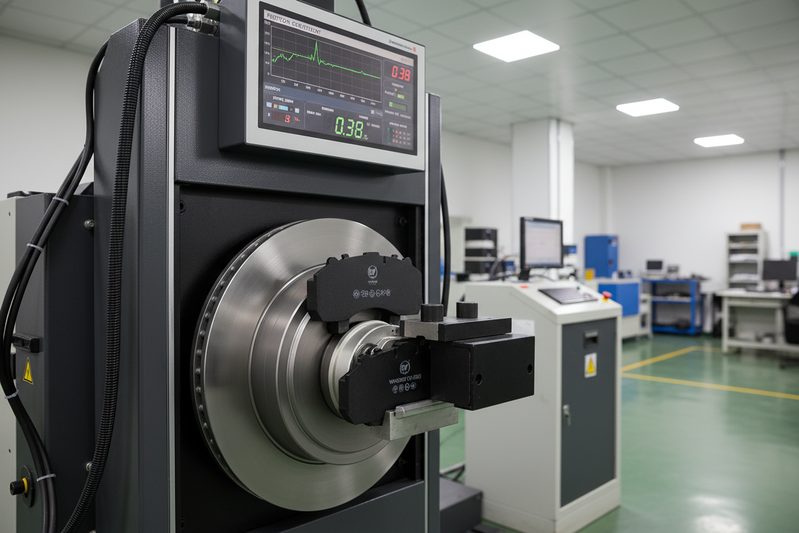
Chasing the highest friction number is a rookie mistake. Building a profitable, sustainable brake parts business is about managing total cost of ownership, and that foundation is consistency. It's the difference between a fleet manager who trusts your brand and re-orders automatically, and one who blames you for their skyrocketing maintenance bills.
The data doesn't lie. Pads with stable friction coefficients last longer, protect other brake components, and deliver predictable performance that drivers and mechanics appreciate. That reliability is what turns a one-time sale into a long-term partnership.
Ready to source brake pads you can count on, batch after batch? Request a quote today and let's discuss how our certified, consistent formulations can improve your fleet's performance and your bottom line.
Was this article helpful?
Average Rating: 5/5 (890)