
How to Read and Compare Brake Pad Friction Codes: A Buyer’s Technical Guide
Summary:
This brake pad friction coefficient guide explains how to read and compare the SAE J866 friction codes stamped on every pad. You'll learn what the two-letter rating means, how to verify a supplier's declared mu value, and the practical differences between FF, GG, and HH ratings for your target market. Understanding these technical specs is essential for buyers to ensure consistent performance and compliance with standards like ECE R90.
How to Read and Compare Brake Pad Friction Codes: A Buyer's Technical Guide
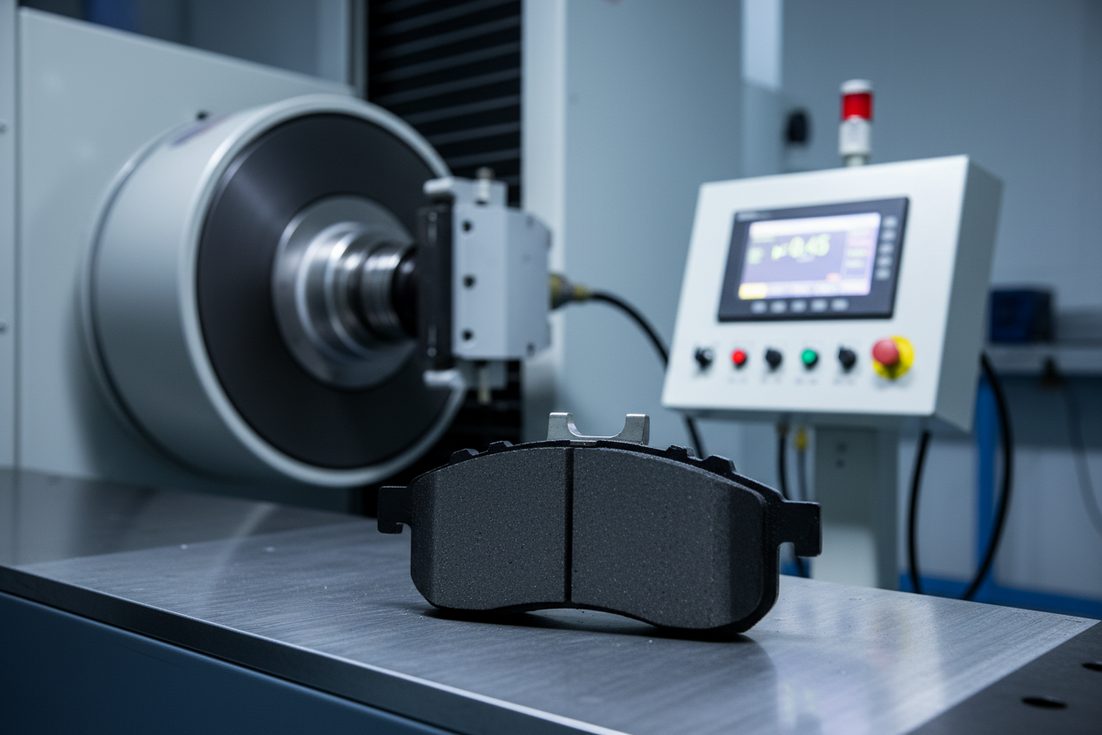
You're evaluating a quote for 10,000 brake pad sets. The specs list a friction code of "FF" and a declared mu value of 0.40. Another supplier offers "GG" pads at a slightly lower price. Which one gives you the consistent, predictable performance your customers demand? The answer lies in understanding the technical language stamped on the pad's edge. It's not just a random letter; it's a standardized performance passport governed by SAE J866 and, for European markets, ECE R90. Misreading it can lead to warranty claims, customer complaints, and damaged reputations.
What Exactly Does the SAE J866 Friction Code Tell You?
The SAE J866 standard provides a universal language for brake pad friction. It's a two-letter code where each letter corresponds to a specific range of friction coefficients (mu, or μ). The first letter represents the pad's performance at relatively low temperatures (200°F to 400°F), simulating normal driving. The second letter indicates performance at elevated temperatures (300°F to 650°F), simulating aggressive or downhill braking. According to the standard, the letter-to-coefficient mapping is fixed: C (≤0.15), D (0.15-0.25), E (0.25-0.35), F (0.35-0.45), G (0.45-0.55), H (0.55-0.65). Letters above H exist but are rare for street applications.
So, an "FF" code means the pad maintains a friction coefficient between 0.35 and 0.45 across both cold and hot test cycles. A "GG" pad operates between 0.45 and 0.55. The code doesn't tell you the exact mu value within that band—that's the declared coefficient from the manufacturer's testing. The real value for a buyer is in the relationship between the two letters. If they're the same (FF, GG), the pad's performance is designed to be stable. If the second letter is higher (e.g., FG), the pad needs heat to reach optimal performance. If the first is higher (e.g., GF), the pad may fade when hot.
For consistent, predictable braking across all conditions, prioritize pads with matching friction code letters.
How Do You Verify a Supplier's Declared Friction Coefficient?
A declared friction coefficient of 0.42 is just a number without proof. Verification starts with understanding the test standards. SAE J2522 (the AK Master test) is a common dynamometer procedure that measures friction performance across speed, temperature, and pressure cycles. For a pad to be certified to ECE R90, its actual friction curve must stay within a tight tolerance band around the declared value—typically ±0.10. That means if a pad is declared at 0.40 mu, its measured values during the official ECE test cannot legally fall below 0.30 or above 0.50.
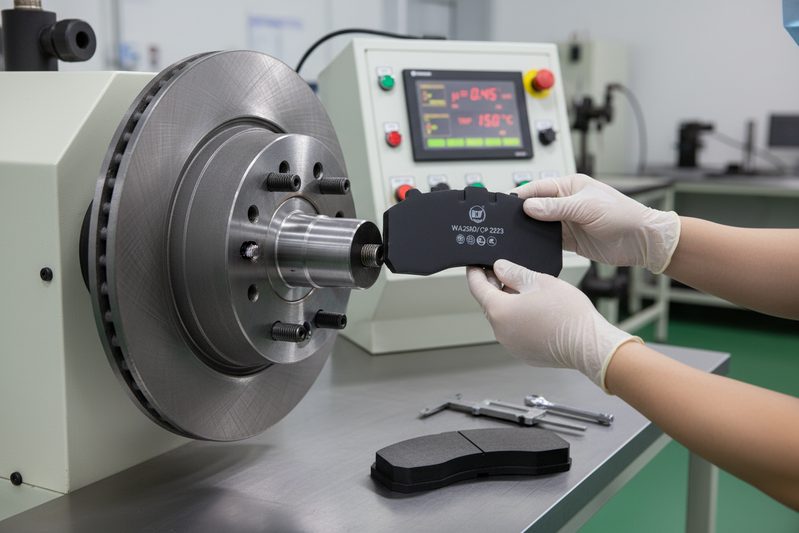
You should ask suppliers for test reports. Look for graphs showing the friction curve over temperature. A quality report will show a relatively flat, stable line. A poor one will show a "fade valley" where friction drops sharply at high temperatures. In BAIYUN Brake's internal 2025 validation, we found that pads meeting ECE R90 requirements showed less than 15% fade from their peak friction value after repeated high-temperature cycles, a key indicator of thermal stability. Don't just accept a certificate; request the underlying dynamometer data for the specific formulation you're buying. Our passenger car brake pad test report provides a clear example of this data presentation.
Always request third-party or in-house dynamometer test reports to validate a supplier's declared friction performance against SAE J2522 or ECE R90 protocols.
What's the Practical Difference Between FF, GG, and HH Ratings for Your Market?
Choosing the right friction rating isn't about picking the "best"; it's about matching performance to application and market expectations. An "FF" rated pad (mu 0.35-0.45) is the global workhorse for standard passenger vehicles. It offers a good balance of stopping power, rotor wear, noise, and dust. Over 70% of the OE replacement market uses FF-rated formulations. A "GG" rated pad (mu 0.45-0.55) provides more aggressive initial bite and is common in performance-oriented or heavier vehicles. It can reduce perceived stopping distances but may increase rotor wear and noise potential.
"HH" rated pads (mu 0.55-0.65) are for severe-duty and high-performance applications. They deliver maximum stopping power but often at the cost of rotor life, increased dust, and potential noise. They may also require higher pedal effort in non-boosted systems. For a distributor, the wrong choice creates problems. Selling HH pads to a taxi fleet will lead to premature rotor replacement complaints. Selling FF pads to sports car enthusiasts might generate claims of "weak brakes." Know your segment. Our understanding brake pad materials guide details how compound choice drives these ratings.
Match the friction rating to the vehicle application: FF for daily drivers, GG for performance/towing, HH for severe-duty/racing—mismatches drive warranty costs.
What Are the Most Common Misconceptions About Friction Codes?
Let's clear up some persistent myths that can trip up even experienced buyers.
Misconception: A higher friction code (HH) is always "better" and safer.
Reality: Higher friction can compromise vehicle stability control (ESC/ABS) calibration, increase stopping distances on low-grip surfaces, and cause premature lock-up. OE manufacturers select a specific mu range to balance overall vehicle dynamics. Straying too far from it can be unsafe.
Misconception: The friction code guarantees performance in all conditions.
Reality: SAE J866 testing happens in a controlled lab. Real-world factors like water, salt, glaze, and pad knock-back aren't measured. A pad can have a perfect GG code but perform poorly if its compound is prone to wet fade or if the backing plate lacks proper anti-corrosion coating.
Misconception: Two pads with the same "FF" code from different suppliers perform identically.
Reality: The code defines a bandwidth (0.35-0.45). Supplier A's pad might consistently test at 0.36 mu, while Supplier B's tests at 0.44 mu. That's a 22% difference in braking force within the same rating. Consistency batch-to-batch is what separates quality manufacturers. This is where quality assurance systems like IATF 16949 prove their value.
How Do Global Standards Like ECE R90 Impact Friction Code Compliance?
ECE R90 isn't just another certificate; it's a legally enforced regulation in over 50 countries requiring replacement brake pads to match or exceed the performance of the original equipment. For friction, Regulation 90 mandates two critical things. First, the replacement pad's declared coefficient of friction must be within ±0.10 of the OE pad's declared value. Second, the pad must pass a full suite of performance tests, including effectiveness, fade, recovery, and wear, on an approved dynamometer.
This has direct business implications. Sourcing non-R90 certified pads for European markets is illegal and voids vehicle insurance. But even for non-regulated markets, R90 certification is a reliable proxy for quality. It proves the pad has been tested to a rigorous, repeatable standard. A manufacturer like BAIYUN Brake, with an IATF 16949 certified facility, designs formulations from the start to hit specific, declared friction targets and maintain them through production. The code on the edge is a promise, and the certification is the guarantee that promise is kept.
ECE R90 certification legally ensures a replacement pad's friction performance is equivalent to OE, protecting you from liability and preserving vehicle safety systems.
Frequently Asked Questions for Brake Pad Buyers
Q: Can a brake pad's friction code change over its lifespan?
A: Yes, but a quality pad minimizes the change. All pads experience a slight friction increase during the initial burnish (bed-in) period, typically 5-10%. After that, the coefficient should remain stable until the pad is near end-of-life. Poor-quality materials can show significant fade (drop) when hot or a gradual decline in effectiveness as the friction material wears.
Q: Why do some premium pads have a lower friction code (e.g., EF) than standard pads?
A: This is often a deliberate engineering choice for specific OE applications. Some luxury and electric vehicle manufacturers prioritize ultra-low noise, minimal dust, and extremely smooth engagement over maximum bite. An EF-rated ceramic compound can deliver that, while still providing adequate stopping power within the vehicle's calibrated brake system.
Q: How important is the consistency of the friction coefficient across a production batch?
A> It's critical for your brand reputation. Inconsistent mu means some customers get brakes that feel "soft" while others feel "grabby" from the same product line. IATF 16949 quality systems require statistical process control (SPC) to keep key parameters, like friction formulation density and curing, within tight limits. This ensures every pad in a batch performs within a narrow window, often as tight as ±0.03 from the target mu.
Q: Do friction codes apply to commercial vehicle brake linings as well?
A: The SAE J866 standard is primarily for disc brake pads. Commercial vehicle drum brake linings often use a different classification system, though the principle of cold and hot performance remains. For heavy-duty applications, factors like recovery after fade and wear rate become even more critical. You can explore our specific C.V. brake linings for details on their performance specifications.
Q: Is a higher friction coefficient always better for reducing stopping distance?
A> Not necessarily. Stopping distance is limited by tire grip (traction). Once the brakes can lock the wheels, additional pad friction doesn't shorten the distance. In fact, excessively high friction can make modulation difficult, lead to premature ABS activation, and increase wear on other brake components. The optimal coefficient is the one the vehicle's hydraulic system and tires were designed to work with.
Decoding friction specs isn't academic. It's a fundamental purchasing skill. It lets you compare apples to apples, spot suppliers who might be over-promising, and select the right product for your target market. The code is the starting point, but the supporting test data and manufacturing certifications are what give you confidence. A supplier who can't provide clear dynamometer graphs or explain their process control for friction consistency is a risk.
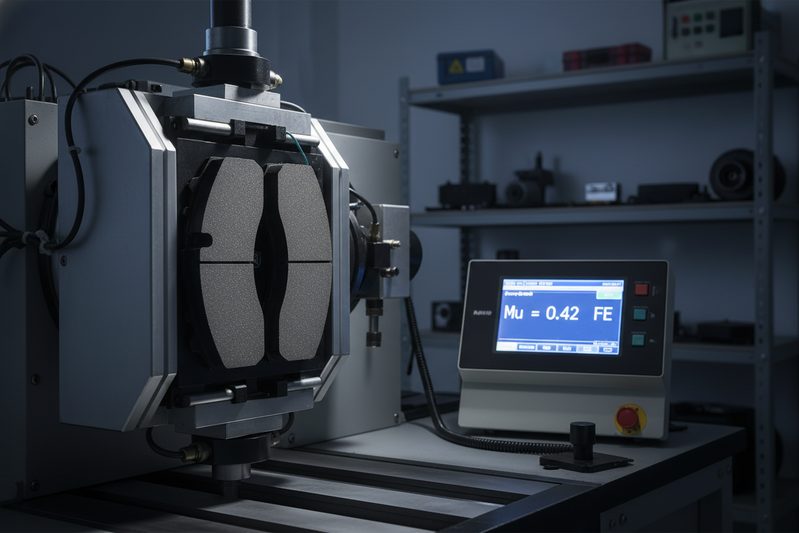
Ready to source brake pads with verified, consistent friction performance? Request a quote from BAIYUN Brake. We'll provide full technical data sheets, including SAE J2522 dynamometer reports and ECE R90 certifications, for any formulation in our full brake pad product range.
Was this article helpful?
Average Rating: 5/5 (1816)