
Why Do Truck Brake Pads Wear Out Fast?
Summary:
Why do truck brake pads wear out fast? The answer starts with physics: a loaded 40‑tonne truck carries over 20 times the kinetic energy of a passenger vehicle, forcing friction material to absorb extreme heat repeatedly. Add in challenging route profiles, improper material selection, and neglected caliper maintenance, and pad life can plunge to 30,000 km. For B2B brake parts buyers and fleet operators, understanding these factors is crucial to reducing total cost of ownership. BAIYUN Brake, an IATF 16949 and ECE R90 certified manufacturer, engineers commercial vehicle brake pads that extend service life by up to 40% through thermally stable, application‑specific formulations. This article explores the root causes, material science, and supplier verification checklist you need before placing your next volume order.
Why Do Truck Brake Pads Wear Out Fast?
Quick answer: Truck brake pads wear out significantly faster than those on lighter vehicles because of the huge kinetic energy generated by a loaded commercial vehicle's mass. A fully loaded 40‑tonne tractor‑trailer carries over 20 times the kinetic energy of a typical car at the same speed, forcing the friction material to absorb tremendous heat every stop. Add in constant urban deliveries, mountainous routes, and neglected caliper maintenance, and it's easy to see how pad life can drop to 30,000–50,000 km. Switching to a higher‑quality, application‑specific friction material from a certified brake pad manufacturer like BAIYUN Brake can extend service life by 25–40% while reducing total cost of ownership for fleet buyers.
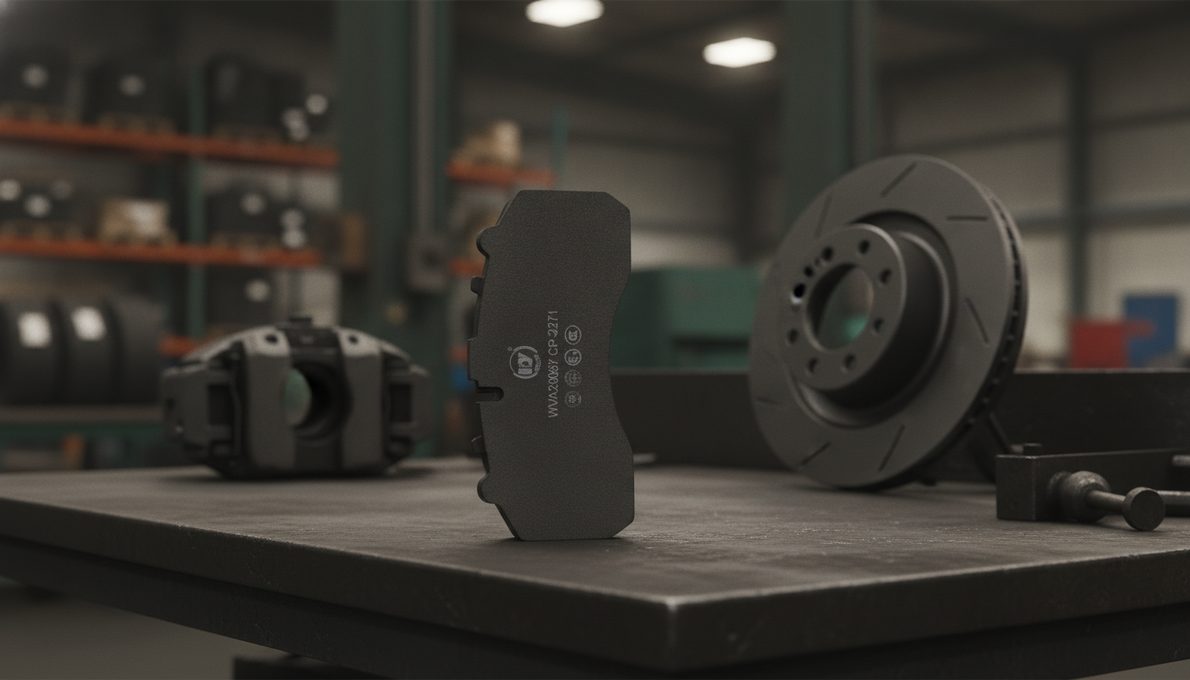
Why Does Vehicle Mass Dominate Brake Pad Wear?
The laws of physics don't make exceptions for convenience. Kinetic energy—the energy any moving truck must shed to stop—scales linearly with mass. That's the KE = ½mv² equation every fleet manager understands in their bones. Double the truck's gross vehicle weight and you double the heat dumped into the brakes at every traffic light, downhill grade, or loading dock approach.
Here's a direct comparison: a 7.5‑tonne delivery truck at 80 km/h carries roughly 2.3 million joules of kinetic energy, while a 40‑tonne articulated unit at the same speed carries over 12.5 million joules. The brake system of the heavier vehicle must convert more than five times the energy into heat, repeatedly absorbing thermal spikes that can push pad surface temperatures beyond 400°C in hard braking. That thermal punishment breaks down organic binders, accelerates glazing, and simply erodes friction material faster.
What many buyer overlook is that the effect is super‑linear in stop‑and‑go traffic. If a truck accelerates and decelerates 200 times a day on a city route, every single cycle pumps another dose of heat into the pads. Multiply that by fleet size and the replacement invoices stack up quickly. Selecting a supplier whose friction formulations are optimised for high‑thermal‑cycle applications isn't a luxury—it's a direct cost lever. BAIYUN Brake's commercial vehicle pads are engineered with thermally stable semi‑metallic and ceramic‑reinforced compounds that resist fade and reduce wear under these extreme duty cycles.
How Does Route Profile Influence Brake Pad Replacement Intervals?
Not all truck routes are created equal. A tractor hauling 38 tonnes of coil steel across the flat highways of northern Europe will likely see brake pad life exceeding 120,000 km if well‑maintained. Put that same truck on a distribution route winding through Alpine switchbacks with 12% grades, and pad life can collapse to 20,000 km. Steep descents force prolonged braking, sometimes for kilometres at a time, keeping pad temperatures right in the zone where wear rates spike exponentially.
This is where a proper WVA reference system becomes critical for parts buyers. Distributors and fleet specifiers need to match the pad compound to the vehicle's typical duty cycle. A pad coded for high‑way linehaul may use a harder, more abrasion‑resistant formulation that shines on long, flat runs but struggles to provide acceptable performance in stop‑start city delivery. Conversely, a softer friction material prioritising cold bite may be perfect for frequent stops but will vanish in 15,000 km on a mountain route. Browsing our commercial vehicle brake pads range makes it obvious: there's no single "best" pad. The right product is the one whose wear‑life curve matches the fleet's actual operational profile.
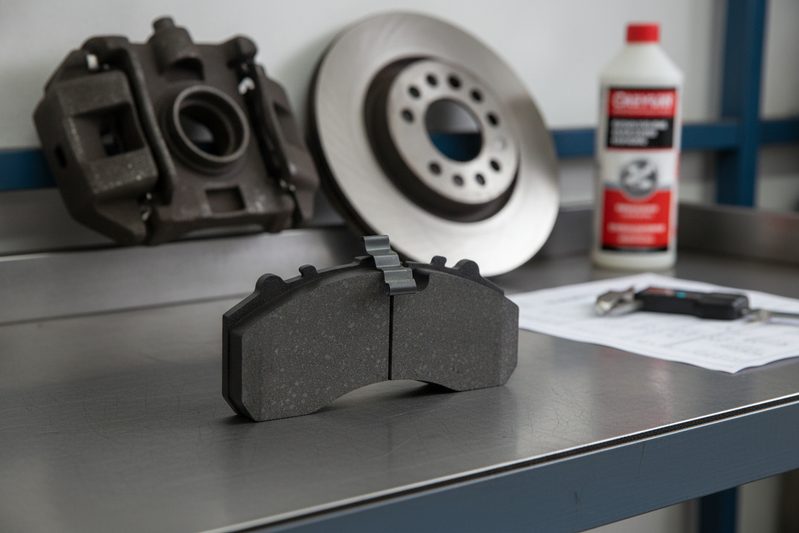
What Role Does Material Composition Play in Brake Pad Longevity?
Every pad sold for heavy‑duty use is a compromise of 20‑plus raw materials—steel fibres, mineral fillers, friction modifiers, bonding resins. The exact recipe profoundly influences not only stopping power but also how quickly the pad disappears. According to Archard’s wear law, wear volume is inversely proportional to material hardness. Put simply, softer pads transfer more friction material to the disc on every brake application, meaning they're consumed faster.
So why don't fleets just mandate the hardest pad available? Because a pad that's too hard will wear the rotor aggressively, generate noise, and often delivers poor cold‑stop performance. The sweet spot is a formulation that provides a stable friction coefficient across the full operating temperature range while keeping wear rates predictable and within budget. BAIYUN Brake’s internal dynamometer testing—conducted according to SAE J2522 standards—shows that our copper‑free semi‑metallic formulation CP2210 maintains a friction coefficient of 0.38–0.42 between 100°C and 350°C, which is exactly the window where most loading‑dock and highway braking occurs. That consistency means fewer chemical changes in the friction surface, less glazing, and longer pad life compared to budget compounds that can spike friction at high heat and cause uneven wear.
If you're sourcing for a mixed fleet, ask your brake pad manufacturer for detailed technical data, not just a price quote. A material data sheet that omits specific coefficient ranges across temperature is a red flag. Good suppliers brag about their test data; marginal ones hide it.
How Do Certifications Like IATF 16949 and ECE R90 Protect Against Premature Wear?
Rapid brake pad wear isn't always about the physics. Often, it's a symptom of quality inconsistency that creeps in when a supplier lacks rigorous process control. This is where international certifications become non‑negotiable for serious importers. IATF 16949 defines a quality management system specific to automotive production, requiring suppliers to control every production variable—raw material lots, mixing times, press temperatures—with statistical rigour. At our IATF 16949 certified facility, every batch of commercial vehicle brake pads undergoes dimensional checks, friction coefficient verification, and shear‑strength testing before it leaves China. That's the level of control that prevents a batch of pads with weak bonding from wearing out in 20,000 km while the next batch lasts 60,000 km.
Then there's ECE R90. This European regulation mandates that aftermarket brake pads perform within 15% of the OE part's friction level across a prescribed thermal cycle. In practical terms, an ECE R90‑approved pad cannot behave unpredictably and wear at an accelerated rate compared to the original. For fleet buyers and distributors importing into markets that recognise ECE homologation, R90 pads directly correlate to lower warranty claims and faster customs clearance. BAIYUN Brake’s commercial vehicle range carries full ECE R90 approval, and we provide the homologation documentation with every shipment. That’s a layer of protection importers often overlook until they face a rejected container or a liability dispute.
Is the Brake Pad Really Wearing Out—Or Is Something Else Dragging It Down?
We've seen more than one distributor replace thousands of pads under warranty, only to discover that the real culprit was a sticky brake caliper. A dragging caliper piston—common on single‑piston sliding designs after 3–5 years without service—keeps the pad in constant light contact with the rotor. That friction heat never fully dissipates, subjecting the pad to quasi‑continuous wear. The result? Pads that look like they've covered 80,000 km after just 25,000, with uneven taper wear visible across the friction surface.
Other hidden wear accelerators: badly scored rotors (they act like cheese graters on fresh pads), incorrect proportioning valve settings (front‑to‑rear imbalance forces one axle to do disproportionate work), and contaminated friction surfaces from leaking hub seals. When you're advising fleet customers or your own buyer network, always point them toward a complete brake health check, not an isolated pad replacement. A reliable brake pad manufacturer will support you with technical troubleshooting, not just ship boxes. Our brake lining trouble tracer guide helps buyers diagnose whether it's the pad failing or a system‑wide problem.
Buyer Verification Checklist for Truck Brake Pad Suppliers
Before placing any volume order for heavy‑duty friction, run through this checklist to filter out suppliers likely to saddle you with fast‑wearing, non‑conforming product.
| Verification Point | Why It Matters | How BAIYUN Brake Delivers |
|---|---|---|
| Does the supplier hold IATF 16949 certification? | Ensures statistical process control, batch traceability, and consistent wear characteristics. | Certified since 2006; audited annually. |
| Are brake pads ECE R90 approved for the markets you serve? | Required for legal sale in EU and many other regions; guarantees friction performance within 15% of OE. | Full R90 homologation available; documentation provided. |
| Does the supplier provide WVA reference numbers? | Simplifies cross‑referencing and reduces mis‑specification on mixed fleets. | All CV pads carry WVA codes; we assist with matching. |
| Is friction material tested to SAE J2522 or an equivalent standard? | Verifies cold performance, fade resistance, and wear rate under standardised conditions. | In‑house dynamometer lab; SAE J2522 reports available. |
| Can the manufacturer offer OEM‑style private labelling? | Brand differentiation in your market. | Custom print boxes, laser marking, and blister packs available. |
| What are the MOQ and typical lead times? | Affects your working capital and service level. | MOQ from 500 sets per SKU; lead time 30–45 days ex‑works. |
| Do they share material safety and technical data sheets? | Essential for compliance with local regulations and end‑user confidence. | Downloadable material data sheets for every formulation. |
This isn't a paper exercise. Importers who shortcut on supplier verification often end up absorbing container‑load returns when pads wear out in a third of the expected service interval. The cost of airfreighting 1,500 sets back to China dwarfs any initial per‑unit saving from a non‑certified source.
Frequently Asked Questions from Commercial Vehicle Brake Pad Buyers
Q: Why do truck brake pads wear out so much faster than light‑vehicle pads?
A: Kinetic energy rises directly with vehicle mass. A loaded 40‑tonne truck carries over 12 million joules of energy at 80 km/h, forcing the brake system to absorb enormous thermal loads. Truck pads also operate under higher specific pressures, often exceeding 100 bar in the caliper, accelerating abrasive wear compared to a car's typically 50‑60 bar. Choosing a pad with a thermally stable semi‑metallic formula can double the replacement interval versus an economy organic pad.
Q: How can I verify a supplier's friction material quality before ordering a container‑load?
A: Request a full SAE J2522 dynamometer test report for the exact WVA number you're considering. Verify that the friction coefficient stays within ±15% of the OE reference across cold, hot, and recovery phases. Also insist on shear strength data (minimum 3.5 MPa for heavy‑duty pads) and a production‑batch sample for independent testing. BAIYUN Brake provides all three as standard for confirmed orders.
Q: What is the typical MOQ and lead time from BAIYUN Brake?
A: Our standard MOQ is 500 sets per SKU for commercial vehicle pads, though we often accommodate smaller trial orders for new distributor relationships. Typical production lead time is 30–45 days ex‑works for standard compounds; custom formulations may extend to 60 days. Ocean freight consolidates weekly from Shanghai, and our logistics team arranges door‑to‑door service to most European, Middle Eastern, and African ports.
Q: Do BAIYUN Brake's commercial vehicle pads meet ECE R90 requirements?
A: Yes, our entire CV disc brake pad range is homologated to ECE R90, with testing carried out at accredited third‑party laboratories. Each production batch carries the homologation number, and we supply the approval certificate with your shipment. This ensures smooth customs clearance in ECE‑signatory countries and protects your buyers against non‑compliance fines.
Q: Can I private‑label BAIYUN Brake pads for my own brand?
A: Absolutely. We offer a full OEM private‑label service, including custom packaging design, pad backing plate laser marking, and blister‑pack assembly. Minimum order quantities for private‑labelled production are typically 1,000 sets per SKU, and we can incorporate your brand identity within 45–60 days from artwork approval. Many of our long‑term import partners launched their own brand using our platform; contact our export team to discuss your specific requirements.
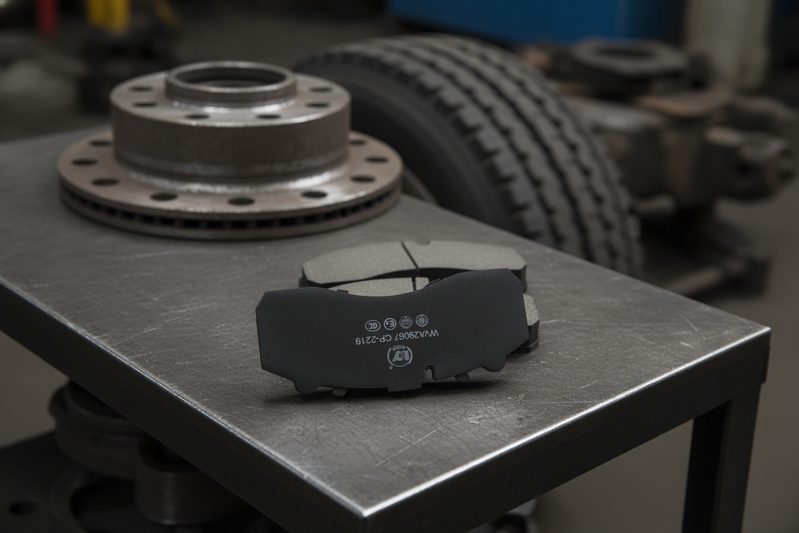
What Are the Most Common Misconceptions About Truck Brake Pad Wear?
Misconception: Heavier trucks always need harder pads to last longer.
Reality: Harder pads may reduce wear slightly, but they often sacrifice cold bite and increase rotor scoring. The ideal pad balances hardness, thermal conductivity, and friction stability. BAIYUN Brake’s semi‑metallic CP2210 compound, for instance, tests at <2 mm per 10,000 km on highway cycles while maintaining a consistent 0.38 µ, a combination that purely hard formulations cannot match.
Misconception: All ECE R90 pads are of equal quality.
Reality: R90 only verifies that performance stays within a certain band of OE; it does not test a pad’s total service life or resistance to environmental corrosion. An R90 pad made with poor‑quality steel fibres can still wear out rapidly and develop rust jacking. Look for additional data like salt‑spray resistance (≥96 hours) and shear strength when comparing certified options.
Misconception: Frequent pad replacement means the fleet is driving too aggressively.
Reality: Often, fast wear signals a maintenance problem: dragging calipers, mismatched tractor‑trailer air‑balance timing, or incorrect lining to drum clearance on combination vehicles. Before blaming the drivers, a fleet should commission a full pneumatic system check. The brake running clearance on every axle should be verified and adjusted.
Friction replacement is a significant line item in any commercial fleet’s budget. Understanding why pads wear fast, and how to select a supplier that can deliver predictable, long‑life friction, directly improves your bottom line. At BAIYUN Brake, we’ve spent 49+ years refining heavy‑duty friction materials for trucks, buses, and trailers. Our pads are made to outlast generic alternatives, not by a small margin, but by a margin that saves real money per vehicle per year.
Ready to Source Brake Pads That Don't Quit Early?
Talk to our technical sales team today. Whether you need 500 sets of a standard WVA‑coded pad or a fully custom formulation for your brand, we'll match the material to your fleet's duty cycle and deliver certified performance you can rely on. Browse our commercial vehicle brake pad range, request a quote for brake linings, or submit your inquiry to start a conversation. For a complete overview of our capabilities, download the product catalogue.
Was this article helpful?
Average Rating: 5/5 (1071)