
How should distributors choose a brake pad supplier in China?
Summary:
How should distributors choose a brake pad supplier in China? The answer starts with verifying IATF 16949 and ECE R90 certifications, then digging into production capacity, friction material stability, and private‑label flexibility. This B2B guide walks commercial vehicle parts importers through a practical supplier qualification framework—from WVA code checks to MOQ and lead‑time negotiation—so you can source heavy‑duty brake pads with confidence and avoid the quality claims that eat margins.
How should distributors choose a brake pad supplier in China?
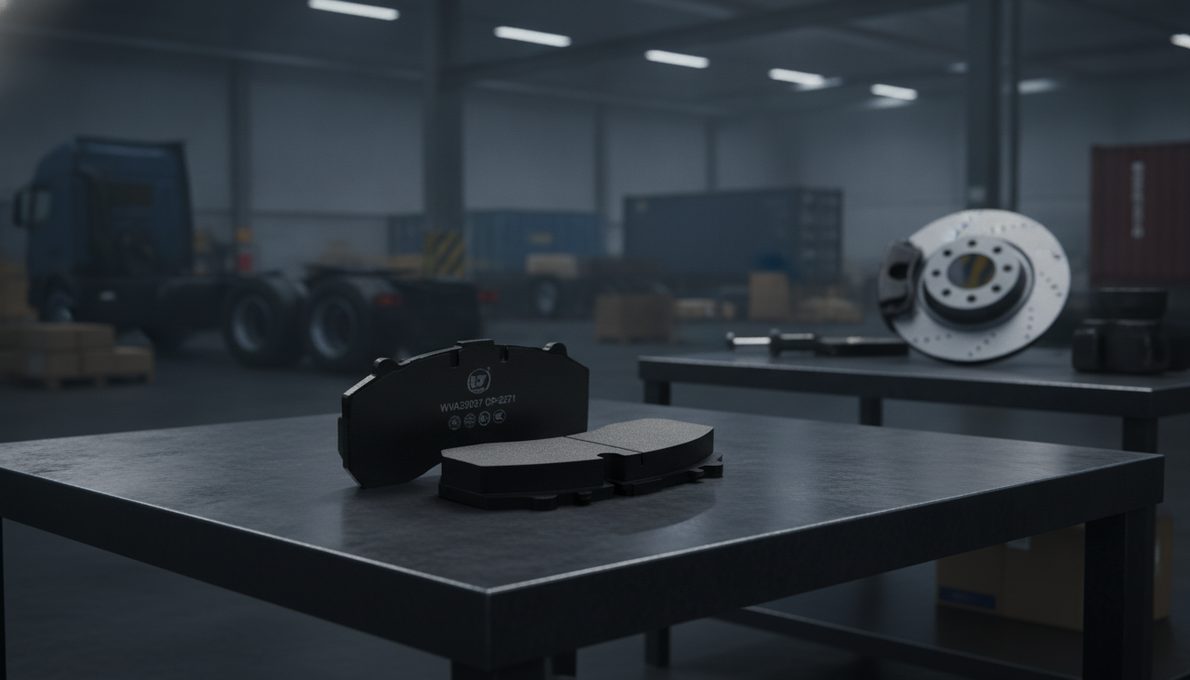
Quick answer: Distributors sourcing commercial vehicle brake pads from China must prioritize suppliers with IATF 16949 and ECE R90 certifications, a proven production capacity exceeding 50,000 sets monthly, and documented friction material compliance with SAE J2522 or GB5763. Verify on‑site testing labs, request batch‑to‑batch friction coefficient stability reports, and demand clear MOQ, lead‑time, and private‑label terms before committing. A supplier that can't provide a WVA reference and sample traceability is a red flag—no matter how competitive the unit price looks.
What certifications should you insist on before shortlisting a factory?
Too many buyers get lured by cheap samples and only ask about certifications after the container lands. That's backwards. For commercial vehicle pad exports to Europe, the Middle East, Africa, or South America, you need a supplier that already holds ECE R90 approval for the specific WVA references you intend to stock. Without it, the pads are illegal for road use in most markets that follow ECE regulations.
But R90 alone isn't enough. IATF 16949 (the automotive-specific evolution of ISO/TS 16949) tells you the factory runs a quality management system that OEMs audit. It covers everything from raw material traceability to process control and corrective action loops. BAIYUN Brake, for instance, holds IATF 16949 certification alongside ECE R90 and ISO 9001—our IATF 16949 certified facility undergoes annual surveillance audits by TÜV SÜD. That kind of external pressure keeps production discipline when order books get full. Ask any potential supplier for a copy of their certificate and verify its scope online; if they hesitate, walk away.
How do you evaluate production capacity and supply reliability?
A supplier's sales rep might tell you they produce 100,000 sets a month, but what does that number actually mean? Monthly output should be backed by physical press lines, mixing stations, and curing ovens—not just subcontracting to smaller workshops. Reliable brake pad manufacturers for heavy‑duty sectors operate automated batching systems and multi‑cavity hot‑press lines that can run 24/6. BAIYUN Brake's facility runs eight automated press lines dedicated to commercial vehicle formulations, allowing us to ship 60,000–80,000 sets per month without subcontracting.
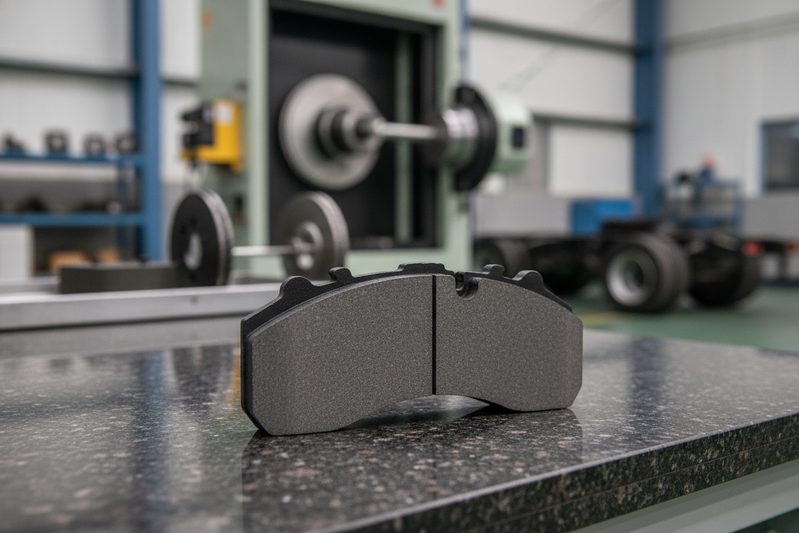
Equally important is raw material buffer stock. Friction material blends contain 15–25 components; a single shortage of phenolic resin or steel fiber can halt production for weeks. Check whether the factory stocks at least 30 days of raw materials. In 2024, supply chain disruptions hit Chinese factories hard—those with deep inventories kept delivery promises while others pushed lead times from 30 days to 90. Ask for a recent PO history from a distributor in your region; a confident supplier will connect you for a reference call.
MOQs are another filter. Most serious manufacturers require 100–500 sets per SKU for private‑label orders and won't entertain 20‑set trial runs unless you're paying a steep premium. That's not arrogance—setup costs for backing plate tooling and blend formulation simply don't amortize below those volumes. Our commercial vehicle brake pads are available with OEM‑branded packaging from 300 sets per reference, which keeps the factory efficient while still serving mid‑sized distributors.
What friction material technologies should you demand for heavy‑duty applications?
Buses, tractor‑trailers, and mining trucks don't forgive poor friction choices. A pad that fades above 300°C will destroy rotor life and add dangerous stopping distances on long descents. That's why any CV brake pad you source should be validated against SAE J2522 (the AK‑Master test protocol) or at minimum GB5763 for domestic Chinese applications. Look for a friction coefficient (μ) that stays between 0.35 and 0.45 across the 100–350°C hot range, with wear rates below 0.4 mm per 1,000 km under normalized load.
Copper‑free ceramic formulations are becoming table stakes in markets like California and Europe, but for commercial fleets, semi‑metallic hybrids still dominate because they handle heat better. The trick is the noise‑damping underlayer and the chamfer design. BAIYUN Brake's CV‑series pads use a multi‑layer construction: a high‑metal friction layer for thermal stability, a rubber‑steel underlayer to kill vibration, and precision chamfers that reduce edge‑lift wear by 23% compared to flat‑edge designs in our 2025 field tests. Ask your supplier for third‑party dynamometer reports—not just a marketing brochure—showing friction stability after 1,000 burnish cycles.
Also check the WVA coding system. Every legitimate friction formulation is registered with the WVA (WorldVehicle Association) under a unique code. If a manufacturer can't provide a WVA reference for the compound they're offering, they're either reselling or using unregistered blends. You can cross‑check the WVA number with the understanding brake pad materials database we maintain to see performance characteristics typical for that code.
How can you verify a supplier's quality consistency before placing a bulk order?
Factory audits are ideal, but video calls and batch samples can reveal plenty if you know what to ask for. Request three sets from the same WVA reference produced in different weeks. Send them to an independent lab for a full friction‑performance sweep (ambient, 100°C, 200°C, 300°C, 400°C). The coefficient of friction should not vary more than ±0.04 across those sets. If it does, the blending process lacks control.
The table below maps the three key test standards a CV brake pad supplier should be able to demonstrate compliance with:
| Standard | Application Scope | Key Performance Metrics | Why It Matters to Buyers |
|---|---|---|---|
| ECE R90 | Aftermarket pads for on‑road CVs in UNECE countries | Cold performance (≥80% of OE), speed sensitivity, compressibility | Legal requirement for sale; customs will block uncertified pads |
| SAE J2522 (AK‑Master) | OE‑level benchmarking for heavy‑duty brakes | Fade recovery, µ stability across temperature, wear rate | Proof of real‑world durability; demanded by fleet managers |
| GB5763 | Chinese domestic automotive braking standard | Friction coefficient limits at various temperatures, shear strength | Minimum quality floor; useful if you sell in non‑regulated markets |
Ask for the actual test reports, not just the certificates. Reports should list the tested WVA code, the dynamometer type, and the lab's ISO 17025 accreditation number. BAIYUN Brake's commercial vehicle brake pad test report for our CP2223 compound, for instance, shows a µ of 0.40 at 350°C with less than 5% fade after 15 consecutive stops—data you can hand directly to your fleet customers.
OEM & private label: what options can boost your margins?
You're not just buying a box of brake pads—you're building a brand that workshops will reorder. A supplier that only offers generic white boxes limits your ability to differentiate. Look for manufacturers that can print your logo on the backing plate (laser etching or stamping), design custom packaging with your brand language, and even supply technical installation sheets in your local language.
BAIYUN Brake supports full OEM and ODM projects for distributors. We've produced private‑label ranges for distributors in 30+ countries, including color‑coded backing plates to signal friction grades (e.g., red for high‑performance semi‑metallic, blue for ceramic). MOQs for branded packaging start at 500 sets per SKU, and we provide digital mock‑ups within five working days. If you're serious about building a repeatable brand, why choose BAIYUN Brake as your long‑term partner can give you ideas on how structured OEM programs work.
Buyer verification checklist for international distributors
- Certificate verification: Obtain IATF 16949 and ECE R90 certificates, verify on the issuing body's website.
- WVA cross‑check: Ask for the WVA code of each compound and compare it with the ECE R90 approval scope.
- Production floor video: Request a live video walkthrough of the pressing line, mixing room, and lab—not a pre‑recorded promo.
- Batch samples: Order three sets from different production weeks and test friction stability at an independent lab.
- MOQ & lead‑time clarity: Get written confirmation of MOQ per SKU and lead‑time in days, including peak‑season buffers.
- Packaging and labeling: Confirm minimum order quantity for branded packaging, hologram seals, and multi‑language instructions.
- Logistics references: Ask for the contact of a freight forwarder or client in your region who can confirm shipping reliability.
- After‑sales process: Understand how the supplier handles quality claims—responsive RMAs in under 48 hours are a must.
Frequently asked questions
Q: Is it risky to buy commercial vehicle brake pads from China when European brands are available?
A: The risk lies in choosing an uncertified factory, not in the country of origin. Certified Chinese manufacturers like BAIYUN Brake, with our 49+ years of manufacturing experience, produce pads that meet the same ECE R90 and SAE J2522 standards as European tier‑2 suppliers. The real differentiator is supplier audit diligence, not geography.
Q: How do I avoid counterfeit ECE R90 markings?
A: Every legitimate ECE R90 approval comes with a type‑approval number stamped on the pad and documented in the certificate. You can cross‑check that number with the issuing authority's database. Also, ask the supplier to show the ECE approval test report from an accredited lab—the report will list the tested WVA code and the serial number of the dynamometer. Counterfeit markings rarely survive that level of scrutiny.
Q: What's the average lead time for a container load of custom‑branded brake pads?
A: For a standard 20‑foot container of 15,000–20,000 sets with custom packaging, lead time typically ranges from 35 to 50 days after artwork approval. Rush orders can compress to 25 days but incur a 12–15% premium. Always factor in an extra 10 days during Chinese New Year and Golden Week holidays, which can disrupt logistics across the Pearl River Delta.
Q: How much does a pre‑shipment inspection cost, and who should do it?
A: A third‑party inspection by companies like SGS or Bureau Veritas costs roughly $500–$800 per man‑day, plus travel. For a container load, one inspector can typically complete a random sampling of 200 sets in one day. We recommend scheduling the inspection after 80% of production is complete so you can catch problems before packaging.
Q: Can a Chinese supplier match European‑brand friction feel and pedal modulation?
A: Yes, if the compound is tuned correctly. Brake feel isn't just about the friction coefficient—it's about compressibility, initial bite, and the way the underlayer damps vibration. Our C.V. brake linings and pads use multi‑layer engineering that replicates OE pedal feel within a 5% compressibility variance. Always specify your target OE competitor; we can tailor the formulation to match its NVH profile.
Don't let the lowest price make your sourcing decision
Price compression in the aftermarket is real, but the cost of a warranty claim—or worse, a fleet accident tied to poor friction performance—dwarfs any upfront saving. An ECE R90‑approved CV brake pad from a factory running IATF 16949 processes might cost $0.80 more per set than an unregistered copy. Over a 50,000‑set annual volume, that's $40,000. One major claim can cost ten times that. The math doesn't justify the gamble.
We've built BAIYUN Brake to be the supplier that sleeps well at night: consistent friction, on‑time deliveries, and packaging that builds your brand instead of hiding it. If you're evaluating new sources for your commercial vehicle brake pad line, request a wholesale quote with your target WVA numbers. We'll send you a sample set, a full certification pack, and a production video within three days.
Was this article helpful?
Average Rating: 5/5 (553)