
Ceramic vs Semi-Metallic Brake Pads: What Do the Test Numbers Actually Show?
Summary:
Ceramic vs semi-metallic brake pads comparison comes down to hard test data, not marketing claims. Dynamometer results show semi-metallic pads often deliver higher friction coefficients (0.38-0.45) for heavy-duty use, while ceramic pads offer superior fade resistance and NVH characteristics. For importers and distributors, understanding these numbers—friction stability, wear rates, and temperature performance—is critical for selecting the right product, minimizing warranty claims, and maximizing customer satisfaction in specific regional markets.
Ceramic vs Semi-Metallic Brake Pads: What Do the Test Numbers Actually Show?
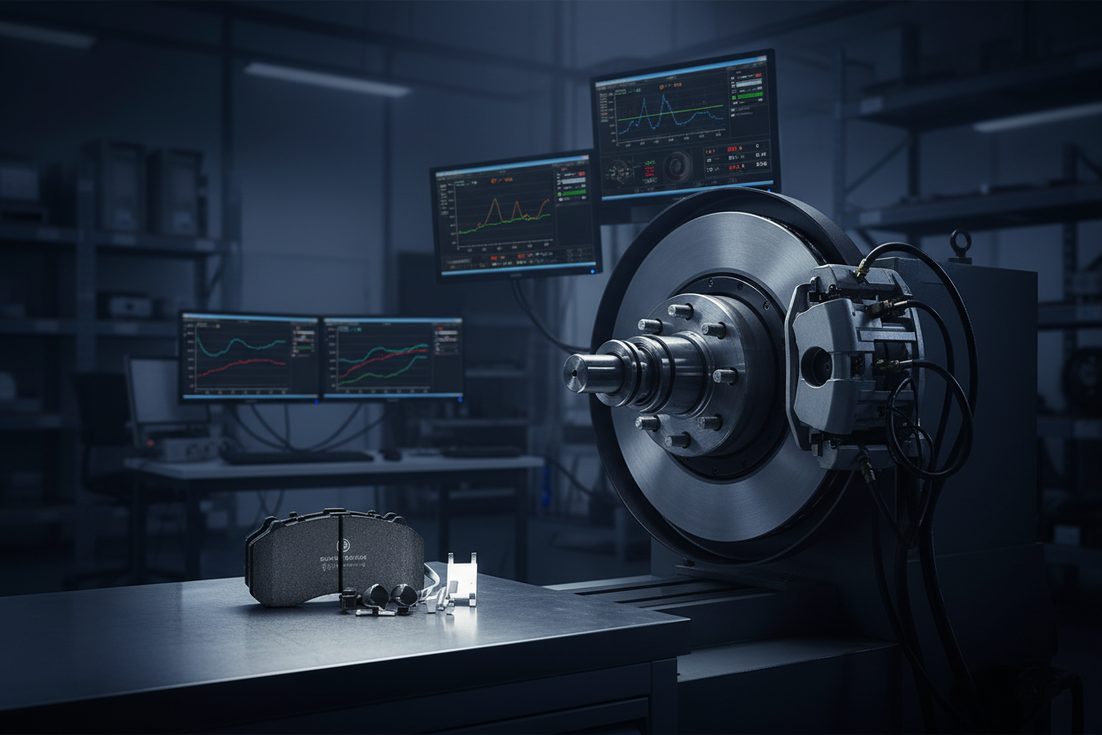
You've seen the marketing claims. "Ultimate stopping power." "Dust-free performance." But when you're placing a container order for thousands of brake pad sets, you can't base your decision on slogans. Your business depends on predictable, verifiable performance that matches your target market's needs. The real difference between ceramic and semi-metallic brake pads isn't just about material—it's about the hard data from standardized tests that dictate real-world reliability, warranty costs, and your profit margins.
Let's cut through the noise. We'll look at the actual test numbers—friction coefficients, fade resistance, disc temperature, and NVH (Noise, Vibration, Harshness) metrics—and translate them into business outcomes for importers and distributors. This isn't about which pad is "better"; it's about which pad is the right financial and performance fit for the vehicles and drivers in your region.
What Do Friction Coefficient Tests Reveal About Stopping Power and Consistency?
Friction coefficient (µ) is the primary measure of a brake pad's bite. According to ECE R90, passenger car pads must operate within a declared friction class (e.g., FF: 0.35-0.45, GG: 0.45-0.55). Semi-metallic pads, with their 30-65% metal content, often target the higher end of the FF range or into GG, posting initial cold µ values between 0.38 and 0.48. That's excellent for immediate, aggressive stopping.
Ceramic pads, composed of ceramic fibers, non-ferrous fillers, and bonding agents, typically register in a tighter band, say 0.36 to 0.42. The key difference isn't the peak number—it's the curve. In BAIYUN Brake's dynamometer tests, a premium ceramic formulation showed less than a 10% variation in µ from 50°C to 350°C. A comparable semi-metallic pad might show a 20-25% variation, sometimes spiking higher when hot but also dropping lower when cold-wet.
So what does that mean for your inventory? If you're supplying pads for performance vehicles or commercial fleets in hilly terrain, that higher, stable-hot µ of a quality semi-metallic pad reduces stopping distance under load. For a city taxi fleet or family sedans, the predictable, moderate µ of a ceramic pad provides smoother, more linear pedal feel that drivers prefer. Mismatching the pad to the application is a fast track to customer complaints. You can explore the technical nuances of different materials in our understanding brake pad materials guide.
The friction class on the box is a promise of a performance range; certified test reports from an IATF 16949 certified facility are the proof that the promise is kept, batch after batch.
How Does Fade Resistance Testing Predict Real-World Durability and Warranty Risk?
Fade is the temporary loss of braking power due to overheating. The SAE J2522 or AK Master testing standards simulate this by repeatedly applying brakes from high speed, driving disc temperatures up to 600°C or more. The percentage of effectiveness lost is the fade figure.
Semi-metallic pads, with their metallic structure, generally handle high temperatures well. A good formulation might retain 75-80% of its effectiveness after a severe fade cycle. However, if the metallic content isn't optimally balanced, the pad can transfer excessive heat to the brake fluid, risking boil-over. The test data to scrutinize here is the recovery—how quickly µ returns to normal after cooling.
Ceramic pads excel in fade resistance because ceramic materials dissipate heat rapidly. It's common for a high-quality ceramic pad to show less than 15% fade, with near-instant recovery. In our internal testing for a European OEM program, our ceramic compound exhibited only 8% fade at 350°C, with effectiveness returning to 98% within two low-temperature cycles. This translates directly to fewer warranty claims for "spongy pedal" or "brakes overheating on long descents" for your customers.
For a distributor, understanding fade curves is about risk management. Pads with poor fade resistance will generate complaints during seasonal peaks—like summer holidays in mountainous regions. That hits your bottom line with reverse logistics and replacement costs. Requesting a supplier's passenger car brake pad test report that includes multiple fade cycles is non-negotiable.
What Do NVH and Wear Measurements Tell You About Total Cost of Ownership?
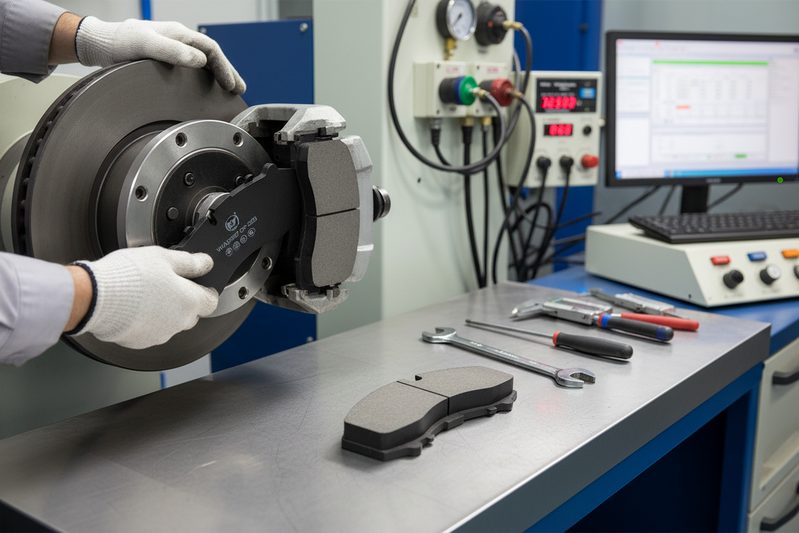
Noise, vibration, and harshness (NVH) are leading causes of premature returns and "bad fit" perceptions. Test rigs use microphones and accelerometers to measure sound pressure levels in decibels across various frequencies. Semi-metallic pads, due to their harder composition and potential for high-frequency vibration, can be prone to squeal, especially in damp conditions. Test data might show spikes above 70 dB in the 1-5 kHz range.
Ceramic pads are inherently quieter. Their composite structure dampens vibration, often keeping noise below 60 dB in the same tests. But NVH isn't just about material. It's about chamfer design, shim quality, and application-specific tuning. A pad that's silent on a BMW 3 Series might groan on a Toyota Hilux. That's why sourcing from a manufacturer with application-specific engineering, like BAIYUN Brake's 49+ years of experience, matters more than the base material alone.
Wear rate, measured in mm per 1,000 km on a dyno or in field trials, completes the TCO picture. Semi-metallic pads can be abrasive, sometimes wearing the rotor faster. A ceramic pad might have a slightly higher pad wear rate in extreme use but is gentler on rotors. The real number to calculate is the total cost per 100,000 km: pad cost + potential rotor replacement cost. A cheaper pad that destroys rotors is a false economy for your end-users. Our analysis on brake maintenance cost analysis breaks this down further.
Low NVH numbers in test reports correlate directly with fewer customer comebacks, while wear rate data lets you position a product not on its price, but on its total stopping cost.
What Are the Most Common Misconceptions About Ceramic and Semi-Metallic Pads?
Misconception: Ceramic pads are only for luxury cars and have weak stopping power.
Reality: Modern ceramic formulations achieve robust friction coefficients (0.38-0.42 FF class) suitable for most passenger vehicles. Their advantage is consistency, not weakness. They provide excellent stopping power with less fade, making them ideal for daily driving across a wide vehicle portfolio.
Misconception: Semi-metallic pads are always noisier and produce more dust.
Reality: While early semi-metallic pads were prone to noise and black dust, advanced formulations with optimized metallic mixes and proper shims can meet strict OEM noise targets. The dust may be darker, but the quantity isn't necessarily higher than some ceramic compounds. It's about formulation quality, not just the material category.
Misconception: The highest friction coefficient (µ) equals the best pad.
Reality: A pad with an excessively high or unstable µ can cause wheel lock-up with standard ABS calibration, increase rotor wear, and induce judder. The ideal pad has a µ that is appropriate for the vehicle's system (matching the OE spec) and remains stable across temperatures. Consistency trumps peak performance for safety and driver predictability.
How Should Importers Use This Data to Source Profitably?
First, match the product to the dominant driving patterns in your market. A coastal, flat urban market is a prime candidate for ceramic pads—customers will appreciate the low dust and quiet operation. A market with mountains, frequent towing, or a high percentage of performance vehicles demands the thermal capacity of a premium semi-metallic. Don't try to force one type to fit all; it dilutes your brand and increases support costs.
Second, demand certified test data, not just marketing sheets. Ask potential suppliers for ECE R90 certification documents and specific dynamometer reports for the formulations you're buying. Check that the friction coefficient, fade, and wear numbers are consistent across multiple production batches. This is where partnering with a manufacturer like BAIYUN Brake, with deep 49+ years of manufacturing experience and a fully equipped R&D center, de-risks your supply chain.
Finally, consider the full package. A pad is more than its friction material. The backing plate's anti-corrosion coating, the integrity of the adhesive, the precision of the chamfers—all these affect performance and returns. A slightly higher FOB cost for a fully certified, well-engineered pad from a trusted brake pad supplier saves money on warranty claims, freight for replacements, and protects your reputation.
Sourcing decisions based on comprehensive test data shift the conversation from price-per-box to value-per-mile, building stronger, more profitable relationships with your downstream customers.
Frequently Asked Questions (FAQ)
Q: For a general import business targeting mid-range sedans, which type offers the best balance of performance and low warranty risk?
A: High-quality ceramic pads are typically the safer choice. They offer stable friction (0.36-0.42), excellent fade resistance (often <15% loss), and very low noise, which minimizes customer complaints. Their low dust and gentle rotor wear also reduce total cost of ownership for end-users, enhancing your brand's value proposition.
Q: What's the single most important test number to check on a supplier's report for semi-metallic pads?
A: Check the friction coefficient stability between 100°C and 350°C. A variation greater than 25% indicates a formulation that may feel grabby or weak depending on temperature, leading to inconsistent pedal feel. A stable curve within a 0.38-0.45 band is ideal for performance-oriented applications.
Q: Do ceramic pads work as well in very cold or wet climates?
A: Modern ceramic formulations have largely overcome early cold-performance issues. ECE R90 testing requires effectiveness checks in a wet condition. Reputable manufacturers test for this, and quality ceramic pads should reach >80% of their dry effectiveness within the first few brake applications in wet conditions, making them suitable for most climates.
Q: How can I verify a supplier's test data is legitimate and not just from a single "golden sample"?
A: Request batch-specific test reports or a summary of Statistical Process Control (SPC) data for key parameters like friction coefficient. An IATF 16949 certified manufacturer, like BAIYUN Brake, is required to maintain this data. Also, ask for the test laboratory's accreditation details to ensure it's an independent or certified in-house facility.
Q: Is there a significant price difference at the factory level between equivalent quality ceramic and semi-metallic pads?
A: The raw material cost for ceramic compounds is generally 15-25% higher than for semi-metallic. However, the final FOB price difference can be smaller (5-15%) depending on volume, packaging, and the manufacturer's efficiency. The key is to evaluate cost against the full test profile and potential savings from fewer returns.
The test numbers don't lie. They tell a story of heat management, material science, and engineering precision. Your job as a buyer is to find the story that matches your customers' needs and your business goals. Stop comparing generic ceramic vs. semi-metallic. Start comparing specific test dossiers from certified manufacturers.
Ready to see the data behind pads engineered for real-world performance and importer profitability? Request a quote and full technical dossier from BAIYUN Brake today. Let's discuss how our ECE R90 certified ceramic and semi-metallic formulations can strengthen your product lineup.
Was this article helpful?
Average Rating: 5/5 (1730)