
What Should Importers Look for When Choosing a Chinese Brake Pad Factory?
Summary:
To properly evaluate a Chinese brake pad manufacturer, importers must scrutinize technical certifications like IATF 16949 and ECE R90, verify published friction codes and copper content compliance, and conduct thorough factory audits of production and quality systems. This 1500-word guide details the specific tests, data points, and supplier qualification steps needed to secure a reliable, high-quality brake pad supply chain from China.
What Should Importers Look for When Choosing a Chinese Brake Pad Factory?
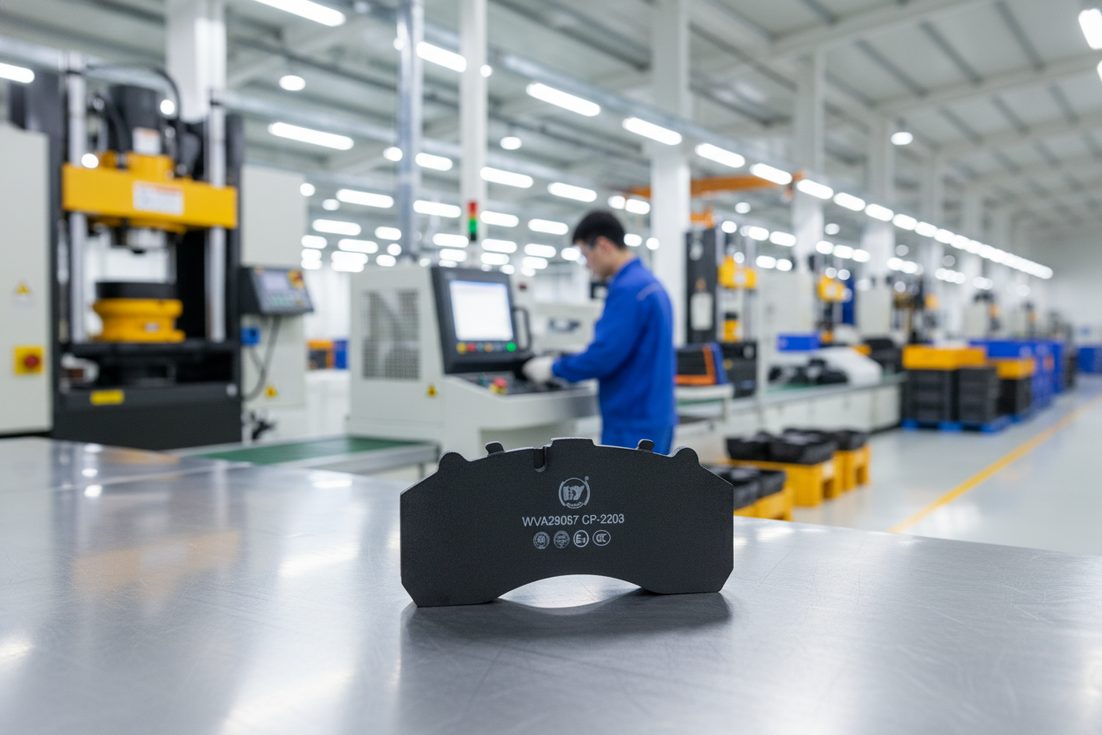
You're sourcing brake pads from China. The price sheets look good, but how do you know which factory will deliver consistent quality for your brand? It's not just about the unit cost. A failed shipment can cost you a major customer or trigger a costly recall. The real question is: what separates a reliable partner from a risky supplier?
Which Certifications Are Non-Negotiable for a Reliable Supplier?
IATF 16949 is the automotive industry's gold standard for quality management systems. It's not just a certificate on the wall; it's a process framework that mandates defect prevention, continuous improvement, and risk-based thinking. A factory with current IATF 16949 certification (audit date within the last 3 years) has systems to control everything from raw material sourcing to final packaging. You can check our quality assurance page to see how this translates into daily operations.
ECE R90 is a legal requirement for selling brake pads in over 50 countries, including the EU, UK, Australia, and many others. This regulation requires extensive type-approval testing on a designated sample batch. Each approved product receives a unique ECE R90 approval number (e.g., E1 90R-02A1234). Always ask for this number and verify it corresponds to the exact part number you're ordering. A factory that can't provide this instantly is likely selling non-compliant products.
ISO 9001 provides the baseline for a documented quality system. While IATF 16949 is more stringent, ISO 9001 ensures basic process control and traceability are in place. For non-automotive or aftermarket-only lines, this might be acceptable, but for OE service or demanding markets, IATF is the benchmark.
An uncertified factory might save you 5-8% on unit cost, but the risk of batch failures, customs rejections, and liability claims isn't worth the discount.
How Do You Verify Technical Specifications and Performance Data?
SAE J866 mandates that every brake pad has a published friction code, like FF or GG. The first letter (C-G) indicates cold friction coefficient (0.15-0.70+), the second indicates hot friction (tested at 316°C/600°F). A code of FF means consistent performance (0.35-0.45) across temperatures. Reputable factories provide this code on the box and in technical datasheets. Don't accept vague promises of "high friction"; demand the standardized code.
Copper content regulations are tightening globally. By 2025, laws in Washington, California, and the EU require brake pads to contain less than 5% copper by weight. A professional supplier will provide a Certificate of Compliance or test report verifying copper content, often alongside a full material data sheets package. This isn't optional anymore—it's a customs clearance document.
Heat resistance defines a pad's safety margin. While standard dynamometer tests run to 350°C, premium formulations are tested to 650°C to simulate extreme downhill braking. Ask for the test report graph showing friction coefficient (μ) versus temperature. The curve should be stable, with no dramatic fade (drop below 0.25). In BAIYUN Brake's 2025 testing, their ceramic formulation maintained a μ of 0.38-0.42 from 100°C to 550°C, showing minimal fade.
Performance claims must be backed by third-party or in-house lab reports that follow SAE, ISO, or ECE test protocols.
What Should a Factory Audit Cover Beyond the Production Line?
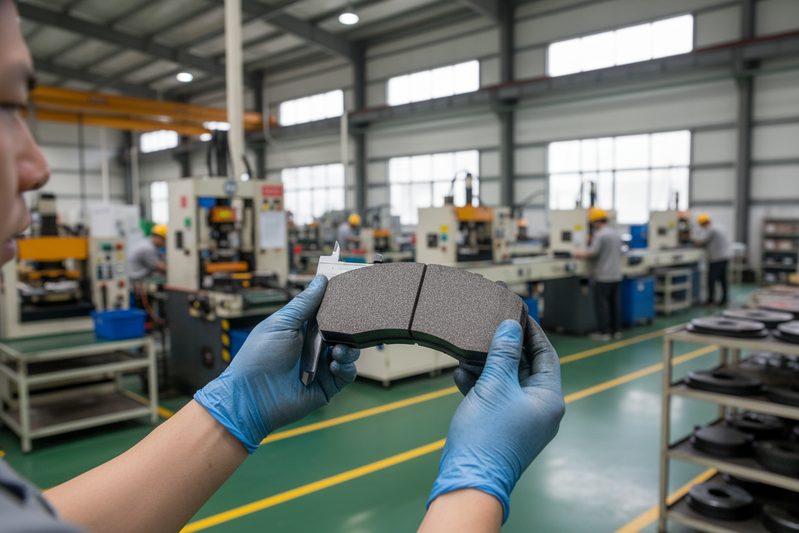
Look at the age and maintenance of the mixing and molding equipment. Modern, computer-controlled mixers ensure batch-to-batch consistency in material density. Presses should have digital pressure and temperature controls. Ask for the calibration records of these machines. A factory still relying heavily on manual, analog equipment presents a higher variability risk.
Raw material sourcing tells you about cost control and quality. Does the factory have long-term contracts with reputable friction material suppliers? Can they trace a batch of pads back to the specific lot of resin or steel fiber used? This traceability is critical for root cause analysis if a problem arises. It's one reason our 49+ years of manufacturing experience includes building deep, audited supplier relationships.
In-process quality checks are more telling than final inspection. A robust factory will have checkpoints after mixing (density test), after molding (dimension check, visual), after curing (hardness test), and after grinding (final thickness, parallelism). Ask to see the check sheets for a recent production run. Are reject rates documented and analyzed?
R&D capability separates a commodity producer from a solutions partner. Does the factory have a lab for basic friction testing, a shear strength tester, or a noise dynamometer? Can they develop a custom formulation for a specific vehicle or market requirement? This capability allows for future collaboration on private-label products. You can see examples of this in our factory tour videos showcasing the technology center.
A thorough audit examines the systems behind the product, not just the product coming off the line.
What Are the Most Common Misconceptions About Sourcing from China?
Misconception: All Chinese factories use the same low-quality materials.
Reality: The gap between top-tier and low-tier Chinese manufacturers is vast. Leading factories like BAIYUN Brake source premium steel fiber, aramid pulp, and ceramic compounds from global suppliers, often the same ones used by European brands. Their passenger car brake pad test report shows performance meeting or exceeding OE specifications.
Misconception: Certification is just paperwork you can buy.
Reality: IATF 16949 and ECE R90 involve rigorous, recurring audits by accredited third-party bodies. For ECE R90, a government-appointed Technical Service (like TÜV or IDIADA) must witness production and test samples from the factory floor. The certificate is tied to the specific production site and process.
Misconception: Lower price always means lower quality.
Reality: While often true, scale efficiencies matter. A large, automated factory with high volume can achieve lower per-unit costs while maintaining quality through automation. The key is to compare total cost of ownership, which includes warranty claims, logistics efficiency, and the supplier's technical support center responsiveness. A slightly higher price with full support often yields better long-term profitability.
How Do You Structure a Sample Evaluation and Trial Order?
Request a pre-production sample from the exact production line you intend to use, not a showroom sample. Test it against your known benchmark—a current supplier's pad or an OE part. Use a dynamometer if possible, or at minimum, conduct a visual and dimensional inspection against the vehicle's specifications. Check for proper chamfers, shims, and wear sensor placement.
A trial order should be large enough to be representative of mass production but small enough to limit risk. For passenger car pads, 500-1000 sets is a common trial size. For C.V. brake pads, 50-100 axles sets might be appropriate. The goal is to see if the quality from the sample holds across a production batch.
Define clear pass/fail criteria before the trial. This could include: 100% dimensional compliance with drawings, friction code consistency across 10 randomly selected pads, noise levels below a certain dB in dynamometer testing, and packaging that survives a defined drop test. Put these criteria in your purchase order.
A structured sample and trial process validates the factory's ability to deliver consistent quality at your required volume.
Frequently Asked Questions (FAQ)
Q: How can I verify a factory's ECE R90 certification is real and current?
A: Every ECE R90 approval has a unique number (e.g., E1 90R-02A1234). The "E1" indicates Germany as the granting authority. You can cross-check this number with the factory's name and address on the certificate. Also, ask for the test report from the Technical Service (like TÜV or Applus). Certificates must be renewed if the production process or formulation changes significantly.
Q: What's the minimum acceptable friction coefficient for a safe passenger car brake pad?
A: According to ECE R90, the minimum acceptable friction coefficient (μ) is 0.25. However, most OE-quality pads operate in the 0.35-0.45 range (an "F" rating). Pads below 0.30 may feel weak and increase stopping distances, especially when wet or cold. Consistent performance across the temperature range is more critical than a single high number.
Q: We need a custom formulation for a specific vehicle application. Can Chinese factories do this?
A: Yes, but capacity varies. A factory with a strong R&D department and a library of existing formulations can typically develop a custom pad within 60-90 days. This involves creating a prototype, lab testing, dynamometer validation, and vehicle testing. Expect an NRE (Non-Recurring Engineering) charge and a minimum order quantity, often starting at 5,000 sets for passenger cars.
Q: What's the lead time we should expect from a qualified Chinese brake pad factory?
A: For standard catalog items with the friction material in stock, lead time is typically 30-45 days FOB China port. This includes production, curing (which alone takes 7-10 days), quality checks, and packaging. For custom or large orders (e.g., 20,000+ sets), lead time can extend to 60-75 days. Always confirm the curing schedule—it's the non-negotiable bottleneck.
Q: How do we handle quality disputes or warranty claims with an overseas factory?
A: This is where your pre-qualification pays off. A professional factory will have a clear warranty policy (often 2-3 years from date of manufacture) and a process for claims. They should request photos, batch numbers, and possibly the return of samples for their lab analysis. A good partner will work proactively to resolve the issue and prevent recurrence, not just replace the goods. Check if they offer a brake pad trouble tracer guide to help diagnose issues.
Choosing the right factory is your most important sourcing decision. It protects your brand reputation and your customers' safety. Look beyond the price. Demand the data, audit the systems, and verify the certifications. A partner like BAIYUN Brake, with IATF 16949 certification and ECE R90 approvals, is built for this level of scrutiny. Ready to evaluate a supplier that won't make you compromise? Request a quote and our full certification package to start a data-driven conversation.
Was this article helpful?
Average Rating: 5/5 (1125)