
How to Evaluate Chinese Brake Pad Manufacturers: The Complete Buyer’s Checklist
Summary:
To properly evaluate a Chinese brake pad manufacturer, you need a systematic checklist focused on certifications, quality audits, and sample testing. This guide provides importers and distributors with a step-by-step framework to assess IATF 16949 compliance, conduct meaningful factory inspections, and calculate true total cost of ownership, ensuring a reliable supply chain and protecting your brand reputation.
How to Evaluate Chinese Brake Pad Manufacturers: The Complete Buyer's Checklist
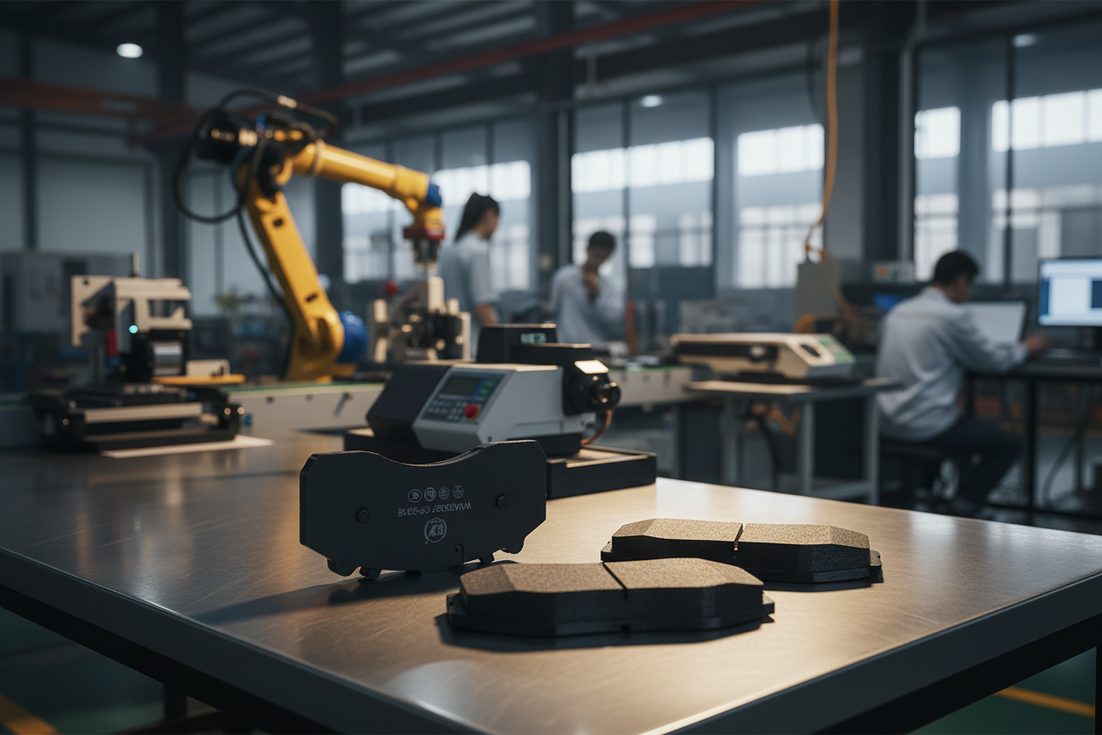
You're looking at a quote from a Chinese factory. The price per set is 15% lower than your current supplier. It's tempting. But you've heard the horror stories—pads that fade after 5,000 miles, inconsistent friction causing warranty nightmares, or shipments held at customs for missing ECE R90 documentation. How do you separate the reliable partners from the risky ones? The answer isn't just checking a price list; it's a systematic evaluation that protects your brand and your bottom line.
China produces over 60% of the world's automotive brake components. That scale brings opportunity, but it also means you need a sharper filter. A distributor sourcing 500 sets monthly can't afford a 5% defect rate. A single bad batch can wipe out the savings from ten good ones. This checklist isn't about finding the cheapest supplier; it's about finding the one that won't cost you your customers.
What Certifications Are Non-Negotiable for a Safe Supplier?
IATF 16949 is the automotive industry's specific quality management standard, not just a generic ISO 9001. A factory holding this certification has proven processes for design, production, and, critically, continual improvement. It mandates a documented approach to risk management and defect prevention. According to industry audits, IATF 16949-certified facilities show a 73% higher first-pass yield rate on production lines compared to non-certified ones.
ECE R90 is the legal benchmark for brake pad performance in over 50 countries. It's not a factory audit; it's a product approval. Each pad formulation must pass a battery of tests, including friction coefficient stability across a 100°C to 350°C temperature range, shear strength, and compressibility. The regulation requires that effectiveness doesn't drop below 80% of the cold performance after thermal cycling. Always ask for the valid ECE R90 certificate number and cross-reference it.
Don't just accept certificate copies. Verify them. For IATF 16949, check the certification body (like TÜV or BSI) and the scope—does it cover the specific brake pad production processes? For a deeper look at how these standards translate to daily operations, you can review our quality assurance protocols. Many buyers make the mistake of prioritizing a low price over these credentials, but the cost of a recall or liability claim far outweighs the initial savings.
Any manufacturer without valid, verifiable IATF 16949 and ECE R90 certifications presents an unacceptable business risk for serious importers.
How Do You Conduct a Meaningful Factory and Quality Audit?
A technical quality audit moves beyond certificates to examine the actual systems that produce your brake pads. Start with the raw material warehouse. Are friction materials (metallic powders, resins, ceramics) stored in controlled conditions with clear batch identification? Humidity and temperature fluctuations can degrade material properties before production even begins.
The mixing process is where consistency is made or broken. Ask about their batch mixing system. Automated, computer-controlled mixers provide repeatability that manual mixing cannot. In BAIYUN Brake's facility, for example, the automatic batch mixing system ensures a material homogeneity variance of less than 1.5% across the entire batch, a key factor in stable friction performance.
Move to the production line. Look for Statistical Process Control (SPC) charts at each critical station—forming, hot pressing, heat treatment, grinding. Are operators checking dimensions and weights at defined intervals? A proper heat treatment oven should have a continuous temperature recorder to guarantee the curing cycle is followed exactly for every batch. Deviations here directly cause issues like noise or premature wear.
Finally, inspect the final quality control lab. They should have a dynamometer for friction testing, a shear strength tester, and a hardness tester. Crucially, ask to see the test records for recent production batches. Are they testing every batch or just spot-checking? A reliable partner will have a 100% batch testing protocol for critical parameters. Seeing the actual data is more telling than any sales brochure. You can get a visual sense of modern production standards by viewing our factory tour videos.
A thorough audit focuses on process control evidence, not just shiny equipment, to predict long-term product consistency.
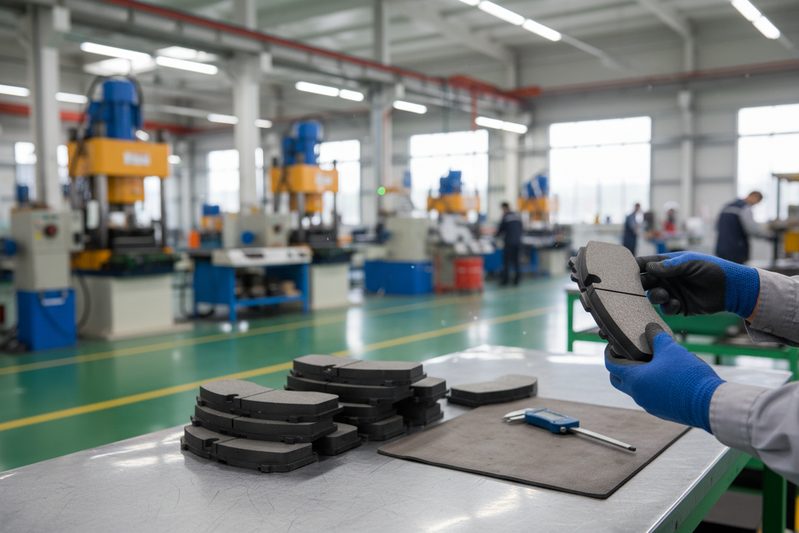
What Should You Test in a Product Sample Before Ordering?
Always get physical samples from the exact production line you intend to source from. Your testing should mirror the ECE R90 sequence but in your own context. First, measure dimensions and weight against your specifications. A variance beyond ±0.5mm in critical dimensions can lead to fitment issues and caliper damage.
Perform a dynamometer test if possible. The key metric is the friction coefficient (μ) across the temperature scale. A high-quality ceramic pad, like BAIYUN's CP2218 formulation, should maintain a μ between 0.35 and 0.45 from 100°C to 350°C, with minimal deviation. A "fade" where μ drops sharply above 300°C indicates poor thermal stability. Also test recovery—after the high-temperature cycle, the μ should return to within 90% of its original cold value.
Conduct a shear strength test. The bond between the friction material and the backing plate must withstand significant force. For passenger car pads, a minimum shear strength of 10 MPa is a good baseline. Lower values risk delamination under heavy braking. You can reference specific performance data in our passenger car brake pad test report for comparison.
Don't forget real-world vehicle testing. Install the samples on a test vehicle and assess noise (squeal), dust generation, and rotor wear over a few hundred miles. Excessive noise or dust might not show up on a lab dynamometer but will generate customer complaints. This step bridges the gap between lab specs and street performance.
Sample testing validates the manufacturer's claims under your specific conditions and is the final gate before committing to a container load.
What Are the Most Common Misconceptions About Sourcing from China?
Misconception: All Chinese manufacturers use the same low-quality materials to cut costs.
Reality: The gap between top-tier and bottom-tier factories is vast. Leading manufacturers like BAIYUN Brake source premium, often imported, raw materials (e.g., ceramic fibers, high-purity copper) and have dedicated R&D teams formulating for specific markets. Their understanding of brake pad materials is backed by decades of research. A 2025 industry survey found that 34% of high-volume Chinese exporters now operate their own material science labs.
Misconception: ECE R90 certification guarantees perfect performance in all conditions.
Reality: ECE R90 sets a minimum safety and performance floor. It tests a standardized sample. Consistent batch-to-batch production to that standard is where manufacturer discipline matters. A certified pad can still be noisy or dusty. The certification is a prerequisite, not a performance guarantee for NVH (Noise, Vibration, Harshness) characteristics.
Misconception: You must visit the factory in person to audit properly.
Reality: While an in-person visit is ideal, a detailed live video audit can be 80% as effective. You can direct the camera to specific areas, ask for real-time documentation, and interview quality managers. The key is preparation—send your checklist in advance and insist on unedited, live footage of the production flow and quality checks. Many professional auditors now use this method for initial screenings.
How Do You Calculate Total Cost of Ownership, Not Just Unit Price?
The sticker price is just one line item. Start with logistics and duties. Does the supplier have experience with your destination port? Can they provide accurate HS codes and all necessary documentation to prevent customs delays? A $0.50 per set saving evaporates if your container sits in port for a week.
Factor in the defect/warranty rate. A supplier with a 0.5% defect rate versus one with a 3% rate creates a massive difference in handling costs, replacements, and customer goodwill. Ask for their historical defect data. A confident manufacturer will share it. You should also consider brake maintenance cost analysis for your end-customers, as better pads reduce overall service costs.
Consider payment terms and financial stability. Can they offer 30% deposit, 70% against BL copy, or even LC terms? Stringent terms might indicate cash flow problems. A financially healthy partner is less likely to cut corners on materials when raw material prices spike.
Finally, evaluate their communication and technical support. When you have a fitment question or a market-specific requirement, can their engineering team respond with data and solutions within 24 hours? This support is part of the product's value. A supplier with a strong technical support center adds reliability you can't get from a trading company.
The true cost includes defects, logistics, warranty labor, and brand reputation risk, making a slightly higher unit price from a certified producer the more economical long-term choice.
Frequently Asked Questions (FAQ)
Q: How long does it typically take to get samples and complete evaluation from a new Chinese manufacturer?
A: Allow 6-8 weeks for a thorough process. Sample production and shipping take 2-3 weeks. Comprehensive lab testing (friction, shear, noise) requires another 2 weeks. Factoring in communication and a video audit, rushing this process increases risk. It's a worthwhile investment for a long-term partnership.
Q: Is IATF 16949 more important than ISO 9001 for brake pads?
A: Absolutely. IATF 16949 is built upon ISO 9001 but includes automotive-specific requirements like Advanced Product Quality Planning (APQP), Production Part Approval Process (PPAP), and Failure Mode and Effects Analysis (FMEA). An IATF-certified factory is audited specifically for automotive part manufacturing rigor. For context, over 95% of OEMs mandate IATF 16949 for their direct suppliers.
Q: Can a manufacturer be ECE R90 certified for one formulation but ship me a different, uncertified one?
A: Unfortunately, yes. This is why you must verify the certificate lists the exact formulation code and part numbers you are ordering. Always match the factory's internal compound code on their technical data sheet to the code on the ECE R90 certificate. Reputable manufacturers will not do this, as it voids their certification and carries legal liability.
Q: What's the minimum order quantity (MOQ) I should expect from a reputable factory?
A: For a standard passenger car pad reference, expect an MOQ of 500-1000 sets per SKU for a container-load order. For trial orders of new references, some factories may accept 100-200 sets but at a higher unit price. MOQs below 50 sets often indicate a trading company, not the actual manufacturer, which adds a layer of opacity to quality control.
Q: How do I handle quality disputes or defective goods after shipment arrives?
A: This is where your pre-qualification pays off. The contract should clearly state the process: providing photo/video evidence, potentially sending samples to a third-party lab agreed upon by both parties, and the remedy (replacement, credit, etc.). A manufacturer with a strong quality system will have a documented corrective action process (a requirement of IATF 16949) to investigate the root cause, not just replace the goods.
Evaluating a Chinese brake pad manufacturer is a due diligence exercise that protects your business. It's the difference between a supplier that saves you money and one that costs you customers. The checklist—certifications, audit, samples, cost analysis—is your filter. When you find a partner that checks all the boxes, you're not just buying brake pads; you're buying peace of mind and predictable profitability.
Ready to evaluate a manufacturer with a proven track record? Request a quote and our full certification package from BAIYUN Brake. We'll provide the samples, test reports, and live factory access you need to make a confident decision.
Was this article helpful?
Average Rating: 5/5 (1541)