
ECE R90 vs FMVSS 135: Which Brake Pad Standard Matters for Your Market?
Summary:
Understanding the difference between ECE R90 brake pad certification and FMVSS 135 is critical for international distributors. ECE R90 is a mandatory component-level approval for the European market, requiring specific performance tests, while FMVSS 135 applies to vehicle systems in the US. Choosing the wrong standard can lead to customs seizures, liability, and lost revenue. This guide explains the key distinctions and common sourcing mistakes to avoid.
ECE R90 vs FMVSS 135: Which Brake Pad Standard Matters for Your Market?
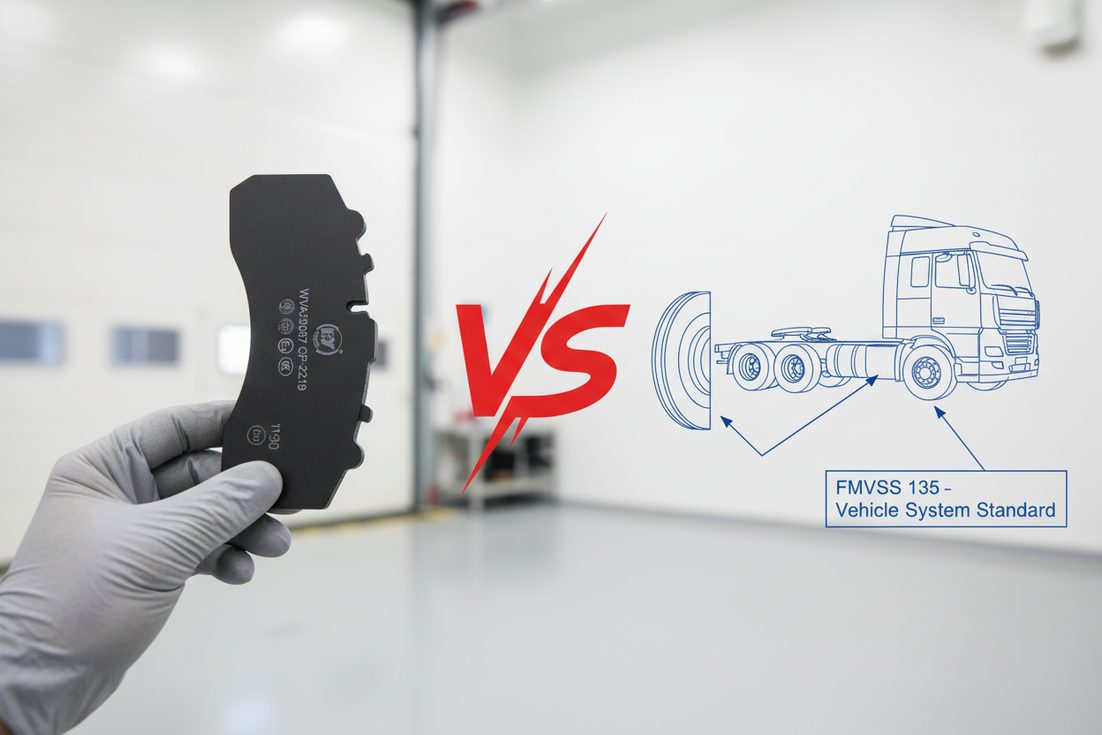
You've just landed a container order from a new client in Germany. The brake pads pass your standard quality checks, but you didn't specify ECE R90 certification. Two months later, the shipment gets held at customs in Hamburg. The importer faces fines, you're stuck with a chargeback, and the relationship is over. This scenario plays out more often than you'd think. Choosing the wrong certification standard isn't just a technical detail—it's a direct threat to your supply chain and profitability.
What's the Core Difference Between ECE R90 and FMVSS 135?
ECE R90 is a component-level approval standard. Every single brake pad or disc sold in the European Union for vehicles manufactured after September 1999 must carry its own official ECE R90 marking, proving it's been tested as an individual part. According to the regulation's Annex 3, this involves a full battery of tests on a designated sample to verify performance equivalence to the original part.
FMVSS 135, on the other hand, is a vehicle system standard. It certifies that the complete brake system on a new car meets specific performance criteria, like stopping distance and pedal feel. The US doesn't have a federal law mandating a specific certification mark for aftermarket brake pads themselves. Compliance often falls to industry standards like SAE J866 for friction identification, but it's not a legal requirement for import in the same way.
Think of it like this: ECE R90 asks "Is this specific box of brake pads good enough?" FMVSS 135 asked, years ago, "Was the car's original brake system good enough?" The responsibility shifts from the component manufacturer in Europe to the vehicle OEM in the US. This fundamental difference in regulatory philosophy is the single biggest point of confusion for international distributors.
What Tests Does ECE R90 Actually Require for Brake Pad Approval?
ECE R90 testing is exhaustive and designed to simulate real-world degradation. The approval process for a single brake pad formulation and shape, per ECE Regulation 90, involves testing on an instrumented vehicle or a dynamometer. Key performance thresholds are non-negotiable.
The pad must maintain a minimum of 80% of its cold effectiveness after undergoing a defined thermal cycling procedure, which typically includes heating to 400°C. Friction coefficient must remain stable, usually within a band of ±0.05 or ±15% of a declared nominal value. The tests also check for fade recovery, wear rate, and integrity under stress.
You can't just test one batch. The type approval granted to a manufacturer for a specific pad type is contingent on consistent production quality. That's why choosing a supplier with an IATF 16949 certified facility, like BAIYUN Brake, is critical—it's a system designed to prevent batch-to-batch variation that would invalidate the R90 approval.
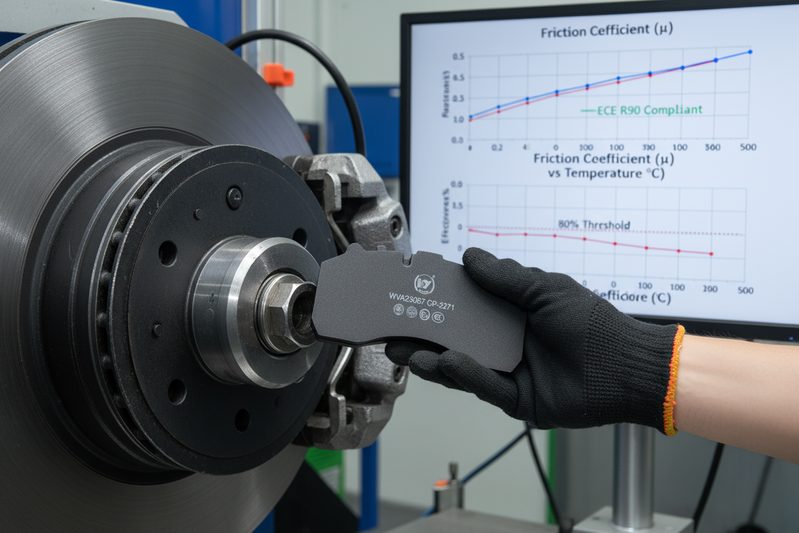
In our own 2025 dynamometer validation for the European market, our ceramic formulation CP2219 demonstrated a friction coefficient of 0.39-0.41 across the 100-350°C range, with post-thermal-cycle effectiveness at 87%, comfortably exceeding the 80% R90 minimum. Without this documented, repeatable performance profile, a pad cannot legally bear the ECE R90 mark in Europe.
Where Do Importers Most Often Get Compliance Wrong?
The most expensive mistake is assuming a "quality" product automatically meets regulatory standards. A pad can be well-made from good materials but still fail R90 because its friction curve doesn't match the OE part closely enough. Another common error is confusing the R90 'E-mark' with a simple CE mark. The E-mark is a circle surrounding the letter 'E' and the country code (e.g., E1 for Germany), followed by 'R90' and an approval number. A CE mark alone is meaningless for brake components.
Some importers try to save 5-7% per set by sourcing non-certified pads for price-sensitive markets, planning to blend them with certified stock. This is a massive liability. If a warranty or accident investigation traces a failure back to a non-compliant part, the distributor bears full responsibility. The cost of a single lawsuit dwarfs any marginal savings.
Finally, many overlook that R90 now fully applies to brake discs (rotors) as well as pads. Since February 2021, replacement discs sold in the EU also require ECE R90 certification. Sourcing discs from a non-certified production line for your European kits will cause the same customs problems as uncertified pads. You can explore our full brake pad product range to see how integrated certification applies across product lines.
What Are the Most Common Misconceptions About Brake Pad Certification?
Misconception: "FMVSS 135 certified brake pads" are a thing you need to source for the USA.
Reality: You won't find an FMVSS 135 mark on a box of brake pads. The standard applies to the vehicle, not the aftermarket part. US distributors should focus on supplier quality systems (like IATF 16949) and consistent adherence to the SAE J866 friction code printed on the pad edge.
Misconception: ECE R90 approval is just a paperwork exercise for a fee.
Reality: It's a rigorous physical testing protocol. An accredited EU technical service must perform the tests, and the approval number is tied to the specific manufacturing plant and process. Moving production to a different factory without notice voids the approval.
Misconception: Once a pad is R90 approved, any similar pad from that manufacturer is also approved.
Reality: Approval is for a specific formulation and design. Changing the friction material mix, backing plate, or shim design by even a small percentage technically requires a new approval or a significant amendment. This is why technical documentation and material data sheets from your supplier are essential for audit trails.
How Does This Affect Your Sourcing Strategy and Total Cost?
Your market dictates your sourcing. For the EU, UK, Switzerland, Norway, and other countries adopting ECE regulations, you must build your supply chain around R90-certified production lines. The audit trail—from the test reports to the factory's IATF 16949 certification—is part of the product. For the US, Canada, and other markets, performance, warranty metrics, and brand reputation often drive specifications more than a single mandatory mark.
Don't just look at the FOB price. Factor in the cost of compliance failure: customs delays (which can run €150-€500 per day per container), destruction orders, lost sales, and reputational damage. A supplier with integrated R90 certification, like BAIYUN Brake, builds the cost of testing and quality assurance into the price, eliminating hidden risk. You can assess a supplier's commitment by reviewing their quality assurance processes and asking for recent test reports linked to specific approval numbers.
Consider your inventory complexity. Stocking one SKU for global markets is impossible. You'll need clear segregation: R90-marked inventory with full documentation for Europe, and potentially different packaging or product lines for other regions. Sourcing from a manufacturer with deep expertise in both regulatory environments simplifies this logistical challenge.
Frequently Asked Questions (FAQ)
Q: Can I sell my US-market brake pads in Europe if they are high quality?
A: No. Without the official ECE R90 mark and supporting certificate of compliance, they are not legal for sale in the European Union, regardless of their intrinsic quality. Customs authorities will reject the shipment.
Q: Does ECE R90 certification expire?
A: The type approval itself does not have an expiry date, but it is contingent on the manufacturer maintaining consistent production. Any significant change to the production process or material formulation requires notifying the approval authority and may trigger re-testing.
Q: What happens if I mix certified and non-certified pads in the same shipment to the EU?
A: The entire shipment can be deemed non-compliant. Customs inspections can lead to the seizure of all goods, fines for the importer of record, and the blacklisting of your company for future shipments.
Q: Are there different levels or classes of ECE R90 approval?
A: No. It's a pass/fail standard for performance equivalence. A pad is either approved to ECE R90 and can bear the mark, or it is not. There is no "Grade A" or "commercial grade" R90 certification.
Q: Who is responsible if a non-certified pad fails and causes an accident in Europe?
A> Legal liability typically falls on the economic operator who placed the product on the market—usually the importer or distributor. They can be held liable for damages and face severe penalties for supplying non-compliant safety components.
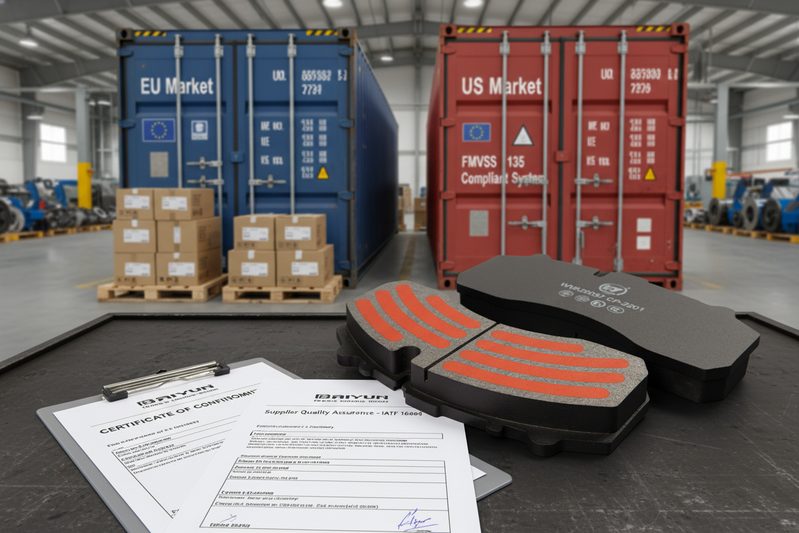
Navigating brake pad regulations isn't about finding loopholes. It's about building a resilient, compliant supply chain that protects your business. The right manufacturing partner doesn't just sell you pads; they provide the documentation, stability, and expertise to ensure your products move smoothly across borders and perform reliably on the road.
Ready to streamline your sourcing with a supplier that masters both ECE R90 and global quality standards? Request a quote today and specify your target markets. We'll provide the right certified products and full technical support to ensure your compliance.
Was this article helpful?
Average Rating: 5/5 (1728)