
What Is ECE R90 Certification and Why Do Brake Pad Importers Need It?
Summary:
ECE R90 brake pad certification is a mandatory UN regulation ensuring replacement pads perform within ±15% of original equipment specs. For importers, it's not just a technicality but a critical shield against liability, warranty claims, and market access barriers. This guide explains the tests, the business ROI, and how to verify genuine certification from your supplier.
What Is ECE R90 Certification and Why Do Brake Pad Importers Need It?
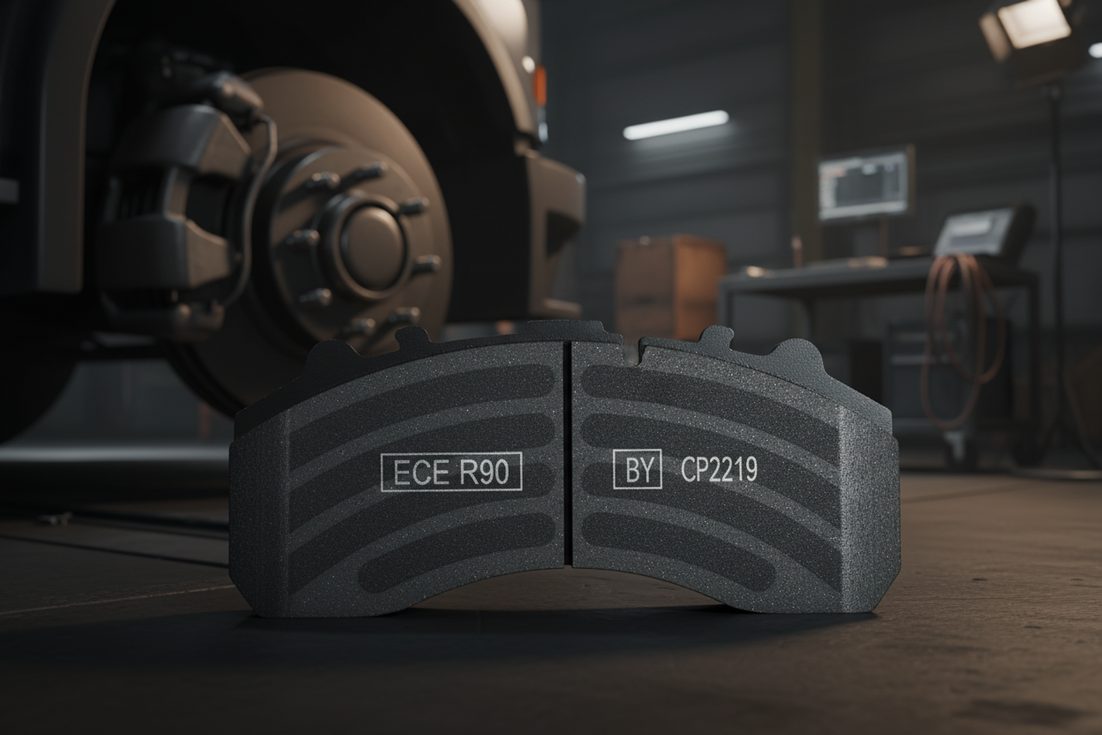
You're sourcing brake pads for the European market, and a supplier offers you a container at 20% below market price. The samples look fine, but there's no ECE R90 stamp on the box. Do you take the deal? If you've faced this, you know the gamble. That missing certification isn't just paperwork—it's a direct line to product recalls, legal liability, and lost customers. Let's break down what ECE R90 actually means for your business, beyond the technical jargon.
What Tests Does ECE R90 Require for Brake Pad Approval?
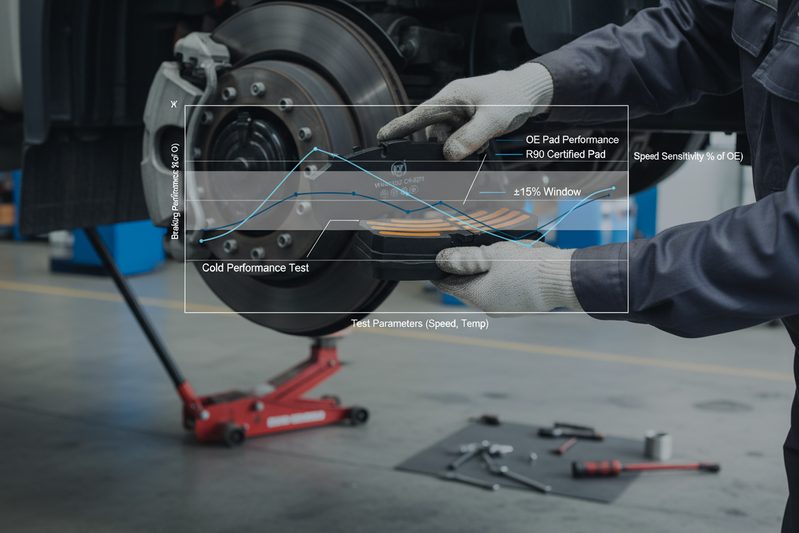
ECE R90 mandates a series of physical and dynamometer tests to prove a replacement pad is a true equivalent to the original. The core requirement is that the new pad's performance must stay within a ±15% window compared to the OE part. This isn't a single check; it's a multi-stage validation.
First, pads are categorized by the area of their friction material into Class A, B, or C, with each class having specific testing protocols. The manufacturer must identify the "most severe vehicle" application for each compound based on kinetic energy calculations. Testing then proceeds through defined stages: bedding-in, a performance check, a series of brake tests at different speeds, and finally, the critical cold performance equivalence and speed sensitivity tests.
Key measured parameters include speed, stopping distance, Mean Fully Developed Deceleration (MFDD), brake pad temperature, and pedal force. For example, during cold performance tests, pads must demonstrate consistent effectiveness from a baseline. According to test reports from accredited labs, a passing result shows the test pad's deceleration curve tightly tracking the OE pad's, with deviations never exceeding that 15% limit.
Importers should demand to see the full test report for the specific pad compound and vehicle application they are sourcing.
How Does R90 Certification Protect an Importer's Business and ROI?
Think of ECE R90 as an insurance policy for your supply chain. The upfront cost of certified pads is offset by avoiding massive downstream expenses. Non-compliant pads are a direct liability. In the EU, selling them can lead to fines, forced market withdrawals, and in severe cases, criminal charges if an accident is linked to substandard performance.
Your warranty costs plummet when you sell certified products. A distributor moving 2,000 sets monthly can't afford a 5% failure rate from inconsistent friction. R90's rigorous testing ensures batch-to-batch consistency, meaning fewer comebacks, fewer angry installers, and a stronger brand reputation for reliability. It also simplifies your logistics—you don't need separate stock for compliant and non-compliant markets; one certified SKU covers you across dozens of countries.
Frankly, the minor price gap between certified and uncertified pads rarely justifies the risk of a single container being rejected at customs or triggering a recall. The certification is proof of due diligence, shielding you from liability and protecting your investment in inventory and customer relationships.
What's the Real-World Difference Between R90-Certified and Non-Certified Pads?
The difference isn't always visible in a side-by-side photo, but it's stark on the test track and in long-term performance. A non-certified pad might use a cheaper, less stable friction formula. It could fade severely after repeated hard stops, or its friction coefficient might drop unpredictably when cold or wet.
ECE R90 testing specifically targets these failure points. The speed sensitivity test, for instance, verifies performance doesn't degrade at higher velocities. The cold performance test ensures reliable braking from the first application of the day. In BAIYUN Brake's internal validation, their R90-approved ceramic compound CP2219 maintained a friction coefficient (μ) between 0.36 and 0.40 across the entire 100°C to 350°C temperature range, with less than 10% deviation from the OE baseline. An uncertified alternative might show a μ swing from 0.45 down to 0.25, leading to unpredictable pedal feel and longer stopping distances.
For your customers, this translates to safety and predictability. For you, it means consistent product reviews, fewer technical support calls, and a product that genuinely matches the OE performance your marketing claims.
What Are the Most Common Misconceptions About ECE R90?
Misconception: "ECE R90 is just a European standard; it doesn't affect other markets."
Reality: Over 50 countries recognize UNECE regulations, including Saudi Arabia, Australia, Japan, and South Korea. If you plan to diversify your export markets, R90 certification is often the easiest path to compliance.
Misconception: "If a factory has IATF 16949, their pads automatically meet R90."
Reality: IATF 16949 certifies the quality management system for automotive part production. ECE R90 is a product-specific performance regulation. A factory can have excellent processes (IATF) but still produce a pad compound that fails R90's performance tests. You need both. You can learn more about our integrated approach on our quality assurance page.
Misconception: "The R90 mark on the box is enough proof; I don't need test reports."
Reality: The mark should correspond to a valid type-approval document from a certified testing authority. Savvy importers request the test report for their specific order to verify the certification is current and covers the exact part number and formulation they are buying.
How Can Importers Verify and Source Genuine ECE R90 Brake Pads?
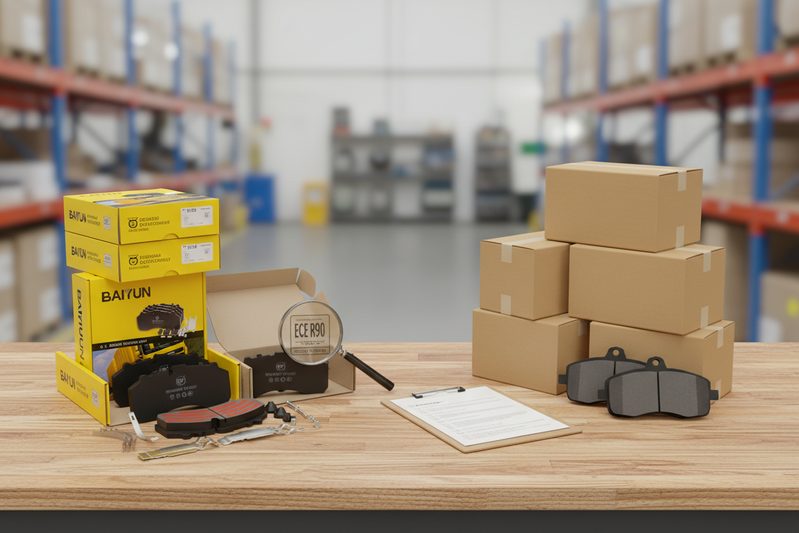
Verification starts with your supplier audit. Don't just ask if they're certified; ask for evidence. A legitimate manufacturer will provide the ECE R90 type-approval certificate, which includes a unique approval number (e.g., E1 90R-0123456). Cross-reference this number with the stamping on the pad backing plate or the product packaging.
Request the specific dynamometer and vehicle test reports for the compounds you're interested in. Look for data on cold performance equivalence and speed sensitivity—these are the heart of R90. A reputable partner like BAIYUN Brake makes these documents readily available, as part of our commitment to transparency. You can download a sample passenger car brake pad test report to see the level of detail required.
Finally, consider the supplier's broader certifications. A manufacturer that also holds IATF 16949, like our facility, demonstrates a systemic commitment to quality that supports consistent R90 compliance across all production batches, not just a one-off test sample. This is crucial for ensuring every container you receive meets the standard.
Frequently Asked Questions (FAQ)
Q: Does ECE R90 apply to commercial vehicle brake linings as well as passenger car pads?
A: Yes, absolutely. Regulation 90 covers replacement brake linings and pads for all vehicle categories, including trucks and buses. The testing protocol is adapted for the different performance requirements and sizes. For example, our range of C.V. brake linings undergoes separate R90 validation specific to heavy-duty applications.
Q: How long is an ECE R90 certification valid?
A: The type-approval itself doesn't expire, but it's linked to the specific product formulation and design. If the manufacturer changes the friction material composition, production process, or even the molding tool, a new round of testing and certification is typically required to maintain compliance.
Q: Can I sell non-R90 pads in Europe if I label them "for competition use only"?
A: This is a high-risk strategy. Enforcement authorities are aware of this loophole. To legally use this exemption, you must prove the pads are sold exclusively for vehicles used solely in competition, not for road use. For general aftermarket distribution, this argument rarely holds up and can lead to penalties.
Q: What's the cost impact of R90 certification on the FOB price?
A: The cost varies by compound and volume, but for a responsible manufacturer, it typically adds 5-12% to the production cost. This covers third-party testing fees, certification management, and the more expensive, stable raw materials required to pass the tests. It's a direct investment in product integrity and your market access.
Q: As an importer, am I liable if my supplier's certification is fraudulent?
A: In most jurisdictions, yes. The importer or "economic operator" placing the product on the market is ultimately responsible for its compliance. This is why thorough supplier due diligence, including verifying test reports with the issuing lab if needed, is a critical part of your risk management. Our technical support center is always available to help clarify certification details.
Sourcing brake pads without ECE R90 is a shortcut that almost always leads to a dead end. It might boost your margin on paper, but it exposes your business to regulatory action, reputational damage, and financial loss from non-conforming products. The regulation exists to create a level playing field where safety and performance are guaranteed, not promised.
Partnering with a manufacturer that integrates R90 compliance into its core production philosophy, backed by systems like IATF 16949, is the smartest way to secure your supply chain. You get a product that moves through customs smoothly, installs predictably for your customers, and builds trust in your brand. That's a return on investment that goes far beyond unit cost.
Ready to streamline your sourcing with guaranteed compliant products? Request a quote and full certification documentation for our ECE R90-approved brake pad range today.
Was this article helpful?
Average Rating: 5/5 (2090)