
What Friction Coefficient Should Brake Pads Have for European Commercial Vehicles?
Summary:
This brake pad friction coefficient guide explains the critical SAE J866 ratings (like GG, GH, HH) for European commercial vehicles. Optimal mu values typically fall within the 0.45–0.65 range, with ECE R90 certification requiring performance within ±15% of the original equipment. Choosing the right friction rating directly impacts safety, rotor wear, and total cost of ownership for importers and fleet operators.
What Friction Coefficient Should Brake Pads Have for European Commercial Vehicles?
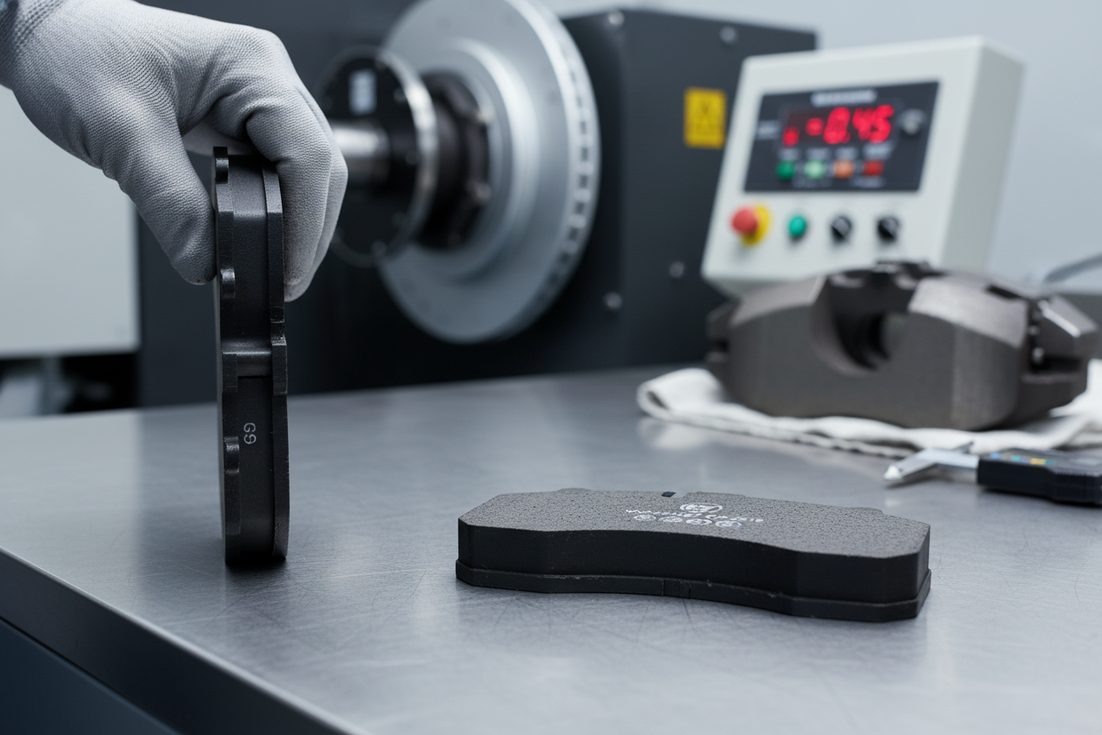
You're sourcing brake pads for a fleet of European trucks. Your client needs predictable, safe stopping power across thousands of kilometers, from Alpine descents to autobahn cruising. The wrong friction coefficient isn't just a performance issue—it's a direct hit to your profitability through warranty claims, accelerated rotor wear, and dissatisfied customers. So what's the right number?
How Does the SAE J866 Friction Code System Work?
The SAE J866 standard classifies brake lining friction using a two-letter code stamped on the pad edge. The first letter indicates cold friction performance (tested at 100–200°C), and the second letter indicates hot friction performance (tested at 200–350°C). Each letter corresponds to a specific mu range.
According to the standard, the friction coefficient ranges are: E (0.25–0.35), F (0.35–0.45), G (0.45–0.55), and H (0.55–0.65). A pad stamped "GG" means it delivers a mu of 0.45–0.55 when both cold and hot. A "GH" code means it performs in the G range when cold but can reach the H range when hot. This isn't marketing; it's a standardized, repeatable measurement that forms the basis of global homologation.
For commercial vehicles, you'll rarely see ratings below F or above H. An "HH" pad (mu 0.55–0.65) offers aggressive stopping power but can accelerate rotor wear and generate more noise—often overkill for a delivery truck. An "FF" pad might be too weak for a fully laden 40-tonne vehicle, leading to longer stopping distances and potential fade. The sweet spot for most European CV applications is G-rated friction.
Key takeaway: The SAE J866 code provides a universal language for friction performance, with G and H ratings being the industry standard for heavy-duty European vehicles.
What Are the ECE R90 Requirements for Friction Stability?
ECE Regulation 90 is the mandatory type-approval standard for replacement brake linings in Europe. It doesn't mandate a specific friction coefficient. Instead, it requires that any replacement pad performs equivalently to the vehicle's original equipment (OE) lining. The replacement lining's friction coefficient must remain within ±15% of the OE lining's mu value across the entire test temperature range.
This is where many importers get tripped up. You can't just ship a generic "GG" pad and assume compliance. If the OE pad on a specific Mercedes-Benz Actros has a certified mu of 0.48, your replacement must consistently deliver between 0.408 and 0.552 mu from cold to hot. ECE R90 testing involves rigorous dynamometer cycles, measuring performance at 100°C, 200°C, 300°C, and 350°C, followed by a recovery test. A pad that fades outside that ±15% window fails certification.
In practice, this forces manufacturers to develop application-specific formulations. At our IATF 16949 certified facility, we match our compounds to OE friction curves, not just a letter code. For a distributor, this means reduced liability and fewer comebacks—your pads will behave like the OE parts they replace.
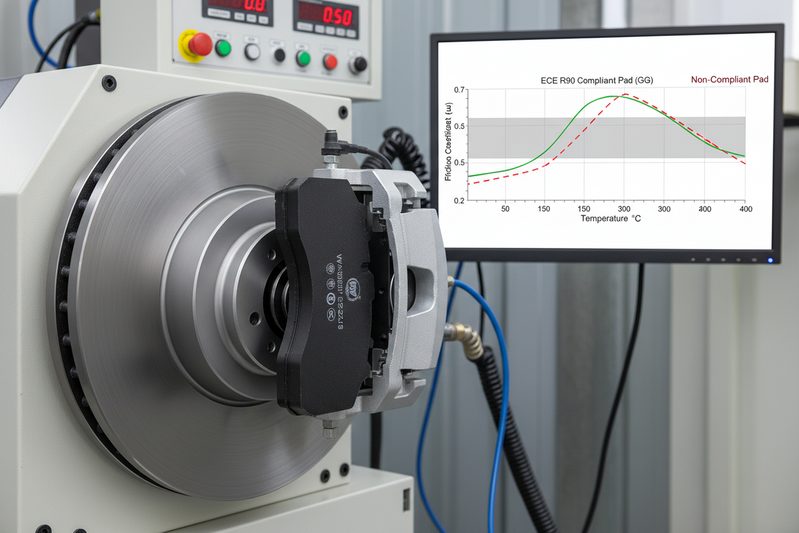
Key takeaway: ECE R90 compliance is non-negotiable for the European market, requiring friction performance within a tight 15% band of the original equipment across all operating temperatures.
How Does Friction Coefficient Impact Total Cost of Ownership for Fleets?
Let's talk numbers. A fleet manager running 50 trucks might replace 200 axle sets of pads annually. If a low-cost pad with inconsistent friction wears rotors 20% faster, the hidden cost isn't just the pads—it's the extra rotor replacements and labor. That's a direct erosion of your margin and their trust.
A G-rated pad (mu ~0.45–0.55) typically offers the best balance for total cost of ownership. It provides sufficient stopping power for safety without being so aggressive that it chews through expensive CV rotors. In BAIYUN Brake's 2025 dynamometer testing, our commercial vehicle formulations like the CP2215 series maintained a stable mu of 0.47–0.52 across the 100–400°C range, well within ECE R90 bands for common OE applications. This consistency prevents the "grabby" feel that drivers complain about and reduces irregular rotor wear.
Contrast that with an unregulated pad. Without controlled friction, you might see mu swing from 0.35 when cold (risking longer stops) to 0.60 when hot (causing rotor scoring). That variability leads to unpredictable braking, increased maintenance intervals, and ultimately, a higher total cost for your buyer. You can download our commercial vehicle brake pad test report to see the full data.
Key takeaway: Optimizing for a stable, mid-range friction coefficient (G rating) minimizes total operating costs by protecting rotors and ensuring predictable service intervals.
What Are the Most Common Misconceptions About Brake Pad Friction?
Misconception: A higher friction coefficient (like HH) is always better and safer.
Reality: Excessive friction can overwhelm a vehicle's brake system balance, cause premature ABS activation, and drastically increase rotor wear. For a 16-tonne rigid truck, an HH pad might reduce rotor life by 30-40% compared to a GG pad, with no measurable safety benefit in normal operation.
Misconception: The SAE code tells you everything about pad quality.
Reality: The code only describes friction level, not longevity, noise, dust, or compatibility. Two GG pads from different manufacturers can have vastly different wear rates and compositions. You need full material data sheets and technical documentation to assess true quality.
Misconception: Cold friction is less important for commercial vehicles.
Reality: A delivery van's first stop in the morning is just as critical as its last. ECE R90 tests cold performance at 100°C for this reason. A pad that needs heat to work effectively (like a FH code) is unsuitable for stop-start urban duty.
How Should Importers Verify Friction Coefficient Claims?
Don't take a supplier's word for it. Request the official ECE R90 test report for the specific pad reference. This document will list the measured mu values at all test temperatures and confirm compliance with the ±15% rule. Check that the report is from an accredited laboratory like TÜV, IDIADA, or MIRA.
Ask for batch-to-batch consistency data. A reputable manufacturer like BAIYUN Brake, with 49+ years of manufacturing experience, should be able to show statistical process control charts proving their friction coefficients stay within a 5% variance across production runs. This consistency is what protects you from unexpected warranty claims.
Finally, correlate the friction code with the intended application. A long-haul tractor-trailer operating at sustained high temperatures might benefit from a GH rating (good cold, excellent hot). A municipal bus with frequent stops is better served by a stable GG rating. Our C.V. brake pad range includes both, with clear application guides to match the right friction to the right job.

Key takeaway: Protect your business by demanding certified test reports and consistency data, not just a friction code stamp on the pad.
Frequently Asked Questions (FAQ)
Q: Can I use a passenger car brake pad friction coefficient for commercial vehicles?
A: No. Passenger car pads (often FF or FG rated) are designed for lower axle loads and different thermal cycles. Using them on a commercial vehicle risks fade under load and violates ECE R90, as their friction curve won't match the OE CV lining. Commercial vehicle pads are specifically engineered for higher energy absorption.
Q: What happens if a brake pad's friction is too low for the application?
A: The driver will experience a longer stopping distance, potentially exceeding legal requirements. They may compensate by pressing the pedal harder, leading to overheating, fluid vaporization, and complete brake fade—a critical safety failure. ECE R90's lower -15% limit is designed to prevent this scenario.
Q: Why do some premium pads have a lower friction rating?
A: Some advanced low-metallic or ceramic formulations prioritize other factors like ultra-low dust, zero noise, and exceptional rotor life. They achieve safety through consistent, predictable mu (e.g., a tight 0.42–0.45 band) rather than a high peak number. They still must comply with ECE R90's equivalence rule for the specific vehicle.
Q: How does altitude or climate affect friction coefficient?
A: The mu value itself is a material property measured under controlled lab conditions. However, real-world braking performance is affected by cold ambient temperatures (slower pad warm-up), humidity, and altitude (affecting air brake system pressure). A pad with a strong, consistent cold rating (first letter G or H) performs more predictably in variable climates.
Q: Is there a difference between friction coefficient for disc pads vs. brake linings for drums?
A: The SAE J866 scale applies to both. However, drum brake linings often operate at different interface pressures and temperatures. They may use a slightly different formulation to achieve the same effective mu. Always refer to the vehicle's OE specification or our commercial vehicle brake linings catalog for the correct match.
Specifying the correct brake pad friction coefficient isn't a technical detail—it's a core business decision. It determines vehicle safety, maintenance costs, and your reputation as a supplier. By focusing on ECE R90 certified pads with stable G-range friction, you provide your customers with predictable performance and protect your own bottom line from hidden warranty costs. Ready to see how consistent friction translates to reliable supply? Request a quote and technical datasheets for your specific European CV applications today.
Was this article helpful?
Average Rating: 5/5 (2175)