
Truck Brake Pads Bulk Order from China: MOQ, Lead Time & Quality Checks
Summary:
Sourcing truck brake pads in bulk from China requires a clear understanding of MOQ, lead time, and rigorous quality verification. This guide breaks down the real numbers — 500 to 2,000 set MOQ, 35-55 day lead time, and the essential certifications (IATF 16949, ECE R90) that separate reliable suppliers from risky ones. Learn how to check friction consistency, commission pre-shipment inspections, and negotiate terms that protect your fleet or distribution business. With China producing 60% of the world's commercial vehicle friction materials, the right sourcing strategy can cut per-axle costs by $12-$18 while delivering OEM-grade performance.
Truck Brake Pads Bulk Order from China: MOQ, Lead Time & Quality Checks
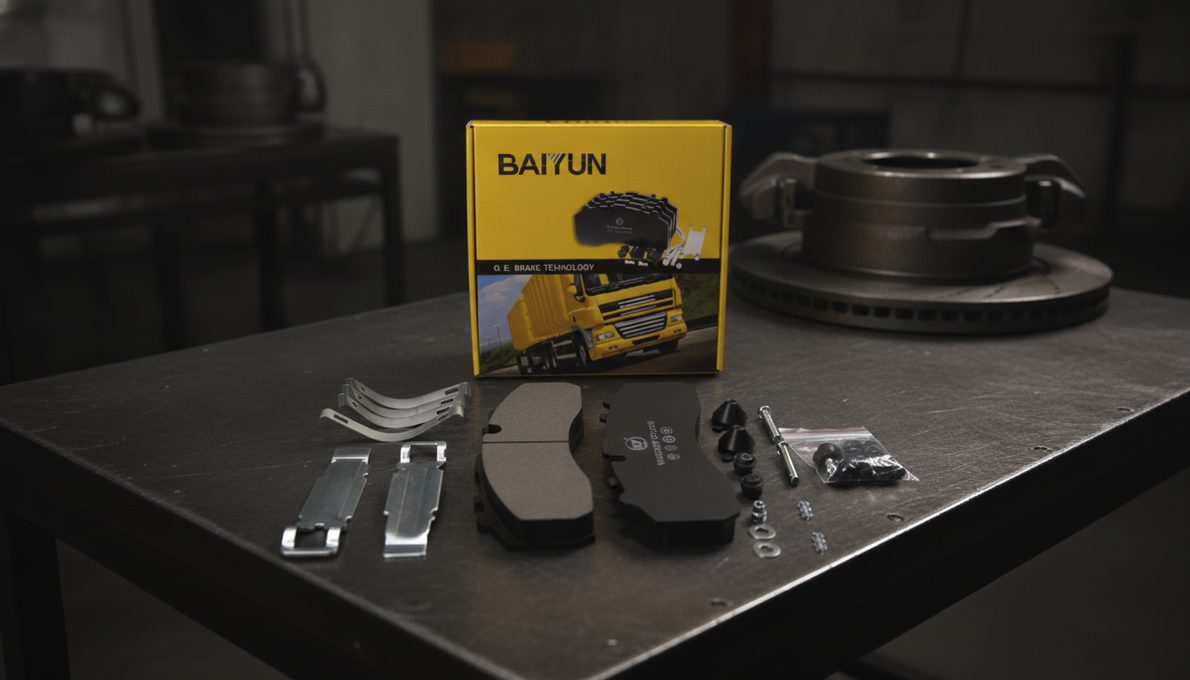
Quick answer: Most Chinese brake factories set a minimum order quantity (MOQ) between 500 and 2,000 sets for commercial vehicle pads. Standard lead time runs 25–45 days for production, plus 15–25 days ocean freight to major ports. Quality checks should verify IATF 16949 certification, ECE R90 approval, consistent friction coefficients across a full dynamometer report, and material homogeneity under SEM. Skipping these steps risks field failures and warranty claims that eat into your margin—fast.
Distributors and fleet managers sourcing truck brake pads from China walk a tightrope. Price advantages can hit 40–60% compared to domestic European or North American aftermarket brands, but a single batch with inconsistent friction material or dimensional drift can ground a fleet. You're not just comparing unit prices—you're vetting engineering data, audit trail, and a factory's ability to deliver the same pad 36 months from now.
We've spent 49 years on the factory floor at BAIYUN Brake. Over the decades, we've seen what trips up even experienced importers. This guide breaks down the real numbers, the must-check documents, and the sourcing habits that separate reliable supply chains from expensive mistakes.
Why Source Truck Brake Pads from China?
China now produces over 60% of the world's friction materials for commercial vehicles. The cluster effect in Shandong Province alone—where dozens of heavy-duty friction material producers operate within a 100 km radius—drives down raw material costs and machining overheads. You're not paying for a brand's marketing department; you're paying for the compacted powder, the steel backing plate, and the oven cycle time.
But the real edge isn't just the headline price. It's the ability to negotiate custom formulations, private label packaging, and delivery schedules that align with your fleet's PM cycle. A mid-sized truck distributor moving 3,000 sets a month can shave $12–$18 per axle set by switching from a global tier-2 brand to a verified IATF 16949 Chinese factory. Multiply that across a year, and you're looking at six figures saved.
Of course, the savings evaporate if the pads glaze at 350°C or crack after 15,000 km. That's why the next sections focus on verification, not just negotiation.
What Certifications Should a Chinese Brake Pad Factory Hold?
Two documents separate serious exporters from garage-level workshops: IATF 16949 and ECE R90. IATF 16949 demands a factory-wide quality management system covering everything from incoming raw material inspection to in-process SPC (Statistical Process Control) and traceability. An auditor physically inspects gauge calibration records, training logs for press operators, and the quarantine procedure for non-conforming lots. It's not a paper exercise—if a factory fakes data, the certification body revokes the certificate.
ECE R90, specific to Europe and many Middle Eastern and African markets, measures braking performance against a homologated original pad. The test runs cold and hot effectiveness stops, speed sensitivity trials, and a fade-and-recovery sequence on a full-scale inertia dynamometer. The regulation requires the replacement pad's performance to stay within 15% of the OE pad's deceleration. For commercial vehicle pads, this means surviving repeated stops from 60 km/h with a loaded axle weight—often 7.5 tonnes or more.
At IATF 16949 certified facility, we run ECE R90 cycles on every new compound before releasing it for serial production. Ask your supplier for the full dynamometer test report, not just the certificate. The report should list individual stop numbers, deceleration values, and temperature curves. If they hesitate, walk away.
What MOQ and Lead Time Should You Expect?
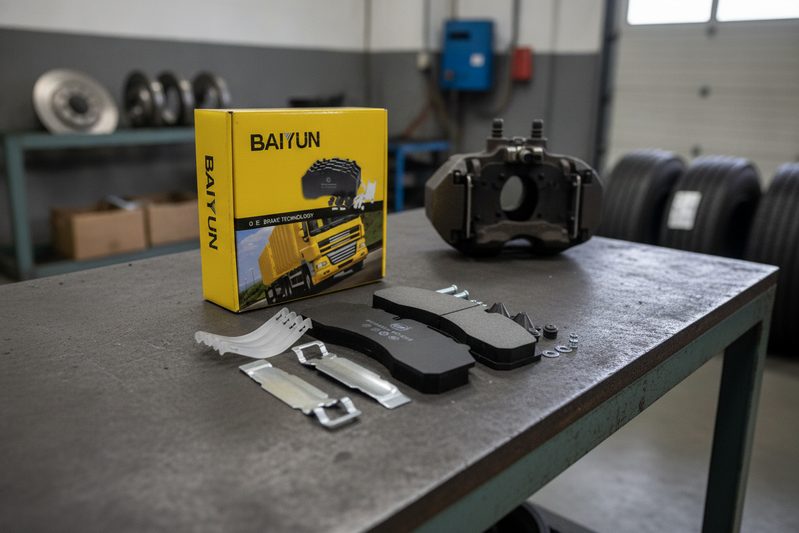
MOQ for commercial vehicle brake pads typically lands between 500 and 2,000 sets per SKU. Smaller factories may offer 300 sets for a premium, but you'll struggle with batch-to-batch consistency at that volume. For mixed-container orders (e.g., multiple pad references plus brake linings), many suppliers will combine items to reach a total container MOQ of around 5,000–8,000 sets.
Standard lead time breaks down like this:
- Raw material procurement: 7–10 days (steel backing plates, friction powder, hardware)
- Production (pressing, curing, grinding, scorching): 10–15 days
- Quality inspection and packaging: 3–5 days
- Ocean freight to Rotterdam/Hamburg/Los Angeles/Dubai: 15–25 days
Total: roughly 35–55 days from deposit to your warehouse. Factor in customs clearance and inland trucking—a conservative total is 8-9 weeks. If you need pads faster, some Chinese factories keep buffer stock of fast-moving truck references (WVA 29330, 29105, 19965, etc.), cutting production lead time to 7 days. Confirm with supplier catalogue for specific WVA availability.
We often advise first-time buyers to build a 12-week inventory buffer. That gives you wiggle room if the shipping line skips a port or China's Golden Week shuts factories for a week.
How Do You Verify Product Quality Before Shipment?
A pre-shipment inspection (PSI) is non-negotiable. Most factories agree to third-party inspection from agencies like SGS, TÜV, or Bureau Veritas for an extra $500–$800. The inspector should check:
- Dimensional accuracy on 200+ random pads against your approved drawing (backing plate thickness, flatness, ear width, slot position)
- Shear strength of the friction material under heat (cold shear ≥ 2.5 MPa is typical for trucks)
- Hardness uniformity (Gogan or Rockwell, within ±5 HRR across the sample)
- Visual defects: edge chipping, uneven scorch layer, rust on backing plate
- Packaging integrity: correct labels, shim kit inclusion, fitting kits if applicable
Beyond the PSI, request a production sample from the actual batch 10 days into production. Test it on your own dynamometer or send it to a third-party lab. Compare the friction coefficient (μ) across the temperature range—typically 0.35–0.45 for semi-metallic commercial pads. A spread wider than 0.10 between 100°C and 350°C should raise a red flag.
For commercial vehicle brake pads, you need the friction curve to hold steady under repeated heavy braking. One trick: ask the supplier to run a 500-cycle endurance test on a dynamometer. The μ should not drop below 0.30 after the test, and pad wear should stay under 0.5 mm.
What Are the Real Costs and Payment Terms?
Current FOB China pricing for truck brake pads (per set, front axle) in 2026 sits in these ranges:
| Pad Type | FOB Price Range (per set) | Typical Application |
|---|---|---|
| Semi-metallic economy | $4.50 – $8.00 | Light truck, trailer axles |
| Medium metallic performance | $8.00 – $14.00 | Heavy-duty truck, bus |
| Premium ceramic/low-met | $12.00 – $20.00 | High-speed bus, mining truck |
Payment terms for new buyers typically follow 30% T/T deposit, 70% before shipment. After a few successful orders, many suppliers shift to 30% deposit and 70% against scanned B/L copy. For orders above $50,000, consider a Letter of Credit (L/C) at sight—it adds bank fees but protects both sides. Don't accept 100% T/T upfront unless the supplier is a known entity you've audited in person.
Ocean freight for a 20GP container (roughly 1,200–1,500 sets of truck pads) from Qingdao or Shanghai to Europe runs between $2,800 and $4,200 depending on the season. Add 5–10% for BAF and insurance. You'll often find that mixed loads—combining wholesale CV brake linings inquiry with disc pads—optimize container utilization and reduce per-kg shipping cost.
Buyer Verification Checklist
Before signing a purchase order, run through this checklist. Every item should have a documented answer, not a verbal promise.
- IATF 16949 certificate: verify validity on the certification body's online database.
- ECE R90 test report: full dynamometer data, not just the certificate number, for the exact compound and backing plate combo.
- Production sample: test pads from the ongoing batch in your own lab or an accredited third-party lab.
- Dimensional measurements: 200-piece random sample checked against your engineering drawing with a CMM.
- Shear test: ISO 6312 or SAE J840, cold and hot shear values must meet your specification.
- Compressibility: ISO 6310—excessive compressibility leads to spongy pedal feel and longer stopping distances.
- Packaging and labeling: verify ECE R90 approval marks on every box, correct WVA number, batch traceability code.
If the supplier pushes back on any of these, reconsider the relationship. Quality problems compound fast once containers are on the water.
Frequently Asked Questions
Q: What is the typical MOQ for truck brake pads from China?
A: Most factories set MOQ at 500–2,000 sets per SKU. Mixed containers can combine multiple references to hit a total MOQ of around 5,000–8,000 sets.
Q: How long does it take from order to delivery?
A: Plan for 35–55 days: 25–30 days production plus 15–25 days ocean freight. Including customs clearance and inland transport, a realistic total is 8–9 weeks.
Q: Which certifications are essential for truck brake pads?
A: IATF 16949 for quality management and ECE R90 for performance compliance in most markets. Some Middle Eastern and African buyers also require SASO or SONCAP certification.
Q: Can I get private label packaging for my truck brake pads?
A: Yes. Most Chinese manufacturers offer OEM packaging with your brand logo, part number, and box design. MOQ for custom packaging usually adds a small surcharge or requires 2,000+ sets per design.
Q: How do I avoid quality problems when buying from a new supplier?
A: Always commission a pre-shipment inspection by a third party. Request production samples from the actual batch and test them in your own lab. Start with a trial order of 500–1,000 sets before committing to larger volumes.
Still worried about landing a bad batch? We've found that most issues trace back to skipping the dynamometer report or accepting a supplier's "standard" compound without specifying friction targets. Don't let that be your story.
Sourcing with Confidence
A truck brake pad bulk order from China doesn't need to feel like a roll of the dice. It's about front-loading the verification—seeing the dynamometer charts before the pads ship, not after. The factories that welcome such scrutiny are the same ones that will keep your rotors cool and your fleet on the road.
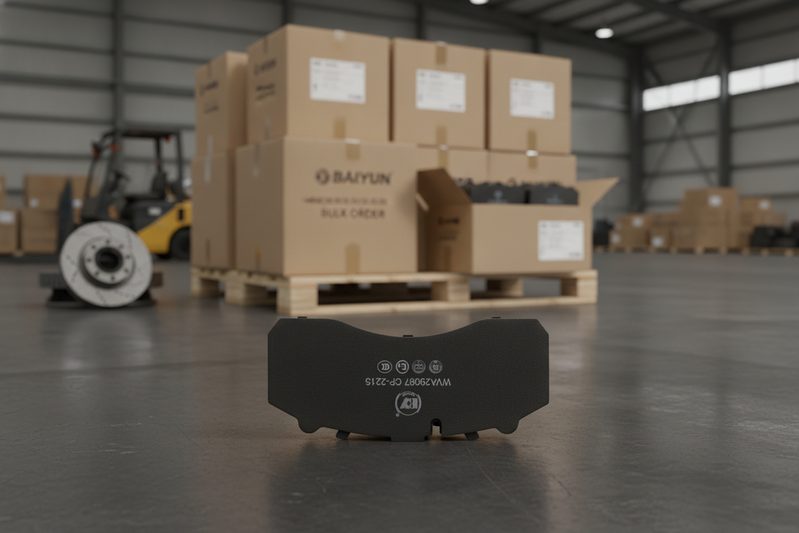
At BAIYUN Brake, our commercial vehicle pads ship to over 60 countries, backed by the same IATF 16949 system and ECE R90 testing that global fleets demand. We don't ask you to take our word for it—we share the test data. For a request a wholesale quote, our export team will prepare a tailored offer including current MOQ, lead time, and FOB pricing for your specific truck references.
If you'd like to review our full heavy-duty product range first, browse our heavy-duty brake pad range or download our product catalogue. We've put over four decades of friction science into every pad—and we're ready to prove it on your dynamometer.
This article was produced by the BAIYUN Brake editorial team, combining 49+ years of brake manufacturing expertise with current industry research. For product inquiries or technical questions, contact our team.
Was this article helpful?
Average Rating: 5/5 (549)