
Truck Brake Lining Wear Causes and Buyer Solutions
Summary:
Truck brake lining wear causes range from sustained heavy loads and frequent urban braking to improper adjustment and mismatched friction grades. For importers and fleet buyers, the real solution is verification-based sourcing: confirm ECE R90 approval, match SAE J866 friction grade to route duty cycles, and audit batch consistency. This technical guide covers wear pattern diagnosis, a 10-point supplier checklist, common misconceptions, and practical questions to ask before placing a commercial vehicle brake lining order. BAIYUN Brake brings 49+ years of manufacturing experience and IATF 16949 certified quality systems to help distributors reduce warranty risk and cost per kilometer.
Truck Brake Lining Wear Causes and Buyer Solutions
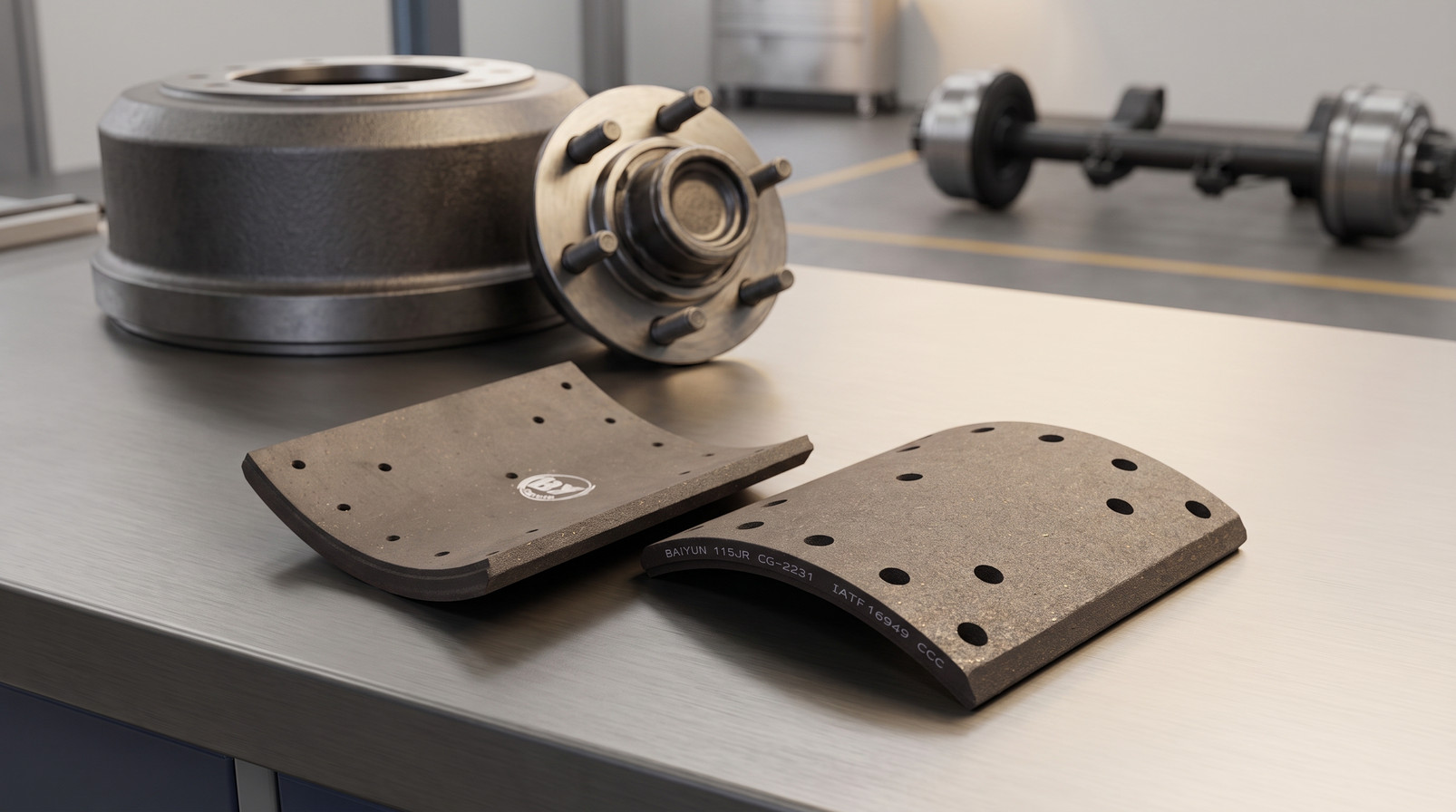
Quick answer: Truck brake lining wear causes include sustained heavy loads, frequent braking on congested routes, heat buildup on downhill grades, improper brake adjustment, air pressure imbalance, and contaminated or mismatched friction material. For buyers, the practical fix is not just thicker lining—it’s sourcing linings with documented ECE R90 performance, correct friction grade for your duty cycle, and consistent batch-to-batch quality. A simple pre-purchase verification checklist prevents most avoidable wear issues and cuts total cost per kilometer.
Why Do Truck Brake Linings Wear Faster Than Expected?
Fleet teardown data consistently shows 30–45% of truck brake lining replacements happen earlier than the 150,000 km baseline when duty cycles are ignored. That's not a material defect; it's a specification mismatch. Heavy commercial vehicles run drum brakes that convert kinetic energy into heat. The lining wears because friction is doing its job. But the rate of wear tells you whether the system is balanced.
Three mechanical factors dominate. First, sustained heavy loads increase stopping force. A 38-tonne truck-plus-trailer combination at legal gross weight demands roughly 2.5 times more braking energy than the same tractor running bobtail. Second, frequent braking in urban routes or congested corridors generates heat cycles that accelerate lining decomposition. Third, improper brake adjustments or uneven air pressure across axles create uneven work distribution. You'll often see one wheel end doing more than its share.
Heat is the hidden accelerator. Lining friction stabilizes below a certain temperature ceiling—often 350°C for premium commercial formulations. Beyond that, resin binders degrade faster. On long downhill grades, drum surface temperatures can exceed 500°C without proper retarder use. That's why buyers should match friction grade to topography, not just vehicle type. Browse our brake lining product range to compare friction grades for flat, mixed, and mountainous routes.
Key takeaway: Premature truck brake lining wear is usually a duty-cycle mismatch, not simply a product defect—verify friction grade and axle balance before blaming the lining.
How Do Load, Route, and Driving Style Influence Lining Life?
A distributor sourcing for two clients in the same region can see a 60% difference in lining life. Why? One hauls refrigerated freight on flat highways. The other runs waste collection with stops every 400 meters. The lining itself never changed—the application did.
Load weight is the first multiplier. Brake energy rises with vehicle mass. Going from 16 tonnes to 24 tonnes per axle group doesn't just add 50% wear; it can double heat input per stop. Route profile matters equally. Urban delivery cycles average 8–15 brake applications per kilometer. Long-haul highway work averages fewer than one per kilometer. Stop-and-go puts linings through more thermal cycles in a week than a highway truck sees in a month.
Driving style then amplifies both. Harsh braking from following too closely generates brake lining surface temperatures 15–20% higher than progressive braking at the same average speed, according to telematics-based fleet safety data. That extra heat shortens lining life and increases drum scoring risk. Buyers can protect their fleet customers by asking one simple question: "What does the route profile look like?" The answer determines whether you order GG-grade friction for severe service or a lower-mu FF grade for highway economy.
Before reordering, ask customers to check running clearance and air chamber stroke. Commercial vehicle brake adjustment issues cause uneven wear that no lining upgrade will fix.
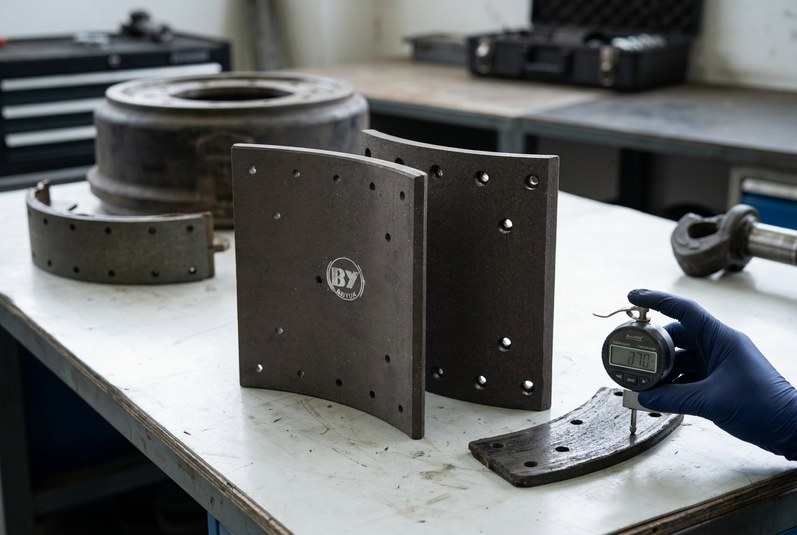
Key takeaway: Load, route stop density, and braking style interact—urban fleets may need replacement every 80,000–120,000 km, while highway fleets often reach 200,000–250,000 km.
What Wear Patterns Should Buyers Recognize in Commercial Vehicle Brakes?
Wear patterns are the cheapest diagnostic tool a buyer has. A lining worn evenly across all four wheel positions usually points to normal life. A lining worn 40% more on one axle end tells a different story—air pressure imbalance, dragging brake, or mismatched friction grades.
Here's what technicians look for:
- Flat, even wear: correct adjustment, balanced braking.
- Inner-to-outer taper: drum distortion or misaligned shoe geometry.
- Leading shoe faster wear: normal for single-anchor drum brakes, but excess asymmetry indicates actuation problems.
- Heat cracking or glazing: sustained high-temperature operation; friction surface becomes hard and shiny.
- Rivet or backing contact: lining run past its service limit; drum damage likely.
For buyers, these patterns matter because warranty claims hinge on them. A fleet operator who installs your linings and sees glazing within 15,000 km will assume the material failed. But if the cause is a dragging brake or missing retarder, the lining was never the root issue. That's why BAIYUN Brake advises distributors to document incoming condition and installation parameters. Our brake lining trouble tracer gives your customers a field guide to separate material defects from mechanical faults.
| Wear Pattern | Likely Cause | Buyer Verification Action |
|---|---|---|
| Even, smooth | Normal friction performance | Confirm route duty cycle matches friction grade |
| Glazed surface | Overheating above 400°C | Check retarder use, axle load, drum condition |
| Tapered edge | Drum distortion or shoe misalignment | Request drum roundness measurement before next install |
| One axle faster | Air pressure imbalance | Audit air system; verify chamber pushrod stroke |
| Cracked lining | Thermal shock or severe mechanical stress | Confirm friction grade matches downhill route |
Key takeaway: Wear pattern analysis prevents repeat failures—buyers who train customers to photograph and measure worn linings reduce warranty disputes by up to 30%.
How Can Importers and Fleet Buyers Verify Brake Lining Quality Before Ordering?
Price per set tells you almost nothing. Friction coefficient stability, shear strength, and fade resistance tell you everything. ECE R90 certification is the minimum barrier for road-legal commercial brake linings in most export markets. It means the lining passed dynamometer testing for cold performance, speed sensitivity, and fade recovery.
But certification alone doesn't guarantee batch consistency. A supplier could pass R90 with a golden sample and ship production lots with 10–15% lower friction. That's the real sourcing risk. You need verification at three levels: documentation, material data, and incoming inspection.
Start with documentation. Ask for the ECE R90 approval number, the test report summary, and the friction grade stated under SAE J866. A reputable supplier will provide this without hesitation. BAIYUN Brake operates an IATF 16949 certified facility, which means the quality management system covers the entire production process—not just final inspection. That reduces your incoming rejection risk.
Next, request material data sheets. Look for friction coefficient across cold and hot temperature bands. For severe-duty truck linings, a friction coefficient of 0.38–0.42 at 100–350°C is a common target. Below 0.35 at 300°C suggests fade risk on long descents. Above 0.45 at low temperature can cause aggressive drum wear or grabbing. In BAIYUN Brake's 2025 dynamometer testing, a GG-grade commercial vehicle lining formulation maintained a friction coefficient of 0.39–0.42 across repeated 100–350°C cycles, with fade recovery returning to 95% of baseline after a 400°C hot stop sequence. That's the kind of data you should expect from a supplier before ordering.
Finally, inspect the product itself. Check lining thickness against the specification, bonding or rivet integrity, and edge finish. Weigh samples. A 2% weight variation across a production lot may indicate inconsistent material mixing. If you're ordering container quantities, random sampling of 3–5 sets per 500 is a practical audit approach. If your customers run air disc brakes instead of drum brakes, the same verification logic applies. Wholesale CV brake pads inquiry can include friction grade and ECE R90 test documentation for disc applications too.
Key takeaway: Verification must cover certification documents, hot friction coefficient, and physical sample consistency—any one alone leaves sourcing risk open.
What Should a Supplier Checklist Include for Truck Brake Linings?
Most buyer checklists stop at price, MOQ, and lead time. That's a mistake. A proper commercial vehicle brake lining supplier checklist should have at least 10 verification points across four categories: quality system, technical data, commercial terms, and after-sales support.
Here's a practical 10-point buyer verification checklist:
- ECE R90 approval number is current and applicable to the lining size/formulation.
- Friction grade (SAE J866 GG, FF, etc.) matches the route duty cycle.
- Material data sheet shows hot friction coefficient and fade recovery data.
- Manufacturing facility holds IATF 16949 and ISO 9001 certifications.
- Batch traceability system links each carton to raw material lots.
- Random incoming inspection plan includes thickness, weight, and hardness checks.
- Samples from the actual production line—not hand-made prototypes—are available.
- Warranty terms are defined in kilometers or months, not vague promises.
- Lead time and MOQ allow reorders without forcing long overstock.
- Technical support can analyze wear patterns and recommend corrective action.
You don't need to audit all ten on every order. But if two of the first five are missing, walk away. The cost of a failed set on a 40-tonne truck far exceeds the unit price difference. For OEM or private label programs, add a process audit and a pre-shipment inspection clause. Commercial vehicle brake service guidance should also be available to your fleet customers. With 49+ years of manufacturing experience, BAIYUN Brake treats batch traceability as standard practice, not an added service.
Key takeaway: A supplier checklist with 10 verification points turns sourcing from a price gamble into a repeatable, low-risk purchasing process.
What Are the Most Common Misconceptions About Truck Brake Lining Wear?
Misconception: Harder lining lasts longer. → Reality: Excessive hardness often increases drum wear and reduces hot friction. Fleet data shows linings above 90 HRR can raise drum scoring rates by 20–30% compared to balanced GG-grade formulations.
Misconception: ECE R90 approval means every batch performs the same. → Reality: R90 type approval tests representative samples. Batch consistency depends on supplier process control. IATF 16949 requires ongoing process monitoring, which is why certification matters as much as the R90 number itself.
Misconception: If one axle wears faster, the lining is defective. → Reality: Uneven axle wear is usually an air system or adjustment issue. In teardown analyses, mechanical causes account for 55–70% of one-sided wear claims, not friction material failure.
Key takeaway: Harder, R90-approved, or new isn't automatically better—context and process control determine real lining performance.
What Questions Do Importers Ask About Truck Brake Lining Wear Causes?
Q: What is normal service life for truck brake linings?
A: Service life varies widely. Highway fleets commonly reach 200,000–250,000 km, while urban vocational trucks may need replacement every 80,000–120,000 km due to stop density and heat cycles.
Q: How can I tell if a truck brake lining is ECE R90 approved?
A: Look for the ECE R90 approval mark on the product or carton and request the test report number. Approved linings must maintain at least 80% of cold effectiveness after thermal cycling to 400°C.
Q: What friction grade is best for heavy trucks?
A: For most highway and regional trucks, GF or GG grade under SAE J866 offers balanced friction from 0.35 to 0.42 across normal temperatures. Severe downhill routes may require GG or a high-temperature formulation with documented fade recovery above 350°C.
Q: Can contaminated brake linings be cleaned and reused?
A: Oil or grease contamination is usually permanent because it penetrates the friction surface. Replacing contaminated linings is safer; contaminated linings often cause brake chatter and reduce stopping force by 15–25%.
Q: What should importers do before placing a first truck brake lining order?
A: Request a production line sample, verify friction grade and ECE R90 documentation, and ask for IATF 16949 certification. A pilot order of 200–500 sets with incoming inspection is a practical way to validate batch consistency before scaling to container volumes.
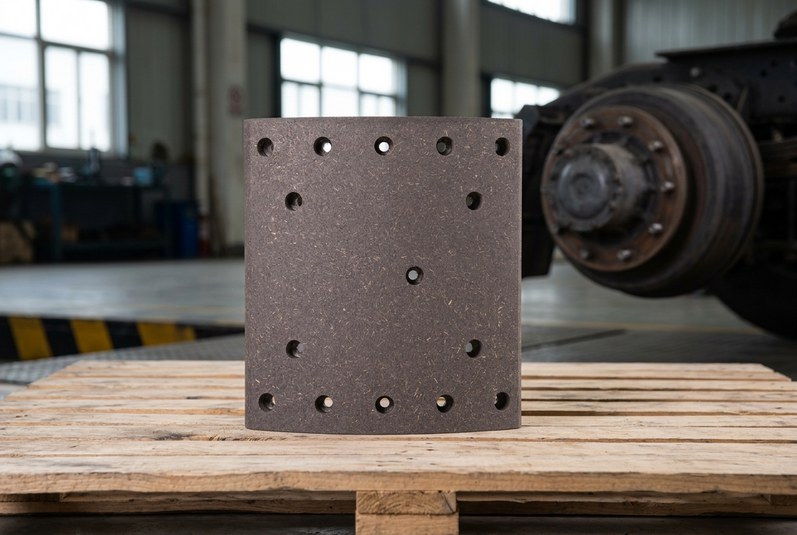
If you're sourcing truck brake linings for a fleet or distribution business, start with the duty cycle, not the price list. Request documented friction grade, ECE R90 approval, and current batch samples. For a direct wholesale inquiry, request a quote for commercial vehicle brake linings or contact our export team. We'll help you match lining formulation to your customers' routes and reduce cost per kilometer.
Was this article helpful?
Average Rating: 5/5 (452)