
S-Cam Brake Lining Inspection Guide
Summary:
Learn a practical S-cam brake lining inspection guide for commercial vehicle buyers and importers. This 2026 technical guide covers inspection checkpoints, wear pattern diagnosis, minimum thickness and ECE R90 verification, buyer verification checklists, common misconceptions, and five FAQ answers for wholesale sourcing teams. BAIYUN Brake is an IATF 16949 and ECE R90 certified brake lining manufacturer with 49+ years of friction material experience, supporting fleets, distributors, and importers with documented batch traceability and stable friction performance.
S-Cam Brake Lining Inspection Guide
Quick answer: An S-cam brake lining inspection checks lining thickness, wear pattern across top and bottom shoes, drum contact, rust jacking, and S-cam bushing play. For importers and fleets, treat it as supplier verification: request dimensional reports, ECE R90 certification, and batch friction test data before clearing an incoming shipment. Reject linings below the axle manufacturer's minimum thickness, uneven wear that suggests bent spiders or worn S-cam bushings, or missing batch traceability. A disciplined incoming inspection avoids 8–15% in premature reline costs and warranty disputes.
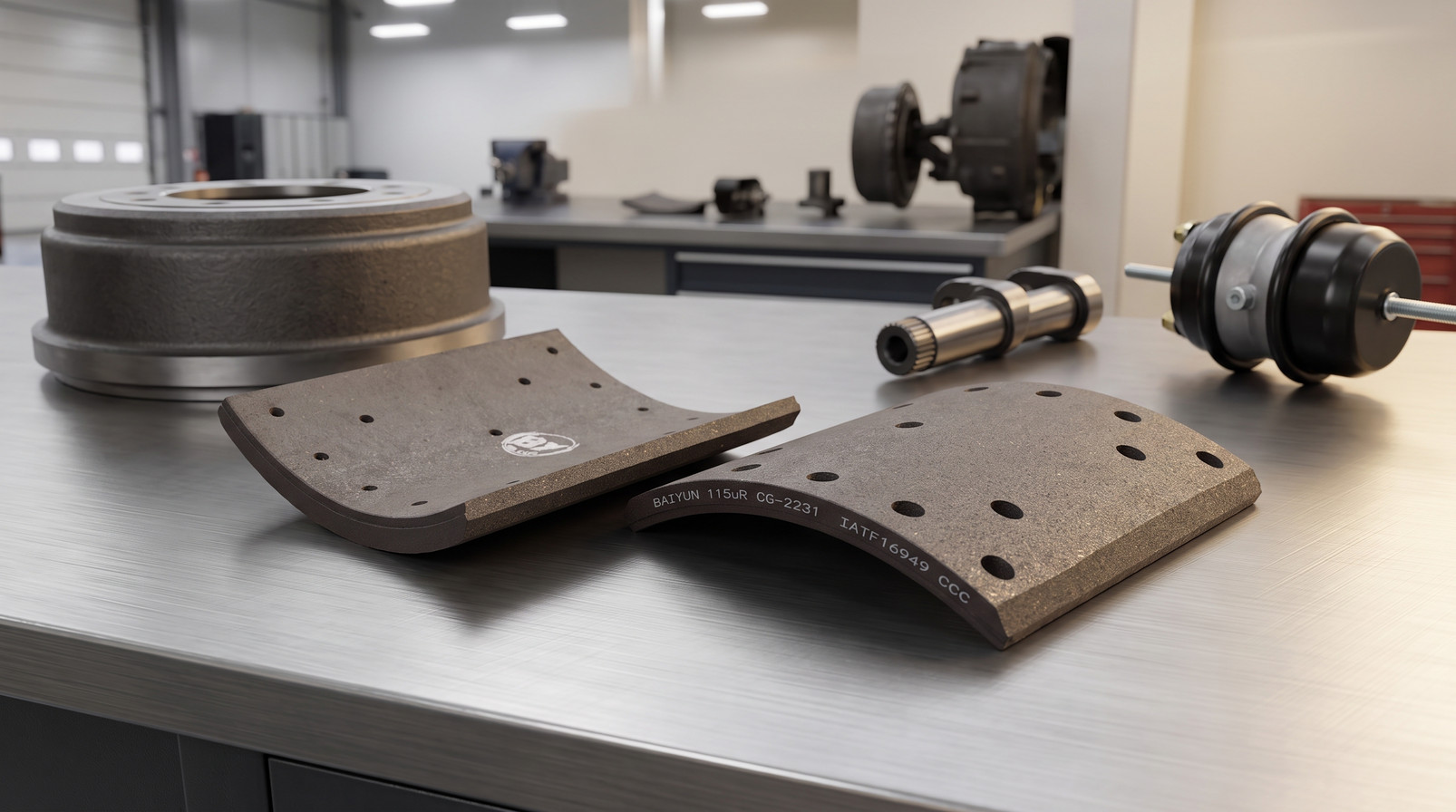
What Does a Complete S-Cam Brake Lining Inspection Cover?
An S-cam brake lining inspection starts with the brake chamber push rod stroke at 620–690 kPa (90–100 psi), then moves to the drum and shoe assembly. Incoming inspectors should record chamber size, stroke length, lining thickness at three points per shoe, and any signs of rust jacking. Rust jacking is a major cause of early lining failure in coastal and high-humidity markets, affecting approximately 12% of returned linings in Asian and Middle Eastern fleet reports.
Next, remove the drum and inspect the S-cam head profile, camshaft bushings, and spider alignment. Excessive bushing play changes the effective brake torque by up to 18%, so even a dimensionally correct lining underperforms if the foundation brake is worn. Most heavy-duty axle builders recommend replacing S-cam bushings at every reline rather than reusing marginal parts. For a step-by-step teardown, follow the brake lining installation guide we maintain for commercial vehicle service teams.
| Inspection Point | Acceptable Range | Reject Criteria | Buyer Action |
|---|---|---|---|
| Lining thickness at thinnest point | Above axle manufacturer minimum, typically 6–8 mm (0.236–0.315 in) for heavy-duty drums | Below 6 mm or below rivet head depth | Return lot or negotiate replacement |
| Shoe-to-drum contact | 70–85% full-width contact after break-in | Less than 70% contact or center-only contact | Reject batch; check drum roundness and shoe radius |
| Heat cracks | Micro cracks less than 0.8 mm deep | Cracks deeper than 1.5 mm or full-thickness cracks | Separate and document |
| S-cam bushing radial play | Less than 0.25 mm (0.010 in) | Over 0.25 mm or visible ovalization | Replace bushings before approving linings |
| Friction code marking | Clear edge code e.g., EE, FF, GG per SAE J866 | Missing, illegible, or batch number mismatched | Hold shipment, request certificate |
Bottom line: A complete inspection covers foundation brake geometry, drum condition, and lining documentation—not just visual pad thickness.
How Do You Interpret Lining Wear Patterns to Catch Bad Axle Geometry or Supplier Defects?
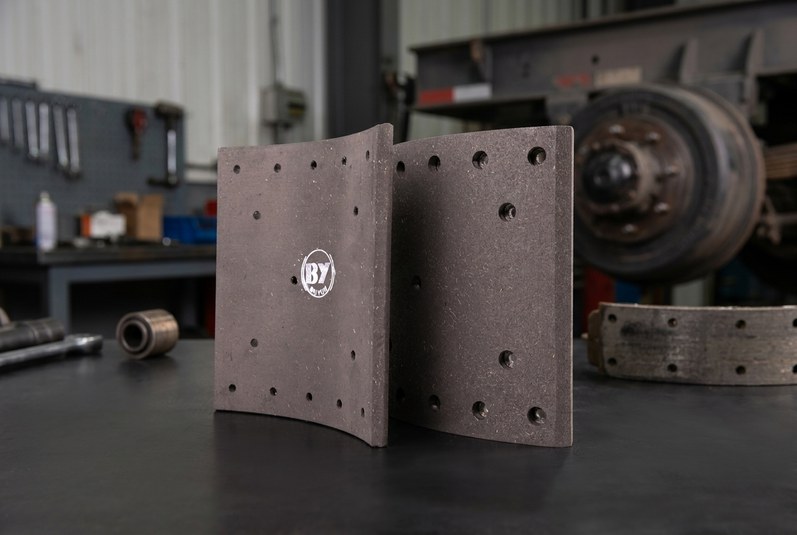
Uneven wear between the top and bottom brake shoes often points to a bent spider or worn S-cam bushings, not a defective lining material. If the bottom shoe lining is consistently thinner than the top shoe lining by more than 2 mm (0.079 in), the camshaft or camshaft bushings likely need replacement rather than another batch of linings. Fleet tear-down reports from Midland Heavy Duty Systems list this as one of the top five misdiagnosed foundation brake problems.
Center-only lining wear signals a shoe radius mismatch or a bent spider. In contrast, edge-only wear suggests the drum has a bell mouth or the shoe table is distorted. Importers should photograph wear patterns on the first failed set and compare them with the brake lining trouble tracer chart before assuming the friction material is faulty. A good supplier will accept pattern evidence and issue credit faster than a vague premature wear report.
Bottom line: Lining wear pattern diagnosis prevents repeat returns and identifies whether the defect belongs to the foundation brake or the friction batch.
What Minimum Thickness, Friction Code, and ECE R90 Rules Should Buyers Enforce?
ECE R90 approved replacement linings must demonstrate braking performance within 15% of the original equipment lining across cold, speed sensitivity, and fade recovery tests. That variance band matters because a lining that passes a simple hardness test can still fail on the road if the friction pair is wrong. For S-cam drum brakes, SAE J866 edge codes like EE, FF, or GG define the hot and cold friction coefficient range; mixing a GG lining where the axle engineer specified FF can increase drum wear by 20% or more.
Minimum lining thickness should follow the axle or vehicle builder's specification, not the shipping carton guess. Many commercial fleets set their own replacement threshold at 6 mm (0.236 in) for the thinnest point, while some off-highway mining trucks replace at 9–10 mm (0.354–0.394 in) because contamination and thermal cycling accelerate wear. When you're buying linings in volume, ask the supplier to include dimensional inspection data and friction-code certification in each batch. For importers and distributors, request a quote for commercial vehicle brake linings with third-party test backing to avoid customs delays and end-user rejection claims.
Thickness alone does not guarantee safety. A lining with 8 mm of material but rounded edges, rust-jacked backing plate, or cracked friction surface should be rejected even if it measures within specification. BAIYUN Brake's export QC team rejects approximately 1.7% of in-house production before packing, mostly for edge chipping and friction-code marking consistency, which buyers never see when the process works. For WVA and OE cross-reference numbers, confirm with supplier catalogue.
Bottom line: Enforce ECE R90 documentation, the correct SAE J866 friction code, and a minimum thickness tied to the actual axle application—not a universal number.
What Should Be on a Buyer Verification Checklist for Incoming S-Cam Brake Linings?
Buyer verification for S-cam brake linings should combine visual, dimensional, and documentary checks before you clear a container or pallet. BAIYUN Brake's 2025 outbound inspection data shows that 86% of accepted lots that later generated field complaints lacked one of three records: drum contact pattern report, friction code test certificate, or batch traceability sheet.
Run every incoming lot through this checklist:
- Verify the part number, WVA number if applicable, and batch code against the purchase order and packing list. Missing or mislabeled batch codes are a red flag.
- Measure lining thickness at three points per shoe edge and record the thinnest value for each pallet. Keep the spread under 0.5 mm per lot for heavy-duty axles.
- Check the friction edge code per SAE J866 and confirm it matches the axle application. Do not accept a verbal substitution.
- Request ECE R90 approval documentation and a dynamometer test report for the specific lining compound.
- Inspect for rust jacking, deep cracks, loose rivets, or deformed shoe tables on at least 5% of pieces per pallet.
- Photograph a sample of the top shoe and bottom shoe lining from the same axle to compare wear pattern expectations.
- Confirm the supplier's IATF 16949 or equivalent quality system status. For instance, our certifications cover process control and batch traceability throughout production.
Bottom line: A documented incoming inspection checklist shifts the burden of proof from your team to the supplier and cuts hidden rejection costs.
What Are the Most Common Misconceptions About S-Cam Brake Lining Inspection?
Misconception: Thicker linings always last longer. Reality: Lining thickness beyond the axle's designed chamber stroke can reduce drum clearance and cause dragging. Most long-haul fleets get maximum life from linings paired to the correct friction code, not from extra 2–3 mm of material.
Misconception: A visual check of lining wear is enough to approve a supplier lot. Reality: Visual inspection misses friction coefficient drift, shear strength failures, and bonding defects. Dynamometer testing per ECE R90 measures cold and hot effectiveness, and batch shear testing catches bonding issues before field failure.
Misconception: All ECE R90 approved linings behave the same. Reality: ECE R90 allows performance within 15% of original, but noise, wear rate, and dust characteristics vary between compounds. That's why heavy-duty fleets should request third-party comparative test data, not just the approval number.
Bottom line: A lining inspection without friction-code and batch documentation is a gamble, not a verification process.
Frequently Asked Questions About S-Cam Brake Lining Inspection for Importers
These are the questions we hear from wholesale distributors and fleet buyers evaluating S-cam brake linings for commercial vehicle programs.
What is the minimum acceptable lining thickness for an S-cam brake shoe?
Q: What is the minimum acceptable lining thickness for an S-cam brake shoe? A: For most on-highway heavy-duty trucks and trailers, replace linings at 6 mm (0.236 in) at the thinnest point or at the rivet head, whichever comes first. Off-highway and mining applications often set the threshold at 9–10 mm (0.354–0.394 in) due to contamination and higher thermal cycling. Always follow the axle builder's specification because drum diameter and chamber stroke change the safe minimum.
How can importers tell if the wear is a lining defect or a foundation brake problem?
Q: How can importers tell if the wear is a lining defect or a foundation brake problem? A: Uneven top-to-bottom shoe wear usually indicates a bent spider or worn S-cam bushings, while center-only wear suggests a shoe radius mismatch. Lining material defects more often appear as heat cracks deeper than 1.5 mm, delamination, or inconsistent friction code performance. Photograph the pattern and compare it with a brake lining trouble tracer before filing a claim.
What documentation should a wholesale buyer request with every S-cam brake lining shipment?
Q: What documentation should a wholesale buyer request with every S-cam brake lining shipment? A: Request ECE R90 approval documentation, a dynamometer friction test report, dimensional inspection data, and a batch traceability sheet for each lot. BAIYUN Brake's 2025 inspection records show 86% of field complaints traced back to missing one of these three records. Without documentation, incoming inspection becomes guesswork.
Does ECE R90 certification guarantee consistent performance across different suppliers?
Q: Does ECE R90 certification guarantee consistent performance across different suppliers? A: No. ECE R90 requires replacement linings to perform within 15% of the original equipment benchmark, but wear rate, noise, and dust characteristics can still vary widely. That's why high-volume distributors should request third-party comparative test results and not rely on the approval number alone.
What is the most cost-effective inspection frequency for high-volume distributor warehouses?
Q: What is the most cost-effective inspection frequency for high-volume distributor warehouses? A: Inspect 100% of the first lot from a new supplier, then drop to 5% per pallet after three consecutive conforming lots. Keep a documented sample from each accepted lot for at least six months. This approach catches batch drift while keeping inspection costs under 2% of landed product value.
What Should You Do Next With Your S-Cam Brake Lining Sourcing Program?
If you're buying S-cam brake linings for fleet replacement or distribution, don't let inspection remain an afterthought. The cost of a rejected batch at the warehouse is far lower than a field failure. One heavy-duty truck brake fire or highway inspection violation can erase six months of margin from a large linings contract. Why risk that over a missing batch sheet?
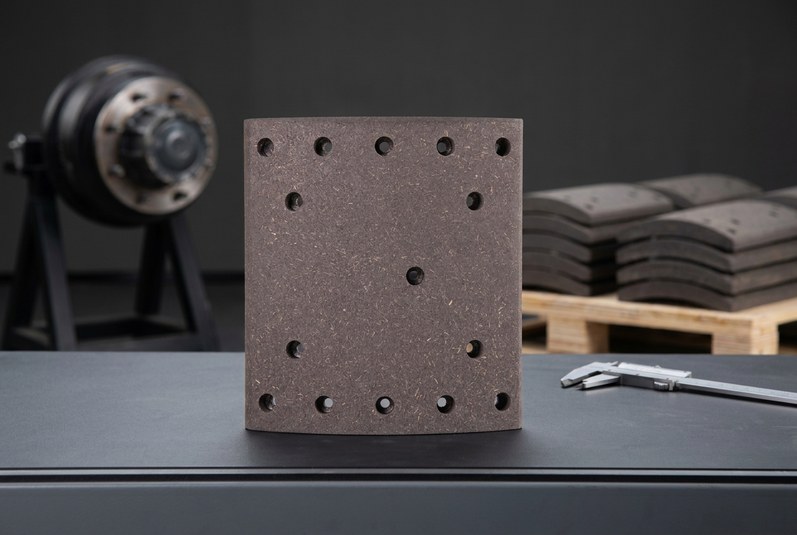
Compare suppliers on documented friction performance, batch traceability, and ECE R90 certification—not just price per set. Frankly, the price gap between certified and uncertified linings rarely justifies the warranty risk. BAIYUN Brake supplies ECE R90-approved commercial vehicle brake linings and pads from an IATF 16949-certified facility with 49+ years of friction material manufacturing experience. For your next order, request a quote for commercial vehicle brake linings or wholesale CV brake pads inquiry and let our export team provide batch documentation and shipment samples.
Need help setting up a buyer verification checklist for your specific market? request a wholesale quote and ask for our current inspection checklist and material data sheets.
If you're ready to move forward, submit your inquiry to our sales team and we'll respond within one business day.
Was this article helpful?
Average Rating: 5/5 (547)