
Truck Brake Lining Supplier Guide: Selection, Testing and Cost Control
Summary:
When searching for a reliable truck brake lining supplier, buyers must look beyond price and verify ECE R90/IATF 16949 certifications, material test data, and production capability. This guide covers supplier qualification, testing standards (SAE J2522, GB 5763, ISO 6312), and practical cost-control tactics. Learn how to negotiate MOQ, avoid quality pitfalls, and secure OEM/private-label brake lining supply for commercial vehicles from a manufacturer with 49+ years of experience.
Truck Brake Lining Supplier Guide: Selection, Testing and Cost Control
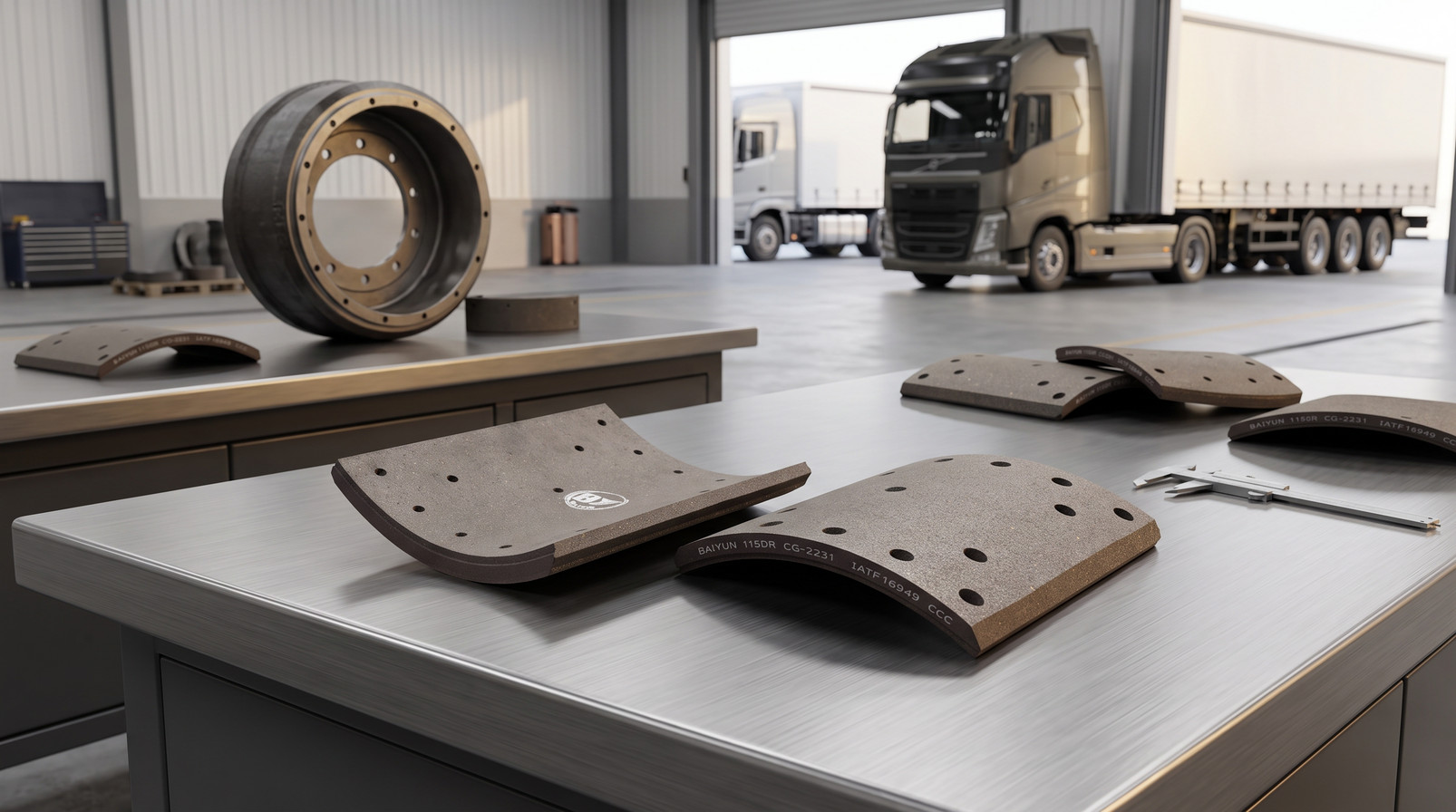
Quick answer: Finding a reliable truck brake lining supplier isn't just about the lowest price—it's about verifying ECE R90 or SAE J2522 certification, checking material consistency batch to batch, and confirming the supplier's ability to serve fleets or distributors with OEM-grade quality. In 2026, after several high-profile brake failure incidents in Europe and North America, buyers are shifting to suppliers with IATF 16949-certified production, full test traceability, and local stock support. Below we break down the supplier qualification process, testing standards that matter, and cost-control tactics used by professional importers.
What Are the Real-World Challenges When Switching Suppliers?
Ever inherited a parts list from a previous fleet manager and found yourself stuck with a single-source brake lining supplier? That's how many distributors and transport companies end up overpaying—without knowing if there's a better option. The fear of switching is real: inconsistent friction levels, mismatched drum fit, or a wave of driver complaints about noise and grab.
A large Latin American distributor we worked with last year had exactly this problem. Their legacy supplier delivered linings that cracked at the rivet holes within 30,000 km. When they tested a batch of BAIOYUN commercial vehicle brake linings, the difference wasn't dramatic in terms of price, but the wear life jumped by 22% based on telemetry from 20 identical trucks. The key was the material formulation—a semi-metallic compound with a consistent friction coefficient of 0.36-0.42 across the 100-300°C range.
The point? A good truck brake lining supplier doesn't just sell you boxes; they'll provide the test data that proves your linings won't disintegrate on steep descents. Don't skip the part where you ask for that data.
Certifications That Separate Professional Suppliers from Trading Companies
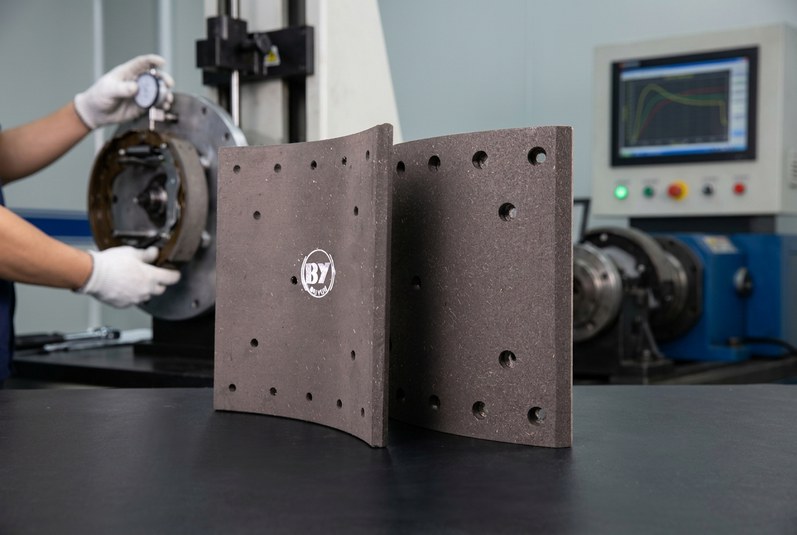
If you ask ten Chinese manufacturers for a brake lining quote, nine of them will say "we have ISO 9001." That's a minimum. For heavy-duty trucks, the real differentiators are ECE R90 certification (mandatory for Europe) and IATF 16949 (automotive quality management). A supplier holding both, like BAIYUN Brake, has proved they can produce at consistent quality levels over time.
And then there's SAE J2522—the AK Master test. This isn't a pass/fail certification; it's a protocol that measures friction coefficient stability across different temperatures, speeds, and pressures. If your supplier can show you an AK Master test report with a friction level deviation below 15% across the entire curve, you're dealing with serious material engineering.
In some regions, like India or the Middle East, buyers often request linings meeting GB 5763 (China's national brake standard). While GB 5763 sets minimum performance thresholds, it doesn't require the same third-party consistency verification as ECE R90. So for export, ECE R90 remains the strongest buyer safeguard.
How to Verify the Quality of Truck Brake Linings Before Placing a Bulk Order
Checking a few sample linings with a magnet and a scale isn't enough. Here's a verification checklist that professional importers use:
- Third-party test reports: Ask for a copy of the ECE R90 approval certificate and the corresponding dynamometer test results for your specific part numbers.
- Material data sheet: The lining compound should list at least 15-20 ingredients, not just "semi-metallic." Look for the presence of aramid fiber, carbon fiber, and specific mineral fillers—cheap linings skip expensive fibers and rely on barium sulfate alone.
- Batch shear strength test: Per ISO 6312, the bond between lining and shoe must exceed 2.5 MPa. Request the batch release test for the batch you'll receive—not a generic certificate.
- Wear indicator and chamfer design: For fleets, mechanical wear indicators cut downtime. Verify the design matches your application: some linings have angled chamfers to reduce noise during bedding-in, while others are squared for maximum initial bite.
- Third-party inspection: Hire a local inspector (SGS, Bureau Veritas) to witness loading or run a random pull test—costs about $500, but can save $10,000 in defective returns.
Testing Standards That Matter for Fleet Buyers
| Standard/Test | What It Actually Measures | Why It Matters in Sourcing |
|---|---|---|
| ECE R90 | Performance equivalence to OE; cold effectiveness, speed sensitivity, temperature recovery | Legal requirement for European trucks; without it, insurance claims after brake failure can be denied. |
| SAE J2522 (AK Master) | Friction coefficient µ across 15 test sections: cold, city traffic, mountain descent, high temperature | Shows if the lining will still stop the truck when hot. A flat µ curve is a sign of quality. |
| ISO 6312 | Shear strength of lining material and bond | Predicts delamination risk; critical for drum brake shoes where rivets may tear through a weak lining. |
| GB 5763 | Baseline friction and wear under controlled conditions | Minimum quality filter for Asia-bound shipments; not sufficient alone for export to regulated markets. |
| SAE J866 | Friction coefficient edge code rating (e.g., FF, GG) | Quick cross-reference; but verify actual µ values—some manufacturers stretch the rating with borderline tests. |
How to Negotiate MOQ, Lead Time, and Logistics Without Getting Burned
Here's a scenario we hear a lot: a distributor wants to test a new truck brake lining supplier with a trial order of 200 sets. The supplier quotes a 500-set MOQ and a 45-day lead time. That kills the deal. But here's the thing—MOQs are often negotiable if you're willing to accept a slightly higher unit price for the first order, or if you agree to cover tooling for a new shoe profile.
At our IATF 16949 certified facility, we keep a stock buffer of popular references (e.g., Volvo, Scania, Mercedes-Benz truck brake shoes) to ship within 15 days for repeat orders. For new OEM private-label projects, tooling takes 30-45 days, but we often run a small pre-series at no extra cost to verify fitment before the mass run.
Logistics-wise, always ask for a DAP incoterm if you're not a shipping expert—that way, the supplier handles freight and insurance up to your warehouse. Sea freight from Shanghai to Rotterdam is hovering around $2,800 per 20-foot container in mid-2026, so build that into your landed cost.
What Are the Most Common Misconceptions About Brake Lining Quality?
Misconception: All ECE R90 linings perform the same.
Reality: The ECE R90 test certifies equivalence within a ±15% tolerance band compared to the OE reference. That's wide. Two ECE R90 linings from different suppliers can deliver noticeably different pedal feel and lining life—one might give 120,000 km, the other 80,000 km under the same route profile.
Misconception: Higher friction is always better.
Reality: Friction above 0.50 on a drum brake shoe can lead to aggressive drum wear, thermal cracking, and wheel lock at low speeds on empty trailers. The ideal range for truck linings is µ 0.35-0.45, balancing stopping power with lining and drum longevity.
Misconception: Branded truck brake linings from Europe are always made in Europe.
Reality: Global brands routinely source from Asian manufacturers under private label agreements. What you're paying for is the quality control layer, not the geography. By sourcing directly from a truck brake lining supplier with the same certifications, you can cut 30-40% off the landed cost without sacrificing quality—but only if the supplier has genuine third-party audits.
Frequently Asked Questions from Distributors and Fleet Managers
Q: What certifications should I absolutely demand from a truck brake lining supplier?
A: At minimum, ECE R90 for European markets or SAE J2522 test data for North American acceptance. The supplier should also hold IATF 16949 for consistent manufacturing quality. Don't accept "ISO 9001 only" as sufficient for heavy-duty applications where brake failure can kill.
Q: How do I know if a Chinese brake lining factory can support OEM or private-label programs?
A: Look for presence of an R&D lab with a Krauss or Link dynamometer, a mixing facility for in-house compound development, and experience with multiple shoe core profiles. Ask for photos of their shoe-core stamping dies. If they buy pre-mixed compounds and weld generic shoes, they're probably not capable of custom programs.
Q: What's a realistic MOQ for the first trial order?
A: For standard references, 100-200 sets is reasonable if the supplier has stock. For new private-label designs, expect 500-1000 sets because the fixed costs of tooling and compound preparation have to be amortized. Some suppliers, including BAIYUN Brake, offer smaller pre-series runs for fitment validation before committing to mass production.
Q: How can I verify that the brake linings I receive will perform on long highway descents?
A: Request the AK Master test report (SAE J2522) specifically for sections covering mountain descent (fade test). The friction coefficient should not drop below 0.25 at the highest temperature point. If the supplier can't provide this data, you're gambling.
Q: What logistics problems cause the most claims with imported brake linings?
A: Corrosion from sea moisture is the top issue. Ensure your linings are packed in vacuum-sealed VCI (Volatile Corrosion Inhibitor) bags with desiccant, and that the shoe steel has undergone a salt spray test of at least 96 hours without red rust. Always inspect a sample immediately upon arrival.
What a Real-World Buyer Verification Checklist Looks Like
Before you sign a contract, go through this list—it's saved more than one importer from a costly mistake:
- Can the supplier provide the ECE R90 approval number and test authority (e.g., TÜV, RDW)?
- Is the friction material manufactured in-house, or purchased as a pre-cured slab? In-house mixing gives better control.
- What's the tolerance for arc grinding? For a 420 mm drum, the shoe radius tolerance should be within ±0.25 mm to ensure full contact.
- Ask for a chemical composition breakdown. If it's all resin and fillers with no temperature-resistant fiber, walk away.
- Request a factory video call. Watch their mixing process and see the dynamometer running live—not a recorded video.
- Does the supplier offer a 2-year shelf life guarantee on the lining bond? If not, you may receive shoes where the lining cracks during storage.
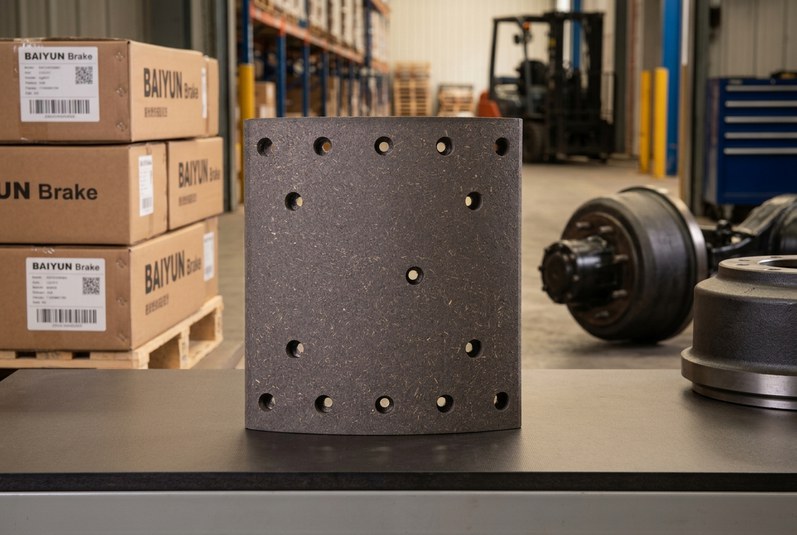
Buying With Confidence Starts With the Right Partner
You've seen the horror stories: linings that delaminate, friction codes that are pure fiction, and suppliers that vanish after the first container. But when you lock in a truck brake lining supplier that gives you full transparency—test data, real batch numbers, live factory audits—your fleet's cost per mile drops, and your drivers stay safe on every route.
If you're sourcing commercial vehicle brake linings or want to compare our reference formulation against your current spec, just request a wholesale quote. We'll run a benchmark test on your sample at no charge to show you the difference. No pressure, just data that helps you make a better decision.
Was this article helpful?
Average Rating: 5/5 (801)