
The Complete ECE R90 Testing Process: What Every Brake Pad Buyer Should Know
Summary:
Understanding the ECE R90 brake pad certification process is essential for any buyer targeting European or UNECE-regulated markets. This mandatory standard requires replacement pads to perform within 15% of OE specifications through rigorous testing like cold performance and speed sensitivity checks. For distributors, sourcing R90-certified products from an IATF 16949 manufacturer like BAIYUN Brake mitigates liability risk and ensures access to a multi-billion euro aftermarket.
The Complete ECE R90 Testing Process: What Every Brake Pad Buyer Should Know
You're evaluating a new brake pad supplier. Their price is attractive, but their product lacks ECE R90 certification. Is it worth the risk? For professional buyers targeting Europe, the Middle East, and other UNECE-regulated markets, the answer is a definitive no. The R90 stamp isn't just a sticker; it's a documented guarantee of safety and performance equivalence. Understanding the testing behind it isn't academic—it's a critical part of your due diligence that protects your business from costly recalls and liability claims.
What Tests Does ECE R90 Require for Brake Pad Approval?
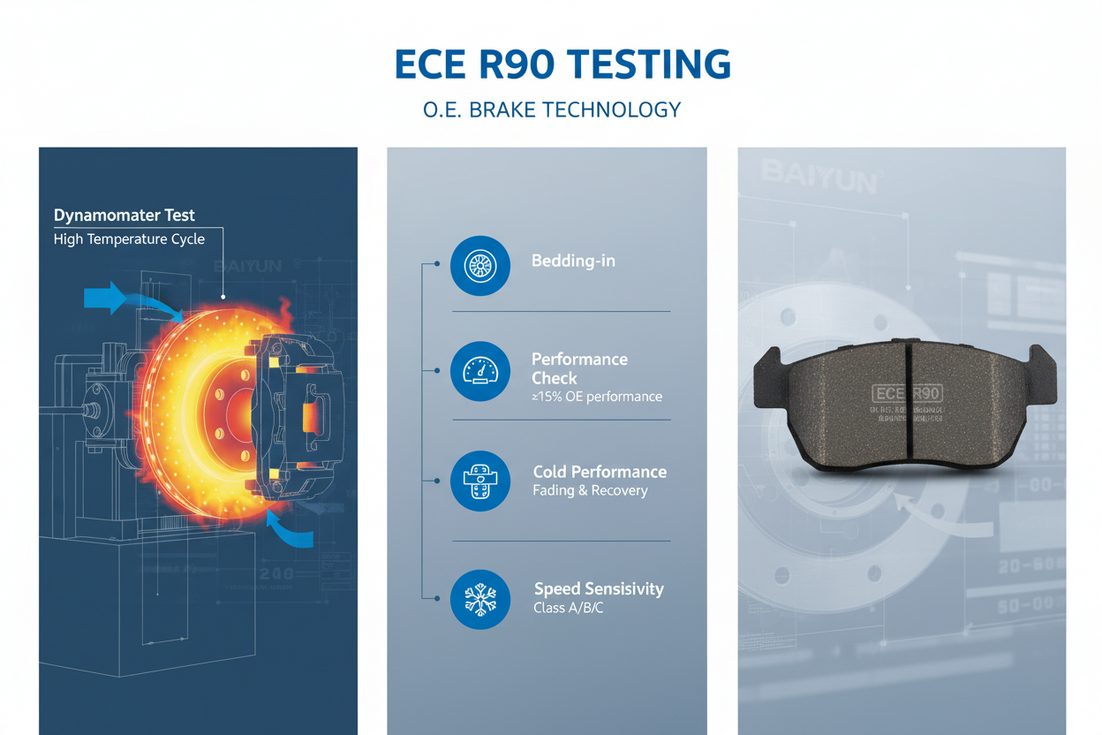
ECE R90 testing specifically targets the failure points of aftermarket brake components. The regulation mandates a sequence of five core tests to validate performance equivalence to the original equipment manufacturer (OEM) part.
First comes bedding-in and a performance check. This isn't just a warm-up. It establishes a baseline friction level for the pad-disc pair. The real validation starts with the brake tests, a series of stops at different speeds and decelerations. According to Annex 3 of the regulation, these tests measure the dynamic coefficient of friction across a defined temperature range.
The cold performance equivalence test is arguably the most critical for real-world safety. It simulates the first brake application of the day. The pad must deliver at least 80% of its effectiveness after thermal cycling, ensuring reliable stopping power from a cold start. The speed sensitivity test then verifies performance doesn't degrade at higher velocities, a common failure mode in substandard compounds.
Every ECE R90 approved brake pad has passed this gauntlet, proving its friction characteristics deviate by no more than ±15% from the OE part across all conditions.
How Are Brake Pads Classified and Tested Under R90?
Not all pads are tested the same way. ECE R90 categorizes brake pads into three classes—A, B, and C—based solely on the area of their friction material. This classification dictates the specific testing protocol.
Class A covers pads with the smallest friction area, Class B is intermediate, and Class C is for the largest pads, typically found on heavy-duty applications. A manufacturer can't just test one vehicle application for a compound. They must calculate the kinetic energy for every vehicle the compound is recommended for to identify the "most severe vehicle." This ensures the test represents the toughest real-world scenario that pad will face.
In BAIYUN Brake's internal validation for their ceramic compound CP2210, this calculation led them to test on a mid-size SUV platform, not a smaller sedan, as it presented higher energy demands. This rigorous approach means when you see an R90 mark on a box from a reputable supplier, you know the compound has been validated against its most challenging application. You can review similar validation data in our passenger car brake pad test report.
What's the Business Impact for Distributors Sourcing R90-Certified Pads?
Let's talk numbers. The European brake friction aftermarket is projected to reach €3.8 billion by 2027, growing at a CAGR of 3.1%. Within that, the certified premium segment is growing faster, at nearly 4%. Sourcing non-compliant pads might save €0.50 per set upfront, but it exposes you to immense risk.
A single liability claim from an accident attributed to brake failure can erase the profit from thousands of sales. More practically, major auto parts chains and e-commerce platforms in Europe now algorithmically filter for R90 certification. If your product line lacks it, you're simply invisible to a huge portion of the market. Investing in certified inventory from a partner like BAIYUN Brake, with full traceability back to the IATF 16949 certified facility, isn't a cost—it's market access insurance.
What Are the Most Common Misconceptions About ECE R90?
Several myths persist in the sourcing community, and they can lead to poor decisions.
Misconception: ECE R90 is just a paperwork exercise for customs.
Reality: It's a performance-based regulation requiring physical dynamometer and vehicle testing. Authorities conduct market surveillance tests, and non-compliant products face removal and fines.
Misconception: If a factory is IATF 16949 certified, their pads automatically meet R90.
Reality: IATF 16949 certifies the quality management system for consistent manufacturing. ECE R90 certifies the performance of the finished product. You need both. A factory like BAIYUN Brake maintains IATF 16949 to ensure every batch of its R90-approved compounds, like those for its C.V. brake pads, meets the same standard as the tested samples.
Misconception: R90 certification lasts forever.
Reality: While the type-approval is granted for a production series, any significant change to the friction material formulation, backing plate, or shim requires re-testing and a new approval. This is why working with a manufacturer that documents every material change is crucial.
For professional buyers, the biggest mistake is viewing R90 as a barrier rather than the baseline qualification for entering the European safety-critical parts market.
How Does R90 Compare to Other Global Standards?
While ECE R90 governs replacement brake linings in over 50 countries following UNECE regulations, other regions have different frameworks. In the United States, the NHTSA regulates at the vehicle level under FMVSS 135; there's no mandatory replacement-part certificate like R90. Buyers should look for evidence of OEM compatibility testing.
This divergence creates a strategic opportunity. A distributor sourcing from a manufacturer like BAIYUN Brake, which designs compounds to meet multiple global benchmarks, can streamline their inventory. A single, well-engineered ceramic or low-metallic NAO compound can often be validated to meet both R90's ±15% OE equivalence and the performance expectations of other markets. This multi-standard capability is a key advantage detailed in our BAIYUN Brake company introduction. The goal is to source pads that don't just pass one test, but are engineered for global reliability.
Frequently Asked Questions (FAQ)
Q: Can I sell non-R90 certified brake pads in Europe?
A: No, it's illegal. ECE R90 is a mandatory technical requirement for selling replacement brake pads and linings in the European Union and other UNECE member states. Non-compliant products can be seized at customs or removed from sale by market surveillance authorities.
Q: How long does the full ECE R90 certification process take?
A> From compound formulation to receiving the type-approval mark, the process typically takes 4 to 6 months for a new compound. This includes lab development, sample production, the mandatory testing cycle at an accredited technical service (which itself can take 3-4 weeks), and documentation review by the approval authority.
Q: Does R90 certification cover wear rates or noise?
A> No, ECE R90 focuses solely on braking performance and safety equivalence. It does not regulate wear life, dust generation, or noise (NVH). These are quality and comfort factors that distinguish premium brands. A manufacturer like BAIYUN Brake conducts additional proprietary tests on wear and noise for its premium lines.
Q: As a distributor, what documents should I request to verify R90 compliance?
A> You should always request the official ECE Type Approval Certificate, which lists the approval number (e.g., E1 90R-0123456). Also ask for the test report from the accredited technical service. Reputable suppliers will provide these. You can see examples of our commitment to documentation in our material data sheets.
Q: Is testing required for every single part number?
A> Not individually. Testing is done per "friction material type" (compound) for its "most severe vehicle" application. Once a compound is approved, all part numbers using that same compound and a similar design (same backing plate type, shim) for vehicles of equal or lower severity can be covered under that same approval, significantly reducing the per-SKU cost of certification.
Navigating brake pad certifications is complex, but it's non-negotiable for serious players in the international aftermarket. The ECE R90 process exists to eliminate guesswork and guarantee a minimum safety threshold. For distributors, partnering with a manufacturer that embeds this rigor into its production system—from raw material understanding brake pad materials to final box—is the smartest way to de-risk your supply chain and build a reputable brand.
Ready to source ECE R90 certified brake pads with full technical documentation? Request a quote and our latest test reports to see how our certified compounds can secure your position in the European market.
Was this article helpful?
Average Rating: 5/5 (1144)