
Semi-Metallic vs Ceramic Brake Pads: The Performance Data Importers Need
Summary:
Semi-metallic brake pads offer critical advantages in heat dissipation and fade resistance that importers for commercial and performance markets can't ignore. This data-driven guide compares semi-metallic vs. ceramic performance across temperature ranges, durability, and total cost of ownership, helping you avoid common sourcing mistakes and select the right technology for your customers' real-world driving demands.
Semi-Metallic vs Ceramic Brake Pads: The Performance Data Importers Need
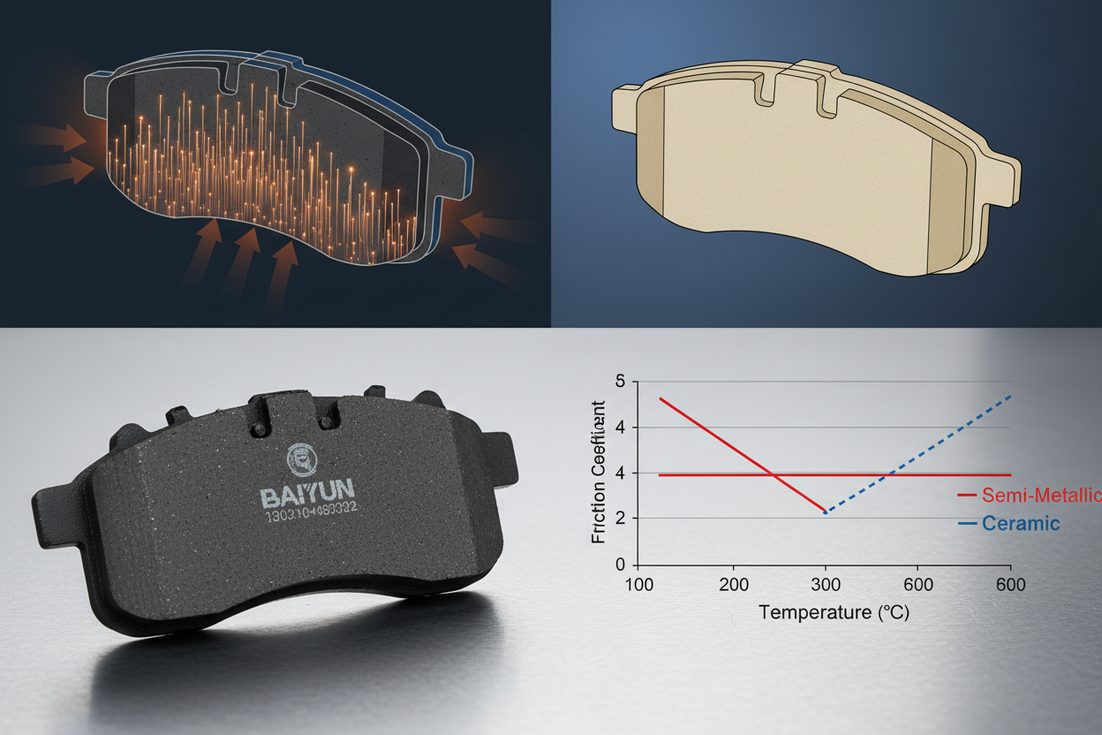
You've probably seen the price lists. Ceramic pads often command a 20-30% premium over semi-metallic options. But if you're sourcing for a market where heavy loads, mountainous terrain, or commercial fleets are the norm, that price difference can be a dangerous trap. Choosing the wrong friction material based on cost alone is a classic mistake that leads to warranty claims, customer complaints, and damaged supplier relationships. The real cost isn't the unit price; it's the total cost of ownership, which includes premature wear, noise issues, and performance failures under stress.
Let's cut through the marketing. We'll look at the hard data on heat dissipation, fade resistance, and material longevity that actually matters when you're placing container orders. This isn't about which pad is "better" in a vacuum. It's about matching the right technology to the specific demands of your target vehicles and drivers.
Where Importers Get the Heat Dissipation Equation Wrong
Brake fade isn't just an annoyance; it's a safety failure. The core advantage of semi-metallic pads lies in their metallic content—typically 30% to 65% by weight. This isn't just filler. Metals like steel, iron, and copper are exceptional conductors. During heavy, repeated braking, they actively pull heat away from the rotor surface and into the pad body, where it can be dissipated.
Think about a delivery truck making constant stops in a hilly city, or a passenger car towing a trailer down a mountain pass. The brake temperature can spike from 100°C to over 500°C in minutes. A ceramic pad, with its lower thermal conductivity, tends to localize that heat at the rotor interface. This can lead to glazing, where the pad surface hardens and loses grip, or even fluid boil in extreme cases. A semi-metallic formulation, by contrast, maintains a more stable friction coefficient across this wide temperature range. In dynamometer testing per SAE J2522 standards, quality semi-metallic pads show a friction coefficient variation of less than ±15% from 100°C to 350°C.
So what's the common mistake? Importers often assume "premium" means ceramic for all applications. For performance sedans in flat urban areas, that might be true. But for the commercial and heavy-duty segments, that assumption is costly. You need a supplier who understands this distinction and can guide your product mix. Our understanding brake pad materials guide breaks down these thermal properties in detail.
For sustained, high-energy braking, the metallic content in semi-metallic pads provides superior heat management, directly combating brake fade.
The Cold Bite vs. High-Temperature Performance Trade-Off
Ceramic pads are famous for their quiet, clean operation and excellent initial "cold bite"—their effectiveness in the first few stops of the day. It's a great selling point. But here's the data point importers miss: that cold performance often comes with a compromise at the upper end of the temperature scale.
Semi-metallic pads offer a more linear performance curve. They provide good, consistent braking from cold start (around 50°C) all the way up to their maximum operating temperature, which can exceed 650°C for heavy-duty formulations. Ceramic pads, while excellent at low temps, can sometimes exhibit a slight drop in friction coefficient as they heat into their optimal mid-range (200-400°C), before potentially recovering. This "friction curve" is critical.
If you're importing for a region with extreme temperature variations—bitterly cold mornings and hot afternoon traffic—a pad that performs consistently across that entire spectrum is vital. A distributor once told us they faced returns on ceramic pads in a Nordic market because drivers felt a "spongy" pedal after the brakes warmed up on long highway drives. The issue wasn't quality; it was an application mismatch. The solution was switching those specific vehicle models to a high-performance semi-metallic compound.
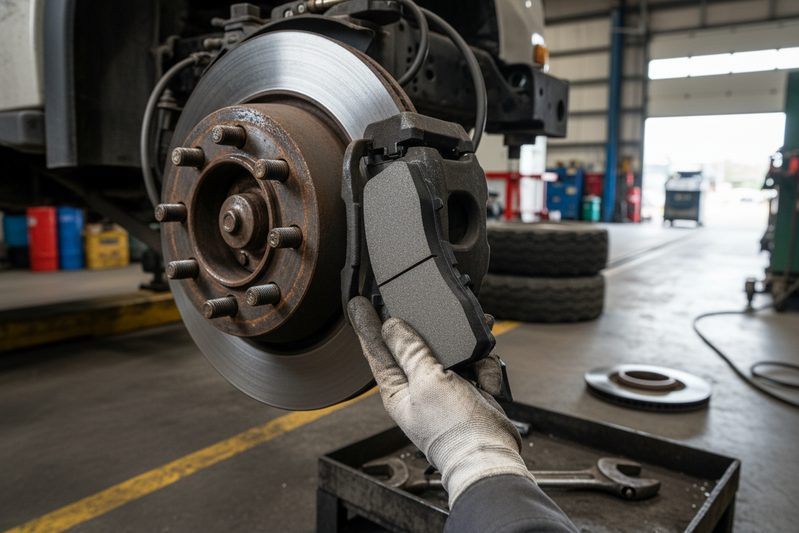
You can't judge a pad by its first stop. You have to look at its entire performance envelope. Downloading our material data sheets gives you the full friction vs. temperature graphs to make these comparisons.
Durability and Total Cost of Ownership for Fleets
Let's talk numbers. A fleet manager running 50 light trucks cares about pad life. Ceramic pads are often marketed as longer-lasting, and for low-stress passenger car use, they can be. But under the punishing stop-and-go cycles of commercial use, the story changes.
The metallic fibers in semi-metallic pads add structural integrity and wear resistance. They're simply tougher. In field data from logistics companies, semi-metallic pads on identical route trucks often outlast ceramic pads by 15-20%. When you factor in the lower upfront cost of semi-metallic pads, the total cost per mile becomes significantly lower.
The other hidden cost? Rotor wear. Softer ceramic formulations can be easier on rotors, but aggressive, metallic-rich semi-metallic pads from a previous era earned a bad reputation for being rotor-eaters. Modern formulations from a quality assurance focused manufacturer like BAIYUN Brake use engineered metallic particles and lubricants like graphite to provide strong braking without excessive rotor abrasion. The key is the specific formulation and the manufacturing control behind it.
Don't just ask for "semi-metallic." Ask for the technical specs: the exact metallic content, the hardness rating (HRB scale), and the expected wear rate (mm/10,000 km). A reputable semi-metallic brake pads wholesale manufacturer will have this data ready and will have validated it through testing like the AK Master test for commercial vehicles.
For commercial fleets, the combined lower purchase price and extended service life of modern semi-metallic pads deliver a superior total cost of ownership.
Noise, Dust, and Managing Customer Expectations
This is the biggest point of friction (pun intended) between technical reality and customer perception. Yes, semi-metallic pads can be noisier and produce more dust than ceramics. It's a physical property of the metal-on-metal contact and the wear particles. But the mistake is thinking this is an unmanageable flaw.
First, not all semi-metallic pads are created equal. Advanced formulations use chamfers, slots, shims, and noise-dampening coatings to mitigate noise. The dust from a high-quality semi-metallic pad is often a darker, less noticeable color and is less likely to embed in wheel finishes than some ceramic dust.
Second, it's about communication. If you're selling to the performance, off-road, or commercial market, educate your dealers. These customers prioritize stopping power and fade resistance over a whisper-quiet brake. A little noise under light braking is a fair trade-off for confidence when hauling a load downhill. Provide your dealers with simple explainer materials. Our brake pad troubleshooting guide includes a section on normal vs. abnormal noise to help with this.
Frankly, trying to force a ceramic pad into a heavy-duty application to avoid noise complaints will lead to a much bigger problem: performance failure. It's better to sell the right product with proper expectations than the wrong product with a silent promise that can't be kept.
FAQ: Sourcing Semi-Metallic Brake Pads for Wholesale
Q: How can I verify the quality of a semi-metallic brake pad supplier?
A: Look beyond the factory tour. Demand proof of compliance with international standards. A legitimate supplier will have test reports showing performance against ECE R90 or similar regulations. For commercial pads, ask for AK Master test references. Always check for IATF 16949 certified facility status—it's the automotive industry's gold standard for quality management, not just generic ISO 9001.
Q: What's the minimum order quantity (MOQ) I should expect for a quality product?
A: Be wary of suppliers offering tiny MOQs with "premium" quality claims. Serious manufacturing of consistent, certified semi-metallic compounds requires large batch production for homogeneity. A credible manufacturer's MOQ is often one pallet or container load per part number. This ensures you get a batch from a single, controlled production run, not a mixed bag of leftovers. BAIYUN Brake, for instance, structures MOQs to guarantee batch consistency for our partners.
Q: Can I get custom formulations or private labeling for my brand?
A: Yes, but it requires commitment. True custom formulation (changing the friction recipe) involves significant R&D and testing costs, usually requiring a very large annual volume. A more practical approach for most importers is private labeling of a manufacturer's proven, certified formulations. This gives you brand control without the upfront engineering cost. Discuss your target market's specific needs (e.g., more emphasis on low dust vs. extreme heat resistance) with your supplier—they often have existing compound variants that can be matched to your needs.
The choice between semi-metallic and ceramic isn't a battle of good vs. bad. It's a strategic decision based on application physics. For markets dominated by heavy vehicles, demanding driving conditions, or cost-conscious fleets, semi-metallic brake pads aren't just an alternative—they're the technically superior and economically sound choice. The importers who succeed are those who source based on data, not just price tags or trends.
You need a partner who provides that data transparently and manufactures with the consistency to back it up batch after batch. That's where our 49+ years of manufacturing experience and commitment to certifications like IATF 16949 and ECE R90 make the difference.
Ready to review technical data sheets for high-performance semi-metallic compounds? Request a quote and full test documentation for your target vehicle applications. Let's discuss how the right friction material can strengthen your product lineup and reduce your warranty overhead.
Was this article helpful?
Average Rating: 5/5 (1335)