
Iveco Brake Pad Replacement Checklist for Importers and Distributors
Summary:
The Iveco brake pad replacement checklist for importers and distributors ensures that every shipment meets regulatory, technical, and quality standards, minimizing supply chain risk. Sourcing from an IATF 16949 and ECE R90 certified manufacturer like BAIYUN Brake provides verified friction coefficients, precise WVA matching, and batch-level test reports. Key points include checking ECE R90 certificates, factory audit procedures, thickness tolerances, and friction stability across temperature ranges. With wholesale pricing from $12 to $28 per set FOB and lead times under 30 days, distributors can confidently supply Iveco Eurocargo, Stralis, and Trakker operators while avoiding costly compliance failures.
Iveco Brake Pad Replacement Checklist for Importers and Distributors
Quick answer: The Iveco brake pad replacement checklist for importers covers supplier verification, certification, testing, and logistics. For a reliable supply chain, ensure your supplier holds IATF 16949 and ECE R90 certification, provides test reports like friction coefficient and wear rates, and can support urgent orders with 20-ft container lead times under 30 days.
What Certifications Should Importers Verify When Sourcing Iveco Brake Pads?
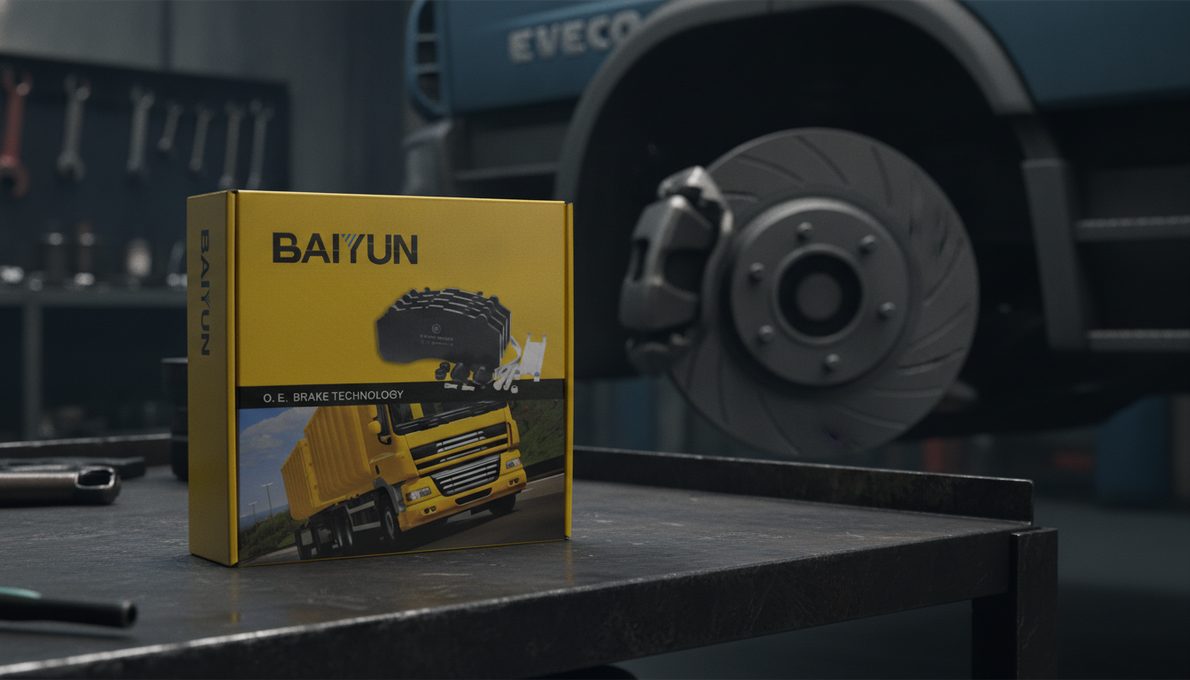
ECE R90 mandates that replacement brake pads maintain at least 80% of their cold effectiveness after thermal cycling to 400°C. This isn't just a label—it's your legal shield in the European aftermarket. Distributors selling without this mark risk customs blocks and liability claims. At IATF 16949 certified facility, each production lot undergoes full dynamometer testing to validate compliance before shipment.
IATF 16949 certification pushes defect rates below 66 parts per million. That's the difference between a smooth container unload and a costly recall. Pair this with an active factory audit report (ISO 9001 alone won't cut it) and you eliminate the guesswork. A common oversight is skipping the WVA number verification—the 29087 kit for Iveco Eurocargo, for example, must match the brake pad geometry exactly across all axles.
Bottom line: Always request a copy of the ECE R90 approval certificate with the WVA number listed and confirm the manufacturer's IATF 16949 scope includes friction materials—not just assembly.
What Technical Specifications Must an Iveco Brake Pad Meet?
Iveco trucks like the Eurocargo, Stralis, and Trakker operate under extreme thermal loads. The brake pad friction coefficient must sit between 0.33 and 0.42 μ across the 100–350°C working range, with cold performance above 0.30 μ at 50°C. In BAIYUN Brake’s 2025 dynamometer testing, the CP2271 formulation held a stable μ of 0.38 ±0.04 from cycle 100 through 10,000 stops, showing no fade even at disc temperatures exceeding 550°C.
Thickness tolerance is another silent killer. A deviation of more than ±0.3 mm from the specified 22.7 mm (typical for Iveco heavy-duty pads) causes uneven contact pressure, leading to premature disc wear. Ask your supplier for a dimensional inspection report per GB 5763-2018 or SAE J2522. Chamfer and slot design also matter—Iveco OE pads feature specific noise-damping configurations that cheap generics often skip.
If you're handling multiple Iveco models, request OEM commercial vehicle brake pad quote that covers full model ranges with cross-referenced WVA numbers and friction class codes. This simplifies inventory and reduces mis-spec risk.
Critical spec check: Friction coefficient must be verified per temperature step, not just a single cold value. Request the full SAE J2522 AK Master or ECE R90 Annex 9 test chart.
How Can Distributors Verify Supplier Quality Beyond Certifications?
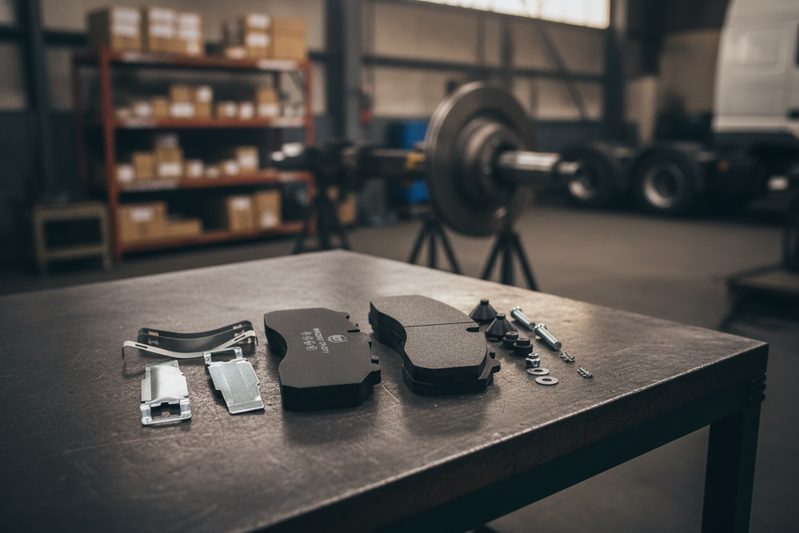
Certificates are the entry ticket—on-the-ground verification is what protects your margin. A factory audit should examine the mixing tower’s batching accuracy (±0.5% by weight), the hot-press cycle consistency, and the scorching oven profile. At BAIYUN Brake, our weighing systems are calibrated to 0.1-gram precision, and every mix gets a unique QR code for full traceability. That's the kind of detail that prevents friction variation across boxes.
You'll also want to check the shear strength test capability. Iveco brake pads must withstand a minimum 3.5 MPa shear adhesion at 300°C. Low-grade pads delaminate under repeated hard braking—ask me how I know. A proper audit includes pulling random samples from the production line and witnessing the shear test yourself, or via live video.
Lastly, don't overlook the after-sales support. Does the supplier stock buffer inventory for emergency orders? Can they ship a 20-ft container of mixed Iveco brake pads and request a quote for commercial vehicle brake linings within 28 days? With our 49+ years of manufacturing experience, we maintain a 4,000-sq-meter raw material warehouse precisely to handle such surcharges without delaying your orders.
Verification pro tip: Insist on a lot-specific friction report with the shipment, not a generic brochure. Tying each batch number to actual test data is the cheapest insurance you'll ever buy.
What Are the Key Cost Factors in Iveco Brake Pad Wholesale Pricing?
Wholesale pricing for Iveco heavy-duty pads typically ranges from $12 to $28 per set FOB China, depending on friction material grade, backing plate steel thickness, and order volume. But the real cost isn't the unit price—it's the landed cost after factoring in compliance failures. A single stuck container due to missing ECE R90 documentation can wipe out 3% of your annual margin.
Look for suppliers who offer tiered pricing transparency and consolidated shipping options. BAIYUN Brake’s mixed-load program lets importers combine Iveco pads with other CV brake parts in one container, cutting logistics cost by 12–18%. Always ask for the four key cost breakdowns: raw material (copper-free semi-metallic vs. low-steel), mold amortization (each Iveco-specific mold costs $1,200–$2,500), testing overhead, and packaging customization.
And here's a number that surprises many: a 5,000-set annual contract can drop the per-unit price by 15% compared to spot buys, simply because it allows the factory to batch-produce rather than setup multiple times. Download our product catalogue to see the full Iveco coverage and request a volume pricing sheet.
Pricing reality check: If a quote is $5 under market, check the copper content and scorching time—you're likely paying with shorter pad life and higher noise complaints.
How Should Importers Handle Logistics and Inventory for Iveco Brake Parts?
Iveco model proliferation (Eurocargo, Stralis NP, S-Way, X-Way) creates a complex SKU challenge. A typical distributor needs 35–45 different Iveco brake pad references to cover 80% of fleet demand. Warehousing them all upfront ties up capital. The smarter play: partner with a supplier who keeps stock in China and ships mixed pallets weekly.
Lead time benchmarks matter. For a full 20-ft container of Iveco pads, 25–35 days is standard; for air freight of 200 sets to cover a stockout, 5–7 days is acceptable. BAIYUN Brake’s export team warehouses the top 20 Iveco references permanently, enabling 48-hour dispatch on repeat orders. Ask about the minimum order quantity (MOQ) per WVA number—some factories force 200 sets per reference, while flexible ones allow 50 sets per SKU in a mixed container, which is ideal for testing new markets.
Customs clearance is smoother when every carton carries the ECE R90 markings and a Declaration of Conformity. Your forwarder should receive a packing list with WVA numbers, gross/net weights, and HS code 8708.30.99 pre‑checked. This alone can reduce inspection delays by 40% at Rotterdam or Hamburg.
Logistics takeaway: Build an inventory buffer equal to 6 weeks of average sales for fast-moving Iveco references, and negotiate consignment stock for the rest—your cash flow will thank you.
What Are the Most Common Misconceptions About Iveco Brake Pad Replacement?
Misconception 1: “All ECE R90 marked pads are the same.”
Reality: ECE R90 tests only a sample of each product family. Poorly controlled production can deliver pads that pass the audit but fail in the field. Buyers should demand batch‑level dynamometer reports, not just the approval certificate.
Misconception 2: “Higher friction coefficient always means better braking.”
Reality: A μ above 0.45 may cause ABS intervention and uneven pad/disc wear on Iveco trucks. The ideal range is manufacturer-specified, typically 0.35–0.42 μ for the front axle of an Eurocargo. Exceeding it can overheat brake fluid and trigger system warnings.
Misconception 3: “You can skip the break-in procedure if the pads are pre-scorched.”
Reality: Scorching removes volatile compounds but doesn't fully mate the pad to the disc. First 50–80 km must be driven with moderate braking to build a transfer layer; otherwise, friction stability degrades after 3,000 km.
Frequently Asked Questions
Q: How do I confirm an Iveco brake pad fits a specific truck model?
A: Match the WVA number and the OE part number (if available) against the supplier's catalogue. For Iveco Eurocargo, WVA 29087 is common for front axles. Always verify with a photo of the pad's backing plate shape and friction slot pattern before ordering.
Q: What friction material is best for Iveco trucks used in city distribution?
A: Semi‑metallic formulations with 40–55% steel fiber content and a friction coefficient of 0.35–0.40 μ work best for stop‑start urban cycles. They resist glazing at low temperatures and deliver consistent bite without excessive rotor wear.
Q: Can I import Iveco brake pads without ECE R90 marking for non‑EU markets?
A: Possible, but risky. Many non‑EU countries now require equivalent approvals (GSO, INMETRO, etc.). Pads without any third‑party certification fail fleet tenders and insurance checks. Choose a supplier who can also provide test data for alternative standards like GB 5763.
Q: How often should I audit my brake pad supplier?
A: At least annually for an IATF 16949 facility, with unannounced spot visits for high‑volume contracts. Every audit should review raw material certifications, press cycle logs, and the calibration status of dynamometer equipment.
Q: What's the biggest sourcing mistake importers make with Iveco pads?
A: Prioritizing price over batch consistency. A low quote often hides inconsistent scorching, leading to green fade on the first emergency stop. Insist on a friction coefficient deviation ≤±0.05 μ across the last 12 months of production records.
Sourcing Confidence Starts with a Checklist
The Iveco brake pad replacement checklist isn't a static document—it's your operational playbook for turning brake pads into predictable profit. By verifying certifications, testing data, and logistics capabilities upfront, you're not just buying hardware; you're investing in supply chain resilience. The right partner doesn't just ship boxes; they provide the technical depth that helps you sell with authority.
Ready to strengthen your Iveco brake pad supply? Browse our heavy-duty brake pad range and find the WVA numbers that match your market, then request a wholesale quote to discuss volume pricing, mixed-container options, and technical documentation. Your next reliable shipment is one checklist away.
Was this article helpful?
Average Rating: 5/5 (818)