
How to Confirm Brake Lining Dimensions Before Ordering
Summary:
How to confirm brake lining dimensions before ordering is a make-or-break step for commercial vehicle brake importers and fleet buyers. This technical guide walks through width, thickness, arc length, and rivet or bonding hole verification, measurement tools, supplier questions, and common buyer mistakes. It includes a buyer verification checklist, FAQ, and sourcing tips for IATF 16949 and ECE R90 certified brake linings. BAIYUN Brake shares practical QC experience from 49+ years of friction manufacturing to help distributors, wholesalers, and importers avoid costly fitment returns. Readers will learn what tolerances actually matter, how to check a sample without an OE drawing, and what to request from a brake lining supplier before signing a purchase order. Dimensional confirmation reduces downtime, prevents heat cracks, and improves first-fit success across truck, bus, and trailer fleets.
How to Confirm Brake Lining Dimensions Before Ordering
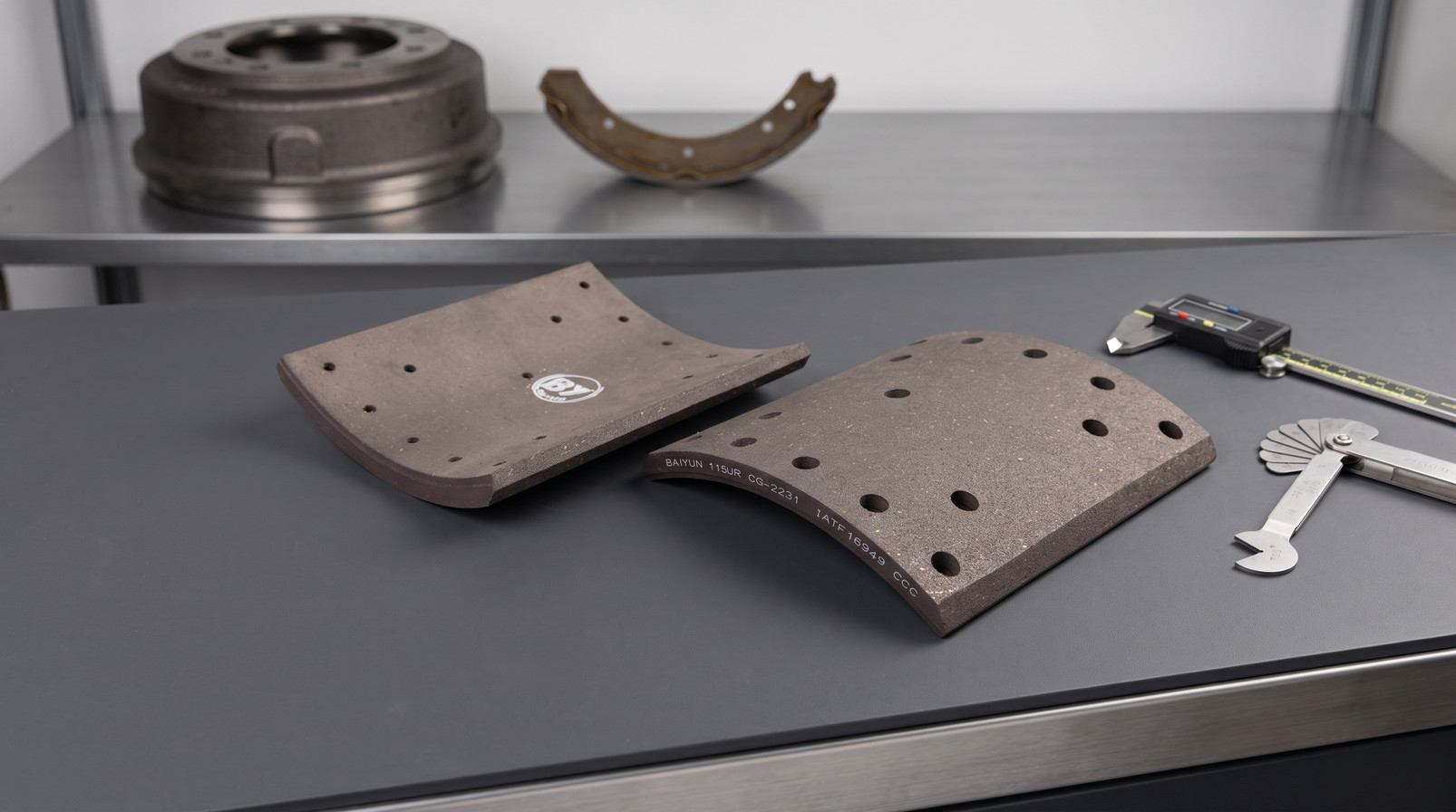
Quick answer: Confirm brake lining dimensions by matching width, thickness, arc length, and rivet or bonding hole spacing against your OE sample or vehicle data plate. For commercial trucks, buses, and trailers, a 1–2 mm mismatch can trigger uneven drum contact, heat cracks, and 15–20% shorter lining life. Use callipers, radius gauges, and a supplier verification checklist. BAIYUN Brake cross-checks 100% of lining sets against ECE R90 approval drawings before dispatch.
Most buyers find out a lining set is wrong after the container lands. That's a costly place to discover a 2 mm arc length error. Dimensional confirmation isn't a technical exercise—it's the difference between a clean fleet rollout and a batch of grounded vehicles.
This guide walks through what to verify, how to measure, and what to ask your supplier before signing a purchase order. It's written for importers and fleet buyers sourcing commercial vehicle brake linings.
Why Do Importers Get Brake Lining Dimensions Wrong?
Dimension errors rarely come from a single bad measurement. They come from comparing catalog images instead of engineering drawings, or reusing an old supplier's dimension sheet for a different axle series.
In BAIYUN Brake's incoming QC logs, width and hole-centre deviations account for more than half of failed first articles. The pattern is familiar: a distributor orders a lining by visual match, the drum number is correct, but the hub geometry isn't. The lining bolts on, then rides high on the drum shoulder. By the third heat cycle, it's cracked at the rivet line.
Independent aftermarket data often cites dimensional mismatch as the root cause in 10–15% of brake lining returns. The cost isn't just freight; it's downtime for a truck that could be earning revenue.
Key takeaway: Always treat the first sample as a dimensional proof, not a cosmetic check.
What Dimensions Must You Verify on a Commercial Vehicle Brake Lining?
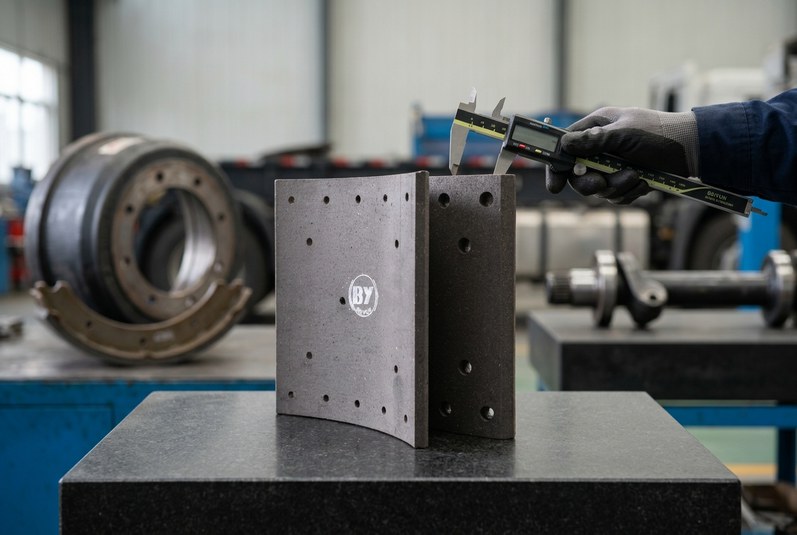
A commercial drum brake lining has four critical dimensions: width, thickness, arc length, and hole pattern. Width controls contact patch across the drum. Thickness determines service life and heat mass. Arc length affects how evenly the lining follows the drum radius.
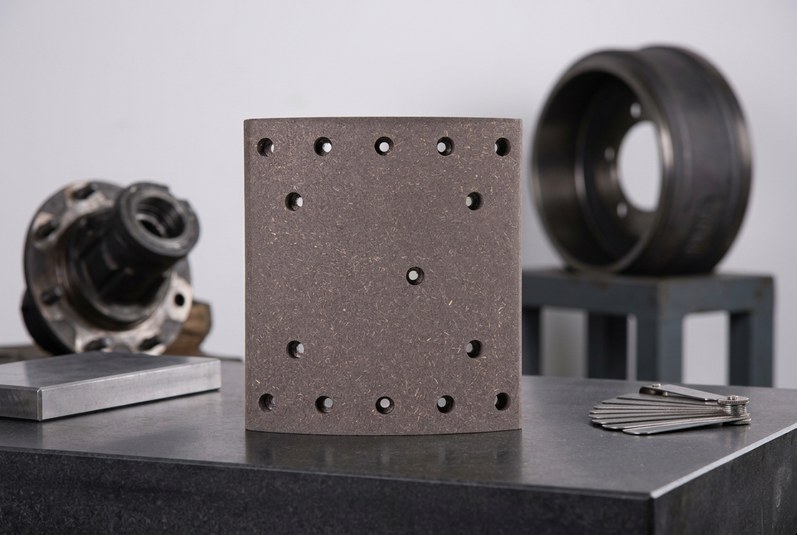
Rivet or bonding hole spacing is the dimension buyers forget. If hole centres are off by 1.5 mm, the lining won't seat flat on the shoe table. On a loaded 40-tonne trailer, that misalignment magnifies into edge loading and premature wear.
Most drum brake shoes accept lining thickness from 12 mm to 18 mm when new, depending on axle manufacturer. Replacement thresholds vary; many OEM manuals call for replacement at 4–6 mm, and anything below 2 mm is unsafe for commercial operation. For available profiles, browse our brake lining product range.
On a 420 mm drum, a 0.5 mm arc mismatch creates a small gap at the heel or toe. That gap closes under load, but it concentrates pressure and eventually shows up as tapered wear or heat checking. Buyers should never assume the drum number alone solves fitment.
How Do You Measure Brake Lining Dimensions Without an OE Drawing?
Most dimension checks for commercial brake linings don't require a coordinate measuring machine. A 150 mm digital calliper, a radius gauge set, and a flat granite surface will cover 90% of first-article checks.
Measure width at three points along the lining length: 10 mm from each end and at the centre. Thickness should be checked at four points, because older shoe tables can be slightly uneven. Arc length is trickier—use a flexible tape for chord length, then compare with the drum's actual inner circumference. If you're preparing to fit, follow the brake lining installation guide.
The table below summarises measurement methods and what each one actually verifies.
| Measurement Type | What It Verifies | Practical Accuracy | Buyer Tip |
|---|---|---|---|
| Digital calliper width/thickness | Flatness and minimum material | ±0.02 mm | Check 3 width points, 4 thickness points |
| Radius gauge or template | Drum curvature match | ±0.1 mm | Compare both ends, not just centre |
| Flexible tape / chord length | Arc length and drum sitting | ±0.5 mm | Measure with lining under light pressure |
| Rivet hole jig or drill template | Shoe table alignment | ±0.2 mm | Never accept loose hole spacing |
| Surface plate / straightedge | Shoe table flatness and bonding face | ±0.05 mm | Check for rocking or light gaps |
At BAIYUN Brake, first-article dimensional reports typically include 12 measurement points per lining: four width, four thickness, two chord, and two hole-centre positions. Keep a written buyer verification checklist for each axle series. That record becomes your internal fitment library and stops repeat mistakes when a new procurement manager takes over an account.
What Should You Ask Your Brake Lining Supplier Before Signing a PO?
A one-page dimensional requirement sheet eliminates most pre-shipment fitment risk. If a supplier can't fill it in, that tells you more than any brochure.
- Do you hold an IATF 16949 certificate for commercial vehicle brake linings? That's the baseline for consistent process control, not a marketing badge.
- Can you provide a dimensional report for each batch, not just the first sample? Batch-level reporting catches drift before it ships.
- What are your tolerance bands for width, thickness, and hole centre positions? Acceptable suppliers quote specific numbers like ±0.3 mm, not standard tolerance.
- Which axle models does this lining suit? Ask for a written fitment list. If WVA or OE references are not available, confirm with supplier catalogue.
- Can you pre-grind or chamfer edges to match my drum profile? That saves field fitting time and reduces initial noise on buses and coaches.
- What is your first-article approval process? A supplier should send two or three samples with a dimension sheet before mass production.
At BAIYUN Brake, linings move through 100% dimensional inspection and ECE R90 batch verification. We're an IATF 16949 certified facility with 49+ years of friction manufacturing experience.
Treat this as a buyer verification checklist, not a formality. A single missing tolerance on the PO can turn a 500-set order into a fire drill.
Key takeaway: The supplier's tolerance sheet matters more than the product photo.
What Are the Most Common Misconceptions About How to Confirm Brake Lining Dimensions?
Three misunderstandings cause most brake lining dimension rejections. They're expensive, and they usually surface after the parts are in your warehouse.
Misconception: A visual match is enough if the part number looks similar. Reality: Brake linings can differ by less than 2 mm in arc length and still look identical in photos. That small delta changes contact pressure distribution and may cut lining life by 15–20%.
Misconception: Thickness is the only dimension that matters. Reality: Width and hole spacing affect drum coverage and shoe seating more than buyers expect. A lining 5 mm too narrow reduces friction surface area and increases peak temperatures, especially on downhill coach routes.
Misconception: If it bolts on, it's safe. Reality: Many linings will physically bolt on with dimensional errors. The problem shows up later as uneven drum wear, brake fade, or cracked friction material at the rivet line.
Key takeaway: Safety-critical fitment is a measurement issue, not an assembly issue.
What Do Wholesale Buyers Ask Most About Lining Dimensions?
These are the questions importers and fleet managers send us most often.
Q: How do you confirm brake lining dimensions when you don't have an OE sample?
A: Use the vehicle data plate or drum drawing to get inner drum diameter, width, and shoe table radius. Then measure a removed lining with a calliper and radius gauge. If no sample is available, request the supplier to cross-check against your axle manufacturer's service bulletin or confirm with supplier catalogue.
Q: What tolerance is acceptable for commercial brake lining width?
A: Most heavy-duty drum brake shoes accept a width tolerance of ±0.5 mm. Some European axle manufacturers tighten this to ±0.3 mm. Anything wider can contact the drum lip; anything narrower reduces friction area and increases temperature by roughly 5–8% per 2 mm reduction.
Q: Should I request a dimensional report for every batch?
A: Yes. Batch-level reports catch tool wear, material spring-back changes, and operator drift. At BAIYUN Brake, dimensional checks are recorded for every production lot, not just the first article.
Q: What is the minimum lining thickness for safe commercial vehicle operation?
A: Many fleets replace linings at 4–6 mm remaining material. Below 2 mm, rivet contact or bonding failure risk rises fast under heavy braking. Some mining and port vehicles use a higher 6 mm threshold because of severe duty cycles.
Q: Can BAIYUN Brake manufacture linings to my existing sample or drawing?
A: Yes. Send a sample, CAD file, or detailed sketch. Our export team will run a first-article inspection with a full dimensional report before mass production. request a quote for commercial vehicle brake linings.
What's the Fastest Way to Confirm Your Lining Dimensions?
If you're still reading, you probably have a drum number and maybe a worn lining on your desk. The fastest route is to send us that sample and the vehicle data. We'll return a dimension sheet, pricing, and a fitment confirmation before you spend a dollar on tooling.
For buyers who need to move now, browse our heavy-duty brake pad range or download our product catalogue. And if you want a direct commercial conversation, request a wholesale quote.
Was this article helpful?
Average Rating: 5/5 (627)