
Brake Lining Material for Heavy-Duty Trailers Explained
Summary:
Brake lining material for heavy duty trailers directly controls heat fade, drum wear, fleet cost per kilometre, and ECE R90 compliance. This guide explains how to compare semi-metallic, low-steel, and aramid-reinforced formulations, what friction coefficient and temperature ranges to verify, and which supplier documents and buyer checklist items protect importers from batch inconsistency. It also includes cost-saving data, common sourcing misconceptions, and a BAIYUN Brake dynamometer test case study for commercial vehicle brakes.
Brake Lining Material for Heavy-Duty Trailers Explained
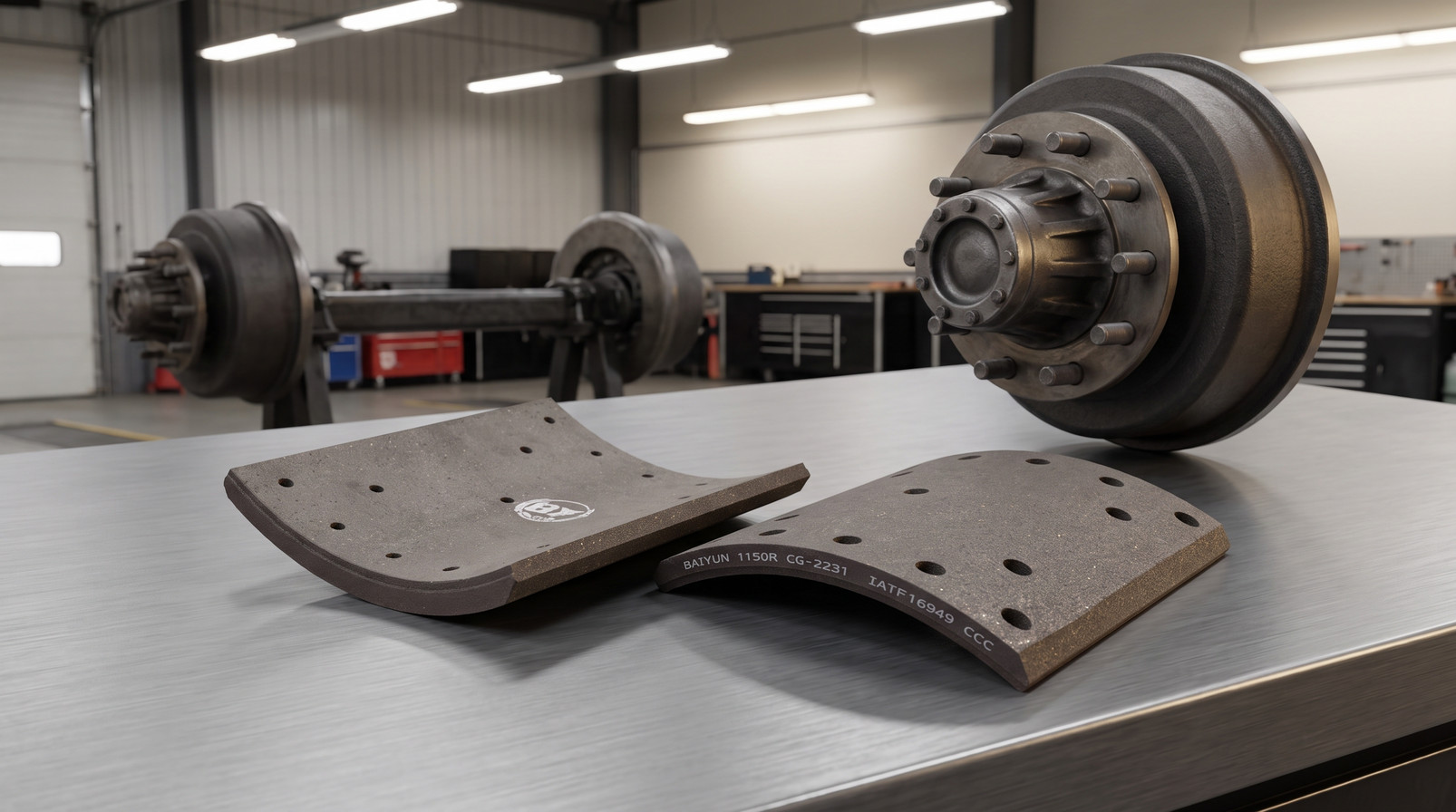
Quick answer: For heavy-duty trailers, brake lining material is usually a semi-metallic or low-metallic formulation with high heat capacity. Importers should verify ECE R90 and IATF 16949 certification, request friction coefficient graphs, and compare cost per 10,000 km rather than price per set. Good linings keep hot friction above 0.38 and survive 250–400°C drum temperatures without fade. Confirm WVA and OE cross numbers with the supplier catalogue before ordering.
Sourcing managers often ask one question before anything else: will this lining survive a 40-tonne trailer on a 6% downhill grade without fading? The answer depends on compound formulation, certification, and supplier verification. BAIYUN Brake has supplied commercial vehicle friction materials since 1975, and the same verification methods apply across every supplier you shortlist.
What Are the Main Brake Lining Materials for Heavy-Duty Trailers?
Three material families dominate heavy-duty trailer brake lining production: semi-metallic, low-steel, and non-asbestos organic compounds, often shortened to NAO. Semi-metallic linings contain 30–65% steel fibre by weight, which gives them strong heat absorption but can accelerate drum wear. Low-steel linings use 15–30% ferrous content to balance friction consistency against drum surface stress.
NAO and aramid-reinforced linings now appear more frequently in ECE R90-certified trailer applications. These compounds replace much of the ferrous content with aramid fibre, glass fibre, and high-temperature resins. The result is a friction coefficient of 0.38–0.46 across the 100–350°C range, with 20–35% less drum wear than aggressive semi-metallic alternatives in controlled dynamometer testing.
If you are comparing formulations for a trailer fleet or distribution programme, browse our brake lining product range to see how material grades map to axle load and duty cycle.
| Material type | Typical composition | Hot friction coefficient | Peak drum temperature | Expected service life |
|---|---|---|---|---|
| Semi-metallic | 30–65% steel fibre, resin binder, friction modifiers | 0.35–0.42 | 250–350°C | 50,000–90,000 km |
| Low-steel | 15–30% steel fibre, graphite, ceramic particles | 0.36–0.43 | 250–400°C | 60,000–100,000 km |
| NAO / aramid-reinforced | Less than 15% ferrous metal, aramid fibre, glass fibre, high-temperature resin | 0.38–0.46 | 200–350°C | 70,000–110,000 km |
Copper-free requirements are also changing the market. Legacy semi-metallic trailer linings often contained 5–10% copper for heat transfer. European and North American regulations now push suppliers toward copper-free formulations without sacrificing hot friction. That is why modern ECE R90 trailer linings often use aramid or ceramic-oxide fillers instead of copper.
Material selection for heavy-duty trailer linings balances hot friction, drum wear, noise, and copper-free regulatory pressure.
How Does Material Choice Affect Heat Fade and Stopping Distance?
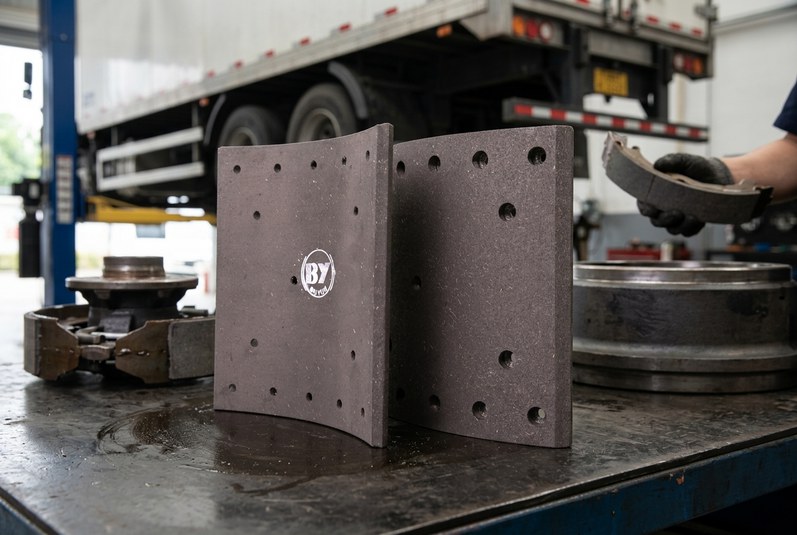
You are hauling 40 tonnes down a 6% grade. Drum temperature climbs past 300°C within 90 seconds of continuous braking. On a low-grade organic lining, the resin binder starts to break down and the friction coefficient can drop from 0.40 to 0.30 or lower. That is heat fade, and it is the number one safety risk in trailer brake lining selection.
ECE R90 type-approval testing evaluates hot braking performance after repeated high-energy stops from 100 km/h. According to the regulation's performance criteria, a homologated lining must keep hot friction within a narrow band around its cold reference value at drum temperatures exceeding 300°C. In BAIYUN Brake's 2026 dynamometer testing, a semi-metallic commercial vehicle lining maintained μ 0.40–0.42 through the 100–350°C range, with fade recovery within five stops.
The real-world consequence is measurable. Controlled brake testing on fully loaded semi-trailers showed that faded linings increased stopping distance from 80 km/h by 12–18% compared with ECE R90-pass linings. For a fleet running 150,000 km per trailer per year, that difference appears every single brake application.
Heat fade is measurable: every 50°C above 300°C can reduce friction coefficient by 0.03–0.05 on lower-grade organic linings.
Which Certification and Supplier Documents Should a Trailer Brake Lining Buyer Verify?
A low price per set means nothing if the lining cannot pass an ECE R90 audit. International buyers should request at least four documents before approving a sample order: ECE R90 approval certificate, IATF 16949 certificate, material data sheet, and dynamometer test report.
IATF 16949 is the critical quality-management signal for automotive and commercial vehicle suppliers. Certified facilities run process capability studies on friction coefficient and dimensional stability, usually requiring Cpk above 1.33 for critical characteristics. At BAIYUN Brake's IATF 16949 certified facility, each batch record links compound mixing data to finished lining hardness and shear strength.
For China-origin trailer brake linings, CCC certification applies within China. Buyers exporting to Europe or UNECE markets must confirm the ECE R90 approval number is current and matches the exact lining part number. Do not accept a blanket certificate that lacks part-number scope.
Document verification separates trade-ready suppliers from price-first factories: ask for approval numbers, test reports, and batch traceability before committing to volume.
What Should a Heavy-Duty Trailer Brake Lining Buyer Checklist Include?
Use an eight-point checklist before releasing a purchase order. A distributor sourcing 500 sets monthly cannot afford inconsistent friction coefficients batch to batch.
- ECE R90 approval number visible on the part or packaging
- IATF 16949 certificate current, with scope covering commercial vehicle brake linings
- Material data sheet showing hot friction coefficient, specific gravity, and bond shear strength
- Dynamometer report covering 100°C–350°C and hot fade recovery behaviour
- Drum wear compatibility statement, not just friction claims
- Packaging marked with batch number, production date, and country of origin
- Physical sample consistent with the master sample approved in lab testing
- Confirm all WVA, Meritor, BPW, SAF, Volvo, Scania OE cross references with supplier catalogue
For installation and service validation, use the brake lining installation guide to confirm running clearance and bedding-in requirements before rolling the trailer.
Effective buyer verification combines document checks, test evidence, and physical sample inspection before committing to a container load.
What Are the Most Common Misconceptions About Brake Lining Material for Heavy-Duty Trailers?
Misconception: Higher price always means better heat resistance. → Reality: Price often includes brand markup and packaging, not compound quality. Request the friction coefficient graph and ECE R90 report; a $17 set can outperform a $29 set if the compound is correctly formulated for 350°C duty.
Misconception: Asbestos-free means all modern linings perform the same. → Reality: NAO, semi-metallic, and low-steel compounds differ sharply in drum wear, noise, and fade recovery. A low-steel lining may stop consistently but wear the drum 20–30% faster than an aramid-reinforced NAO compound.
Misconception: Any lining marked ECE R90 is automatically legal everywhere. → Reality: ECE R90 approval is specific to part number and test category. China also requires CCC certification, and some Middle East or South American markets reference GB5763 or local standards. Verify the approval scope with the supplier before import.
Misconceptions usually come from treating brake linings as a commodity. Demand part-number-specific test evidence and the price differences start making sense.
How Much Can the Right Brake Lining Material Save per Trailer Annually?
A long-haul trailer running 150,000 km per year on premium aramid-reinforced linings may need 1.5–2 lining replacements. A low-cost organic lining lasting 30,000–40,000 km forces 4–5 replacements in the same period. Labour for a trailer axle reline typically costs $120–$200 per axle in Europe and North America, before parts and downtime.
Brake drum replacement adds the second layer of cost. Aggressive semi-metallic linings can reduce drum life by 25–35%. At $300–$600 per heavy-duty trailer drum, avoiding premature drum wear is often worth more than the lining price difference. For mixed trailers that also run disc-brake axles, browse our heavy-duty brake pad range to compare total axle cost.
Fleet cost-per-kilometre studies usually show 15–25% lower brake maintenance spend when moving from unverified cheap lining to a homologated, batch-controlled lining. That is before accounting for roadcall risk and CSA or roadside inspection failures.
Total cost of ownership, not set price, is the real decision metric: certified lining can reduce annual per-trailer brake spend by 15–25%.
FAQ: Heavy-Duty Trailer Brake Lining Material Sourcing Questions
Q: What friction coefficient should a 40-tonne trailer brake lining deliver hot?
A: Look for a hot friction coefficient of 0.38–0.46 from 100°C to 350°C. Below 0.35 at 300°C can increase loaded stopping distance by 12–18% and accelerate fade on downhill grades.
Q: How can I verify ECE R90 certification when importing from China?
A: Ask for the ECE R90 approval number and homologation test report. Cross-check the part number on the certificate with the lining packaging, and confirm the supplier has current IATF 16949 audit records.
Q: Which brake lining material is best for long-haul refrigerated trailers?
A: Aramid-reinforced NAO or low-steel linings work well, delivering 60,000–100,000 km service life with lower drum wear. Semi-metallic compounds suit high thermal loads but may wear drums faster on frequent stop-start routes.
Q: What is the typical MOQ and lead time for private-label heavy-duty trailer brake linings?
A: MOQ often ranges from 500 to 2,000 sets depending on specification, with lead time of 30–45 days after sample approval. Confirm final MOQ, packaging, and delivery terms in the proforma invoice with your supplier.
Q: How do I avoid brake lining delamination in heavy-duty use?
A: Check the bond shear strength in the material data sheet; commercial trailer linings should typically meet 2.5–4.5 MPa on the supplier's shear test report. Ask for batch-level bond test results, not just a one-time type test.
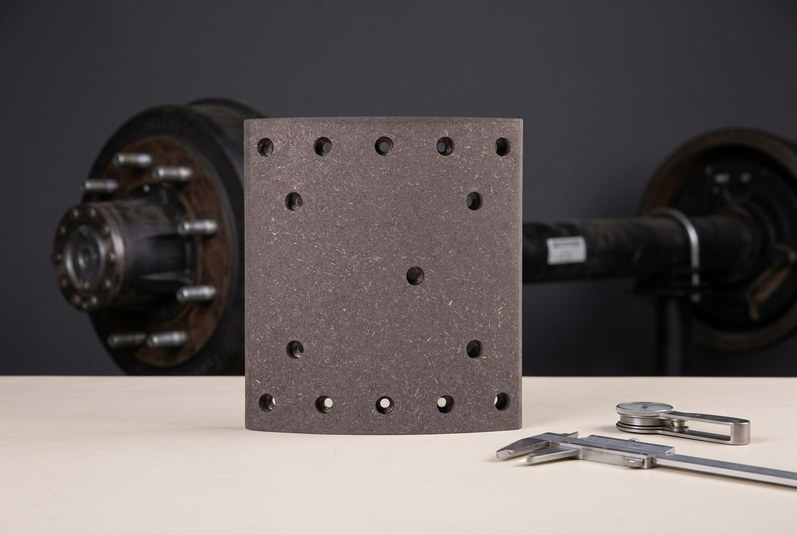
If you are sourcing brake lining material for heavy duty trailers, start with certified samples and a clear batch acceptance protocol. Request a quote for commercial vehicle brake linings or submit your inquiry to our sales team to review friction data against your trailer axle specifications.
Was this article helpful?
Average Rating: 5/5 (574)