
How to Choose a Brake Lining Supplier: Buyer Checklist
Summary:
How to choose brake lining supplier starts with verifying WVA 19032 dimensions before price. The WVA 19032 lining for BPW trailer axles measures 420 mm outer arc, 180 mm width, and 17/18 mm thickness, with 10 rivet holes and an R205 radius. This buyer checklist covers fitment verification, ECE R90 and IATF 16949 documentation, friction material dynamometer data, landed cost comparison, MOQ and lead time, and common sourcing misconceptions. Importers and distributors should request a dimensioned drawing, a signed fitment confirmation and batch test reports before placing a bulk order. BAIYUN Brake supplies commercial vehicle brake linings backed by 49+ years of manufacturing experience and full technical support for international buyers.
How to Choose a Brake Lining Supplier: Buyer Checklist
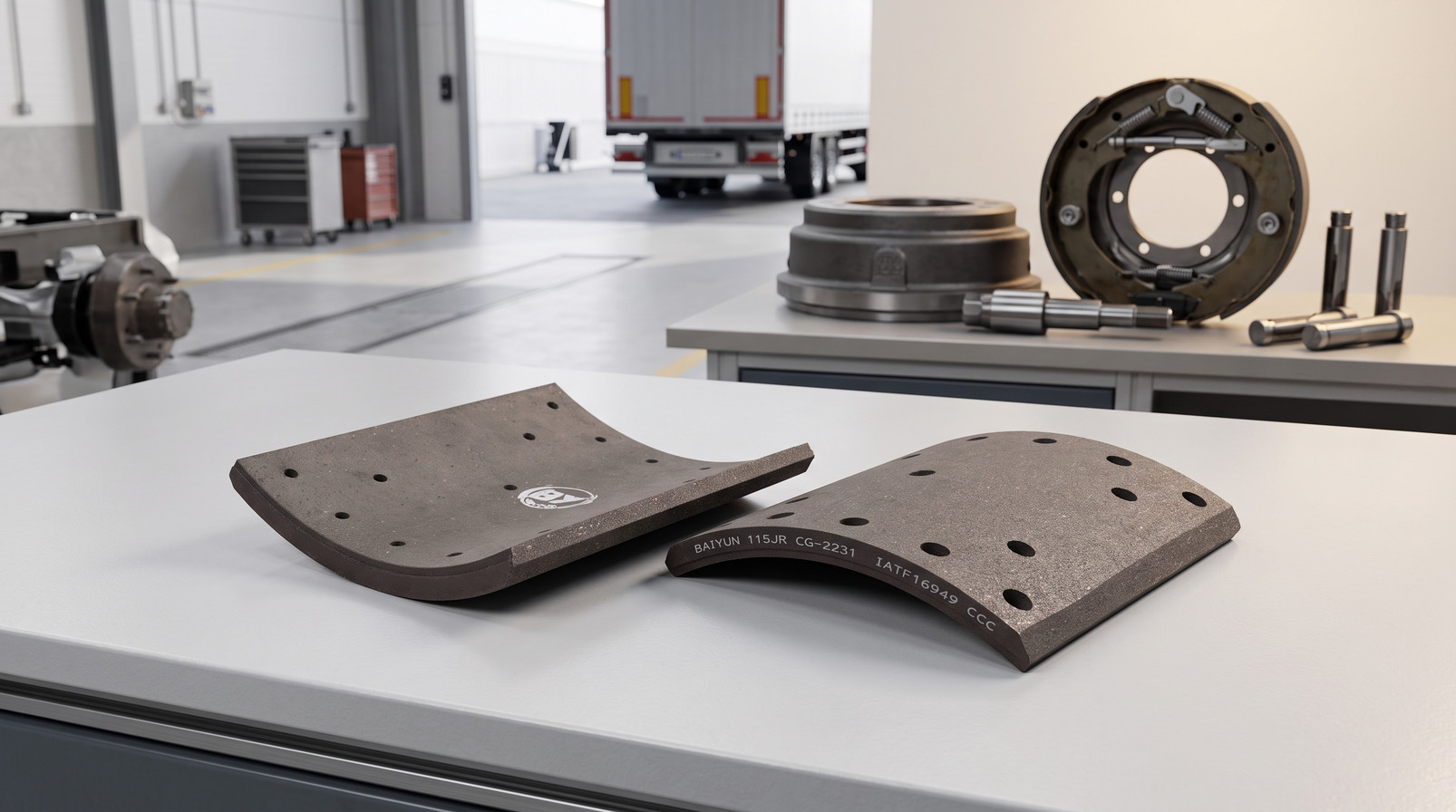
Quick answer: How to choose brake lining supplier starts with fitment, not price. The WVA 19032 brake lining measures 420 mm outer arc, 180 mm width, and 17/18 mm thickness, with 10 rivet holes and an R205 radius for BPW trailer axles using S-cam drum brakes. Order from a supplier that confirms these dimensions against your existing linings, shares IATF 16949 and ECE R90 certificates, and supports you with technical verification before shipment. If your supplier cannot produce a dimensioned drawing or a batch test report, walk away.
Why Does Choosing the Wrong Truck Brake Lining Supplier Hurt Your Fleet Operation?
A distributor sourcing 500 sets monthly can't afford inconsistent friction coefficients batch to batch. If a batch runs 8% softer, drivers report longer stopping distances on loaded trailers, and your warranty claims eat the margin you saved. For BPW trailer axles, the WVA 19032 lining must seat properly in the drum; even a 2 mm width difference changes heat distribution across the shoe.
From a sourcing view, the real cost isn't the lining. It's freight, customs delays, and the time your customer's trailer sits in the workshop. That's why you select a supplier first on verification capability, second on price. If you're reviewing your current vendor, start with commercial vehicle brake linings that come with controlled drawings and test documentation.
Summary: Supplier selection determines not just product cost, but fleet uptime, warranty exposure and repeat order stability.
What Are the Exact WVA 19032 Dimensions You Should Check?
WVA 19032 is not a universal size. The number comes from the European friction material classification system, but actual manufacturing tolerances still vary by factory.
| Parameter | WVA 19032 Specification | Why It Matters |
|---|---|---|
| Outer arc length | 420 mm | Drum shoe fitment on BPW trailer axles |
| Width | 180 mm | Contact patch and thermal load |
| Thickness | 17/18 mm | Wear reserve and drum clearance |
| Rivet holes | 10 | Rivet pattern alignment |
| Radius | R205 | Drum curvature match |
| Drum diameter | 420 mm | Full lining contact |
Public aftermarket listings for WVA 19032 show outer bow length around 222 mm and inner bow length around 205 mm, alongside the 420 mm drum diameter. Treat those as reference points, not as your purchase specification. Always request a controlled drawing from the brake lining supplier.
Summary: Always request a dimensioned drawing with tolerances, not just a WVA number.
How Do You Verify Fitment Before Placing a Bulk Order?
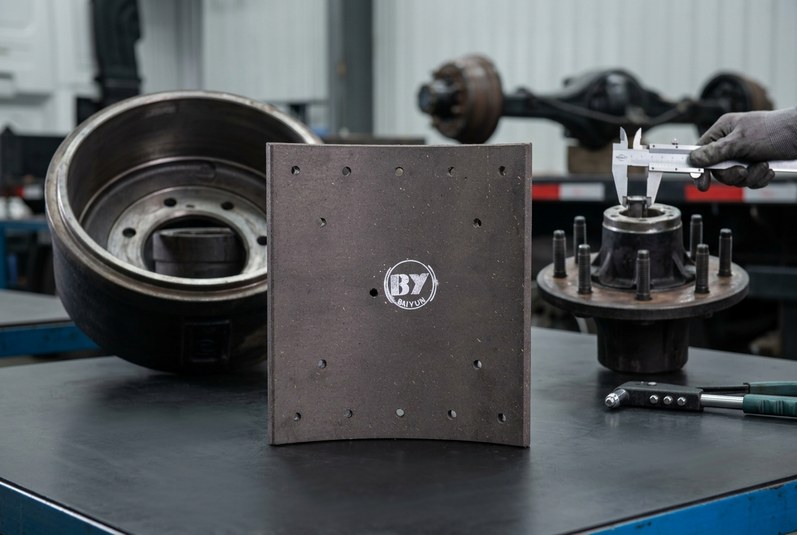
Fitment verification starts on the bench, not after the container lands. For WVA 19032, one mismatched hole pattern can force you to re-drill or scrap an entire pallet.
- Measure outer arc length, width, thickness on three used linings, not one.
- Count rivet holes and check hole-to-hole spacing against a template.
- Verify R205 radius with a radius gauge or compare against drum internal radius.
- Confirm S-cam orientation and anchor pin location on your brake shoe.
- Ask the supplier for a signed fitment confirmation for BPW trailer axles.
- Request pre-shipment photos of batch stamps and packing list.
If you need installation guidance, review our brake lining installation guide before relining brake shoes.
Summary: A 30-minute bench check prevents a 30-day return cycle and a lost distributor account.
What Certifications and Friction Material Questions Should You Ask a Truck Brake Lining Supplier?
ECE R90 is not a paper formality. In the European aftermarket, a replacement lining must be approved for the specific brake system, so a supplier cannot simply paste an approval number on any WVA number.
Ask for the approval certificate or homologation document that ties the formulation to WVA 19032. Also check that the factory holds IATF 16949 certification and ISO 9001 for quality management. BAIYUN Brake's commercial vehicle production runs link each batch to raw material lot records, which matters when a fleet reports inconsistent wear.
On friction material, determine whether the lining is semi-metallic, low-metallic, or ceramic, and ask for the SAE J2522 or GB 5763 dynamometer report. You want stable friction across 100–350°C loaded trailer operation, not a peak number that fades after one long descent.
Use our material data sheets as a template for what a serious supplier should provide.
Summary: Certifications and dyno data are the difference between a supplier that stands behind the lining and one that ships and disappears.
What Are the Most Common Misconceptions About Choosing a Brake Lining Supplier?
Misconception: All WVA 19032 linings are identical. Reality: Dimensions can match, but friction formulation, rivet grade and heat treatment vary. A low-cost lining may fade 20% sooner in continuous mountain descents.
Misconception: The cheapest quote saves money. Reality: Freight, import duty, return logistics and downtime can double landed cost if fitment fails. A $45 per set listing might become $110 landed after returns.
Misconception: ECE R90 certification is optional for aftermarket. Reality: In many EU and Middle East markets, uncertified linings cannot clear customs or pass fleet audits.
Summary: Cheap, non-verified linings create hidden costs that show up as downtime and rejected shipments.
How Can You Compare Truck Brake Lining Supplier Quotes Without Overpaying?
Price per set is only one line. A $45 per set WVA 19032 quote from one supplier might become $72 landed after freight, palletizing, duty and customs inspection, while a $48 quote with better packing and fewer handling charges lands lower.
Ask for quote details: Incoterm, pallet size, packaging type, lead time, payment terms, and whether the price includes batch test reports. If you also buy disc brake pads for mixed fleets, compare wholesale CV brake pads inquiry separately; bundling can unlock better freight efficiency but also complicates certification checks.
Summary: Compare landed cost and technical documentation, not FOB headline price.
What Questions Do Importers Ask Before Switching Brake Lining Suppliers?
Q: How do I confirm WVA 19032 fits my BPW trailer axle?
A: Measure your current lining against 420 mm outer arc, 180 mm width, 17/18 mm thickness, 10 rivet holes and R205 radius. If any number is off by more than 0.5 mm, ask the supplier for a sample before committing.
Q: What MOQ should I expect for truck brake linings?
A: Many aftermarket suppliers set 100–200 sets per WVA number as a starting MOQ, with container-level pricing at 500–1,000 sets. Sea freight from China to major EU ports typically runs 28–35 days, so factor that into your order cycle.
Q: Is ECE R90 approval required for WVA 19032 linings in all markets?
A: ECE R90 is mandatory for replacement brake linings in EU and many Middle East markets. Some African or Asian fleets may accept non-R90 product, but customs audits and insurer requirements increasingly favour R90-approved linings.
Q: What friction material should I choose for BPW trailer brake linings?
A: Low-metallic and semi-metallic formulations are common for heavy trailer use because they manage heat well. Ask for a dynamometer report covering 100–350°C so you can verify that friction stays stable under loaded descents.
Q: How can I avoid receiving linings with the right dimensions but wrong rivet hole pattern?
A: Request a 1:1 CAD drawing or a physical sample before production. Check that all 10 holes align with your brake shoe template, and have the supplier sign off on your drawing confirmation.
If you're due for a supplier review, start with the fitment checklist above. At BAIYUN Brake, we've spent 49+ years making commercial vehicle brake linings that clear ECE R90 and IATF 16949 audits, and we'll send you the dimensioned drawing before you commit. Request a quote for commercial vehicle brake linings or contact our export team with your WVA number and annual volume.
V30 Related Technical Pages
- WVA 19032 Dimensions
- WVA 19032 Cross Reference
- WVA 19032 Application Guide
- Commercial Vehicle Brake Pads
- Commercial Vehicle Brake Linings
- Request a Wholesale Quote
Was this article helpful?
Average Rating: 5/5 (396)