
Disc Brake Pad Fitment Verification: What Buyers Should Check
Summary:
Disc brake pad fitment verification is the most overlooked step in commercial vehicle brake sourcing. This technical guide explains how importers, distributors and fleet buyers can check WVA numbers, pad dimensions, friction codes, retention hardware and ECE R90 approval before placing an order. Written for wholesale buyers, it covers supplier verification, documentation requests and cost-saving fitment workflows. BAIYUN Brake's IATF 16949 certified facility uses a three-layer fitment check to reduce post-delivery disputes to below 0.5%. You'll learn which questions to ask a commercial vehicle brake pads supplier, what red flags to spot in a catalogue, and how cross-checking drawings protects landed cost. The article also includes a buyer verification checklist and answers five common fitment questions. Use this guide to verify truck and bus brake pad fitment with confidence and avoid returns, warranty claims and fleet downtime.
Disc Brake Pad Fitment Verification: What Buyers Should Check
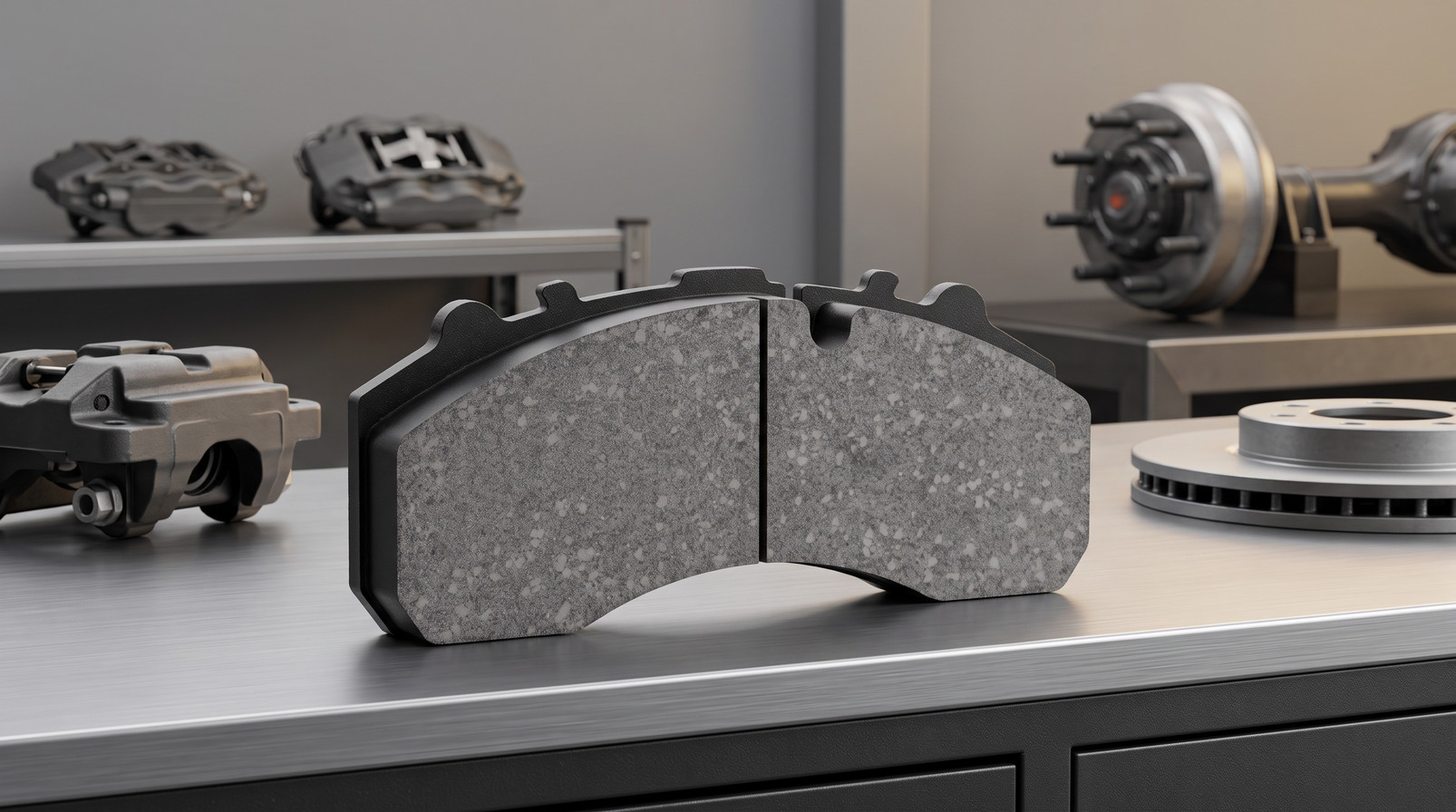
Quick answer: Disc brake pad fitment verification is the pre-purchase process of matching a commercial vehicle brake pad to the correct caliper, axle and friction approval. You need to check the WVA number, pad width, height and thickness, backing plate shape, retention springs or clips, friction code, and ECE R90 test approval against your OE reference. Never rely on a photo or a generic model name. If a supplier can't provide dimensional drawings and homologation data, walk away. For importers and fleet buyers, this one step prevents most returns, warranty claims and vehicle downtime.
Why Does Fitment Verification Fail for Many Commercial Vehicle Buyers?
Most fitment problems don't start with a bad factory audit. They start with a buyer approving a quote based on a photo and a part number that turns out to be a similar reference. Trucks and buses run dozens of caliper families across brands, and two pads can look identical while differing in backing plate thickness by 0.5 mm or more. That difference changes caliper clearance, retraction, and noise behavior.
At BAIYUN Brake, we treat disc brake pad fitment verification as a sourcing gate, not a paperwork formality. Our IATF 16949 certified facility documents pad geometry, friction coefficient and ECE R90 approval before a sample is shipped. According to ECE Regulation 90, a brake pad must maintain at least 80% of its cold effectiveness after thermal cycling to 400°C. That's part of fitment evaluation because an approved pad that doesn't fit mechanically still fails the fleet.
Summary: Fitment failure is usually a pre-shipment verification failure, not a manufacturing defect.
What Are the Three Fitment Layers a Buyer Should Check?
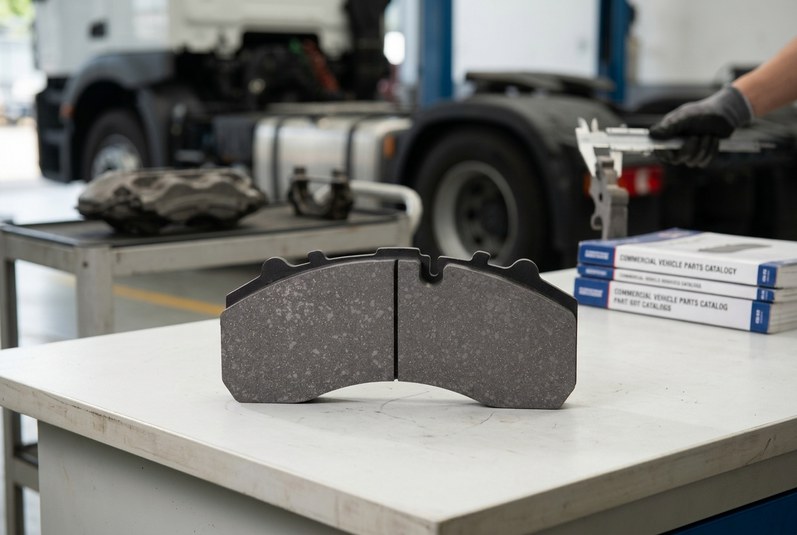
There's no single number that proves fitment. You need three layers of confirmation: mechanical dimensions, friction performance, and retention hardware. Missing any of the three opens the door to field issues.
What mechanical dimensions define pad fitment?
WVA number, pad length, width, total thickness, backing plate thickness, ear position and piston contact area. Request a drawing with tolerances. At BAIYUN Brake, catalogue references such as CP2218, CP2215 and CP2203 are kept on file with caliper family and WVA data. Exact WVA dimensions: Confirm with supplier catalogue.
What friction and homologation data should you verify?
Friction class and ECE R90 approval number. In BAIYUN Brake's 2025 dynamometer testing, a commercial vehicle disc pad formulation recorded 0.38-0.42 friction coefficient across 100-350°C, but that value must be confirmed against the specific reference. ECE R90 covers performance, not mechanical fitment.
What retention hardware and wear features matter?
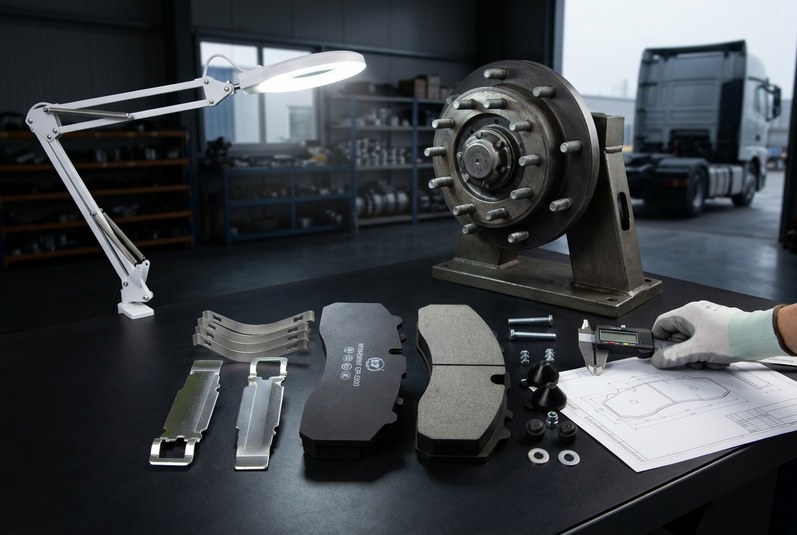
Anti-rattle springs, retention clips, backing plate shims and wear indicators. A missing clip can cause caliper noise and uneven pad movement. Check whether the supplier includes hardware as part of the pad kit.
| Verification point | What to request | Why it matters | BAIYUN Brake practice |
|---|---|---|---|
| WVA number | Stamped or printed number on pad backplate and catalogue page | Identifies dimensional family and mounting interface | Confirm with supplier catalogue |
| Pad dimensions | Length, width, total thickness, backing plate thickness with ±0.3 mm tolerances | Prevents caliper bind and retraction issues | Confirm with supplier catalogue |
| Caliper family / OE reference | OE part number, caliper model, axle application | Confirms pad must fit exact brake system | Cross-checked before sample dispatch |
| Friction material code | Manufacturer friction class and dynamometer report | Confirms braking performance and wear consistency | 0.38-0.42 friction coefficient in 2025 CV dynamometer test |
| Homologation | ECE R90 approval number and test report | Required for road-use commercial vehicles in many markets | ECE R90 certified |
| Retention hardware | Included clips, springs, shims, wear indicators | Avoids noise and uneven pad movement | Kit scope checked at order confirmation |
Summary: The three fitment layers are mechanical dimensions, friction homologation, and retention hardware. Check all three before accepting a quote.
How Do You Cross-Check a Supplier's Fitment Claim Against OE Data?
Take your OE part number and the supplier's WVA reference. Put them side by side. If the supplier says equivalent but doesn't provide a dimension overlay, ask for a PDF drawing. BAIYUN Brake offers a download our product catalogue with code-level references, but every buyer should still confirm against their own fleet data.
Ask for the drawing to show total thickness, backing plate flatness and retention clip position. Don't accept a photo of a similar pad as proof. A truck brake pad that is 0.5 mm thicker in the backing plate can generate retraction drag and uneven wear within 5,000 km.
Summary: Cross-checking requires both the OE reference and the supplier's WVA drawing. A catalogue photo is not a fitment certificate.
Which Buyer Verification Checklist Prevents Costly Fitment Errors?
Use this checklist before you sign a proforma invoice or release a deposit. Look for a trusted brake pad supplier that treats this checklist as standard export documentation.
- WVA number and OE cross-reference confirmed on supplier drawing
- Pad length, width, thickness and backing plate tolerance within ±0.3 mm
- Friction code and ECE R90 approval number valid for target market
- Retention clips, springs and wear indicators included in packing list
- Sample photo shows backplate stamp, shim and friction material edge
- Factory audit evidence: IATF 16949 or ISO 9001 certificate current
- Batch inspection records for thickness, shear strength and flatness supplied
Summary: A written checklist with dimensional and homologation proof removes most subjective supplier evaluation before samples ship.
What Are the Most Common Misconceptions About Disc Brake Pad Fitment Verification?
Misconception: If the pad looks the same, it fits.
Reality: Two pads can share the same outer silhouette while differing in backing plate thickness, ear geometry or clip position. A 0.5 mm thickness variation changes caliper clearance and wear behavior, even when the pad fits into the caliper body.
Misconception: WVA number alone confirms mechanical fitment.
Reality: WVA is one identifier. The same WVA family can cover multiple friction classes and hardware kits. You still need caliper family and retention hardware confirmation. BAIYUN Brake's internal discrepancy review shows fitment errors often happen when WVA is read without the drawing.
Misconception: ECE R90 approval proves the pad will fit every vehicle in that application.
Reality: ECE R90 proves friction performance and conformity of production. It does not test mechanical fitment across all OE variations. Fitment remains a separate engineering check.
Summary: Visual similarity, WVA alone and ECE R90 approval are necessary but not sufficient for fitment verification.
How Should Importers Use Fitment Verification to Cut Sourcing Cost?
Fitment verification isn't about avoiding a bad batch. It's about avoiding the 18-25% landed cost penalty that comes from return freight, re-inspection and line downtime when stock doesn't fit. A fleet buying 500 sets monthly can't absorb that. BAIYUN Brake's approach of checking fitment before samples prevents this. If you also source commercial vehicle brake linings, apply the same verification process.
So what does that mean for your bottom line? It means fewer inbound inspection failures and better warehouse throughput. The time spent checking drawings before payment is always cheaper than the time spent reworking a container that arrived with the wrong pads.
Summary: Fitment verification reduces total landed cost by preventing return freight, re-inspection and fleet downtime.
What Questions Do Importers Ask About Disc Brake Pad Fitment Verification?
Q: How do I verify a WVA number if my supplier doesn't provide dimensions?
A: Ask for the stamped backplate photo and catalogue page. If they can't provide it, stop. ECE R90 performance approval does not replace dimensional fitment, so missing WVA data is a sourcing red flag.
Q: Which standards should a commercial vehicle brake pad carry?
A: For road-use trucks and buses in most export markets, ECE R90 homologation is required. Depending on the destination, suppliers may also supply SAE J2522 dynamometer reports or GB 5763 test data. Request documentation that matches your local approval requirements.
Q: Is a factory audit enough to confirm brake pad fitment?
A: No. A factory audit confirms production control and certifications such as IATF 16949, but it doesn't verify that a specific part number matches your axle or caliper. You still need dimension drawings and WVA cross-checking.
Q: What tolerance should I accept on truck brake pad thickness?
A: A common inspection threshold is ±0.3 mm on total thickness and backing plate thickness. Tighter tolerances may be needed for air disc calipers with low running clearance. Always request the supplier's drawing with tolerance zones before payment.
Q: Can I use one commercial vehicle brake pad for multiple truck models?
A: Only if the WVA reference, caliper family, friction class and hardware kit match every model on your list. Even then, confirm each OE cross-reference individually. Do not assume that the same pad covers an entire brand range.
What Should You Do Next to Verify Disc Brake Pad Fitment?
Fitment verification doesn't cost you time. It returns it in fewer returns, fewer warranty claims and cleaner fleet uptime. If you're comparing suppliers, ask for the drawings and homologation numbers first. Browse our heavy-duty brake pad range and request a wholesale quote with your OE references. We'll run the fitment check before you commit a deposit.
Was this article helpful?
Average Rating: 5/5 (367)