
How to Choose a BPW Brake Lining Supplier
Summary:
How to choose BPW brake lining supplier starts with certifications, not price. A genuine BPW brake lining supplier must hold IATF 16949 and ECE R90 approvals, welcome factory audits, and provide dynamometer friction curves that prove batch consistency. BAIYUN Brake, with 49+ years of manufacturing experience, routinely cuts total sourcing costs by 15–30% for importers and distributors. This guide covers supplier verification, testing requirements, cost drivers, and common misconceptions—so you can qualify a partner before placing a container order. You'll learn why landed cost per axle per 100,000 km matters more than ex-works unit price, what red flags to watch in factory audits, and how to structure a pre-shipment batch test.
How to Choose a BPW Brake Lining Supplier
What Certifications Should a BPW Brake Lining Supplier Actually Have?
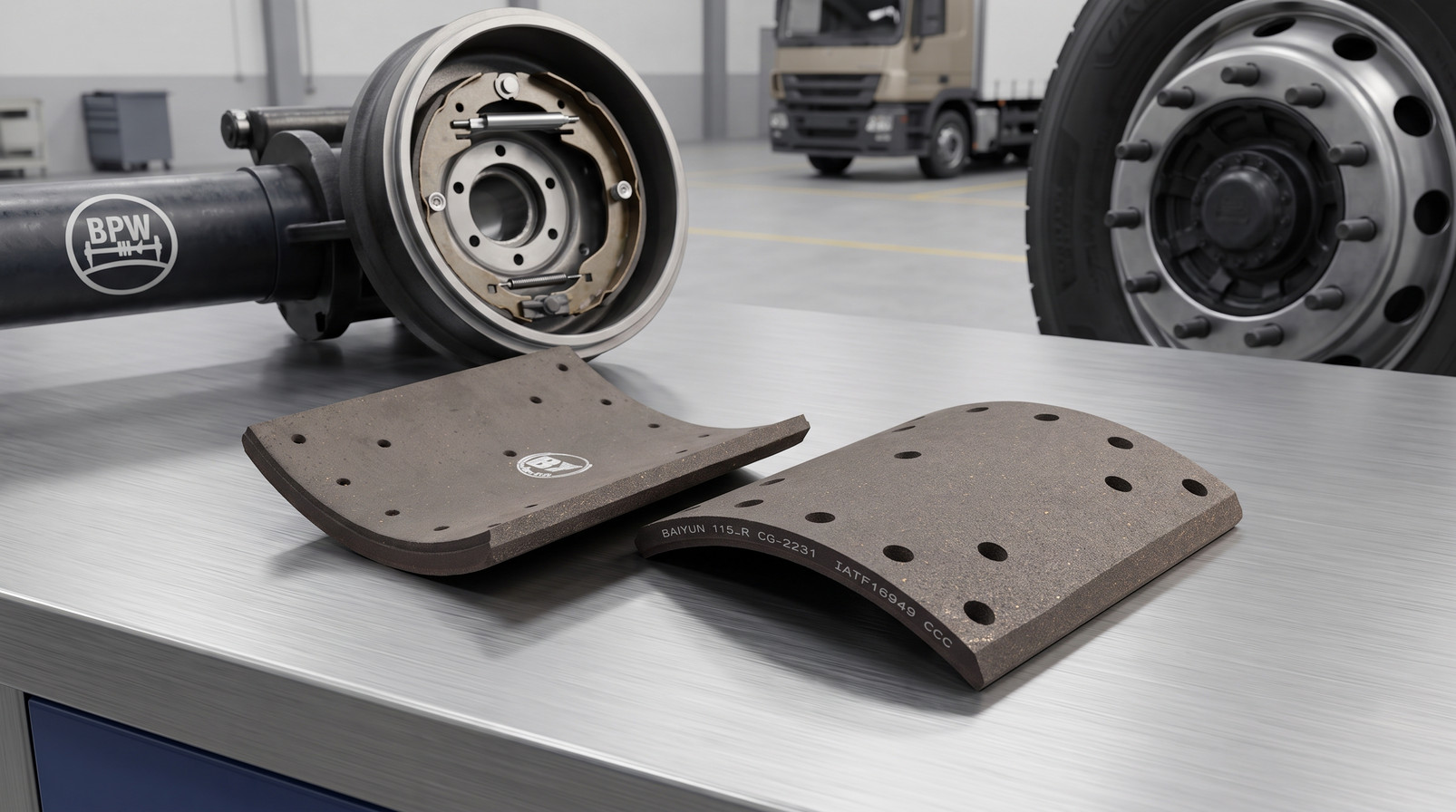
A buyer from Hamburg asked us last month for ECE R90 certificates before discussing price. That's smart. BPW trailer axles run hard. A brake lining failure on a 40-tonne combination isn't just a warranty claim, it's a potential road safety incident.
IATF 16949 confirms the supplier operates a quality management system designed for automotive series production. That includes process control, traceability, and defect prevention—not just final inspection. ECE R90 goes further on product performance. According to ECE Regulation 90, a replacement brake lining must not deviate from the reference lining's performance by more than 15% in cold and hot braking tests. If a supplier can't show an ECE R90 approval number matched to the exact BPW drum brake size you're buying, stop there. ISO 9001 is useful but not enough on its own.
At a facility like IATF 16949 certified facility from BAIYUN Brake, we hold all three certifications. You'll get the approval documents, test reports, and the factory tour invitation before you place a single order.
Certification summary: IATF 16949 plus ECE R90 is the minimum combination for BPW trailer axle linings; anything less increases your recall risk.
What Factory Audit and Verification Steps Should Buyers Take Before Signing a Contract?
Last year, a distributor we work with rejected three suppliers because none would allow a live video audit. That's not unreasonable. You're committing to 12 months of inventory. The factory must show how they mix friction materials, cure the linings, and track batch numbers.
| Verification Area | What to Request | Red Flag |
|---|---|---|
| Certifications | Valid IATF 16949, ECE R90 approval, ISO 9001 | Expired certs or approvals for different lining sizes |
| Factory Audit | Live video walkthrough or third-party audit report | No photos, no video, no on-site visit option |
| Friction Testing | Dynamometer reports with friction coefficient curves at 100–400°C | Only a one-page passed letter |
| Batch Consistency | Random batch samples from last 6 months, test data | No lot traceability system |
| BPW Model Coverage | Exact BPW axle model range and drum diameter; if not listed, confirm with supplier catalogue | Universal fit claims without test data |
| Logistics & Lead Time | Confirmed packing list, Incoterms, production lead time | Vague delivery windows or hidden freight charges |
Don't stop at the table. Run a practical checklist before signing anything:
- Request a live video tour of mixing, pressing, and curing areas, not just the warehouse.
- Ask for three importer references in your region with similar order volume.
- Order a pre-production sample and compare it against an original BPW shoe geometry.
- Run a random batch test on at least 20 sets before container loading.
- Confirm the batch code appears on each box and can be traced to the raw material lot.
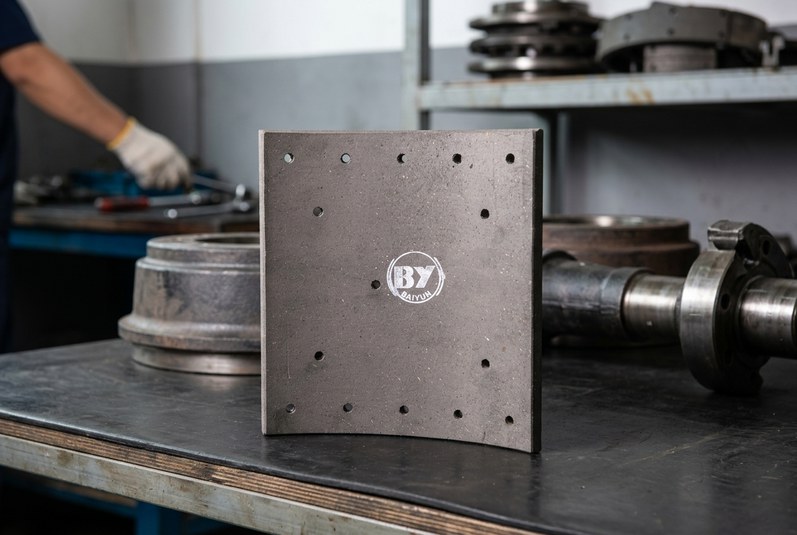
Verification summary: A supplier that refuses a factory audit or batch traceability check isn't saving you time—they're hiding a quality problem.
How Do You Evaluate Friction Performance and Batch Consistency?
A BPW drum brake lining on a 40-tonne trailer can reach drum surface temperatures above 350°C on long descents. If the friction coefficient fades at 300°C, braking distance increases at exactly the moment the driver needs it most. That's why ECE R90 testing includes hot performance checks.
When you evaluate a supplier, ask for dynamometer reports that plot friction coefficient against temperature. You want a curve that stays within a predictable band—typically 0.35–0.45 µ for heavy-duty drum linings—across cold and hot stops. Batch consistency matters just as much. If lining from container 1 grips at 0.42 µ and container 2 at 0.34 µ, fleet operators will notice uneven wear and brake imbalance. Require the supplier to state their batch-to-batch variation tolerance. Good manufacturers keep it within ±0.02 µ.
BAIYUN Brake's quality assurance system includes batch traceability from raw material mixing through curing, so each production lot can be traced to a raw material formula and test record. That's the kind of control that prevents hot returns. It's also why browse our brake lining product range includes the dynamometer curves, not just a certificate cover page.
Performance summary: Request full dynamometer curves, not just a pass/fail certificate, and confirm the batch-to-batch friction variation stays under ±0.02 µ.
What Are the Real Cost Drivers Beyond Unit Price?
Most buyers start with the ex-works price and stop there. That's a mistake. Freight, duties, warranty reserves, and container rejection rates often exceed the unit price difference. A lining that costs $0.30 more per set but ships with a 0.5% rejection rate is cheaper than a $0.20 cheaper lining with a 3% rejection rate.
BAIYUN Brake has worked with importers to cut total sourcing costs by 15–30% over a 12-month period, mainly by reducing quality claims, improving packing density, and shortening lead times. Ask the supplier for a landed cost model: ex-works price, freight per pallet, insurance, duty rate, and expected warranty reserve. Also compare the material formulation. Semi-metallic, low-metallic, and organic linings have different wear rates and drum wear characteristics. A lining that lasts 80,000 km may cost less per kilometre than one that lasts 60,000 km, even if the upfront price is higher. We usually advise distributors to calculate cost per axle per 100,000 km, not cost per box. If you also move disc brake pads for mixed fleets, request a quote for commercial vehicle brake pads can consolidate the shipment and lower freight per unit.
Cost summary: Compare landed cost per axle per 100,000 km, not ex-works price per box—that's how sourcing costs drop by 15–30%.
What Are the Most Common Misconceptions About Choosing a BPW Brake Lining Supplier?
We still hear three myths repeated in sourcing meetings.
Misconception: Any brake lining that fits a BPW shoe will perform the same. Reality: Fitment is just geometry. Friction stability, shear strength, and drum compatibility come from the friction formulation and curing process. Two linings with identical dimensions can differ by over 30% in fade resistance at 350°C.
Misconception: ECE R90 approval is only a European import document. Reality: ECE R90 is a performance requirement. Even in markets outside the EU, it serves as a proxy for hot and cold effectiveness testing. A supplier without ECE R90 cannot prove the lining matches original performance.
Misconception: The lowest unit price is the safest way to protect margin. Reality: Warranty returns, freight rework, and customer downtime usually erase the savings. BAIYUN Brake's import data shows a 15–30% reduction in total sourcing cost is often achieved by reducing defects, not by negotiating the last cent off unit price.
What Questions Do Importers Ask About BPW Brake Lining Suppliers?
Q: How do I verify a BPW brake lining supplier's ECE R90 approval is genuine?
A: Ask for the approval number and the test report showing the exact lining dimensions and friction class. Cross-check the approval number with the issuing authority's public database. A genuine BPW brake lining supplier will provide this within 48 hours, not weeks.
Q: What is the difference between IATF 16949 and ISO 9001 for a brake lining factory?
A: ISO 9001 covers general quality management. IATF 16949 adds automotive-specific requirements for traceability, defect prevention, and continuous improvement. For commercial vehicle brake linings, IATF 16949 is the stronger signal because it includes production part approval and full batch traceability.
Q: How many samples should I test before placing a container order?
A: At least 20 sets pulled randomly from a production batch, not hand-picked samples. Test them on a dynamometer across cold and hot cycles. If more than one set falls outside a ±0.02 µ friction band, pause the order.
Q: Can a single BPW brake lining cover all BPW drum brake sizes?
A: No. BPW axles come in different weight ratings and drum sizes. The supplier must confirm the exact BPW model range and drum diameter compatibility. If the catalogue doesn't list them, always write: Confirm with supplier catalogue.
Q: What lead time should I expect from a reliable BPW brake lining supplier?
A: 25–35 days is typical for a 20-foot container of commercial vehicle brake linings, excluding transit. Add 5–7 days for pre-shipment inspection and batch testing. If a supplier promises 10 days, you should question whether they're actually producing the linings or just repacking stock.
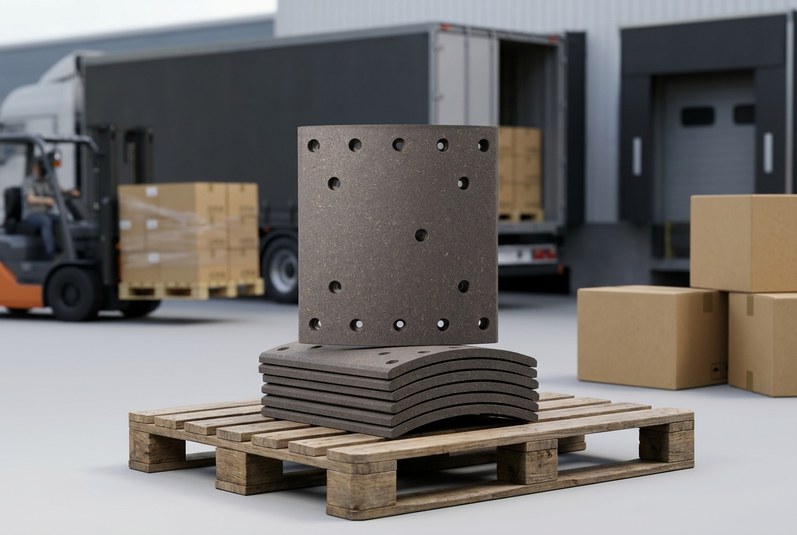
If you're tired of juggling three suppliers and still worrying about batch consistency, it's time to narrow the field. Request a quote for commercial vehicle brake linings from a manufacturer that shows you the test data, opens the factory door, and treats your landed cost as the real metric. Or contact our export team directly and we'll run through the BPW compatibility list with you.
Was this article helpful?
Average Rating: 5/5 (412)