
Brake Lining vs Brake Shoe: What Buyers Should Know
Summary:
Brake lining vs brake shoe explained: brake lining is the friction material, while the brake shoe is the curved steel carrier inside a drum brake. Commercial vehicle importers and fleet buyers often ask which one to source—the practical answer is usually a complete shoe-and-lining assembly. This technical guide covers the differences in force direction, heat range, shear bond requirements, ECE R90 certification, and IATF 16949 batch control. You'll also find a buyer verification checklist, five FAQ answers, and common sourcing misconceptions. BAIYUN Brake supplies both commercial vehicle brake linings and disc brake pads under certified production systems. Request a wholesale quote after confirming axle drum diameter, lining width, and annual volume.
Brake Lining vs Brake Shoe: What Buyers Should Know
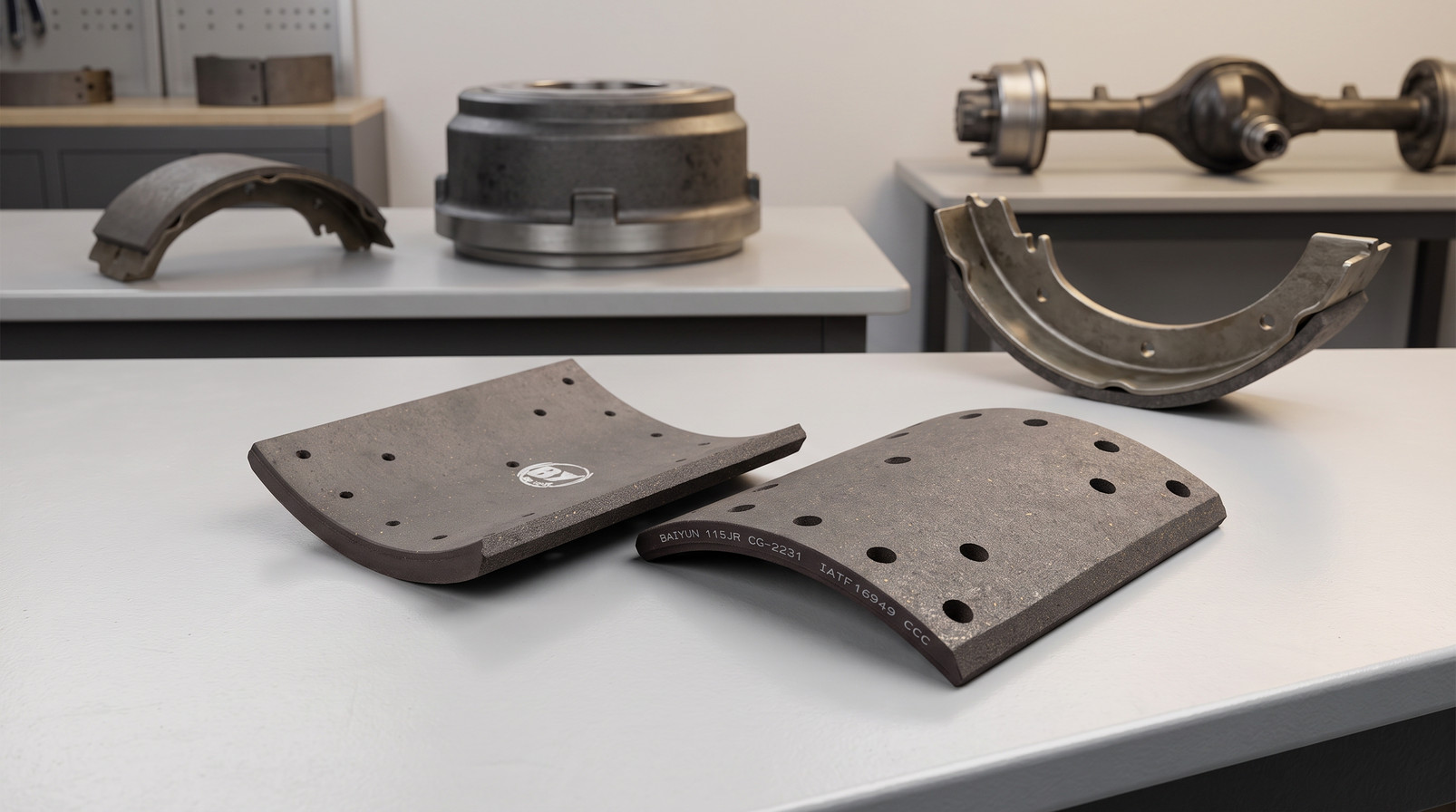
Quick answer: Brake lining is the friction material that does the stopping. Brake shoe is the metal carrier inside a drum brake. In a disc brake, pads clamp a rotor. In a drum brake, shoes push outward so the lining contacts the drum. For most commercial vehicle importers and fleet buyers, the practical order is a complete brake shoe assembly with the lining already bonded or riveted. That cuts risk of mismatched parts and simplifies warranty handling. You can request a quote for commercial vehicle brake linings either as bare lining or fitted assemblies.
What Exactly Is the Difference Between a Brake Lining and a Brake Shoe?
A brake lining is the friction material layer attached to a carrier; a brake shoe is the curved metal carrier used only in drum brake systems. That's the core difference in brake lining vs brake shoe explained for sourcing. Linings are made from friction compounds, often containing aramid fibre, brass chips, graphite, and phenolic resin. Shoes are stamped or welded steel profiles, formed to match drum diameter.
| Feature | Brake Lining | Brake Shoe | Buyer Impact |
|---|---|---|---|
| Base material | Friction compound with resin, fibres, metal particles | Stamped or welded steel | Inspect both material certs |
| Function | Creates friction against drum | Carries lining and transfers force | Weak shoe leads to tapered wear |
| Typical replacement unit | Bare lining set for relining | Complete shoe assembly with lining | Match to service model |
| Critical test | Friction coefficient, wear rate, fade recovery per ECE R90 | Dimensional fit, shear bond, cam profile | Request both test reports |
Buyers sometimes confuse linings with disc brake pads. Disc brake pads clamp a rotor from both sides. Drum brake shoes push outward. The force direction matters for wear patterns and heat dissipation. A drum brake lining sees high shear forces at the bond line, not just compressive force. That's why bond strength testing matters more on shoes than on disc pads.
In practice, a distributor can buy linings alone for relining programs or buy complete shoes. If your customers still rivet linings in-house, you need consistent thickness, chamfers, and drill hole patterns. If you buy complete shoes, you're really buying a validated assembly. BAIYUN Brake offers OEM brake lining solutions for both approaches.
Bottom line: A lining is material; a shoe is structure—they work together, and sourcing them as a matched set reduces field failures.
How Do Brake Linings and Brake Shoes Work Together in Commercial Drum Brakes?
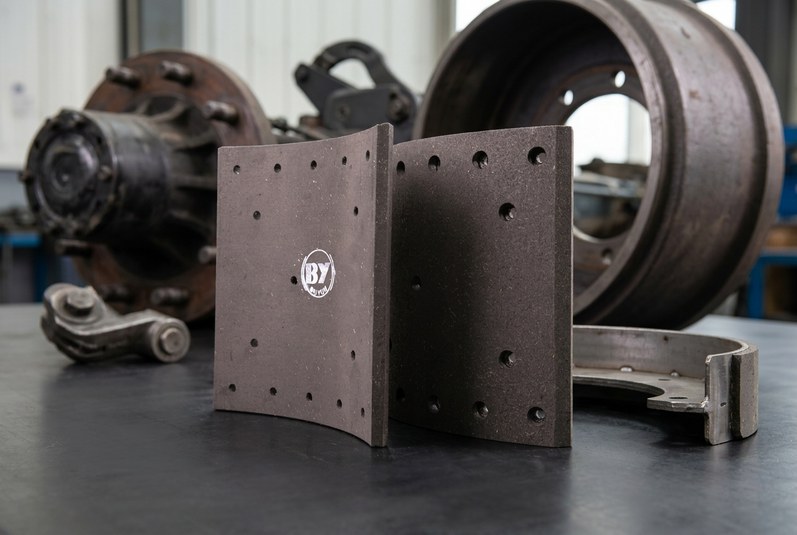
In a commercial vehicle drum brake, the wheel cylinder pushes the brake shoes outward until the linings press against the inside of the rotating drum. Friction between lining and drum converts kinetic energy into heat. Rear axle drum brakes on trucks and trailers often run cooler than front disc brakes, but they still see repeated temperature spikes of 200–400°C on long descents.
The shoe does more than hold the lining. It transfers braking torque through the anchor points and return springs. If a shoe flexes or rusts unevenly, the lining wears tapered. You'll see that as a warranty claim months later. A well-formed shoe with correct cam profile and an ECE R90-approved lining can maintain friction coefficient between 0.38 and 0.42 across normal operating temperatures, based on BAIYUN Brake's 2025 dynamometer records for commercial vehicle linings.
Force direction is also why drum brakes work well as parking brakes. The shoe geometry can self-energize, meaning the drum rotation helps pull the shoe into tighter contact. That design gives strong holding force with less hydraulic pressure. But it also means a worn lining or weak return spring can cause dragging, uneven heat, and cracked drums. For proper fitment, see the brake lining installation guide.
Summary: Lining and shoe function as one thermal and mechanical system; matching both to the drum diameter and axle load is non-negotiable for fleet uptime.
What Should You Check Before Confirming a Brake Shoe or Lining Order?
ECE R90 approval for commercial vehicle replacement linings is a legal requirement in EU and UNECE markets. The test compares aftermarket parts to original equipment performance, including cold stop distance, speed sensitivity, and recovery after high-temperature fade. Linings that pass ECE R90 must retain at least 80% of cold effectiveness after thermal cycling.
Beyond certification, your incoming QC should verify these points before a container ships:
- Friction coefficient range under hot and cold conditions, not just one average number.
- Shear bond strength between lining and shoe; poor bonding fails around 250–350°C under load.
- Drum diameter match for the axle model. Confirm with supplier catalogue if your drawing isn't on file.
- Chamfered edges and slot patterns to reduce noise and thermal cracking.
- Batch traceability, including friction compound lot numbers and cure dates.
- Rivet or adhesive type; structural rivets should not contact the drum even at full wear.
Frankly, the price gap between certified and uncertified linings rarely justifies the cargo insurance and warranty exposure. A container of axle sets that fail 3,000 km into service costs far more than the unit price difference. BAIYUN Brake runs incoming steel, friction compound, and finished assembly checks under an IATF 16949 certified facility system.
Checklist summary: Certification, shear bond, dimensional match, edge finish, and batch traceability are the five checks that prevent most import failures.
What Are the Most Common Misconceptions About Brake Lining vs Brake Shoe?
One common purchasing error is treating lining and shoe as interchangeable terms. They aren't, and the confusion leads to wrong RFQs. Here are three field-tested misconceptions.
Misconception: A brake lining and a brake shoe are the same part. Reality: The lining is only the friction material. The shoe is the steel carrier. A complete shoe assembly includes both. Importers who send an RFQ for "brake shoes" when they need bare linings often receive the wrong quote.
Misconception: Any lining can be riveted onto any shoe. Reality: Shoe radius, rivet hole position, edge clearance, and friction mix all need matching. A lining that's too thick reduces drum clearance and can overheat; a wrong radius wears the centre or edges first. Confirm with supplier catalogue when dimensions are not on your drawing.
Misconception: Disc brakes have linings, drum brakes have shoes, so fleets don't need both. Reality: Many commercial vehicles run disc brakes on the steer axle and drum brakes on drive or trailer axles. That means a mixed fleet must stock wholesale CV brake pads inquiry items and drum shoe assemblies in the same parts programme. Ignoring either leads to vehicle downtime.
Summary: Lining and shoe are separate components with separate QC requirements; mixed commercial fleets often need both drum shoes and disc pads.
How Do ECE R90 and IATF 16949 Affect Your Sourcing Decision?
ECE Regulation 90 sets minimum performance for replacement brake linings and drum brake shoes sold in EU and many export markets. The approval includes cold performance, speed sensitivity, and fade recovery tests against the original part. Passing parts must stay within a defined performance band, not just stop the vehicle once.
IATF 16949 is a process quality standard for automotive series production. It controls how the factory manages raw material, heat treatment, bonding, curing, and traceability. An ECE R90 certificate tells you the design passed. IATF 16949 tells you the factory can repeat that result consistently across batches. That's the difference between a golden sample and a sustainable supply chain.
In BAIYUN Brake's production data for commercial vehicle linings, friction coefficient control across a 100–350°C range remains within ±0.03, which supports stable braking on long-haul truck routes. The factory has supplied friction materials for over 49 years, including OEM and aftermarket programmes for trucks, buses, and trailers. You can review our 49+ years of manufacturing experience before shortlisting suppliers.
Summary: Buy ECE R90 for legal and performance confidence; buy from an IATF 16949 plant for batch-to-batch repeatability.
What Questions Do Buyers Ask Most About Brake Lining vs Brake Shoe?
Q: Can I buy brake lining without the shoe?
A: Yes. Many distributors run in-house relining programmes. You'll need to specify drum diameter, lining width, thickness, rivet hole pattern, and friction compound. BAIYUN Brake supplies bare linings and can match your existing shoe profiles after sample approval.
Q: Is a brake shoe always sold with lining?
A: Not always. Some aftermarket suppliers sell bare shoes for relining, but complete shoe assemblies are more common in export trade. A complete assembly should include bonded or riveted lining, return springs where required, and ECE R90 marking. Confirm packaging contents before comparing prices.
Q: What temperature range should a commercial brake lining handle?
A: For truck and trailer drum brakes, look for stable friction from around 100°C to 400°C. Long mountain descents can push drum temperatures past 350°C. ECE R90 fade testing covers recovery from high-temperature conditions, so approved linings should maintain at least 80% of cold effectiveness after thermal load.
Q: How do I verify a Chinese brake lining supplier is reliable?
A: Request the ECE R90 approval number, IATF 16949 certificate, and a recent batch test report. Ask for shear bond test data and friction coefficient curves at 100°C, 200°C, 300°C, and 350°C. Then check whether the supplier can provide batch traceability from raw material lot to finished set. If not, keep looking.
Q: What is the typical import lead time for commercial brake shoes and linings?
A: Depending on tooling and order size, lead times run 25–45 days after drawing confirmation. Existing tooling shortens this to 15–25 days. Custom compounds or unusual drum diameters add 10–15 days for raw material curing and test validation. Request a request a wholesale quote with your annual volumes to get a production schedule.
What Should You Do Next?
Start with your axle population. Map every truck, trailer, and bus in the fleet to drum diameter, shoe width, and current lining spec. If you don't have that data, pull one sample from each axle and send it to your supplier for matching. That's faster than guessing and cheaper than stocking wrong parts.
Then challenge suppliers on performance, not just price. Ask for ECE R90 certificates, IATF 16949 scope, friction curves, and shear bond records. If a factory can't produce those, the savings won't survive the first warranty wave.
BAIYUN Brake supplies commercial vehicle brake linings and C.V. brake pads for distributors and fleets in Europe, the Middle East, Asia, and Latin America. When you're ready to compare specs and lead times, get in touch with our export team with your target volumes and axle list.
Was this article helpful?
Average Rating: 5/5 (485)