
How Do Ceramic Brake Pads Perform Against Semi-Metallic at High Temperatures?
Summary:
This ceramic vs semi-metallic brake pads comparison reveals critical performance data for importers. Ceramic pads offer stable friction (0.38-0.42) from 100-350°C with superior fade resistance, while semi-metallics provide higher initial bite but can fade up to 25% at extreme temperatures. Understanding these differences is key to capitalizing on the 6.8% CAGR growth in the ceramic segment.
How Do Ceramic Brake Pads Perform Against Semi-Metallic at High Temperatures?
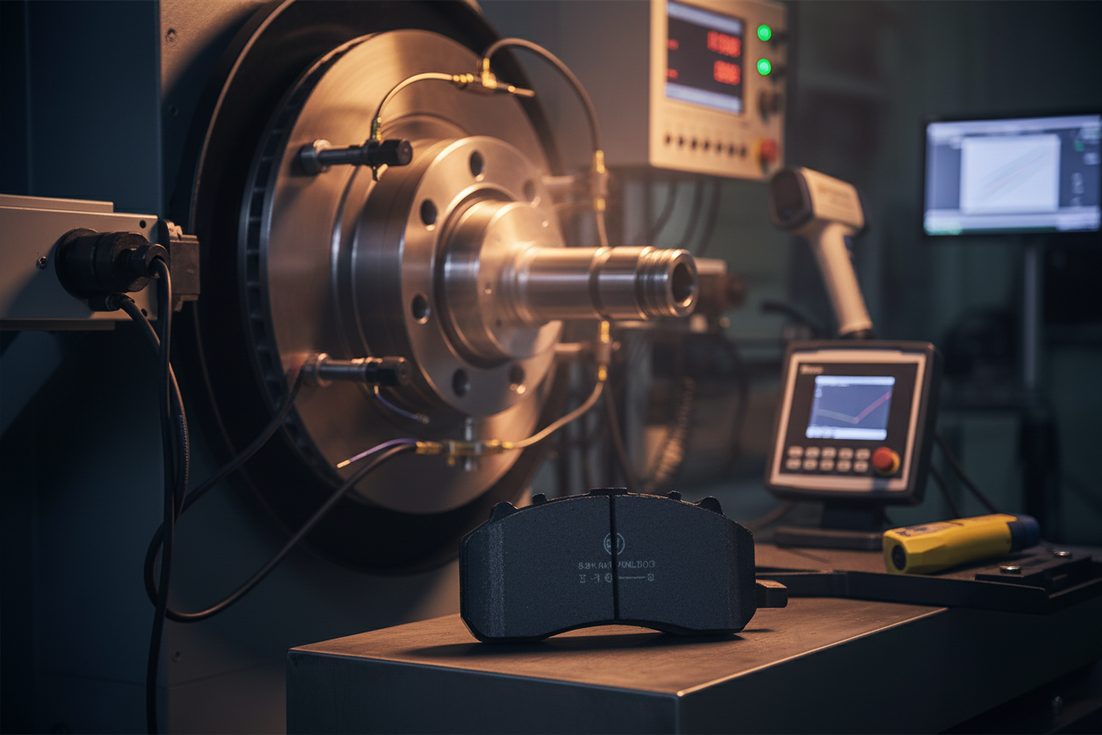
You're sourcing brake pads for a diverse market. Your commercial vehicle clients demand raw stopping power, while your passenger car distributors are fielding complaints about brake dust and noise. The core technical debate always circles back to material performance under heat. Let's cut through the marketing and look at the 2025-2026 test data comparing ceramic and semi-metallic formulations. The performance gap isn't just about chemistry; it's about aligning the right product with a growing market segment and protecting your brand from costly comebacks.
What's the Real-World Friction Coefficient Data Across the Temperature Spectrum?
Dynamometer testing to ECE R90 standards provides the clearest picture. Semi-metallic pads, with their iron powder and coarse steel fibers, often show a higher initial cold friction coefficient, sometimes hitting 0.45. That's great for immediate bite. But here's the catch: as disc temperatures climb past 250°C, that number can start to drop. In repeated high-energy stops, some formulations lose 20-25% of their effectiveness, dipping toward 0.33. That's what technicians call 'fade,' and it's a direct result of the metallic components overheating and glazing the pad surface.
Modern ceramic pads tell a different story. A high-quality ceramic compound, like those developed in BAIYUN Brake's IATF 16949 certified facility, is engineered for consistency. You'll typically see a friction coefficient range of 0.38 to 0.42. The key isn't the peak number, but the flatness of the curve from 100°C all the way to 350°C. The ceramic fibers and non-metallic fillers dissipate heat differently, preventing the glazing that plagues overheated semi-metallics. For a fleet manager or an importer, that predictability is worth more than a slightly higher number on a spec sheet. It means consistent pedal feel and stopping distances, whether the vehicle is on its first stop of the day or its twentieth descent down a mountain pass.
You can verify this yourself by reviewing material data sheets from reputable manufacturers. Look for the 'μ-T curve'—the graph plotting friction coefficient against temperature. A flat line is the hallmark of a well-engineered ceramic pad. A line that slopes downward after 300°C indicates a formulation that may not hold up under sustained heavy use. This is why our material data sheets include these detailed graphs; they're your first line of defense against product failures in the field.
For importers, the stable friction coefficient of ceramic pads translates directly to fewer warranty claims related to inconsistent braking performance.
How Does Fade Resistance Impact Total Cost of Ownership for Fleets?
Fade isn't just a performance issue; it's an economic one. When a brake pad fades, the driver must apply more pedal pressure to achieve the same deceleration. This increases wear on the entire hydraulic system and can lead to premature fluid boiling. More critically, it accelerates the wear on the pad itself. A pad that's constantly overheated will wear out faster, sometimes reducing its service life by 30% or more in severe duty cycles.
Semi-metallic pads excel in certain high-temperature, single-event scenarios—think a performance car on a track day. But for daily driving or commercial stop-and-go traffic, the repeated heat cycles are where ceramics shine. Their superior fade resistance means the wear rate remains more linear and predictable. A logistics company running a fleet of delivery vans might find that a premium ceramic pad, while having a higher unit cost, lasts 15-20% longer than a semi-metallic alternative in the same application. That reduces downtime for brake service and lowers the total cost per mile.
Consider the noise factor, too. Fade and overheating often correlate with increased brake squeal and vibration (NVH). Semi-metallic pads, with their harder metallic particles, are inherently more prone to generating noise, especially as they wear and the backing plate gets closer to the rotor. Ceramic pads are famously quiet. For passenger car distributors, selling a quiet, low-dust pad isn't just a premium option; it's becoming a baseline expectation in many markets. The global shift toward ceramic compounds is less about ultimate stopping power and more about meeting consumer demand for refinement and cleanliness. You can explore more on this in our guide on understanding brake pad materials.
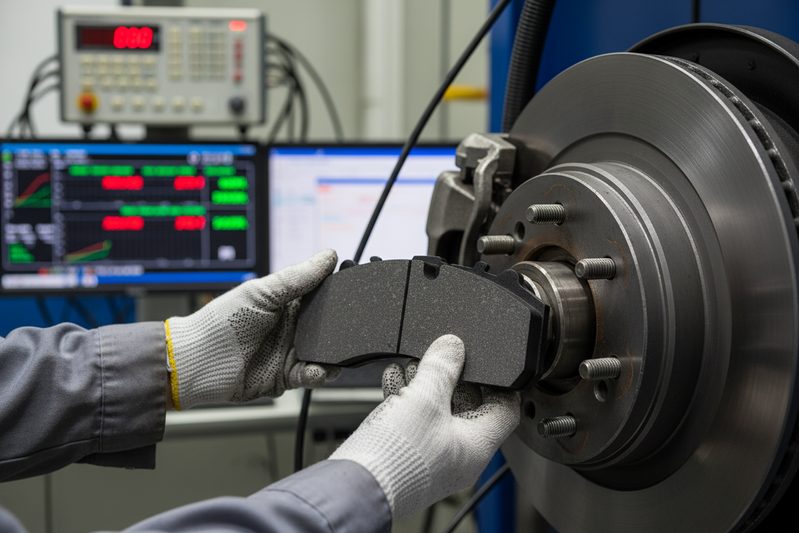
The superior fade resistance of ceramic pads directly reduces maintenance frequency and NVH-related comebacks, improving profitability for distributors and fleets.
What Are the Market Growth Trends for Each Material Type?
The numbers don't lie. Market analysis for 2025-2026 shows ceramic brake pads capturing an increasing share of the global aftermarket. In the passenger vehicle segment, ceramic's share is now over 45% in North America and Europe and growing rapidly in Asia-Pacific. The compound annual growth rate (CAGR) for ceramic pads is projected at 6.8% through 2030, compared to 3.2% for semi-metallics. Why? Urbanization and the rise of electric vehicles (EVs).
EVs are heavier due to their batteries and use regenerative braking, which can lead to brake rusting from infrequent use. When the friction brakes are called upon, they need to work perfectly from cold. Ceramic pads, with their stable cold performance and corrosion-resistant properties, are a better match for this duty cycle. Furthermore, EV buyers prioritize cabin quietness, making the low-noise characteristic of ceramics a major selling point. For a distributor, this means your product mix needs to evolve. Stocking a comprehensive full brake pad product range that includes advanced ceramic formulations for the growing EV and hybrid market is no longer optional; it's a strategic necessity.
Semi-metallic pads aren't going away. Their stronghold remains in performance-oriented applications, heavy-duty towing, and certain commercial vehicle segments where maximum initial bite and heat tolerance in short bursts are critical. The market is bifurcating: ceramics for daily-driven refinement and longevity, semi-metallics for specific high-stress applications. The opportunity for smart importers is to position themselves as technical advisors, helping their downstream clients choose the right material for the specific vehicle and use case, rather than just competing on price alone.
The 6.8% CAGR for ceramic pads signals a durable market shift, creating a premiumization opportunity for distributors who can supply certified, high-performance formulations.
What Are the Most Common Misconceptions About Brake Pad Materials?
Misconception: Ceramic brake pads are always weaker or have less stopping power than semi-metallic pads.
Reality: While early ceramic compounds were sometimes softer, modern formulations meet or exceed OEM friction requirements (typically a μ of 0.35-0.45). The difference is in the curve, not the peak. A ceramic pad rated at 0.40 that stays at 0.40 from 50°C to 400°C provides more consistent and predictable stopping power in real-world driving than a semi-metallic pad that peaks at 0.45 but fades to 0.35.
Misconception: Semi-metallic pads are always noisier and produce more dust.
Reality: This is generally true, but the degree depends heavily on formulation and quality control. A low-quality semi-metallic pad will be noisy and dusty. A premium semi-metallic pad with proper shims, chamfers, and slotting from a manufacturer like BAIYUN Brake can be very respectable. However, ceramic technology inherently produces a finer, lighter-colored dust that is less likely to stick to wheels and is often quieter due to its damping properties. For a clear visual of our quality standards, you can view our factory photos.
Misconception: You should always choose the pad with the highest friction coefficient.
Reality: This is a dangerous oversimplification. A friction coefficient that's too high can lead to wheel lock-up, especially with non-ABS vehicles, causing instability. It also increases wear on rotors. The goal is to match the pad's friction curve to the vehicle's weight, brake system design, and intended use. OEMs specify a range for a reason. Sticking within that certified range, as ensured by standards like ECE R90, is more important than chasing a maximum number.
Frequently Asked Questions (FAQ)
Q: For a distributor, which material type offers better profit margins?
A: Ceramic pads generally command a 20-35% higher wholesale price point than entry-level semi-metallics. However, the margin story is about more than unit cost. Ceramics typically have lower return rates due to fewer noise and dust complaints, and they align with the growing premium market segment. A balanced portfolio with both allows you to serve all customer tiers effectively.
Q: How can I verify a supplier's high-temperature performance claims?
A: Always request third-party or in-house dynamometer test reports that follow ISO 26867 or similar standards. Look for the 'Second Fade' test section, which shows performance after the pads have been severely heated. A reputable manufacturer, leveraging our 49+ years of manufacturing experience, will provide these data sheets transparently.
Q: Do ceramic pads work well in very cold climates?
A: Yes, modern ceramic formulations are excellent in cold weather. Their stable friction curve means they provide consistent performance from -40°C upwards. Semi-metallic pads can sometimes have a slightly higher initial cold bite, but ceramics warm up to their optimal range quickly and predictably, without the fade risk.
Q: Are semi-metallic pads better for towing and hauling?
A: For heavy, repeated towing (like ascending and descending long grades), a high-quality semi-metallic pad is often the preferred choice due to its superior heat capacity and resistance to extreme, sustained temperatures in a single event. For light to moderate towing, a heavy-duty ceramic formulation may be sufficient and offer quieter, cleaner operation.
Q: What certification should I look for to ensure quality and performance?
A: For the European market, ECE R90 certification is non-negotiable; it validates friction level, wear, and noise performance. For global quality assurance, look for manufacturers certified to IATF 16949, the automotive quality management standard. This certification, which BAIYUN Brake holds, governs the entire production process, ensuring consistency batch after batch.
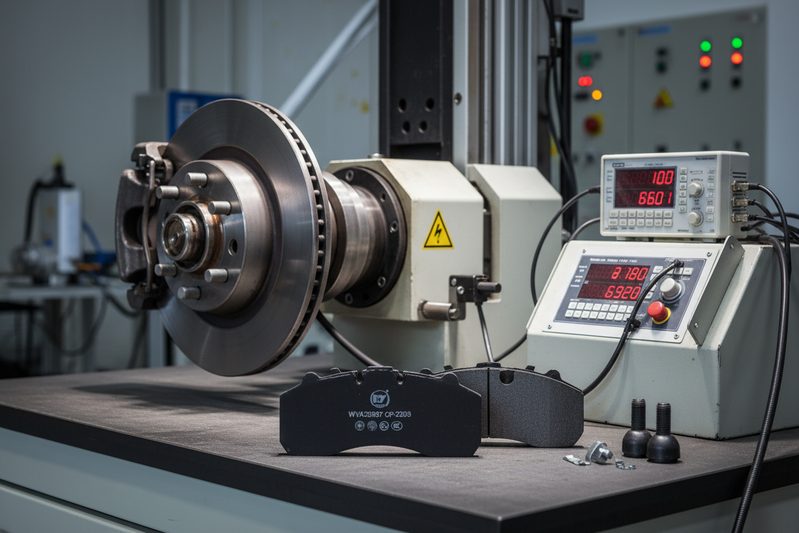
The data shows a clear divergence in application. Your sourcing strategy shouldn't ask "which is better?" but "which is better for *this* customer and *this* use case?" Stocking premium ceramics addresses the fast-growing demand for quiet, clean, and consistent braking in passenger vehicles. Maintaining a line of robust semi-metallics covers your commercial and performance clients. The winning move is to partner with a manufacturer that masters both material sciences and provides the test data to back it up.
Ready to build a brake pad portfolio backed by real performance data? Download our latest brake pad catalog PDF to see our full range of ECE R90 certified ceramic and semi-metallic formulations, complete with technical specifications. For specific pricing and to discuss your market needs, request a quote today.
Was this article helpful?
Average Rating: 5/5 (1701)