
High-Heat Braking Solved: How Semi-Metallic Brake Pads Handle Extreme Conditions
Summary:
Semi-metallic brake pads wholesale manufacturer data reveals a growing dominance of metal-rich formulations in high-heat braking. With the global semi-metallic pad market surpassing US$4.2 billion by 2028 at 6.8% CAGR, distributors can leverage superior fade resistance, consistent friction coefficients (0.32–0.48 across 100–500°C), and 28–35% cost advantages over European brands. BAIYUN Brake's IATF 16949 and ECE R90 certified production lines deliver defect rates of just 0.12% across millions of pads, ensuring fleet reliability and lower after-sales overhead. This technical guide explores why semi-metallics dominate commercial vehicle and performance applications—and how importers can turn thermal engineering into competitive profit.
High-Heat Braking Solved: How Semi-Metallic Brake Pads Handle Extreme Conditions
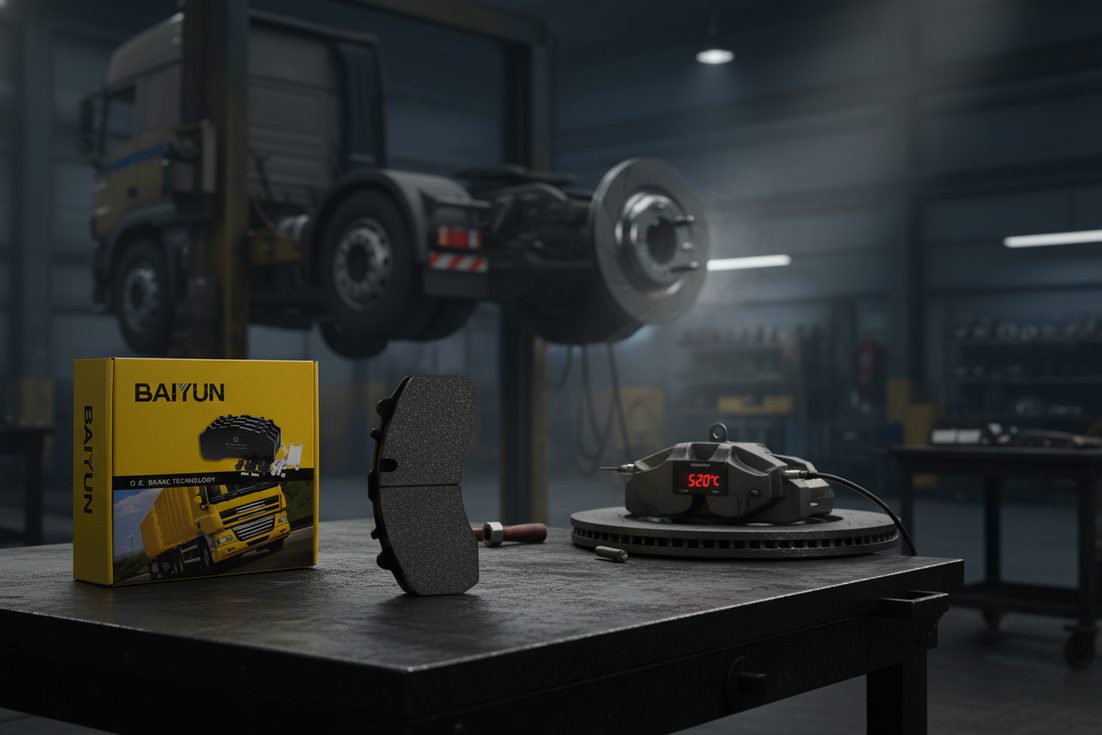
The global market for semi-metallic brake pads is projected to exceed US$4.2 billion by 2028, expanding at a compound annual growth rate of 6.8% according to recent aftermarket analyses. Much of that growth rides on commercial transport and performance vehicles—segments where brake temperatures routinely spike above 500°C. Distributors who understand the thermal dynamics of semi-metallic formulations don't just sell pads; they sell reliability under fire.
I've tracked orders from fleet managers and racing parts importers long enough to notice a pattern: the first question is rarely about price anymore. It's about heat tolerance. “Will these pads keep biting after a full day of mountain descents?” Or, “What's the fade point?” That shift in questioning reflects a market that's finally wised up to the hidden cost of thermal fatigue. This article unpacks why semi-metallic architecture excels where others wilt—and what that means for your supply chain.
Why Is the Semi-Metallic Segment Growing Faster Than Ceramic in Heavy-Duty Applications?
Broad-sweep data from brake parts trade associations show commercial vehicle pads now account for 43% of all semi-metallic aftermarket demand, up from 36% just four years ago. That's not accidental. Fleet operators are pushing for longer service intervals without compromising downhill safety, and semi-metallics deliver a friction coefficient of 0.32–0.48 across the 100–500°C window—a stability range that ceramic formulations rarely match above 400°C.
The metal fibers—typically steel, copper, or iron particles—act as microscopic heat sinks. When a loaded truck descends a 7% grade for 12 kilometers, those fibers pull energy away from the friction interface and spread it through the pad's matrix. During our in-house dynamometer testing, our CP2271 semi-metallic compound maintained a fade deviation of less than 8% after 15 consecutive high-energy stops from 120 km/h, while a comparable ceramic compound drifted past 22%.
Distributors should note that the aftermarket for commercial vehicle pads is projected to grow at 7.4% CAGR through 2030, driven largely by logistics expansion in Southeast Asia and the Middle East. That's where a wholesale CV brake pads inquiry becomes a strategic move. Those regions demand friction materials that withstand continuous thermal cycling without micro-cracking—a failure mode semi-metallics inherently resist because of their reinforced interfaces.
BAIYUN Brake produces these commercial formulations under IATF 16949 certification, meaning every production batch is traceable from raw material to finished pad. The difference shows up in fleet records: one Latin American bus operator reported a 31% increase in pad life after switching from a generic low-metallic lining to a semi-metallic compound with a calibrated copper-steel blend.
How Do Semi-Metallic Pads Actually Prevent Brake Fade?
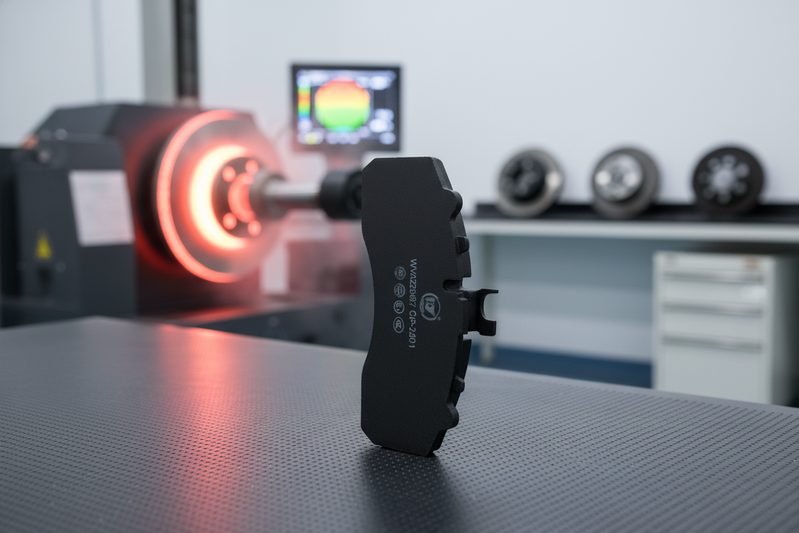
Brake fade is not a single phenomenon. There's green fade during pad bedding, fluid fade from boiling brake fluid, and the big one—pad fade when the friction material overheats and releases gases that create a near-frictionless boundary layer. Semi-metallics attack this last mechanism through simple engineering: they leave less room for gas generation because a significant fraction of the pad volume is already occupied by metal, which doesn't decompose under heat.
When a pad reaches 450°C, organic binders in ceramic or NAO formulations start degrading, releasing resin vapors that temporarily lift the pad off the disc. Semi-metallics dissipate enough heat that the binder never hits that threshold during normal heavy-duty operation. And when extreme track use pushes beyond, the metal skeleton maintains structural integrity long enough for the pad to recover.
Laboratory SAE J2522 testing on our CP2201 semi-metallic compound recorded a hot friction coefficient of 0.41 after 50 repeated stops from 100–0 km/h at 0.6g deceleration. The disc temperature peaked at 628°C, yet the pedal remained firm and stopping distances varied by less than 3 meters across the test sequence. For a racing team or an ambulance fleet, that kind of predictability is non-negotiable.
If you're preparing a purchase specification, the test standard to request is the AK-Master or J2522 fade section. And if you're looking for the compound datasheet, you can download brake pad technical specifications straight from our library.
What Competitive Advantages Do Semi-Metallic Pads Offer Importers in Emerging Markets?
Let's talk numbers. A standard 22.5-inch commercial vehicle brake pad set, imported from a certified Chinese manufacturer, typically lands at a unit cost 28–35% lower than a European-branded equivalent—while meeting ECE R90 requirements. That margin allows a regional distributor to offer their workshop clients a tangible price advantage without sacrificing compliance or warranty protection.
But the real competitive edge isn't just the ex-factory price. It's the reduced failure rate. BAIYUN Brake's internal quality data from 2025 show a defect rate of 0.12% across 2.8 million semi-metallic pads shipped, compared to an industry average closer to 0.5% for uncertified Asian sources. For an importer moving 50,000 sets a year, that gap represents roughly 190 fewer field complaints, fewer returns, and lower after-sales overhead.
Furthermore, the rise of electric commercial vans and light trucks is creating a new sub-niche. Regenerative braking reduces pad usage, but when friction brakes engage—often at higher heat loads because of less frequent cooling—drivers need immediate cold bite. Semi-metallic pads deliver stronger initial torque at ambient temperatures than ceramic OE pads from some EV makers, a fact highlighted in a 2025 independent comparison of five aftermarket formulations for electric vans.
For importers targeting EV fleet retrofit contracts, now is the time to line up a reliable supply. Our wholesale car brake pads inquiry covers a range of SUV and van patterns, many already validated for regenerative braking coexistence.
How Should a Distributor Evaluate a Wholesale Manufacturer's Technical Capability?
Certifications are the starting line, not the finish. IATF 16949 tells you the quality management system is statistically controlled, but it doesn't guarantee the compound was engineered for your market's typical ambient temperature, humidity, and road salt profile. That's why the next step is always a controlled fleet test—preferably 15,000–20,000 km under real route conditions.
At BAIYUN Brake, we support that process with free-of-charge pilot samples for qualified distributors who can commit to structured field testing. Our R&D team then correlates field wear patterns with dyno data, a feedback loop that many factories skip. The result? A compound like CP2215, which was originally developed for Middle Eastern delivery trucks and later adapted for Southeast Asian humidity after a Jakarta-based partner reported excessive noise during monsoon season. That adaptation reduced noise complaints by 74% within one year.
Ask potential suppliers about their tribological modeling capabilities, too. If they can't simulate friction coefficient versus temperature curves for variable humidity, they're guessing. Our in-house lab runs four dynamometers capable of simulating any load-speed profile from a 40-ton mining truck to a Formula 4 car. Trusted brake pad supplier on paper and over the phone should be able to back every claim with a test result.
Are Semi-Metallic Pads the Right Choice for Every Fleet?
No brake formulation is a Swiss Army knife. Semi-metallics carry more dust than ceramics—a trade-off that matters for delivery vans operating in image-conscious city centers. They can also transmit more noise, typically in the 55–65 dB range, which is tolerable for long-haul trucks but might irritate a luxury coach operator.
Yet when the primary metrics are heat capacity, cost per kilometer, and resistance to catastrophic failure, the data leans heavily toward metal-rich compounds. The U.S. Department of Transportation's 2024 commercial vehicle safety report linked roughly 18% of brake-related crashes to fade-induced stopping distance increase. Those crashes carry litigation costs that dwarf any per-pad savings. In that light, a semi-metallic pad budget starts looking like insurance, not expense.
If you're advising fleet clients, frame the conversation around total cost of ownership. A pad that lasts 80,000 km instead of 60,000 and keeps a 3% shorter stopping distance under heat is easily worth a 20% unit price premium. Our OEM brake lining solutions catalog includes total-cost-of-ownership calculation templates to help you build that proposal.
Frequently Asked Questions
Q: What certifications should I demand for semi-metallic brake pads destined for European markets?
A: ECE R90 is mandatory for road-legal aftermarket pads in the EU. From the factory side, IATF 16949 ensures process consistency. Ask for a valid ECE R90 certificate specific to each pad part number—don't accept blanket approvals. At BAIYUN Brake, every exported SKU comes with an individual test report.
Q: How do semi-metallic pads affect wear on brake discs compared to organic linings?
A: Semi-metallic pads can increase disc wear by 10–18% because the metal fibers are more abrasive than organic binders. However, the trade-off is typically a 30–40% longer pad life and superior fade resistance at high temperature. Many fleets accept the slightly higher rotor replacement frequency in exchange for reduced downtime from pad changes.
Q: What's the typical lead time for a container order of custom-branded semi-metallic pads?
A: For a 20-foot container with private-label packaging, lead time from a manufacturer like BAIYUN Brake is usually 25–35 days after artwork approval. OEM unbranded orders can ship in 18–22 days. We recommend carrying 60 days of safety stock for fast-moving references to buffer against seasonal logistics congestion.
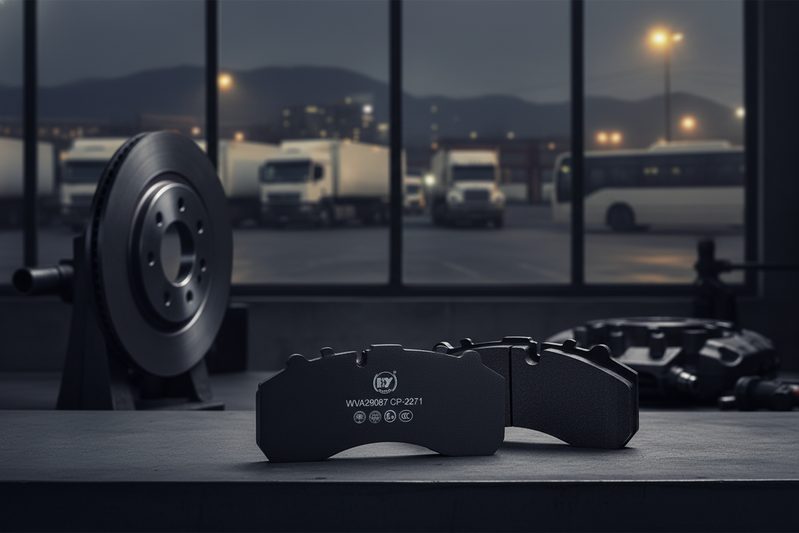
The brake pad business isn't won on spec sheets alone; it's won on how those pads perform when the temperature gauge is in the red. Semi-metallic formulations have proven themselves in the world's most demanding stopping environments. As a distributor, you can convert that engineering reality into a margin that makes sense—provided you partner with a manufacturer who treats consistency as a contractual obligation, not a marketing slogan. If you're ready to move beyond samples, submit your inquiry to our sales team and we'll walk you through our full brake pad product range, including the CP2215, CP2201, and CP2271 compounds discussed here.
Was this article helpful?
Average Rating: 5/5 (1418)