
Hey folks! I just received new OEM brake pads and rotors. Rotors were damaged in transit. would they still be viable for: Practical B2B Guide
Summary:
Hey folks! I just received new OEM brake pads and rotors. Rotors were damaged in transit. would they still be viable for installation? This practical B2B guide answers that Reddit-style buyer question for fleet managers, distributors, and maintenance teams. Damaged rotors with cracks, gouges, warping, or impact marks are not viable for a commercial vehicle. The two front brake pads showing uneven wear are also abnormal—new OEM pads should have consistent friction material thickness. The guide covers receiving inspection, damage classification, freight claim documentation, supplier qualification, and packaging standards. BAIYUN Brake's IATF 16949 and ECE R90 certified manufacturing process holds pad thickness variation under 0.3 mm, so uneven new pads are a red flag. We explain when to reject, how to document damage, and what wholesale buyers should demand from their truck brake pad supplier before the next shipment.
Hey folks! I just received new OEM brake pads and rotors. Rotors were damaged in transit. would they still be viable for: Practical B2B Guide
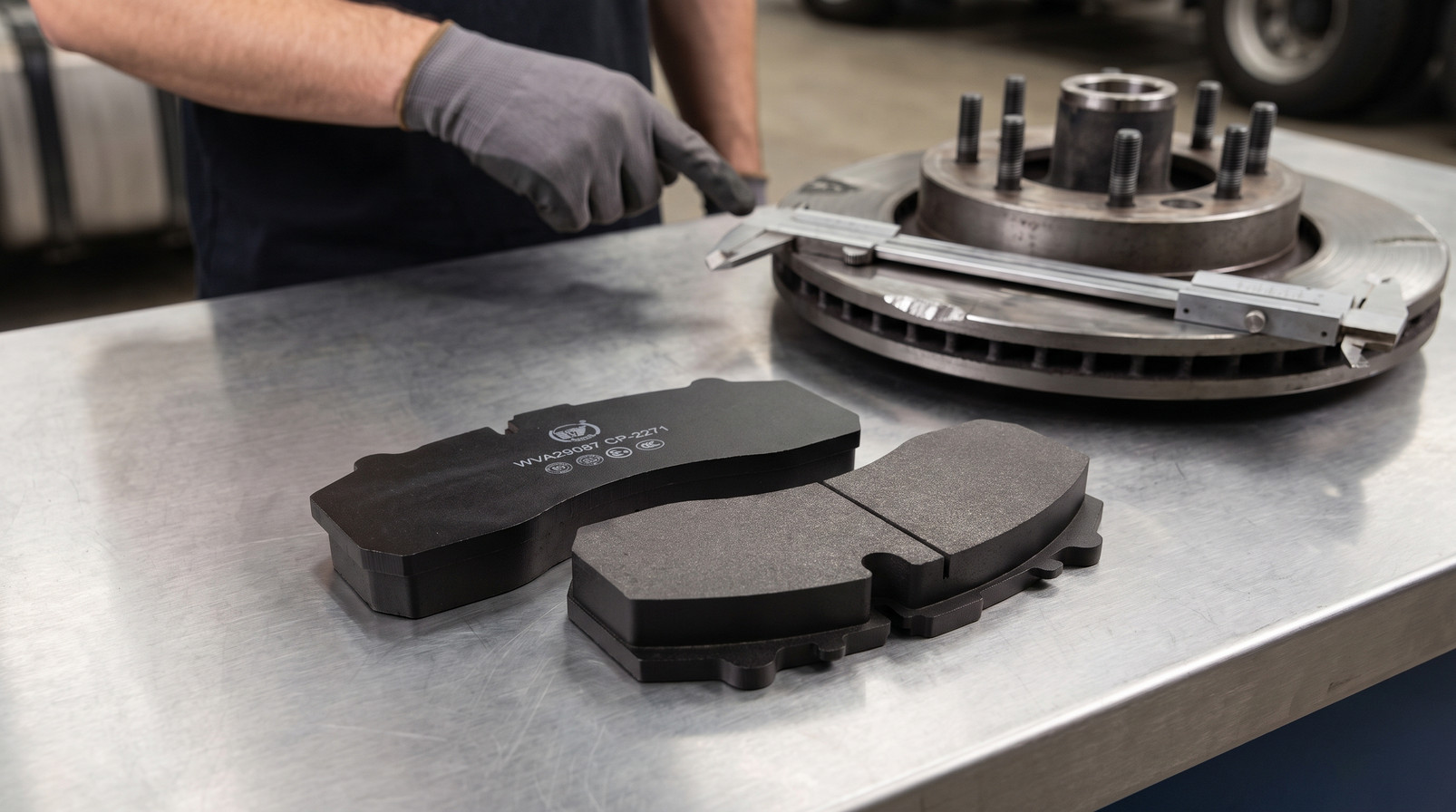
Quick answer: Damaged rotors with cracks, gouges, warping, or impact marks should not go on a commercial vehicle. Even minor shipping damage can create rotor runout, vibration, and premature pad wear. The two front brake pads showing uneven wear are also not normal—new OEM pads from a certified supplier should have consistent friction material thickness. Quarantine the shipment, photograph everything, and file a carrier claim or request replacement before the claim window closes. Don't mix suspect parts into good inventory.
You signed for a damaged shipment. Now what?
You sign for a pallet, the driver leaves, and then you peel back the shrink wrap. Two rotors have chips on the outer edge and one has a shallow scrape across the friction face. That's the moment to stop and document, not to grab a micrometer and hope for the best.
- Photograph the pallet, labels, and each damaged rotor from multiple angles before moving anything.
- Check the Bill of Lading. If you signed clean, your carrier claim position weakens. Most LTL freight carriers require claims within 3–7 days.
- Measure visible damage: chip depth, crack length, and rotor runout using a dial indicator on the hub face. No dial indicator? Mark the rotor as rejected.
- Quarantine the affected boxes and mark them DO NOT INSTALL. Mixing rejected parts with good inventory is how a rotor ends up on a steer axle.
- Contact your supplier or freight forwarder. Share photos, the packing slip, and the WVA reference if you have it.
When is a damaged rotor actually scrap?
Not every scuff means a scrap rotor, but the line between cosmetic and structural damage is thinner than most buyers think. For a heavy-duty truck rotor, a 1 mm deep gouge on the friction surface can reduce contact area and create hot spots. A crack of any visible length is a hard reject—cast iron doesn't heal.
| Damage type | Install? | Action |
|---|---|---|
| Light surface rust | Yes, after cleaning | Remove with a non-metallic abrasive pad; does not affect rotor integrity. |
| Edge chip outside the pad contact path, less than 5 mm | Conditional | Check for cracks extending inward; if none, may be acceptable after measuring balance and runout. Confirm with supplier catalogue for your application. |
| Crack, any length or direction | No | Immediate reject. Rotor can fail under thermal cycling and heavy braking. |
| Deep gouge or score on friction surface greater than 0.5 mm | No | Reduces stopping performance, causes pad material transfer and judder. |
| Warping or lateral runout beyond 0.15 mm | No | Even small runout causes pedal pulsation and cuts pad life by 30–40% on commercial vehicles. |
| Bent mounting flange or damaged hub mating face | No | Rotor won't seat true against the hub; clamping distortion can lead to disc thickness variation. |
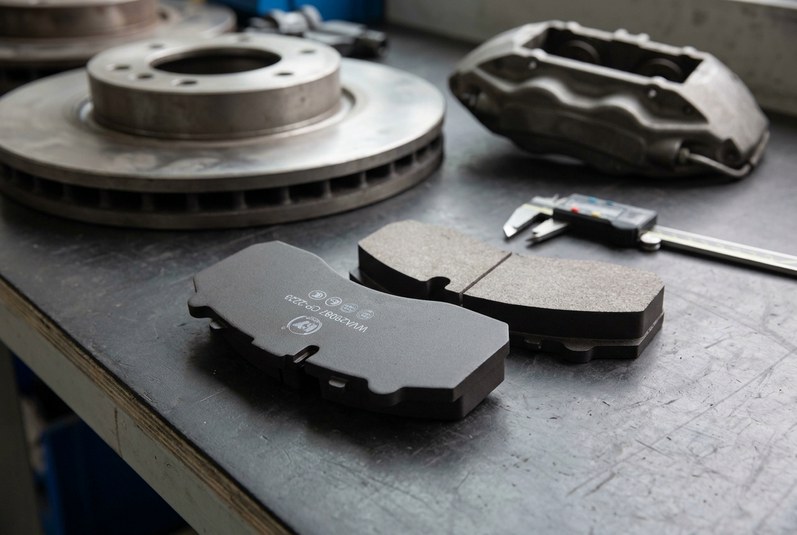
Why would two of four new brake pads show uneven wear before installation?
That detail should worry you more than the rotor chips. New pads don't wear themselves. If two of four front pads show uneven friction material thickness or an angle across the face, something happened before the box reached your dock.
Potential causes include a mixed production batch with different friction material compression or curing, mishandling that dropped a pad on edge and spalled the friction surface, counterfeit or repackaged sets where used pads got mixed into OEM-looking boxes, or a wrong pad from a different WVA reference slipped in during packing.
Uneven wear on new pads is not normal. Return the entire axle set, not just two pads. Mixing new and suspect pads on the same caliper creates taper wear, brake pull, and uneven rotor contact. At BAIYUN Brake, our outgoing QC holds pad thickness variation across a set under 0.3 mm for commercial vehicle disc pads. Anything beyond that triggers a full batch inspection.
How does this affect fleet maintenance and supplier audits?
A single damaged rotor that reaches a service bay can sideline a truck for a full shift. For fleets running 40–60 trucks, that's roughly $600–$1,200 per day in lost revenue and labor, not counting the cost of a second brake service. That's why incoming inspection matters as much as the purchase price.
Supplier audits should verify how the factory controls friction material density, curing time, dimensional checks, and packaging. A factory with IATF 16949 certification has process controls in place, and ECE R90 testing confirms pad performance under thermal load. Ask for batch test reports, not just a wall certificate. IATF 16949 certified facility documentation should show dimensional capability and defect rates.
What packaging failures cause rotor damage before the pallet even reaches you?
Heavy cast iron rotors are unforgiving in transit. If they're packed loose on a pallet with only a single layer of stretch film, they'll shift, slam into each other, and chip edges. Brake pads suffer from vibration abrasion if they're packed flat without interleaf sheets. A proper export pack for commercial vehicle brake parts uses edge protectors, dividers, and corrosion-inhibiting VCI paper. BAIYUN Brake ships commercial vehicle brake pads and linings in reinforced cartons with individual part wrapping to control moisture and movement.
For importers in the Middle East, Southeast Asia, or Latin America, ocean freight humidity can trigger surface rust even before the truck delivers. That rust is usually harmless, but if it hides a crack, you need to clean and inspect before accepting. Ask your trusted brake pad supplier how they pack mixed containers—rotors and pads should never share a carton without a rigid separator.
What's the right way for a distributor to handle replacement and claims?
If you import brake parts for resale, your purchase order terms determine whether this headache costs you money or just a few emails. Specify freight damage replacement in the original PO: who covers return freight, who covers inbound replacement freight, and what photo evidence is required.
When the damage is contested, request a third-party inspection before the parts leave your warehouse. Understand your supplier's lead time and MOQ. A replacement set of commercial vehicle brake pads or rotors can take 4–8 weeks if produced to order. Ask about buffer stock for fast-moving references. For distributors sourcing heavy-duty pads, browse our heavy-duty brake pad range to see how BAIYUN Brake handles export packaging and damage-free delivery.
Buyer verification checklist for damaged brake shipments
- Signed Bill of Lading with damage notation or subject to inspection.
- Photos of pallet, carton labels, and each damaged rotor from top, edge, and mounting face.
- Dial indicator readings for rotor runout on at least three points around the disc.
- Pad thickness measured at all four corners and center with a calibrated micrometer; record the variation.
- WVA reference and production batch code visible on each pad backing plate and box label.
- Supplier's freight damage claim form and contact window documented in writing.
Frequently Asked Questions
Can I install rotors with minor edge damage on a commercial truck?
Sometimes, but only if the chip is outside the pad contact path, smaller than 5 mm, and free of cracks. Measure runout and confirm with supplier catalogue. When in doubt, replace the rotor—the cost of a failed rotor on a loaded truck far exceeds the part price.
How much rotor runout is acceptable for a heavy-duty truck?
Most commercial vehicle applications require lateral runout under 0.15 mm. Beyond that, you'll see pedal pulsation, steering wheel shake, and uneven pad wear. Always check the manufacturer's spec, not a generic rule.
New brake pads show uneven wear—should I return the whole set or just two?
Return the complete axle set. Mixing two suspect pads with two good pads on the same caliper creates taper wear, pull, and uneven rotor contact. A certified supplier should replace the set without argument.
What documentation do I need for a freight damage claim on brake parts?
Photos of the pallet, each damaged part, the Bill of Lading with damage notation, and the packing slip showing part numbers and WVA references. File with the carrier within the claim window, usually 3–7 days for LTL freight, and copy your supplier.
How do I avoid receiving damaged rotors and pads next time?
Work with a supplier that uses export-grade packaging, ships on pallets with edge protectors, and provides batch-level QC reports. For commercial vehicle brake linings, brake lining installation guide includes packaging and handling notes that reduce transit damage.
If you're sourcing commercial vehicle brake pads or linings, BAIYUN Brake's export team can walk you through freight packaging options, replacement lead times, and batch inspection data. For a replacement set or new quote, request a quote for commercial vehicle brake linings or submit your inquiry to our sales team. We've spent 49+ years making sure parts arrive in the same condition they left the factory.
Was this article helpful?
Average Rating: 5/5 (194)