
Heavy Duty Truck Brake Pads: Complete Selection Guide for Fleet Managers
Summary:
For fleet managers and wholesale buyers, selecting the right heavy duty truck brake pads wholesale China is a critical decision impacting safety, downtime, and total cost of ownership. This guide analyzes material choices, decodes technical specifications, and reveals the hidden costs in sourcing to help you build a profitable, reliable supply chain. Learn how to verify certifications, ensure batch consistency, and partner with a supplier that delivers predictable performance mile after mile.
Heavy Duty Truck Brake Pads: Complete Selection Guide for Fleet Managers
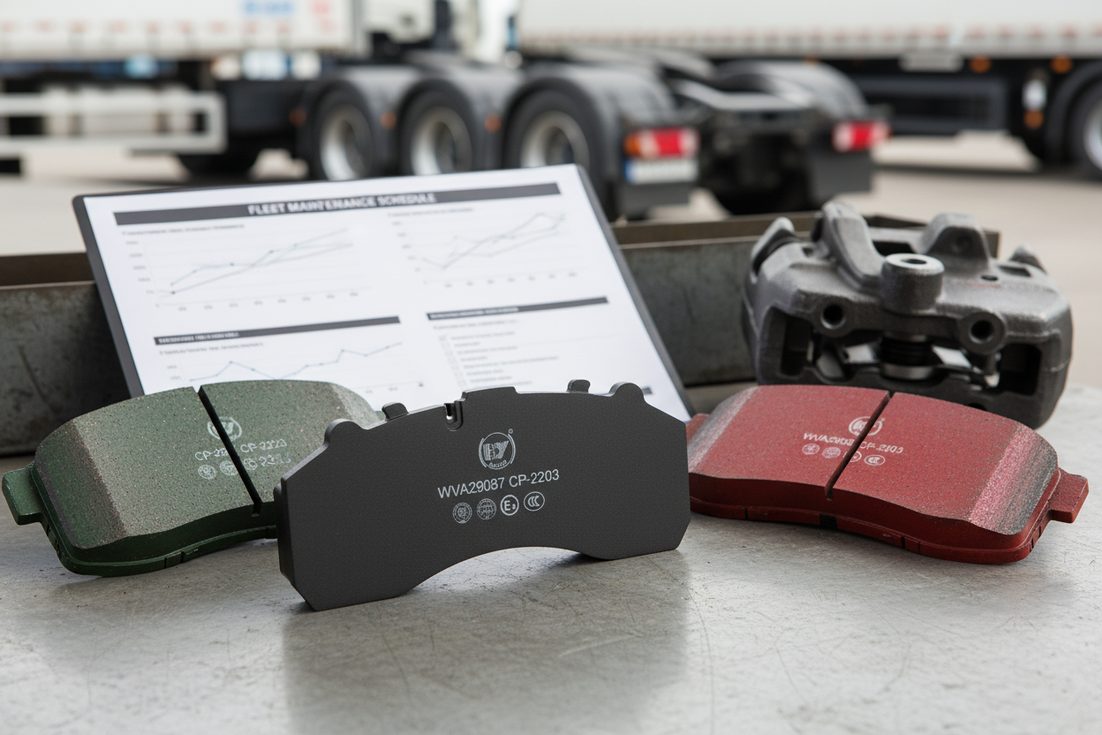
If you're sourcing brake pads for a fleet, you know the numbers. A single unscheduled maintenance event can cost over $1,200 in downtime and labor. Multiply that by a fleet of 50 trucks, and the wrong brake pad choice becomes a six-figure problem. For importers and distributors, the pressure is on to find a supplier that delivers not just a product, but a predictable, profitable cost-per-mile for your clients. This guide cuts through the noise, focusing on the technical and commercial factors that directly impact your bottom line when you're looking for heavy duty truck brake pads wholesale China.
Material Selection: It's About Total Cost of Ownership, Not Just Price
You'll see three main material types: semi-metallic, low-metallic NAO (Non-Asbestos Organic), and ceramic formulations. The cheapest pad per set isn't always the cheapest over 100,000 miles. Let's break it down for a fleet manager's perspective.
Semi-metallic pads are the workhorse for a reason. They offer a strong initial bite, good heat dissipation, and are cost-effective. They're a solid default for mixed on-highway fleets. But they can be harder on rotors, increasing your clients' total brake maintenance cost over time if rotor wear isn't factored in.
Low-metallic NAO pads, often with aramid or other synthetic fibers, generate less dust and are quieter. They're kinder to rotors, which extends the overall brake system life. For fleets in urban delivery or passenger transport where noise and cleanliness matter, this can be a smarter long-term play, even at a slightly higher unit cost.
Ceramic or ceramic-hybrid compounds are the premium tier. They excel at managing extreme heat from constant downhill braking or heavy stop-and-go traffic. They offer the longest life and minimal rotor wear. For mountainous routes or severe-duty vocational trucks, they can actually lower the total cost of ownership despite the higher upfront price. You can learn more about the science behind these choices in our guide to understanding brake pad materials.
Decoding Specifications: What Fleet Buyers Must Verify
You can't manage what you don't measure. When evaluating a supplier's heavy duty brake pads, technical datasheets are your best friend. Don't just glance at them; scrutinize them.
First, check the friction coefficient (the "μ" or "FF" rating). It's not a single number. A quality pad will list coefficients at low, medium, and high temperatures (e.g., 100°C, 200°C, 300°C). You want a stable curve. A pad that starts at μ=0.45 but drops to 0.30 at 300°C has fade risk. For consistent performance, look for a variation of less than ±0.10 across the temperature range.
Second, verify the load rating and application match. A pad designed for a 15-ton dump truck has a completely different reinforcement and heat capacity than one for a 3-ton delivery van. Using an under-spec pad leads to premature wear and potential safety issues. Always cross-reference the OEM part number or the supplier's application guide. BAIYUN Brake provides detailed commercial vehicle brake pad test report for this exact purpose.
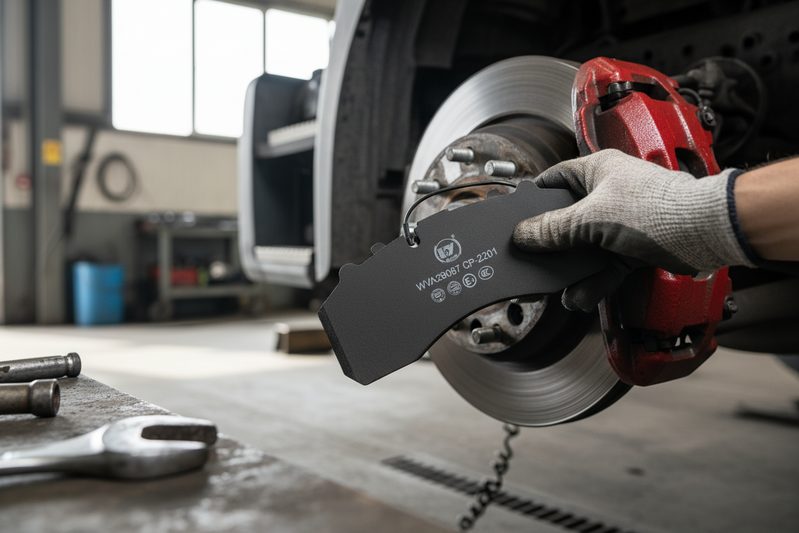
Third, look for the certifications. ECE R90 isn't just a sticker; it's a legally mandated performance standard in over 50 countries, requiring pads to meet or exceed the performance of the vehicle's original equipment. For a distributor, selling R90-certified pads isn't optional—it's your liability shield. Similarly, IATF 16949 certification for the manufacturing facility, which BAIYUN Brake holds, signals a systematic, automotive-grade quality management process. It's the difference between a factory that makes parts and one that engineers reliable components.
The Hidden Costs of Sourcing: Quality Consistency & Logistics
Your landed cost isn't just the FOB price. Inconsistent quality is a silent budget killer. Imagine a container arrives, and 5% of the pads have slight dimensional variances. Your client's mechanics spend extra time on fitting, or worse, you get a callback for a "defective" batch. That erases your margin and damages your reputation.
A supplier with robust process control, like automated mixing and pressing, delivers batch-to-batch consistency. This is where IATF 16949 certified facility processes pay off. They prevent the variation that leads to comebacks. Ask potential suppliers about their Statistical Process Control (SPC) and how they manage key variables like density and hardness.
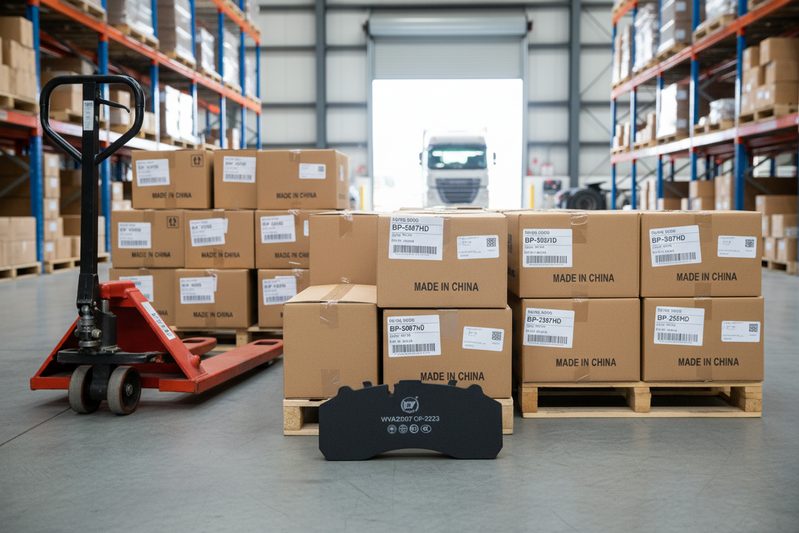
Then there's logistics. Can the supplier consolidate different pad types (disc and drum) into a single container? What's their lead time from order to shipment? A reliable 30-day turnaround is often more valuable than a 5% lower price with a 90-day, unpredictable wait. For complex fleets, having a single source for both C.V. brake pads and brake lining products simplifies your procurement and inventory management dramatically.
Building a Partnership, Not Just Placing an Order
The most successful importers treat their brake pad supplier as a technical partner. Does the supplier offer more than a catalog? Can they provide application engineering support? For instance, if a fleet is transitioning to newer air-disc brake systems, can the supplier advise on the correct pad shape and chamfer to prevent noise?
Access to technical resources is crucial. A partner should provide clear brake lining installation guide and troubleshooting documents. When a fleet client reports an issue like edge cracking, you need to diagnose it quickly. Is it a material issue, an installation error, or a problem with the brake chamber? Having a supplier with a deep technical support center turns you from a parts seller into a solutions provider.
Finally, consider the supplier's R&D commitment. The commercial vehicle brake market isn't static. Regulations tighten, and new vehicle models are released. A supplier that invests in testing and development ensures your product line stays current and compliant. You're not just buying today's pad; you're investing in access to tomorrow's technology.
Frequently Asked Questions (For Importers & Distributors)
Q: What's the minimum order quantity (MOQ) for a profitable wholesale order of heavy-duty truck pads from China?
A: It varies, but for a standard 20-foot container, you're typically looking at an MOQ of 1,500 to 2,000 sets to make the shipping economics work. However, a flexible supplier might allow mixed SKUs within that container. For a trial order, some reputable factories like BAIYUN Brake may accept 500-800 sets if it's part of a longer-term partnership plan. Always clarify if the MOQ is per SKU or per container.
Q: How do I verify the authenticity of certifications like ECE R90 and IATF 16949?
A: Always ask for the certificate numbers and the full, scanned certificates. For ECE R90, you can cross-check the approval number (e.g., E1 90R-0123456) format. For IATF 16949, request the certificate issued by a recognized certification body (e.g., TÜV, BSI, DNV). A legitimate supplier will provide these transparently. You can also review our documented competitive advantages which are built on these verifiable standards.
Q: What's the typical lifespan difference between a budget pad and a premium, certified pad for a Class 8 truck?
A: In highway service, a premium pad with stable friction materials can last 30-50% longer. Where you really see the difference is in severe service. A budget pad might last 40,000 miles in a dump truck application, while a premium severe-duty pad could reach 60,000+ miles. The longer life, combined with reduced rotor wear (often 20% less), means your fleet clients save on total parts and labor costs, making your premium product an easier sell.
Selecting the right heavy duty truck brake pads is a strategic decision that affects safety, operational costs, and your business reputation. It's about aligning material technology with duty cycles, insisting on verifiable quality, and choosing a supplier that acts as a partner. The goal isn't just to fill a container; it's to build a reliable, profitable supply chain for your fleet customers.
Ready to evaluate a partner that meets this standard? Request a quote from BAIYUN Brake today. Share your target applications and volumes, and we'll provide detailed specifications, certification documents, and a competitive proposal focused on your total cost of ownership.
Was this article helpful?
Average Rating: 5/5 (1334)