
ECE R90 Certified Brake Pads China Supplier: A Step-by-Step Certification Guide
Summary:
ECE R90 certified brake pads China supplier BAIYUN Brake provides this step-by-step guide to the ECE R90 certification process for brake pad importers. From dynamometer testing to on-road verification, you’ll learn the technical performance benchmarks, costs, and how to verify supplier credentials. With over 1,200 R90-approved part numbers and IATF 16949 quality systems, BAIYUN Brake helps distributors avoid compliance risks in the EU and other R90-adopting markets. This article covers friction stability, wear limits, compression standards, and practical checks that save your next shipment from customs rejection.
ECE R90 Certified Brake Pads China Supplier: A Step-by-Step Certification Guide
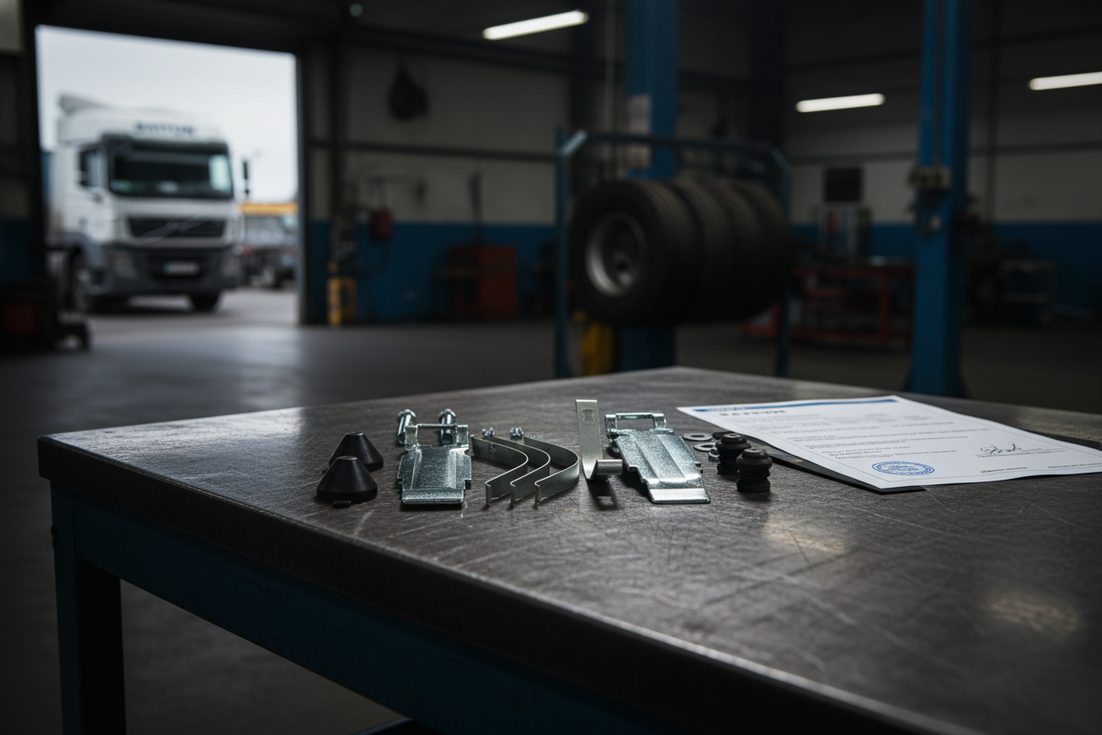
Every container of brake pads bound for a European warehouse now faces a hard regulatory gate. Without ECE R90 approval, your shipment doesn't clear customs — not for passenger cars, not for most commercial vehicles. For an importer, that means demurrage costs pile up while your customer runs out of stock. So the real question isn't whether you need R90, but how to be certain your Chinese supplier has genuine approval that holds up under retailer scrutiny.
BAIYUN Brake has been shipping ECE R90 certified brake pads from its factory in China for over two decades. We've seen every kind of compliance shortcut — and we know what makes an approval file bulletproof. This guide walks you through the technical backbone of R90, from the dynamometer tests to the on-road verification, so you can ask the right questions before your next purchase order.
How Does ECE R90 Fit Into Europe's Aftermarket Brake Framework?
Almost every aftermarket friction material sold in the EU and EEA must carry an R90 homologation number. The regulation kicked in for passenger car pads back in 1999, and later extensions brought brake linings and discs into the same regime. Now, any replacement pad for a vehicle registered after a certain date — think November 2016 for discs, earlier for linings — needs a matching R90 certificate. The UK, despite Brexit, still accepts ECE marks alongside its own UKCA pathway, so R90 effectively remains the de facto standard across the continent.
But what does the mark actually prove? In short, it confirms that the brake pad's cold and hot performance, friction stability, wear rate, and noise levels fall within a tight corridor around the original equipment (OE) part. The testing isn't just a one-off check — it's a sequence designed to push the pad beyond normal driving extremes. Our IATF 16949 certified facility integrates these test parameters into every production batch's quality plan, not just the homologation sample.
What Tests Does a Brake Pad Actually Undergo for R90 Approval?
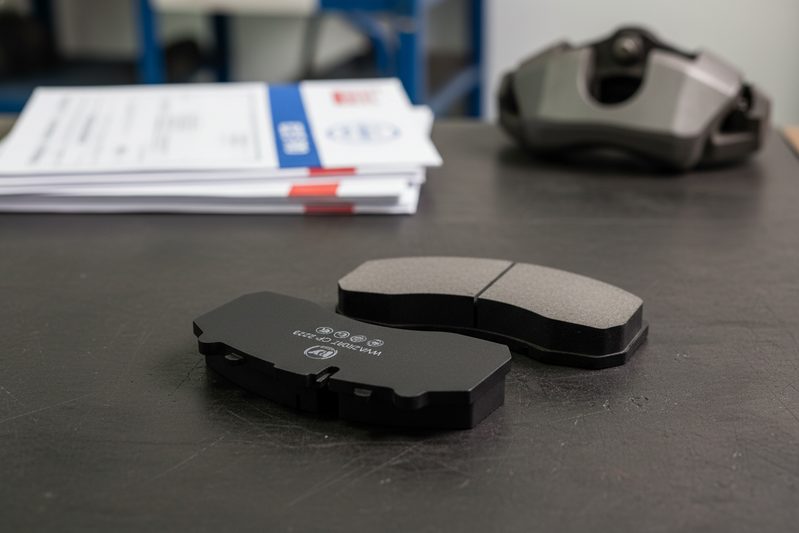
If you've ever wondered what's inside that 40-page approval report your supplier hands over, here's the unvarnished rundown. An independent technical service — usually a TÜV, DEKRA, or VCA-accredited lab — runs the candidate pad through a prescribed series of inertia dynamometer tests followed by a real-vehicle road trial. Nothing gets approved without both.
The dyno session replicates thousands of simulated stops on a loaded roller rig, at temperatures ranging from 100 °C all the way up to 600 °C. The pad's friction coefficient must remain within ±15% of the OE value throughout this heat cycle. If the friction drops below 0.25 during a high-speed fade test, it's a failure. Cold stop effectiveness gets measured at 40 °C and again at 100 °C — the average deceleration must hit at least 5.8 m/s² for passenger car pads, and the variance across four stops cannot exceed 20%. That's a brutally repeatable standard, and it catches low-grade formulations fast.
Wear is tracked, too. The R90 test protocol demands that the pad's mass loss per 1,000 km (simulated) stays within 130% of the OE pad's wear rate. In real numbers, if the OE pad loses 8 grams over a fixed duty cycle, the R90 candidate can't lose more than 10.4 grams. Many budget pads fail here because their binders break down under sustained heat — a problem that shows up on the road as doubled replacement intervals.
After the dyno, the same pad part number goes onto a vehicle. The technical service verifies that the noise, vibration, and harshness (NVH) characteristics don't degrade the driver's experience. They also confirm that the actuator forces remain within 115% of the OE specification, ensuring the brake booster isn't working harder to compensate for a lazy friction material. In essence, R90 approval means the independent lab has proven your brake pad will stop as well, last roughly as long, and remain as quiet as the factory part — documented with a homologation number traceable to the UNECE database.
What Technical Parameters Make or Break an R90 Submission?
Not all pad formulations are created equal, and R90 doesn't care about marketing. It cares about numbers. From a brake pad composition guide, you'll know that ceramic, semi-metallic, and NAO blends each have distinct friction profiles. The trick is getting that profile to match the OE curve across the entire temperature range — not just at the cold bite everyone feels in a showroom test drive.
BAIYUN's R&D team records friction coefficients across 14 temperature points from 100 °C to 550 °C. For our CP2223 ceramic formulation, the mu stays bounded between 0.38 and 0.44, peaking at 350 °C before trailing off gently to 0.35 at 500 °C. That's a delta of less than 0.09, well inside the R90 allowed window. Semi-metallic pads often swing wider, which is why you'll see more R90-approved ceramics for European sedan applications — they simply follow the OE friction signature with fewer excursions.
Compression strength matters under the hood, too. The pad's backing plate and friction block must survive 450 bar of hydraulic line pressure without permanent deformation beyond 2%. A pad that compresses excessively under pedal force increases the driver's pedal travel, which directly lengthens stopping distance. In BAIYUN's internal pre-homologation screening, we reject any batch showing compressibility above 1.5%, a margin that gives the technical service zero reason to fail us during the formal R90 compression test.
How Long Does R90 Certification Take and What Does It Cost?
Here's the question that decides whether an importer commits to a new part number. A full R90 approval cycle — from sample submission to final certificate — typically runs 8 to 14 weeks, depending on the lab's queue. The lab fees for a single pad family (covering multiple vehicle applications with similar pad geometry) run between €4,000 and €8,000, excluding any re-testing if the first attempt fails. That's a non-trivial investment, and it's why many small factories skip R90 entirely for low-volume or obsolete references.
At BAIYUN Brake, we've absorbed that cost for our core lineup. Our current certificate portfolio covers over 1,200 part numbers across passenger and commercial vehicle ranges, all accessible when you download our product catalogue. For a distributor, this means you don't have to front the approval cost for common references like WVA 23810 or 25689 — they're already printed on the box with an E2 or E9 homologation number right next to the ECE R90 stamp.
How Can You Cross-Check a Supplier's R90 Credentials — in 5 Minutes?
Counterfeit ECE marks are a real problem, especially on trading platforms. The UNECE R90 database is theoretically public, but navigating it takes a trained eye. Here's a practical five-minute check we recommend:
- Locate the homologation number on the pad or box. It starts with a country code (e.g., E2 for France, E9 for Spain) followed by a sequence. An original equipment brake pad won't carry this number — only aftermarket replacements do.
- Verify the number matches the vehicle application. The approval covers a specific pad shape and friction family, not a universal mark. A VW Golf pad with an R90 number issued for a Ford Focus is invalid.
- Ask for the test report's first page. Serious wholesale car brake pads inquiry suppliers can show you the approval certificate front page, which lists the pad dimensions, friction family code, and the test lab's name. BAIYUN provides this in every pre-shipment documentation package.
Also, if you're importing commercial vehicle pads, note that many Middle Eastern and Southeast Asian markets now require R90 as a mandatory homologation — Egypt, Malaysia, and Saudi Arabia have adopted it. That means your same ECE R90 certified batch can often serve multiple markets without extra paperwork.
FAQ
Q: Does every brake pad I import to Europe need an individual ECE R90 certificate?
A: Yes, each pad part number — meaning a unique shape and friction material combination — must have its own R90 homologation. However, a single approval can cover multiple vehicle models if the pad geometry and the friction family match. A smart wholesale CV brake pads inquiry should ask your supplier for the homologation extension list to see exactly which OEM references are covered under one certificate.
Q: What's the real-world difference between an ECE R90 pad and a pad with only an ISO quality certification?
A: ISO 9001 or IATF 16949 cover the factory's quality management system, not the product's braking performance. A pad can come from an ISO-certified plant and still fail R90 because its friction coefficient drops too sharply at 400 °C. Only R90 guarantees that an accredited lab has actually validated the pad's stopping distance, wear life, and thermal stability against the original part.
Q: Can I get an R90 certificate for brake pads that were never approved as original equipment?
A: Yes, that's exactly what the regulation exists for — replacement pads. The technical service compares your aftermarket pad to the OE pad of the vehicle it intends to fit. As long as your pad meets the performance and dimensional standards within the allowed tolerances, it gets approved. BAIYUN Brake regularly develops new R90-approved references for vehicles where the OE pad design has been superseded or is no longer available.
Getting brake pad certification right isn't about memorizing regulation paragraphs — it's about choosing a manufacturing partner whose R90 homologation is current, test-proven, and documented. Request a wholesale quote from our export team with your target part numbers, and we'll send you the corresponding approval certificates alongside pricing. Alternatively, browse our passenger car brake pad range to see the full catalog of ready-to-ship, ECE R90 certified references.
Was this article helpful?
Average Rating: 5/5 (961)