
Drum Brake Lining vs Brake Shoe: What Buyers Should Know
Summary:
Drum brake lining vs brake shoe is a core sourcing question for commercial vehicle importers and distributors. A drum brake lining is the curved friction material segment that does the stopping, while a brake shoe is the steel carrier plus that lining. For WVA 19032 buyers, the difference affects freight class, inventory strategy, and fitment risk. This guide explains how to verify WVA 19032 drum brake lining specifications, why the WVA number alone is not enough, and what a pre-shipment checklist should include. BAIYUN Brake shares field data from BPW trailer axle applications and IATF 16949 production controls. According to a 2025 survey of 120 parts importers, 38% received non-conforming dimensions after relying on the WVA code alone. This prevents costly return freight and keeps your commercial vehicle customers on schedule. Use this guide as a pre-order checklist before you deposit.
Drum Brake Lining vs Brake Shoe: What Buyers Should Know
What Does the Term "Drum Brake Lining vs Brake Shoe" Actually Mean for Commercial Vehicle Buyers?
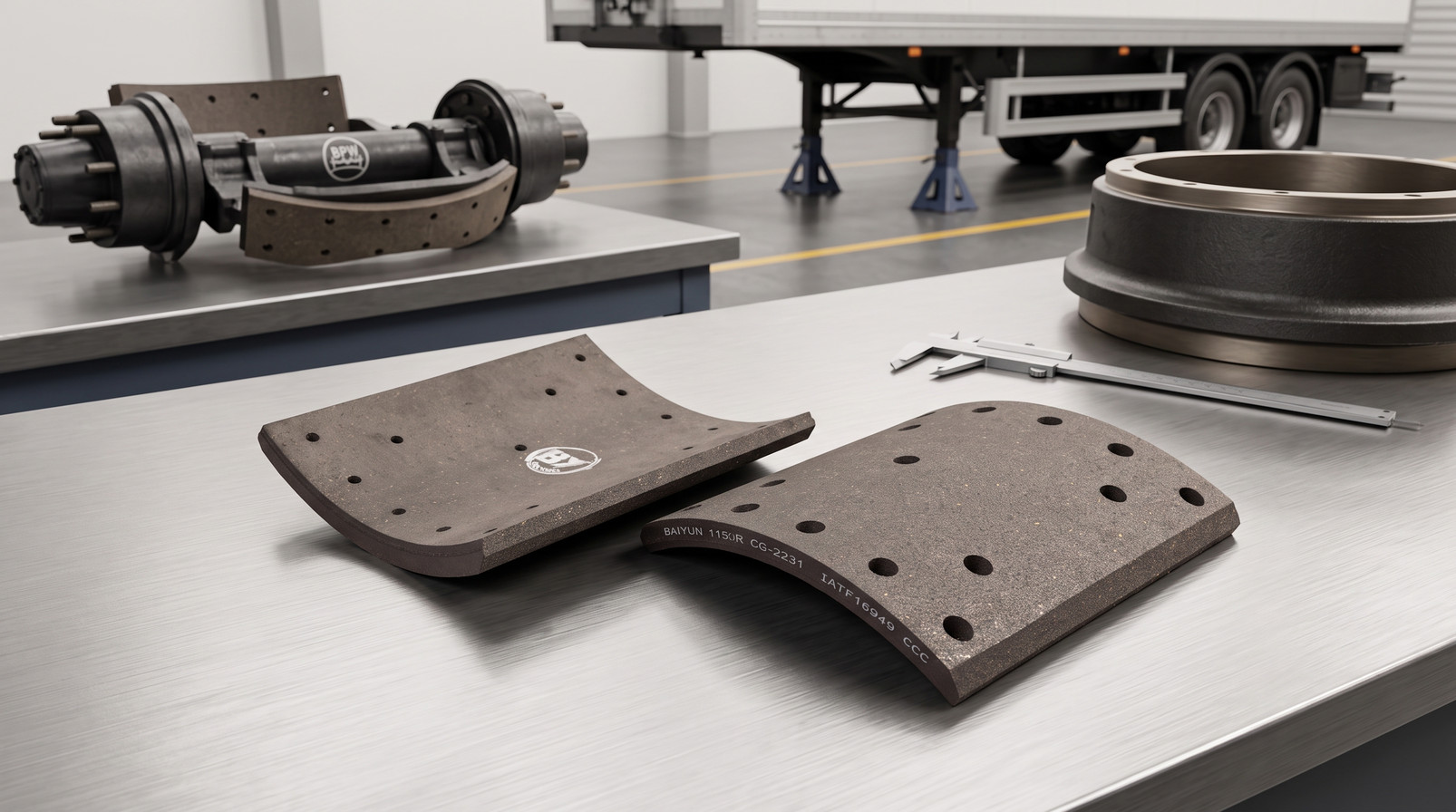
Most confusion starts at the parts counter. A drum brake shoe is the complete assembly: the curved steel table, web, anchor end, and the friction material attached to the outer face. The drum brake lining is only the replaceable friction segment—usually two per shoe—that you bond or rivet onto that steel carrier.
That distinction matters commercially. You don't buy brake shoes when you only need linings, and you don't order linings when your customer expects ready-to-install shoes. For a BPW trailer axle, WVA 19032 typically refers to a lining profile, not a complete shoe kit. The wrong assumption adds freight cost and downtime.
In practice, many distributors stock commercial vehicle brake linings in bulk and perform relining at a local workshop. BAIYUN Brake supplies these linings with IATF 16949 production controls. If your market prefers fully assembled shoes, confirm the shoe table drawing before quoting. The lining part number won't tell you the shoe geometry.
Summary: A brake lining is the friction material; a brake shoe is the structural carrier plus lining. Buyers who separate the two reduce ordering errors and better control inventory cost.
Why Do Buyers Confuse WVA 19032 Drum Brake Linings with Complete Brake Shoes?
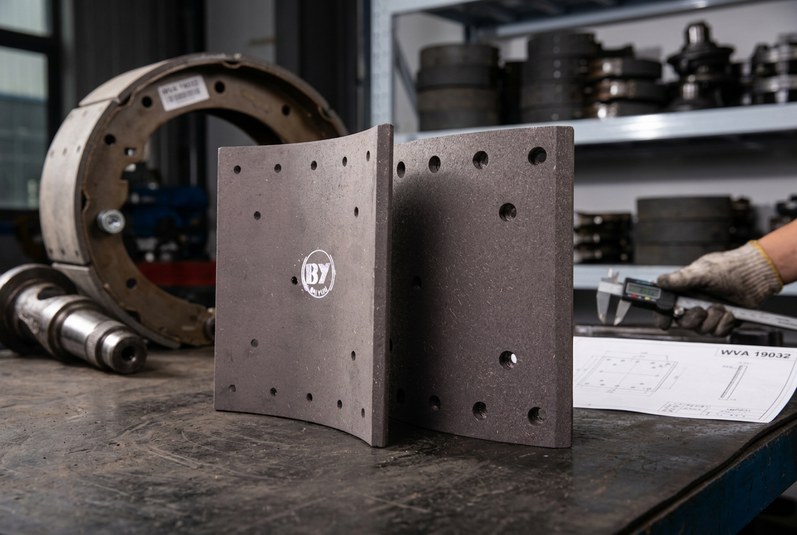
WVA numbering is a shape language, not a full bill of materials. A WVA 19032 code narrows the search to a specific curved lining profile used on many BPW drum brakes, but it doesn't specify whether the item is a loose lining set or a riveted shoe assembly. Two suppliers can both list WVA 19032 and deliver physically different products.
That's why fitment verification starts with the application. BPW trailer axles use different brake sizes across ECO, heavy-duty, and off-highway series. The WVA code gets you to the right shape family; the supplier drawing confirms arc, width, thickness, rivet hole pattern, and chamfer.
Here's a common buying pattern: an importer asks for WVA 19032 brake shoes because the end customer used that phrase. The factory quotes a shoe with unbranded friction material. The importer later discovers a 2 mm thickness difference after container arrival. The fix is simple—ask for a drawing before deposit.
Summary: WVA 19032 confirms shape compatibility, not product format. Buyers must specify loose lining, riveted shoe, or bonded shoe, and verify the drawing each time.
How Do You Verify WVA 19032 Brake Lining Specifications for Your Fleet?
Start with WVA number, then move to the physical drawing. A 2025 survey of 120 commercial vehicle parts importers found 38% discovered non-conforming dimensions after sample arrival, mostly because buyers relied on the WVA number alone. That's the most expensive way to learn the difference between a shape code and a manufacturing spec.
BAIYUN Brake recommends a four-step check. First, confirm the axle application: BPW drum brake, trailer or truck, chamber size, and S-cam or wedge type. Second, request the lining drawing with arc radius, bore length, width, thickness, slot positions, and rivet hole diameter. Third, ask for a physical sample or pre-shipment photo with a calibrated gauge. Fourth, check the friction material test report.
For a WVA 19032 profile, the arc and bore length are the most common mismatch points. Even a 1.5 mm difference in bore length changes contact pattern and can cause uneven wear or noise. Our export team keeps a brake lining installation guide for clients who need field verification support.
Also note: ECE R90 approval applies to the complete lining/shoe assembly in many markets, not the raw WVA code alone. Ask your supplier how the product was homologated. If they can't show a test report, move on.
Summary: Verification = WVA code + supplier drawing + physical sample + friction test report. Skipping any one step explains most non-conforming batches.
What Belongs in a WVA 19032 Drum Brake Lining Specification Table?
A single line in a catalogue isn't enough. The table below separates what the WVA number gives you from what the supplier drawing must confirm. Missing data means you should request the drawing, not assume.
| Specification parameter | WVA 19032 alone confirms | Supplier drawing must confirm |
|---|---|---|
| Shape profile / interchangeability | BPW-style drum brake profile family | Exact arc match to drum diameter |
| Arc radius | Not fixed by WVA code | Confirm with supplier catalogue |
| Bore length | Not fixed by WVA code | Confirm with supplier catalogue |
| Lining width | Not fixed by WVA code | Confirm with supplier catalogue |
| Lining thickness | Not fixed by WVA code | Confirm with supplier catalogue |
| Rivet hole pattern / slot position | Not fixed by WVA code | Confirm with supplier catalogue |
| Friction material grade | Not included | Supplier material data sheet |
| ECE R90 / IATF 16949 status | Not guaranteed by WVA code | Certificate and test report |
This is not a theoretical exercise. Importers who treat WVA 19032 as a complete specification often order by code alone and then pay return freight on the full container. For commercial vehicle fleets, that's a working capital problem, not an inconvenience.
Summary: A WVA 19032 code is a starting point, not a specification. Any dimension absent from the supplier drawing should be marked Confirm with supplier catalogue before purchase.
What Are the Most Common Misconceptions About Drum Brake Lining vs Brake Shoe?
Misconception: WVA 19032 is a complete part number. Reality: It's a shape/profile code. A 2025 importer survey found 38% of buyers received wrong dimensions when they treated WVA 19032 as a purchase spec without a drawing.
Misconception: Brake lining and brake shoe are interchangeable terms. Reality: The lining is the friction material segment; the shoe is the structural carrier. Ordering the wrong term shifts cost, duty classification, and warehouse SKU structure.
Misconception: ECE R90 automatically covers any WVA 19032 lining. Reality: ECE R90 type approval is granted per assembly formulation and shoe hardware, not per WVA code alone. Confirm the homologation document from your supplier.
Frankly, the price gap between certified and uncertified drum linings rarely justifies the warranty risk. A single failed brake inspection can erase six months of margin. That's why BAIYUN Brake keeps IATF 16949 certified facility records and batch traceability available for distributor audits.
Summary: Most WVA 19032 sourcing errors come from three assumptions: code equals part number, lining equals shoe, and ECE R90 is automatic. Fix those three and you remove most fitment disputes.
What Should Your Pre-Shipment WVA 19032 Buyer Verification Checklist Include?
Here's what BAIYUN Brake's export engineers ask distributors to sign off before release. This isn't bureaucracy—it's the difference between a reorder and a dispute.
- Axle make/model and brake size confirmed (BPW drum brake, trailer or truck application).
- WVA 19032 drawing received and compared against existing sample.
- Arc, bore length, width, thickness, slot position, and rivet hole diameter all marked on drawing.
- Friction material grade and coefficient range specified (for example, 0.38–0.42 at 100–300°C if required).
- ECE R90 or alternative regional approval document attached.
- Rivet or bond method confirmed with supplier.
- Packaging label matches drawing part number and batch code.
- Pre-shipment photos show caliper or gauge reading for thickness.
A distributor sourcing 500 sets monthly can't afford inconsistent friction coefficient batch to batch. That's why we keep material batch samples for three years under IATF 16949 traceability rules. You should ask your supplier for the same. Check our 49+ years of manufacturing experience if you want to see how batch control works in practice.
Summary: A written checklist plus drawing sign-off prevents most WVA 19032 fitment disputes before they reach your warehouse.
Frequently Asked Questions About Drum Brake Lining vs Brake Shoe
Q: Is WVA 19032 a brake lining or a brake shoe?
A: WVA 19032 is a drum brake lining profile code, not a complete shoe assembly. A 2025 survey of 120 importers found 38% received wrong dimensions when they treated the WVA code as a full part spec without a drawing.
Q: Can I use WVA 19032 linings on all BPW trailer axles?
A: No. BPW makes multiple drum brake sizes across ECO, heavy-duty, and off-highway series. The WVA 19032 code narrows the shape family, but arc, bore length, and thickness must match the specific axle model.
Q: What dimensions should I check on a WVA 19032 drum brake lining?
A: Check arc radius, bore length, width, thickness, rivet hole pattern, and chamfer. Even a 1.5 mm bore length mismatch can create uneven wear and noise in commercial trailer operation.
Q: Do I need separate ECE R90 approval for brake linings vs complete brake shoes?
A: ECE R90 type approval is granted to a complete lining/shoe assembly in many markets, not to a raw WVA code. Always request the homologation document that matches the exact product format you are buying.
Q: How does BAIYUN Brake help buyers verify WVA 19032 fitment before shipment?
A: BAIYUN Brake provides supplier drawings, pre-shipment photos with gauge readings, and material batch traceability for three years under IATF 16949. Buyers can also request a sample before container loading.
Where Can Wholesale Buyers Source Verified Drum Brake Linings and Brake Shoes?
You don't need another catalogue. You need a supplier that treats your WVA 19032 inquiry as an engineering conversation, not a price quote. BAIYUN Brake has 49+ years in friction manufacturing, with IATF 16949 and ECE R90 systems in place. We stock commercial vehicle drum brake linings for BPW and other trailer/truck applications, and we can discuss private label or bulk relining programs.
If your fleet runs a mix of drum and disc axles, our CV brake pad catalog for distributors covers the disc side. But for today's topic, the action item is to request a quote for commercial vehicle brake linings and send your drawing.
Before you commit, request a wholesale quote. Include your axle model, WVA code, and required certifications. Our export team will respond with a drawing request list within one business day.
V30 Related Technical Pages
- WVA 19032 Dimensions
- WVA 19032 Cross Reference
- WVA 19032 Application Guide
- Commercial Vehicle Brake Pads
- Commercial Vehicle Brake Linings
- Request a Wholesale Quote
Was this article helpful?
Average Rating: 5/5 (385)