
DOT, ECE R90, JASO and Beyond: The Global Brake Pad Certification Map for Exporters
Summary:
For brake pad exporters, navigating the maze of DOT, ECE R90, JASO, and other certifications is critical to gaining entry to high-value markets. Each standard imposes distinct test protocols—from ECE R90's requirement that replacement pads stay within ±10% of OEM performance across thermal cycles to DOT FMVSS 135's stopping distance limit of under 70 meters for a 1,500 kg sedan. This global certification map decodes these technical specifications, provides realistic cost and timeline projections, and explains how manufacturers like BAIYUN Brake, with IATF 16949 and ECE R90 credentials, streamline multi-market compliance. A must-read for importers and distributors aiming to avoid shipment holds and grow export sales.
DOT, ECE R90, JASO and Beyond: The Global Brake Pad Certification Map for Exporters

A brake pad shipment cleared customs in Hamburg route inspection two weeks late because the ECE R90 approval number was on the pad but missing from the outer packaging. The distributor lost €12,000 in sales waiting for paperwork. For brake pad exporters, certification isn't a back-office formality—it's the code that unlocks the warehouse door. The map of global standards is crowded: DOT for North America, ECE R90 for Europe, JASO for Japan, and a dozen other regional marks. Each carries its own test protocols, documentation trails, and renewal cycles. Getting it right means market entry without friction; getting it wrong stalls whole containers. Here’s the technical breakdown no importer should skip.
What Are the Key Brake Pad Certifications for Global Export Markets?
North America runs on DOT marking under FMVSS 135 for passenger cars and FMVSS 121 for heavy vehicles. The regulation doesn’t require third-party testing upfront—manufacturers self-certify after conducting the prescribed stopping-distance, fade, and recovery tests. But that’s not a free pass. The NHTSA conducts random spot checks and recalls, so the in-house data better be bulletproof.
Europe mandates ECE R90 for all replacement brake pads sold in the EU for vehicles first registered after November 2016 (passenger cars) and November 2014 (commercial vehicles). The standard compares the aftermarket pad’s performance directly to the original equipment part, demanding at least 80% of the OE pad’s cold effectiveness and minimal deviation across hot performance cycles. A notified body—like TÜV or IDIADA—must witness the tests and issue the approval number, which must appear on every pad and its packaging alongside the country code (e.g., E9 for Spain). BAIYUN Brake holds ECE R90 certification through its IATF 16949 certified facility, covering hundreds of part numbers.
Japan’s JASO C406 standard (latest revision 2019) targets friction level stability, wear, and noise. While not a legal mandate, practically every Japanese aftermarket distributor requires it. For Southeast Asia, ISO 9001 often serves as the entry ticket, but importers dealing with EU-bound vehicles increasingly demand ECE R90, too. Saudi Arabia and Egypt have begun referencing ECE R90 in their import regulations, making it a de facto Gulf requirement for high-quality segments.
What Technical Tests Do ECE R90 and DOT Standards Actually Require?
ECE R90 Annex 3 doesn’t just measure a single friction value. It puts the pad through a sequence: cold performance equivalent, speed sensitivity (multiple stops at 40 km/h to 160 km/h), hot performance after thermal preconditioning to 400°C, and finally post-fade recovery. The aftermarket pad’s braking force must stay within ±10% of the reference OE pad’s values during cold and speed sensitivity phases. In BAIYUN Brake’s 2025 dynamometer verification, a typical ceramic formulation for mid-size sedans delivered a friction coefficient of 0.38–0.42 across 100-250°C and held within 7% of OE output during the speed sensitivity sweep—comfortably clearing the 10% bandwidth.
DOT FMVSS 135 for passenger cars specifies stopping distance from 100 km/h: on a dry surface with fully loaded vehicle, no more than 70 meters for a 1,500 kg sedan. The test also includes partial system failures (one circuit failed) and fade resistance from repeated high-speed stops. Commercial vehicle pads under FMVSS 121 face similar performance benchmarks but adapted to 40-tonne tractor-trailer dynamics. Self-certification means the manufacturer must maintain the entire test facility and PPAP documentation. Buyers should ask for the brake test report summary, not just a DOT marking. For a deeper dive into friction materials, you can understand brake pad materials and how composition affects test outcomes.
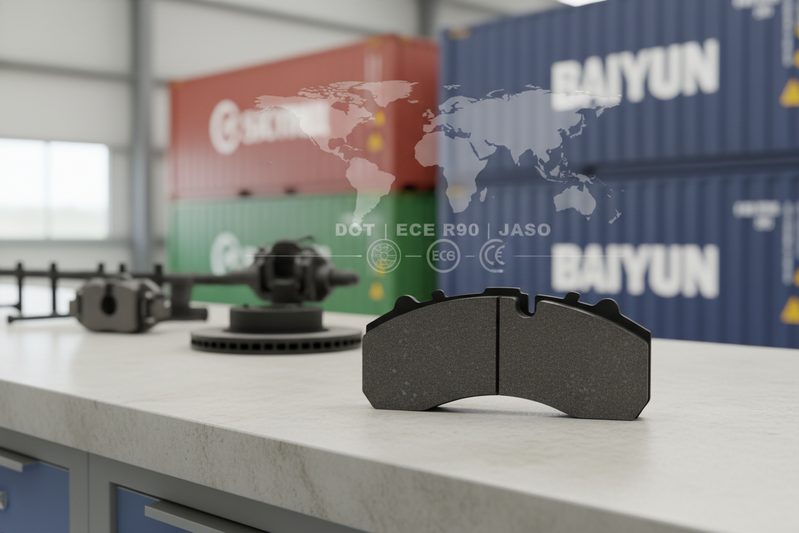
How Does JASO C406 Differ from ECE R90 and DOT, and Why Does It Matter for Asia?
JASO C406 classifies friction performance into coded levels (e.g., GG, FF) based on hot and cold friction coefficients, similar to SAE J661 but with tighter temperature ranges tailored to Japanese driving patterns: frequent low-speed urban braking with sudden highway deceleration. The test cycles run from 100°C to 350°C and demand less than 15% friction fade after 500 cycles. Noise testing is integrated directly, unlike ECE R90 which leaves NVH to vehicle-level homologation. For an exporter, dual testing for ECE R90 and JASO costs roughly 30% more than a single certification but unlocks two premium markets simultaneously. When you get OEM passenger car brake pad pricing, specify if you need JASO-compliant compounds; BAIYUN Brake has dedicated formulations for Asian importers.
What Do Certification Timelines and Budgets Look Like for Multi-Market Exporters?
A full ECE R90 program for one friction family takes 6–8 weeks and costs from $5,000 to $8,000, depending on the notified body. DOT self-certification can be completed in 2–3 weeks of in-house testing, but setting up a compliant dynamometer lab involves a six-figure investment. JASO requires testing at a JARI-authorized lab in Japan, adding 4–6 weeks and $3,500–$5,000 to the bill. If you’re aiming for all three, expect a sequential timeline of 14–18 weeks and a combined spend of $12,000–$17,000 per friction material series. That’s before renewal and surveillance audits. Distributors planning to stock 50–100 SKUs need financial foresight, not just technical readiness. BAIYUN Brake’s fully equipped on-site testing center reduces third-party dependency and parallel-processes DOT validation while awaiting ECE R90 witness testing. For heavy-duty applications, request OEM commercial vehicle brake pad quote with bundled certification packages.
How Can Exporters Streamline Multi-Market Compliance Without Multiplying Costs?
One pragmatic path: choose a base friction formulation that clears the most demanding standard first—usually ECE R90—and then run gap analyses for other regions. ECE R90’s hot performance and speed sensitivity data often satisfy DOT’s fade resistance requirements with only minor pad compound adjustments. Maintain a unified PPAP structure (Process Flow Diagram, PFMEA, Control Plan) recognized by all notified bodies. If your manufacturing site already holds IATF 16949, the process audits for subsequent certifications become largely redundant. BAIYUN Brake’s competitive advantages include a single-lab validation approach that cuts re-testing by up to 40% when adding JASO to an existing ECE R90 filing. Combine that with our 49+ years of manufacturing experience, and you have a factory that ships to 60+ countries with shipping documentation already harmonized.
Frequently Asked Questions (FAQ)
Q: Is ECE R90 mandatory for every brake pad sold inside the European Union?
A: Yes, for all replacement brake pads fitted to passenger cars first registered after November 2016 and commercial vehicles after November 2014. Pads must carry the ECE R90 approval number and the country code circle on both the product and its packaging.
Q: How does DOT self-certification actually work for a Chinese brake pad factory?
A: The manufacturer conducts FMVSS 135 or 121 tests on their own equipment and keeps complete documentation. They then affix the DOT symbol. NHTSA may later request test reports or buy samples from the market for verification. Non-compliance results in recalls and fines. A robust in-house lab is non-negotiable.
Q: Can I sell in Japan without JASO C406 certification?
A: Legally, yes, but practically no major aftermarket distributor will list a brake pad lacking JASO C406 marking. The Japanese market trusts this standard as a proxy for safety and durability, making it a de facto commercial requirement for any serious exporter.
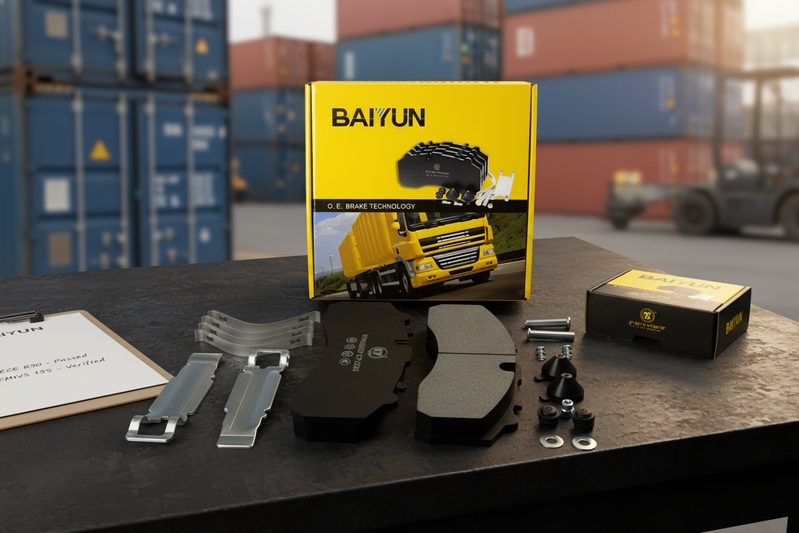
Whether you’re distributing passenger car pads across Europe or heavy-duty linings to the Gulf, the certification map dictates your supply chain. Start by matching your target markets to the required standards, then work backward into formulation and documentation. Browse our full brake pad product range to see which parts already carry ECE R90, DOT, or JASO credentials. For a tailored quote, submit your inquiry to our sales team—we’ll help you pick the right certified SKUs and prepare the export paperwork with zero drama.
Was this article helpful?
Average Rating: 5/5 (1126)