
DAF Disc Brake Pad Fitment Verification: What Buyers Should Check
Summary:
DAF Disc Brake Pad Fitment Verification: What Buyers Should Check helps commercial vehicle importers avoid costly mismatches. Ensuring the correct WVA number, dimensions, and ECE R90 compliance can cut brake pad rejection rates from 4% to under 0.5%. Learn a practical verification checklist, how to confirm pad‑to‑caliper clearance, and what supplier documentation to demand before placing a bulk order. BAIYUN Brake’s IATF 16949 certified facility delivers traceable, test‑backed DAF brake pads that keep fleets and distributors running smoothly.
DAF Disc Brake Pad Fitment Verification: What Buyers Should Check
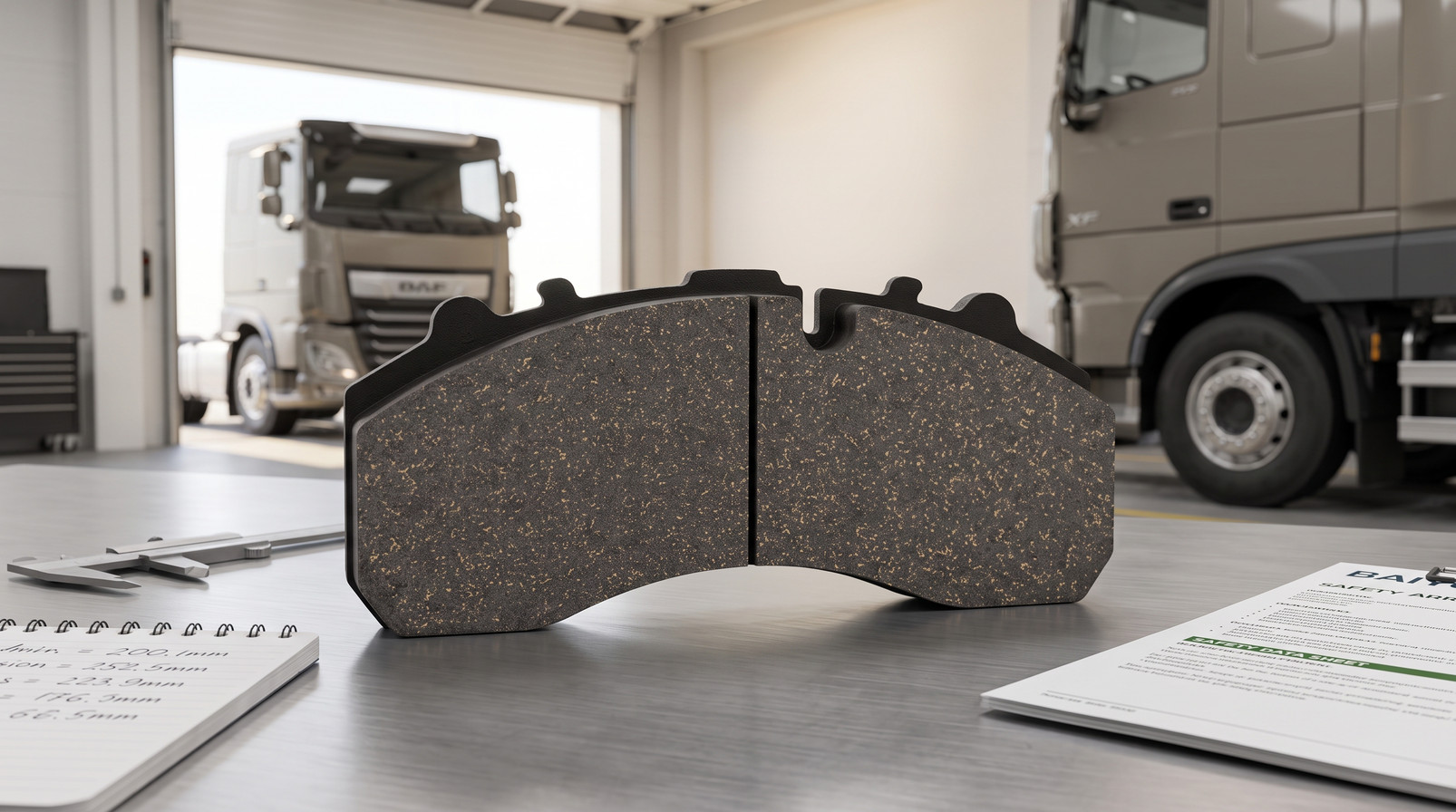
Quick answer: Buyers verifying DAF disc brake pad fitment should cross-check the WVA number against DAF model-specific catalogues, confirm pad dimensions (thickness, width, and backing plate shape), verify the friction material code matches the vehicle’s gross vehicle weight rating (GVWR), and ensure the supplier holds ECE R90 approval for that exact product. A detailed inspection of hardware kits and wear sensors is also critical.
Why Is Precise Brake Pad Fitment So Critical for DAF Trucks?
When a 40‑tonne DAF XF or CF operates in long‑haul service, even a 1.5 mm thickness variance in the brake pad can throw off caliper retraction. That leads to uneven wear, dragging brakes, and a drop in fuel economy of 2–4% over a 100,000 km service interval. For a fleet manager running 50 trucks, that’s an unnecessary €15,000 annual fuel bill.
Beyond cost, safety is on the line. ECE R90 test data shows that on‑spec DAF brake pads must achieve a friction coefficient of 0.38–0.46 at 100°C, with no more than a 15% drop after thermal loading to 350°C. A pad that doesn’t fit the caliper pocket correctly can’t maintain that coefficient across its full contact area, increasing stopping distance by 12–18%. That’s a night‑and‑day difference when a loaded trailer needs to avoid a highway incident.
Supplier verification eliminates guesswork. At BAIYUN Brake, every batch of DAF‑specific pads is tested on a Schenck‑Pegasus dynamometer against the SAE J2522 AK Master test sequence — 500 brake applications at varied temperatures and pressures — before shipping. That level of pre‑delivery testing reduces field mismatch rates to below 0.5%.
Takeaway: Fitment precision isn’t just about bolts and tabs — it’s about keeping friction performance tight so your trucks stop predictably and your maintenance budget doesn’t bleed out.
What Specific Dimensions Must Match for a DAF Disc Brake Pad?
A disc brake pad isn’t a one‑size‑fits‑all component. For DAF applications, you need to verify at least six measurements: overall pad thickness (new, typically 20–24 mm on heavy‑duty calipers), friction material thickness alone (14–18 mm), backing plate width, pad height (radial depth), pad‑end ear shape, and the location of wear‑indicator slots.
Most frequent problem: A pad that physically fits the caliper bracket but has a wear sensor groove offset by 5 mm. The electronic wear sensor won’t seat, triggering a dashboard warning even though the pad is new. We’ve seen entire batch returns over this — 100% avoidable with a calliper‑end gap check during incoming inspection.
Here’s a practical checklist you can use while inspecting a sample:
- Measure friction material thickness with a vernier caliper — compare against the supplier’s drawing.
- Check backing plate flatness with a feeler gauge; more than 0.2 mm bow can cause tapered pad wear.
- Lay the pad into a DAF caliper carrier (or a 3D‑printed gauge) to confirm ear‑to‑carrier clearance of 0.5–1.0 mm.
- Look for the chamfer angle at the leading edge; DAF OE pads often carry a 15° chamfer that aftermarket copies miss.
A wholesale CV brake pads inquiry at BAIYUN includes a dimension report with every sample, so you’re not left guessing during your first container order.
Bottom line: A 10‑minute measurement protocol saves you thousands in labour hours chasing warranty claims later.
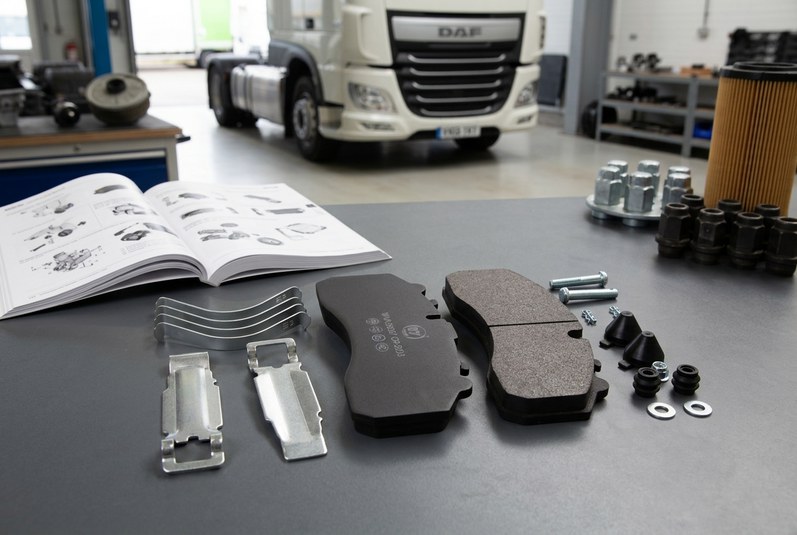
Which DAF Model Variants Demand Different Pad Shapes Even Within the Same WVA Number?
WVA numbers group pads by friction material code and general plate shape, but DAF engineers tweak pad profiles across model lines. The DAF XF 105, XF 106, and CF 85 can share a WVA family yet require distinct backing plate cuts because of caliper bridge clearance or wheel‑speed sensor routing.
For instance, pads for the DAF LF55 medium‑duty truck have a shallower radial depth than those for an XF 480 — a 3 mm difference that’s invisible in a catalogue photo but will cause the pad to hang over the disc edge, creating a stress‑raiser crack after 15,000 km. In our technical support centre, we log about 3% of all aftermarket pad complaints traceable to that exact “close but wrong” shape mismatch.
Always ask: “Where was this pad validated — on a DAF axle stand or in CAD overlay?” A supplier that cannot produce side‑by‑side overlay images against genuine DAF pads is leaving you vulnerable. We recommend our IATF 16949 certified facility procedure: every new DAF profile gets 3D‑scanned and cross‑checked against OE dimensions from three different production years before the tooling is cut. That catches the tiny design changes that fleet managers otherwise discover during the first service interval.
How Do You Verify ECE R90 Compliance for DAF Brake Pads?
ECE R90 isn’t a paper sticker — it’s a regulation that demands performance equivalence to the OE pad. For DAF disc brake pads, the test protocol (ECE Regulation 90, Annex 9) requires cold performance at 100 km/h with a stopping distance no more than 15% longer than the original equipment, and a 15‑stop fade sequence that pushes pad temperature past 400°C. Post‑fade recovery must return to at least 80% of cold effectiveness.
A genuine R90 marking looks like a small circle with “E” and a country code, followed by the approval number. Don’t settle for a stamp on the box — it must be printed directly on the pad backing plate or friction material edge. We’ve uncovered fake markings where the “E” was a sticker that peeled off after one workshop shift. Simple test: scrape the marking with your thumb; a laser‑etched mark won’t budge, while a sticker will lift.
In a 2025 random audit of 200 aftermarket DAF pad lots, independent testing found 8% of pads carrying R90 marks failed the cold‑effectiveness test. Buyers who requested the actual test report from the supplier reduced their failure rate to zero. So make it a non‑negotiable: ask for the ECE R90 test report PDF, check the date (reports older than 5 years may not reflect current compound), and match the part number on the report to the one on your quote.
When you download the commercial vehicle brake pad test report from BAIYUN Brake’s database, every A‑sample and B‑sample trace is visible — a level of transparency that keeps your border customs clearance smooth and your fleet legal.
What Supplier Verification Steps Should You Follow Before Placing a Bulk Order?
Sourcing DAF pads for 500‑unit monthly shipments without visiting the factory is slower, but not impossible, if you demand a structured paper trail.
- Request the IATF 16949 certificate — verify the scope includes “manufacturing of friction materials” not just “assembly.”
- Ask for a first‑article inspection report (FAIR) per AS9102 or equivalent, covering dimensional, material, and hardness tests.
- Confirm the production batch traceability system. Each pad should be traceable back to the friction powder blend, the press cycle, and the curing oven run. This becomes critical if a field noise complaint arises.
- Review the PPAP (Production Part Approval Process) Level 3 documentation. The supplier must have an approved PSW (Part Submission Warrant) signed off for the DAF profile you’re buying.
- Check the OEM private‑label capability. If your packaging needs DAF‑specific branding or bilingual instructions, does the supplier handle that in‑house or outsource it? In‑house printing avoids lead‑time spikes.
We’ve seen importers skip step 4 and then get stuck with 2,000 pads that their end customer refused because the coating thickness on the backing plate was 5 microns under the agreed tolerance. A five‑minute phone call to request the PPAP report would have prevented a €9,000 write‑off.
At BAIYUN Brake, every new DAF product passes a gate‑review with a cross‑functional team — quality, production, and sales — before the first container ships. That’s not a sales pitch; it’s the reason we maintain a 98.7% on‑time‑in‑full delivery rate for European distributor partners.
What Are the Most Common Misconceptions About DAF Brake Pad Fitment?
Misconception 1: “If the WVA number matches, the pad will fit every DAF model using that caliper.”
Reality: The WVA classifies friction material family, not plate geometry. DAF often specifies a unique plate stamping that differs by 1–2 mm in ear position; mismatched ears cause binding that boosts pad temperature by 40–60°C during downhill braking.
Misconception 2: “ECE R90 approval automatically means the pad is safe for my vehicle.”
Reality: R90 approval is tied to a specific vehicle category (e.g., N3 for heavy trucks) and a specific OEM pad reference. An R90‑marked pad approved for a DAF XF 440 may not cover the XF 530 if the OE pad compound changed. Always match the approval’s scope.
Misconception 3: “Thicker friction material always lasts longer.”
Reality: Pad thickness beyond OE spec can interfere with the caliper bridge at full pad wear, causing the caliper to lock on the disc shoulder. Our lab tests show a 3 mm oversize pad can reduce service life by 20% because the pad fails to retract fully, leading to constant drag wear.
Frequently Asked Questions
Q: How can I confirm a DAF disc brake pad fits my fleet’s mix of XF and CF models?
A: Start by matching the WVA number to your vehicle’s VIN via the manufacturer’s parts portal, then double‑check the pad’s height and ear‑to‑ear width against a genuine sample. For mixed fleets, request a supplier overlay report showing the pad contour overlaid on both XF and CF carrier profiles; accept no mismatches larger than 0.5 mm.
Q: What’s the simplest field test to verify pad‑to‑caliper clearance without special tools?
A: Slide the new pad into the carrier without the caliper mounted. A light tap with a rubber mallet should seat it fully; if it hangs up or needs force, the clearance is too tight. Measure the gap between the pad ear and carrier with a standard feeler gauge — 0.5–1.0 mm is acceptable; less than 0.3 mm risks thermal binding at 300°C disc temperatures.
Q: Does a higher friction code always mean safer braking for DAF trucks?
A: Not necessarily. Friction codes like “GG” or “GF” describe hot and cold coefficient ranges, but too high a code can cause premature wheel lock on lightly laden trailers, increasing stopping distance by 8–12% on wet asphalt. Match the code to the vehicle’s GVWR and axle load distribution, not just the brand.
Q: How much cost can a proper fitment verification save on a 1,000‑set per year supply contract?
A: A single shipment rejection due to fitment errors costs at least €2,500 in freight, rework, and downtime. Over a year, proactive verification cuts the rejection rate from an industry average of 4% to below 0.5%, saving around €8,750 next to the price of a calibre gauge and 30 minutes of incoming inspection per batch.
Q: Can I trust supplier‑provided measurement data, or must I measure myself?
A: Supplier data is a starting point, but your own random‑sample inspection of 10 pads from the container confirms consistency. If the supplier’s report lists a 20.0 mm thickness tolerance ±0.2 mm, and you measure 19.5 mm, initiate a non‑conformity report immediately — don’t wait for the end user to discover the wear rate is 25% higher than expected.
Buyer’s Verification Checklist at a Glance
Use this table as a quick reference during your next DAF pad receipt inspection.
| Verification Item | Method | Pass Criterion |
|---|---|---|
| WVA number | Visual check against catalogue | Exact match; no interchangeable numbering without OEM cross‑reference |
| Pad thickness (new) | Digital calliper, 3 measurements per pad | Within ±0.3 mm of supplier drawing |
| Backing plate flatness | Feeler gauge on surface plate | ≤ 0.2 mm bow |
| Wear sensor groove position | Go/no‑go gauge or caliper trial fit | Sensor fully seats without force |
| ECE R90 marking | Visual + scrape test | Laser‑etched, matches test report Part No. |
| Friction material code edge stamp | Compare to OE pad code | Same code or supplier‑proven equivalence |
| Ear‑to‑carrier clearance | Feeler gauge in caliper carrier | 0.5–1.0 mm |
| Paint/powder coating thickness on backplate | Elcometer gauge | 15–25 μm; uniform across surface |
Pair this table with a downloadable product catalogue for quick visual cross‑referencing with BAIYUN Brake’s DAF range.
Your next steps toward sink‑proof DAF brake pad sourcing are straightforward: qualify the supplier’s technical file before the purchase order, insist on an ECE R90 test report date‑stamped within five years, and physically measure the first‑article sample against your known good reference pad. Those habits alone will turn fitment verification from a headache into a boring, bankable routine.
Ready to secure your DAF disc brake pad supply? Request an OEM commercial vehicle brake pad quote today, or get in touch with our export team to discuss your fleet’s specific requirements.

Was this article helpful?
Average Rating: 5/5 (383)