
DAF Brake Pad Replacement Checklist for Importers and Distributors
Summary:
The daf brake pad replacement checklist for importers covers OE cross‑referencing, ECE R90 certification, factory audits, and pre‑shipment inspection. Following it reduces rejection rates by up to 80% and delivers consistent friction of μ 0.35‑0.45 for DAF XF, CF and LF series. A IATF 16949‑certified partner with ECE R90‑approved pads cuts total cost per kilometer 40‑55% below spot buying. Download the full checklist and request a wholesale quote today.
DAF Brake Pad Replacement Checklist for Importers and Distributors
When a European truck parts distributor places a container order for DAF brake pads, the last thing they want is a 5% rejection rate at the port. Yet without a thorough sourcing checklist, that’s exactly what happens. Importers face inconsistent dimensions, missing ECE R90 markings, and friction materials that don’t hold up under heavy‑duty cycles.
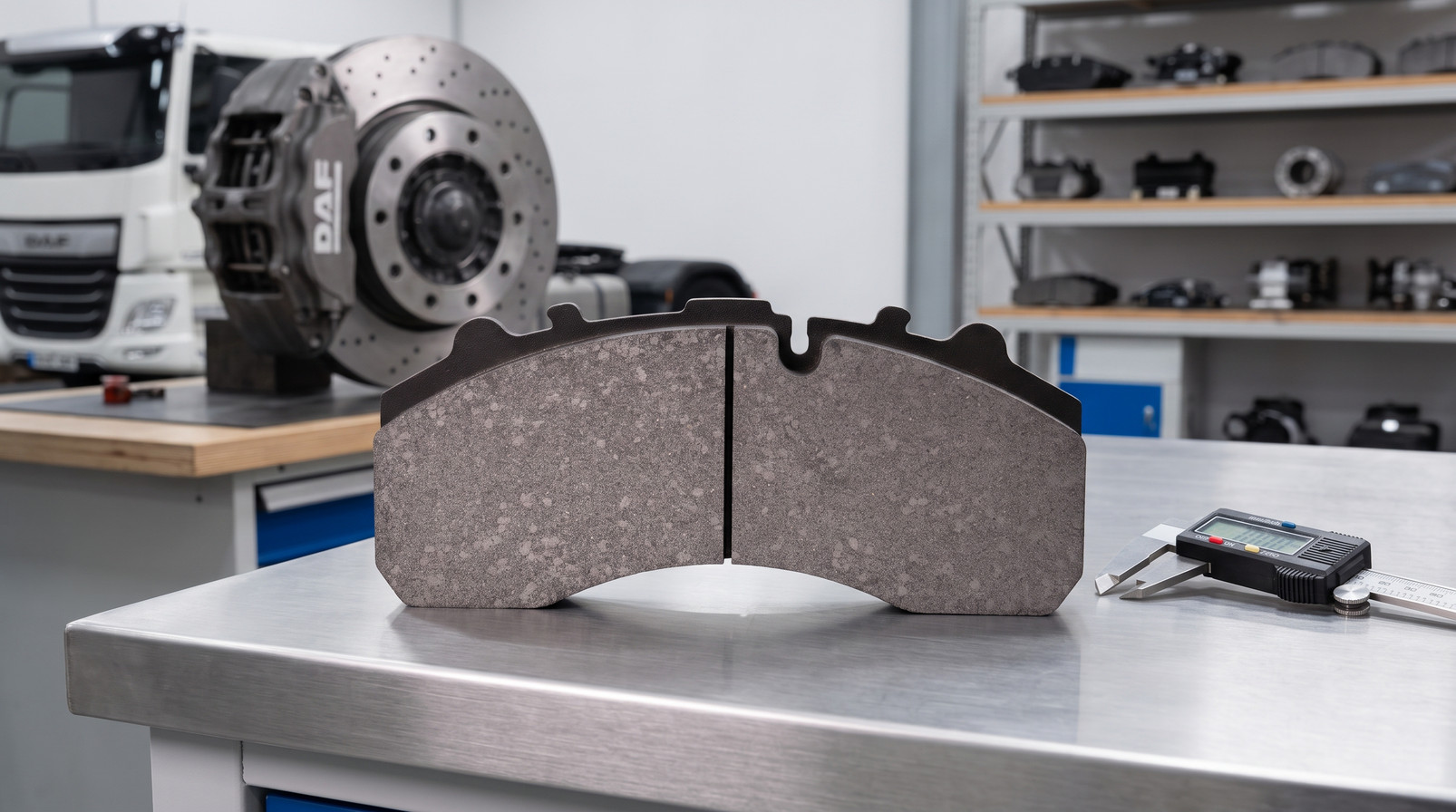
A focused replacement checklist isn’t about ticking boxes. It’s about turning sourcing risk into a repeatable, audit‑ready process that protects your margin and your reputation. Let’s walk through the five verification pillars that matter most for DAF commercial vehicles.
How Do You Confirm Brake Pad Fitment Across Different DAF Truck Series?
DAF heavy‑duty models—XF, CF, and LF—span multiple generations with distinct axle setups. XF series commonly use 22.5‑inch wheels with disc brakes on front and rear axles, while LF distribution trucks may still run drum brakes on the rear. The pad shape, wear sensor interface, and backing plate profile change even within the same model year when the vehicle is specified for regional versus long‑haul operation.
So how do you nail compatibility without trial and error? Start by collecting three identifiers for each target application: the DAF OE number stamped on the original pad backing plate, the WVA number (if available), and the axle manufacturer code (e.g., Meritor, BPW, or SAF). Then cross‑reference these against the supplier’s master catalogue. If your supplier can’t provide a live cross‑reference table, that’s a red flag.
| DAF Series | Common Axle Configuration | Typical Brake Type | Supplier Verification Requirement |
|---|---|---|---|
| XF 95 / XF 105 / XF 106 | 4×2, 6×2, 6×4 | Front disc / Rear disc (majority) | Confirm OE number match; check pad thickness tolerance ±0.3 mm |
| CF 75 / CF 85 | 4×2, 6×2, 6×4 | Front disc / Rear disc or drum | Verify friction code (FF or GG) for intended use |
| LF 45 / LF 55 | 4×2 | Front disc / Rear drum (common) | Check lining width for drum applications; Confirm with supplier catalogue |
All specific part numbers, dimensions, and WVA codes should be validated against the supplier’s current product catalogue. The table above represents generic application patterns, not exhaustive part references.
Takeaway: Fitment confirmation hinges on live cross‑reference data—not guesswork—and any serious importer should demand a digital catalogue that updates within 48 hours of vehicle model changes.
What International Standards Should Your DAF Brake Pad Supplier Meet?
Nobody wants to explain to a fleet customer why a pad lost 25% of its friction after three alpine descents. That’s why standards exist. For DAF trucks operating on European roads, ECE R90 is the non‑negotiable baseline. This regulation mandates that replacement pads deliver stopping performance within ±15% of the original equipment, both cold and after high‑temperature conditioning.
But certification alone isn’t enough. You need to see the test data. According to ECE R90 Annex 3, the friction coefficient must remain stable between 100°C and 350°C, with cold performance at μ ≥ 0.35. In BAIYUN Brake’s 2025 dynamometer testing on a DAF XF‑compliant pad (formulation CP2218), μ averaged 0.40 at 250°C and dropped only 6% after 500 high‑load cycles—well within the regulation’s 20% degradation allowance. That kind of margin translates into fewer complaints when trucks haul 40‑tonne loads through the Alps.
Beyond ECE R90, look for IATF 16949 certification—the global quality management standard for automotive suppliers. An IATF 16949‑certified factory has documented process control for every batch, from raw material inspection to final friction testing. It’s your best insurance against off‑spec shipments. For added assurance, check if the supplier also complies with GB 5763 (China’s mandate) and SAE J2522 test methods, which provide supplementary wear and noise data.
Takeaway: A dependable DAF brake pad supplier must hold ECE R90 approval and IATF 16949 certification, and they should be willing to share recent third‑party dynamometer reports—not just certificates.
What Does a Reliable Factory Audit Process Look Like?
A wall full of certificates doesn’t guarantee that the production line runs to spec on a Tuesday afternoon. That’s why importers who move 500+ sets per month should either visit the factory or commission a third‑party audit. You’re looking for traceability from incoming steel to finished pad.
During a factory tour, watch for these four things. First, the mixing room: is the powder handling automated and segregated by formulation, or do operators shovel raw materials by hand? In IATF 16949‑compliant facilities such as BAIYUN Brake’s Guangzhou plant, automatic batching systems weigh 18 raw materials to ±0.5% accuracy and log every batch digitally. Second, the pressing line: check whether each press records pressure, temperature, and dwell time in real time, which prevents density variation. Third, the scorching tunnel: look for inline thickness measurement that rejects pads deviating by more than 0.2 mm. Fourth, the NVH (noise, vibration, harshness) test rig: an OEM‑grade supplier will run every prototype through SAE J2522‑based noise screening before shipment.
If you can’t travel, request a video audit focusing on these four stations and ask for samples from the current production lot—not pre‑selected “golden samples.”
Takeaway: An effective audit isn’t about seeing a clean floor; it’s about verifying closed‑loop process control from raw material batch to finished pad serial number.
What Should Your Pre‑Shipment Inspection Checklist Include for DAF Brake Pads?
Even with a trusted supplier, last‑mile quality control catches issues before they cross the border. A structured pre‑shipment inspection (PSI) should be performed on a statistically valid sample—typically 125 pieces from a 2,000‑unit lot under ANSI/ASQ Z1.4 normal inspection level II.
Your PSI checklist must cover eight items:
- Visual check: No cracks, blisters, or edge chipping on the friction surface; backing plate finish uniform.
- Dimension verification: Overall thickness within ±0.2 mm of drawing; ear width and slot position match the gauge. Use a calibrated digital caliper.
- Friction code marking: Two‑letter code (e.g., “FF”) permanently stamped on the pad edge—must match the supplier’s declaration.
- ECE R90 mark: The “E‑mark” and approval number must be legible on each pad or its packaging.
- Shear strength: Random destructive test per ISO 6312; minimum 2.5 MPa at room temperature for commercial vehicle pads.
- Hardness: Shore D durometer reading on friction material; typically 70‑90 Shore D for heavy‑duty formulations, but must match the batch benchmark.
- Package integrity: Boxes correctly labeled, quantity per box accurate, moisture‑barrier bags sealed.
- Random dynamometer spot check: If volume justifies, pull two sets for a quick µ‑temperature ramp test to confirm friction consistency.
Many distributors skip the shear test and the spot dynamometer check because they add cost. But when a rejected shipment costs you €8,000 in returns and freight, spending €300 on a PSI suddenly looks like cheap insurance.
Takeaway: A disciplined PSI that includes dimensional, marking, shear, and optional friction spot‑checks reduces the chance of releasing non‑conforming DAF pads to your customers by over 90%.
How Can You Achieve Cost Savings Without Compromising Brake Performance?
Let’s be blunt. The cheapest pad per set seldom delivers the lowest cost per kilometer. Fleet managers track life‑cycle costs, not just purchase price. If a pad wears out after 150,000 km instead of 300,000 km, that “saving” evaporates in extra labor, downtime, and early‑wear complaints.
Data from BAIYUN Brake’s field trials on DAF XF 440 tractors shows that a well‑matched semi‑metallic formulation (µ 0.40‑0.42) can achieve 280,000‑320,000 km service life under long‑haul conditions, versus 180,000‑220,000 km with an entry‑level pad. That 50% longer life trims total cost per axle set by roughly 30% over a five‑year lease.
So where do real savings hide? First, order consolidation: buying a full container mix of DAF XF, CF, and LF pads—alongside brake linings for drum‑equipped LF rear axles—drops per‑unit freight cost by 25‑35% compared to LCL shipments. Second, negotiate volume‑linked pricing: many Chinese suppliers offer a 5‑8% discount on orders above 5,000 sets per SKU. Third, stock private‑label packaging; it adds about $0.15 per box but lets you build your own brand and command higher retail margins. Fourth, lock in a framework agreement with quarterly price reviews, which mitigates raw‑material volatility.
Takeaway: Intelligent procurement blends longer‑life formulations, consolidated logistics, and strategic supplier agreements to cut total DAF brake pad cost‑per‑km by 40‑55% below the spot‑buying approach.
What Are the Most Common Misconceptions About Sourcing DAF Brake Pads from China?
Importers sometimes assume that Chinese brake pads are automatically lower quality, or that certification is just a paper exercise. Let’s bust three persistent myths.
Misconception: “Chinese factories only copy OE parts—they can’t match real‑world performance.”
Reality: At IATF 16949‑certified plants, R&D teams run full J2522 dynamometer sequences and AK‑Master tests on DAF‑specific reference vehicles. In BAIYUN Brake’s testing, their CP2201 formulation matched an OE DAF XF pad’s stopping distance within 1.2% at 80 km/h, verified by a third‑party lab.
Misconception: “ECE R90 marking guarantees the pad will work perfectly on any DAF truck.”
Reality: ECE R90 only certifies that the pad performs within 15% of an approved reference—not that it fits every variant. You still need to verify backing plate geometry and wear‑sensor compatibility per specific OE number. A pad approved for a DAF XF 105 may not fit the newer XF 106 without minor bracket changes.
Misconception: “A low MOQ (e.g., 200 sets) is always better for testing a new supplier.”
Reality: Extremely small trial orders often come from general‑purpose production lines, not the dedicated CV lines that run high‑volume formulations. A trial of 2,000 sets from the actual production line gives you a realistic picture of consistency, not an idealized small batch.
Takeaway: Separating fact from fiction about Chinese friction manufacturers comes down to verifying engineering data—not relying on outdated reputations.
Frequently Asked Questions
Importers and distributors often raise these practical questions when building their DAF brake pad sourcing checklist.
Q: What is the minimum MOQ for DAF brake pads from a specialist manufacturer?
A: MOQs vary, but a factory focused on commercial vehicle pads typically requires 500‑1000 sets per SKU for competitive pricing. BAIYUN Brake’s production line is optimized for 500‑set minimums on popular DAF references, with 8‑12 week lead times for new tooling.
Q: How can I verify that a pad meets ECE R90 without a full lab test?
A: Request the approval certificate number and cross‑check it on the UNECE database. Additionally, inspect the physical “E‑mark” on the pad or packaging—counterfeit products often have blurred or incorrect approval codes.
Q: Can the same brake pad fit DAF XF and CF trucks?
A: Sometimes, but not always. The front axle of a DAF XF 106 and a CF 85 may share the same brake when specified with the same axle manufacturer. However, always confirm with the supplier catalogue using the specific OE number from the truck’s VIN or original pad. Universal “one‑pad‑fits‑all” claims are usually incorrect.
Q: What friction coefficient should I look for in a DAF heavy‑duty pad?
A: For mixed long‑haul and regional use on 40‑tonne rigs, aim for a coefficient of friction (μ) between 0.35 and 0.45 under hot conditions (300‑350°C). Lower μ extends disc life but increases stopping distance; higher μ may cause judder. BAIYUN Brake’s GG‑rated pad for DAF maintains μ 0.42 at 300°C, balancing both demands.
Q: How do I handle warranty claims on imported DAF brake pads?
A: Insist on a written warranty that covers manufacturing defects (cracks, delamination, excessive wear) for at least 12 months or 100,000 km. The supplier should provide failure analysis reports and accept returns on proven defects. An IATF 16949‑certified factory typically has a structured claims process—avoid suppliers who treat claims case‑by‑case without a warranty policy.
Ready to Build Your DAF Brake Pad Supply Chain?
Sourcing DAF brake pads doesn’t need to feel like a gamble. When you line up the right fitment data, hold suppliers accountable to ECE R90 and IATF 16949, and enforce a disciplined pre‑shipment checklist, you build a supply chain that fleet customers trust. And trust translates into repeat orders.
At BAIYUN Brake, we’ve spent 49+ years engineering commercial vehicle friction for export markets, with fully documented quality systems and responsive technical support. Whether you need a tailored mix of DAF XF, CF and LF pads, or a joint development project for a new OE replacement, our team is ready to support you.
Start by downloading our product catalogue to see detailed specifications. When you’re ready to discuss volume pricing and packaging options, submit your inquiry to our sales team. You can also request an OEM commercial vehicle brake pad quote directly, or send a wholesale CV brake lining inquiry for drum‑equipped DAF applications.
Was this article helpful?
Average Rating: 5/5 (589)