
The Importer’s Guide to Sourcing High-Quality Ceramic Brake Pads
Summary:
For importers seeking a reliable ceramic brake pads manufacturer China, this guide details the critical technical specifications and compliance standards like ECE R90 that define true quality.
The Importer's Guide to Sourcing High-Quality Ceramic Brake Pads
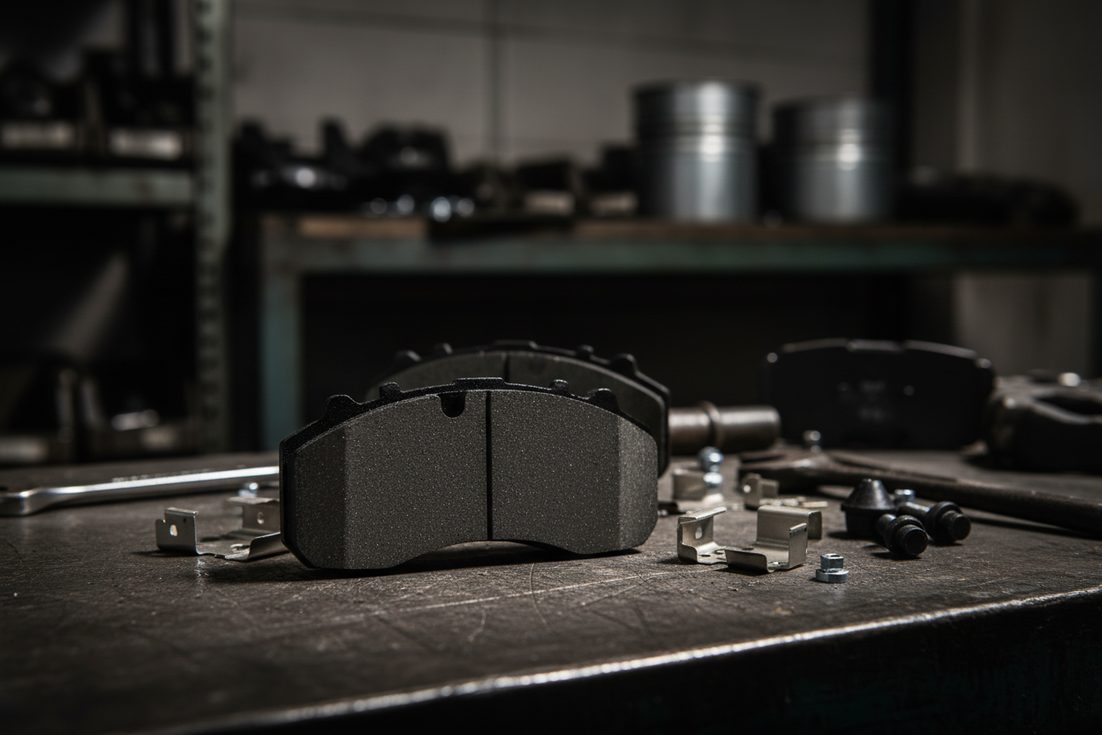
You're sourcing brake pads for a market that demands quiet, clean performance. Your customers ask for ceramic pads, but the quotes you get vary wildly. How do you know you're getting genuine quality that meets safety standards, not just a marketing label? The difference between a profitable, low-return line and a liability often comes down to technical specifications and compliance. This guide cuts through the noise, focusing on the hard data and test standards you need to evaluate a ceramic brake pads manufacturer China.
Let's be clear: not all ceramic formulas are equal. A pad that's 80% ceramic filler and 20% resin will behave very differently from one with a balanced, engineered friction matrix. We'll look at the specs that matter for importers, from friction coefficient stability to rotor compatibility.
Beyond the Marketing: Decoding Ceramic Brake Pad Specifications
Every manufacturer talks about low dust and low noise. You need to verify performance. Start with the friction coefficient, typically expressed as an EE, EF, or FF rating per the SAE J866 standard. For most passenger car applications, an EF rating (0.25-0.35 cold, 0.35-0.45 hot) offers a solid balance. Ask your supplier for the full friction curve across a temperature range, say from 100°C to 350°C. A quality ceramic pad will maintain a stable coefficient, with less than a 15% fade at peak temperatures.
What about wear rates? A good ceramic pad should offer a wear rate competitive with premium semi-metallics, often in the range of 0.4 to 0.6 cm³/MJ in standardized tests like the AK Master. Request the material data sheets for this data. Don't just accept a generic claim of "long lasting brake pads"; get the numbers.
Rotor friendliness is another critical metric. The goal is effective braking with minimal rotor wear. High-quality ceramics use engineered abrasive particles that clean the rotor surface without aggressive scoring. Ask for the rotor wear data. A ratio of pad wear to rotor wear close to 1:1 is a strong indicator of a balanced, brake rotor friendly formulation.
Compliance is Non-Negotiable: Understanding ECE R90 and Beyond
If you're importing into Europe, the Middle East, or many other regions, ECE R90 certification isn't optional—it's a legal requirement for replacement brake pads. This regulation ensures the aftermarket pad performs equal to or better than the vehicle's original equipment. The test is rigorous, comparing the candidate pad directly against the OE reference pad for friction behavior, wear, and noise.
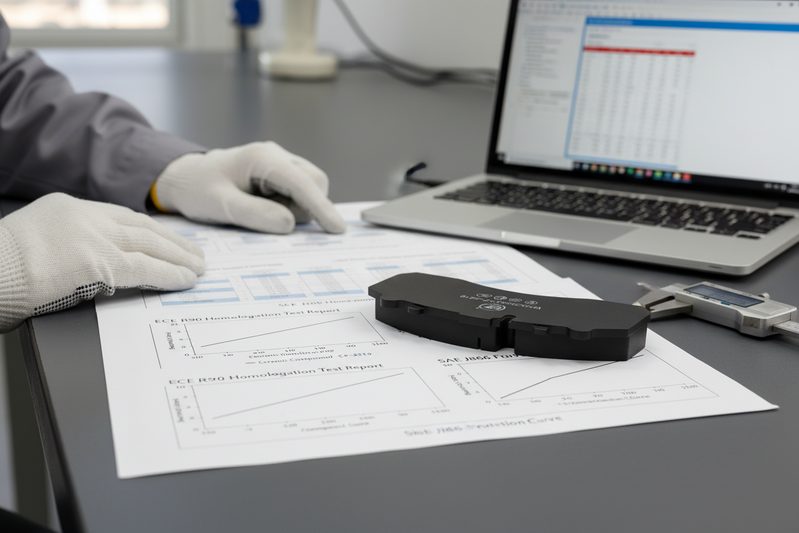
A manufacturer with full ECE R90 certification for their ceramic lines has already invested in the testing to prove compliance. At BAIYUN Brake, our ECE R90 certified ceramic pads undergo this exacting homologation process, providing you with the documentation needed for customs and market approval. It's your insurance against recalls and liability.
But don't stop there. Inquire about other relevant standards. Does the factory hold IATF 16949 certification? This automotive quality management system is a strong signal of process control and consistency—critical when you're ordering by the container. Our IATF 16949 certified facility is built around this principle of traceability and zero-defect mentality.
The Real-World Trade-offs: Ceramic vs. Metallic Performance
Your commercial clients might ask, "Why pay more for ceramic?" The answer lies in total cost of ownership and application fit. For fleet operators of taxis or delivery vans in urban environments, the dust-free braking advantage of ceramics is a direct labor cost saver. Less wheel cleaning extends intervals between professional washes.
However, for a heavily laden commercial vehicle doing mountain descents, a semi-metallic pad's higher heat tolerance might be the safer choice. It's about matching the product to the duty cycle. A reputable supplier won't push ceramics for every application; they'll help you segment your catalog. For your C.V. brake pads range, you might stock both types.
Consider noise. Ceramic pads excel as low noise brake pads because their composite structure dampens high-frequency vibrations that cause squeal. This is a major selling point for passenger car drivers. But verify this with NVH (Noise, Vibration, Harshness) test data, not just promises.
Sourcing with Confidence: Auditing Your Ceramic Brake Pads Manufacturer
Price per set is easy to compare. True cost includes consistency, documentation, and technical support. When evaluating a ceramic brake pads manufacturer China, dig into their R&D and testing capabilities. Do they have a dynamometer for friction testing? Can they provide batch test reports?
Ask about
Was this article helpful?
Average Rating: 5/5 (2373)