
Ceramic Brake Pads: The Importer’s Complete Buying Guide
Summary:
This complete guide for importers details how to source from a reliable ceramic brake pads manufacturer China. It focuses on critical technical specifications, mandatory certifications like ECE R90, and factory audit checks to ensure you import high-performance, safe, and compliant ceramic brake pads for your market.
Ceramic Brake Pads: The Importer's Complete Buying Guide
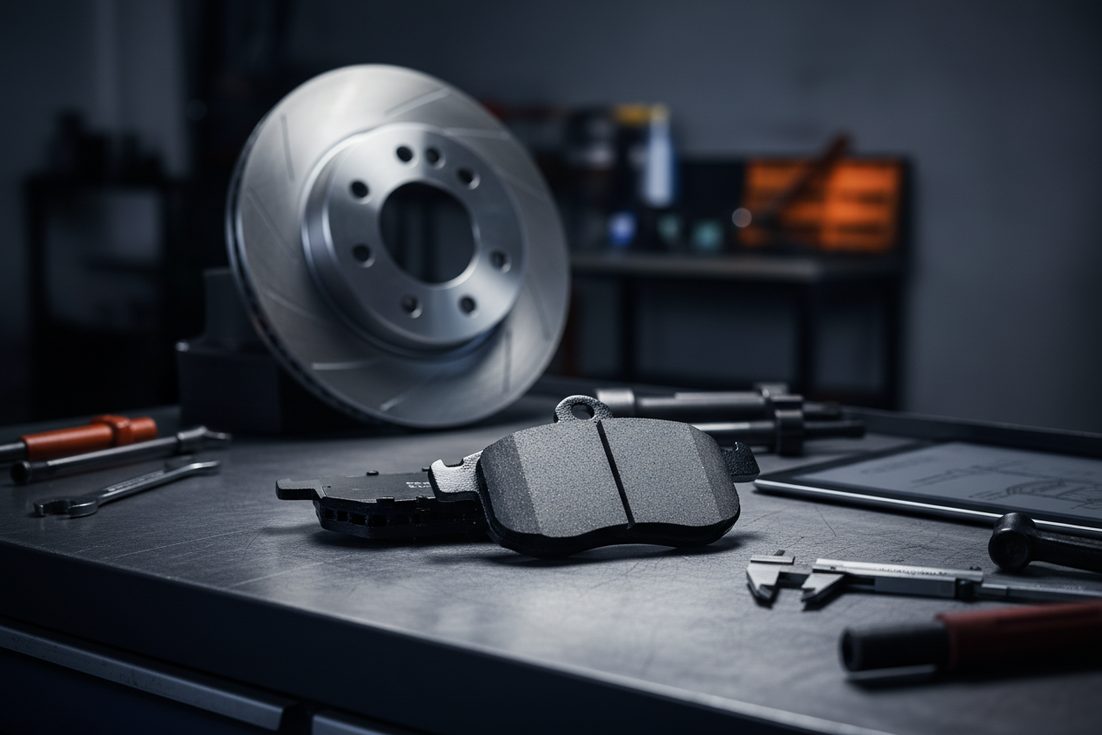
You're probably seeing more demand for ceramic brake pads from your customers. They want quiet, clean, and consistent braking. But sourcing them from a ceramic brake pads manufacturer China isn't just about finding the lowest price. It's about verifying performance claims, understanding the technical specs that matter, and ensuring the products you import meet the safety standards your market requires. A single batch failure can cost you more in returns and reputation than you saved on the unit cost.
This guide cuts through the marketing fluff. We'll focus on the technical specifications, test standards, and compliance requirements that separate high-performance ceramic pads from generic alternatives. Whether you're stocking for passenger cars or light trucks, you'll learn what to look for in a supplier's data sheets and factory audits.
Beyond the Marketing: Decoding Ceramic Pad Performance Specs
Every manufacturer talks about low noise and low dust. The real question is how they achieve it and, more importantly, how they prove it. The performance of a ceramic brake pad hinges on its friction formulation and structural integrity.
Look for these key technical parameters in a supplier's material data sheets:
- Friction Coefficient (μ): This isn't a single number. A quality ceramic pad will specify μ across a temperature range (e.g., 100°C, 200°C, 300°C, 350°C). You want a stable curve. Many cheap pads have a high initial μ that fades dramatically as temperatures rise. For passenger cars, look for a consistent μ between 0.35 and 0.45 across the operating range.
- Compressibility: Measured in millimeters under load. Lower, more consistent compressibility (typically under 0.10mm) ensures better pedal feel and more precise modulation. High or variable compressibility leads to a spongy pedal.
- Wear Rate: Expressed in cm³/MJ (volume loss per megajoule of energy). A lower number means longer pad life. Premium ceramic formulations from experienced manufacturers like BAIYUN Brake target rates that are 15-20% better than basic organic pads, directly impacting your customers' total cost of ownership.
- Rotor Friendliness: This is critical. The pad material must provide effective friction without being overly abrasive. Check for specifications on rotor wear or ask for passenger car brake pad test report data that compares pad wear to rotor wear. A good ceramic pad should be gentle on the rotor.
The Compliance Checklist: Certifications That Actually Matter
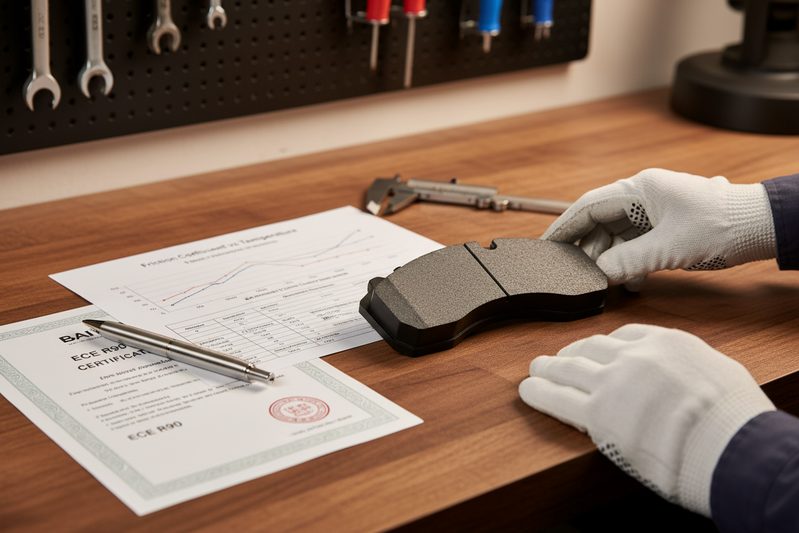
You can't afford to guess on safety. Certifications are your independent verification that a product meets minimum legal and performance standards. For ceramic brake pads destined for global markets, two certifications are non-negotiable.
ECE R90 Certification: This is the European standard for replacement brake pads. It's recognized worldwide as a benchmark for quality and safety. An ECE R90 certification means the pad has passed rigorous tests for friction behavior, shear strength, compressibility, and wear. It's not just a paperwork exercise; it involves physical testing at accredited labs. Always ask for the valid test report and certification number.
IATF 16949: This isn't a product certification; it's a quality management system certification for the factory. If your supplier is IATF 16949 certified, it means their entire manufacturing process—from raw material sourcing to final inspection—is controlled to automotive industry standards. It drastically reduces the risk of batch-to-batch inconsistency. BAIYUN Brake operates an IATF 16949 certified facility, which is a fundamental reason for our product reliability.
Other marks like GB 5763 (China) or JIS D 4411 (Japan) are important for their respective regions. Know your target market's requirements. A supplier that proactively holds multiple certifications demonstrates a commitment to global compliance, not just local minimums.
Ceramic vs. Metallic: A Data-Driven Comparison for Your Inventory
Your customers will ask you which is better. The answer is "it depends," but you need the data to back up your recommendation. Let's move past generalizations and look at measurable differences.
Noise and Dust: This is where ceramic truly shines. The non-ferrous, non-abrasive composition of ceramic friction material generates significantly less high-frequency vibration, which is the primary cause of brake squeal. Independent tests show a reduction in audible noise incidents of over 70% compared to semi-metallic pads. The dust is also lighter in color and less sticky, so it doesn't bond to alloy wheels. For the urban driver or the customer who values a clean car, this is a major selling point.
Heat Management and Fade Resistance: Metallic pads often handle extreme, sustained heat slightly better in pure racing applications due to their higher thermal conductivity. However, for 99% of street driving, modern ceramic formulations are superior. They maintain a more stable friction coefficient as temperatures rise from ambient to 650°C. This means predictable stopping power during mountain descents or repeated hard stops. The fade resistance of a quality ceramic pad often matches or exceeds that of a standard semi-metallic pad.
Rotor Wear: This is a key cost factor for the end-user. Metallic pads, by their nature, are more abrasive. They can increase rotor wear by 20-30% compared to ceramic pads. When you recommend ceramic, you're not just selling a pad; you're potentially extending the life of the entire brake rotor set, which adds tangible value. You can find detailed comparisons in our competitor test reports.
Auditing Your Ceramic Brake Pads Manufacturer in China
Finding a supplier online is easy. Verifying their capability is the hard part. Before you place a large order, your due diligence should go beyond a price quote. Here's what to scrutinize.
Raw Material Sourcing: Where do the ceramic fibers, copper flakes, binders, and lubricants come from? A reputable manufacturer has traceable, certified sources for key ingredients. Inconsistent raw materials are the root cause of performance variation. Ask for their material control process.
Production Process Control: How is the mix formulated? Is it done by weight with automated systems? Is the curing process (heat treatment) tightly controlled with temperature profiling? Modern factories use automated batch mixing and continuous oven curing to eliminate human error. Watch our factory tour videos to see these processes in action.
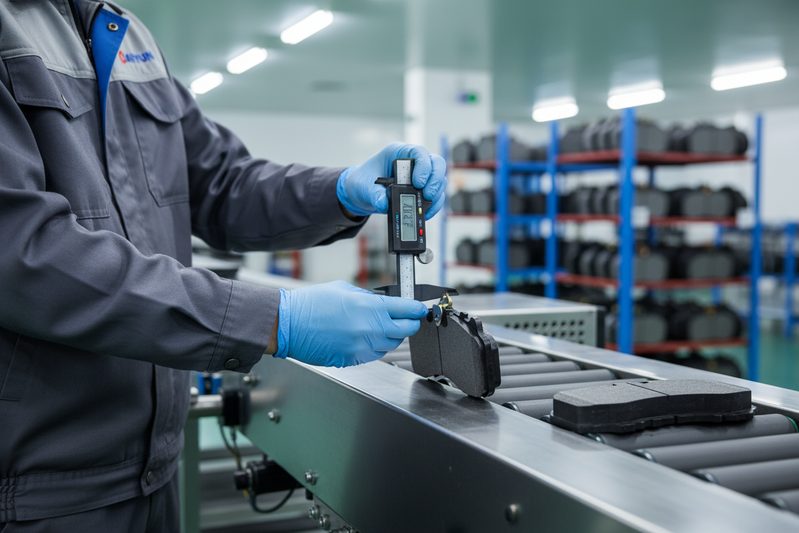
Testing and Quality Gates: Does the factory perform 100% dimensional checks? Do they have a shear strength test for every batch? What about a dynamometer for performance validation? A serious manufacturer will have a fully equipped lab, not just a final visual inspection. This is where our 49+ years of manufacturing experience translates into built-in quality checks at every stage.
R&D Investment: Can they develop a custom formulation for a specific vehicle platform or market requirement? Or are they just selling a generic "ceramic" formula? A true partner has an R&D department that continuously refines formulations based on real-world feedback and new material science.
Frequently Asked Questions for Importers & Distributors
What's the realistic minimum order quantity (MOQ) for ceramic pads from a Chinese manufacturer?
It varies widely. For standard passenger car applications, serious manufacturers might have an MOQ of 50-100 sets per part number. For a full brake pad product range, you can often negotiate mixed-container loads. Be wary of factories offering extremely low MOQs (like 10 sets); it often indicates they are traders or have severe quality control issues with batch consistency.
How do I verify ECE R90 certification is genuine?
First, ask for the official test report from the accredited laboratory (like IDIADA, TÜV, etc.). It should list the exact pad reference, friction code (e.g., GG), and the manufacturer's name and address. Second, you can cross-reference the approval number on the pad's packaging or backing plate with the official ECE database. A legitimate manufacturer will provide this transparency without hesitation.
What's the lead time for a 20-foot container of mixed ceramic brake pads?
For an in-stock catalog item, expect 25-35 days from order confirmation to port of loading, including production and pre-shipment testing. This allows time for batch mixing, curing, grinding, and final QA. For custom formulations or new tooling, add 60-90 days for R&D and sample approval. Always factor in sea freight time from there. Reliable suppliers provide a detailed production schedule.
Sourcing ceramic brake pads is a technical procurement exercise. The brands that succeed are those that partner with manufacturers who treat certifications as a baseline, not a marketing badge, and who can provide the data to back up every performance claim. Your reputation depends on the consistency and safety of the parts you sell.
Ready to evaluate a supplier that meets these criteria? Request a quote from BAIYUN Brake. We'll provide full technical data sheets, certification documents, and factory audit reports so you can make an informed decision with confidence.
Was this article helpful?
Average Rating: 5/5 (2056)