
Can Chinese Brake Pads Match OEM Specifications for European Trucks?
Summary:
Chinese brake pads can match OEM specifications for European trucks when manufactured to strict technical and compliance standards like ECE R90 and IATF 16949. Success depends on accurate brake pad OEM cross-reference China practices, precise WVA number matching, and rigorous testing protocols that verify performance equivalence with original equipment.
Can Chinese Brake Pads Match OEM Specifications for European Trucks?
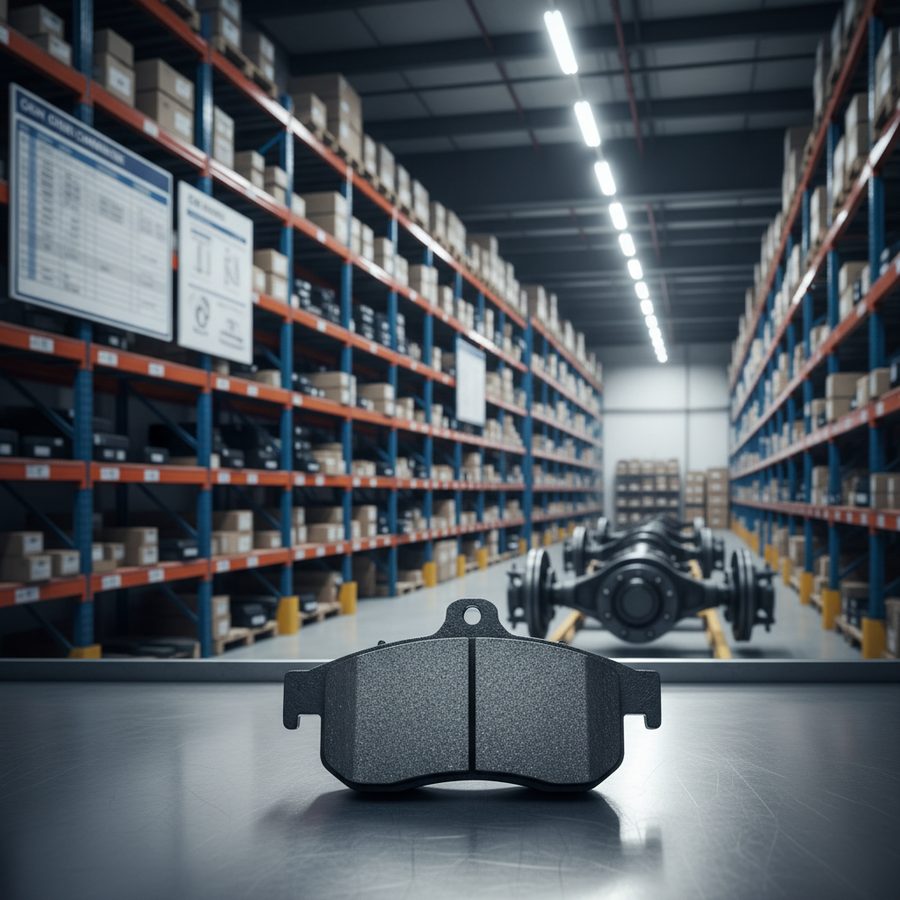
You're sourcing brake pads for a fleet of Volvo or Mercedes trucks. The OEM parts are reliable, but the cost is squeezing your margins. You've seen competitive quotes from Chinese manufacturers, but a nagging question remains: can these aftermarket pads truly deliver the same performance and safety as the original equipment? It's not just about price; it's about liability, warranty claims, and your reputation. The answer lies not in the country of origin, but in the technical specifications, test protocols, and quality systems behind the product.
For professional importers and distributors, the core issue is compatibility and compliance. A brake pad isn't just a piece of friction material; it's a safety-critical component engineered for a specific vehicle's weight, speed, and braking system. Matching OEM specs isn't a suggestion—it's a commercial and legal necessity. Let's break down what that actually means on the factory floor and the test bench.
What Does "Matching OEM Specifications" Actually Mean for Brake Pads?
OEM specifications are a detailed recipe, not a vague target. They define the exact physical dimensions, material composition, and performance envelope a brake pad must operate within. For European trucks, this is heavily governed by ECE Regulation 90. Matching these specs means your aftermarket pad must slot into the caliper with the same running clearance, apply even pressure across the rotor, and generate a predictable amount of friction at every temperature from a cold morning start to a sustained downhill descent.
The most critical specification is the friction coefficient, usually expressed as an "EE" or "FF" rating under ECE R90. An "FF" rated pad, for example, must maintain a friction coefficient between 0.35 and 0.45 when cold (100°C) and cannot drop below 0.25 when hot (350°C). Deviating from this band can cause brake judder, increased stopping distances, or premature wear on other components. It's why a proper understanding brake pad materials is foundational for any sourcing decision.
Physical dimensions are just as precise. A thickness variance of even 0.5mm can affect caliper piston retraction, leading to drag and overheating. The location and shape of wear sensors, shims, and chamfers are all part of the OEM design to manage noise and vibration. A true OEM match replicates these details exactly, which is why a reliable brake pad catalog PDF with accurate technical drawings is non-negotiable for professional buyers.
Matching OEM specifications requires replicating the exact physical, chemical, and performance characteristics defined by the vehicle manufacturer and codified in regulations like ECE R90.
How Do You Cross-Reference Brake Pads from China to European OEM Numbers?
You've got an OEM part number from a DAF XF or a Scania R-series. How do you find the correct Chinese equivalent? The industry standard is the WVA (Wirtschaftsverband der Automobilindustrie) numbering system. A WVA number like 29087 uniquely identifies a brake pad's critical dimensions and application. Reputable manufacturers build their entire full brake pad product range around this universal referencing system.
The cross-reference process is more than a database lookup. It involves technical verification. First, the WVA number confirms the physical fit. Then, the manufacturer must ensure the friction material formulation is appropriate for the vehicle's Gross Vehicle Weight (GVW) and typical duty cycle—a pad for a 40-tonne tractor unit needs a different compound than one for a 16-tonne rigid truck. This is where a supplier's 49+ years of manufacturing experience translates into correct application engineering.
Many buyers make the mistake of focusing solely on the WVA match. You also need to confirm the regulatory approval. Does the Chinese pad carry the relevant ECE R90 approval mark (an "E" within a circle followed by a country number)? This certification is your assurance that the pad has passed the same type-approval tests as the OEM part. Without it, you're assuming risk, regardless of how good the dimensional fit appears.
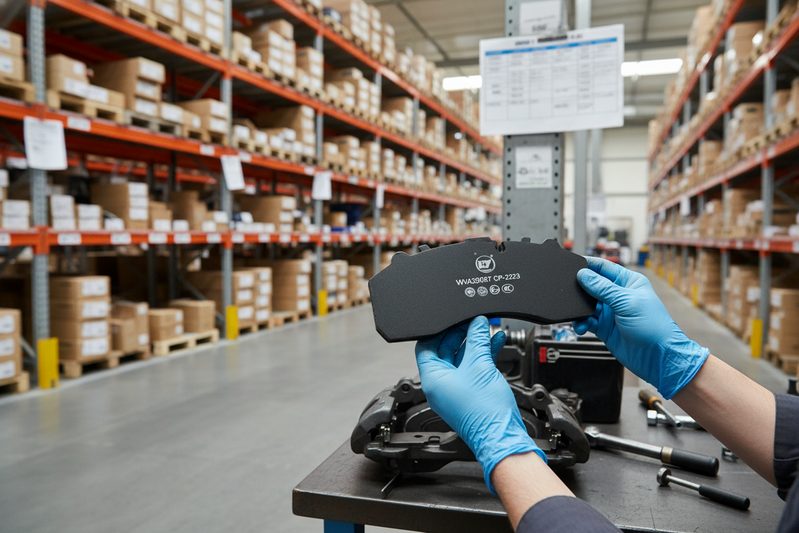
Let's take a real-world example. An OEM brake pad for a common European truck axle might have part number 12345678 and correspond to WVA 29087. A certified Chinese manufacturer like BAIYUN Brake would produce its equivalent pad (e.g., their CP2223 series) to precisely match the WVA 29087 geometry. But the work doesn't stop there. Their R&D team would then formulate a material—say, a low-metallic compound—designed to hit the OEM's specified FF friction rating and pass the full suite of ECE R90 dynamometer and vehicle tests. They'd document this in a commercial vehicle brake pad test report available to buyers.
Accurate cross-referencing combines WVA number verification with friction material engineering and regulatory compliance checks to ensure true OEM equivalence.
What Tests Does ECE R90 Require for Brake Pad Approval?
ECE R90 is the legal benchmark for replacement brake pads in Europe. It's not a single test, but a rigorous protocol designed to prove a pad is at least as effective as the original equipment. The regulation mandates a head-to-head comparison between the aftermarket pad and the OEM pad on the same vehicle or inertia dynamometer.
The core sequence is the Type I test, or "normal effectiveness" test. This involves a series of stops from 80% of the vehicle's maximum speed to measure fade and recovery. The aftermarket pad's performance must fall within a 15% tolerance band of the OEM pad's results. More demanding is the Type II test (fade test) for vehicles over 3.5 tonnes, which subjects the brakes to repeated high-energy stops to simulate mountain descent conditions. The pad must not exhibit dangerous fade or structural failure.
Beyond performance, R90 requires checks for dimensional stability, shear strength, and compressibility. The pad is baked in an oven at high temperatures to ensure it doesn't warp or crack. It's subjected to a shear test to guarantee the friction material won't detach from the backing plate under extreme force. These physical tests are what separate a pad that merely fits from one that will survive real-world abuse. You can see this engineering rigor in action in our factory tour videos.
The final proof is the marking. An ECE R90-approved pad is permanently marked with the regulation number, the friction coefficient code (e.g., FF), a manufacturer code, and a production batch number. This creates full traceability. If a batch has issues, it can be recalled. For a distributor, this traceability is a key risk management tool. It's also a sign that the manufacturer operates under an IATF 16949 certified quality management system, which mandates strict control over every production batch.
ECE R90 approval requires a battery of performance, durability, and physical property tests that directly compare the aftermarket pad against the OEM benchmark, ensuring equivalent safety and function.
What Are the Most Common Misconceptions About Chinese Brake Pads?
Misconception: All Chinese brake pads are low-quality copies.
Reality: The market is stratified. There are uncertified, price-driven factories, and there are certified, engineering-driven manufacturers like BAIYUN Brake that supply global OEMs and Tier 1 suppliers. The difference is investment in R&D, testing equipment, and quality systems. A 2025 industry audit showed that the top 15% of Chinese export-focused brake pad plants now operate at parity with European aftermarket facilities in terms of IATF 16949 certification and ECE R90 compliance rates.
Misconception: If the dimensions match, the pad will work.
Reality: Dimensional fit is just the first step. The wrong friction material can cause multiple problems. A pad that's too "hard" (high friction) can lock wheels prematurely or wear out rotors quickly. A pad that's too "soft" (low friction) will increase stopping distance and cause the vehicle's ABS to work overtime. The material must be matched to the vehicle's weight and performance characteristics, which is detailed in a proper brake running clearance tips guide.
Misconception: ECE R90 certification is easy to obtain or fake.
Reality: ECE R90 is a government-mandated type approval. The testing must be performed by a recognized technical service, and the certification is granted by a national authority (like the German KBA). The test reports are extensive, and the marking requirements are specific. While counterfeit marks exist, a professional buyer should always request the official test report from the manufacturer. Reputable suppliers provide these openly, as seen in our available competitor test reports for comparison.
How Can You Verify a Chinese Supplier's Claims of OEM Equivalence?
Trust, but verify. Start with the certifications. Demand proof of a valid IATF 16949 certificate for their manufacturing site. This automotive-specific standard proves they have controlled processes for design, production, and inspection. Then, ask for the ECE R90 test reports for the specific WVA numbers you're buying. The report should clearly show the tested pad's performance versus the OEM baseline.
Go beyond paperwork. Request material data sheets that specify the friction coefficient curve (mu vs. temperature). Ask for samples and have them independently measured for critical dimensions like thickness, length, and hole positions. A serious manufacturer will welcome this due diligence. In fact, BAIYUN Brake's quality assurance process includes providing sample packs with full documentation for exactly this purpose.
Finally, assess their technical capability. Do they have a real R&D department that can discuss formulation adjustments for specific applications? Can they provide support if you encounter a technical issue in the field? A supplier that only has a sales team can't help you solve a noise complaint or a wear issue. Their ability to offer detailed brake pad troubleshooting guidance is a strong indicator of their technical depth and commitment to a partnership, not just a transaction.
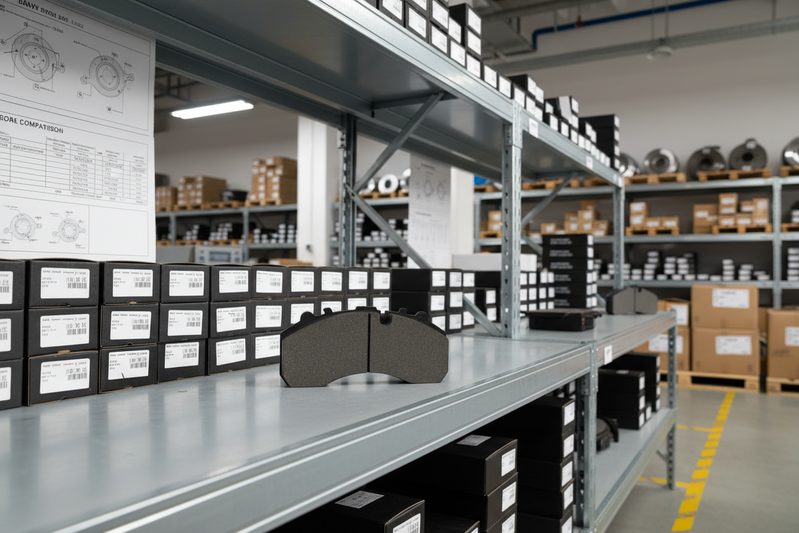
Verification requires a three-step process: auditing formal certifications (IATF 16949, ECE R90), reviewing technical test data, and evaluating the supplier's in-house engineering and support capabilities.
Frequently Asked Questions (FAQ)
Q: Can I use a Chinese brake pad with a European WVA number as a direct OEM replacement?
A: Yes, if and only if the pad carries official ECE R90 approval for that application. The WVA number ensures physical compatibility, but the ECE R90 mark certifies performance equivalence. For example, BAIYUN Brake's pad for WVA 29087 includes the ECE R90 mark, confirming it passed all required tests against the OEM benchmark, with a documented friction coefficient stability of ±0.05 across the mandated temperature range.
Q: How significant is the price difference between certified Chinese pads and European OEM parts?
A: The difference is typically 30-50%, but it varies by vehicle platform and order volume. The gap isn't just labor cost; it reflects the different supply chains. You're paying for the manufacturer's efficiency and direct export model. However, the price difference between certified and uncertified Chinese pads can be 15-25%. That smaller gap rarely justifies the warranty and liability risk of using a non-compliant part.
Q: Do Chinese manufacturers offer formulations for specific European climates or driving conditions?
A: Leading manufacturers do. For instance, a formulation for Nordic operations might be optimized for consistent cold-weather bite and resistance to salt corrosion. A pad for Alpine regions would prioritize high-temperature stability and fade resistance. This requires advanced R&D. BAIYUN Brake, for example, develops different material grades within its C.V. brake pad range to address these regional performance demands.
Q: What happens if a certified Chinese brake pad fails in service?
A: With proper certification and batch traceability, the process mirrors that of any branded aftermarket part. The distributor documents the failure with photos, mileage, and batch numbers. The manufacturer's technical team investigates, often requesting the return of the failed part for analysis. If a material or manufacturing defect is confirmed, a warranty claim is processed. This structured support is a core benefit of working with an IATF 16949 certified supplier with a dedicated technical support center.
Q: How do I ensure consistent quality across multiple batches from a Chinese supplier?
A: Consistency is guaranteed by the supplier's quality management system (IATF 16949). This system mandates statistical process control (SPC) for critical production steps, from raw material mixing to final curing. Each batch should have its own test records for shear strength, hardness, and dimensions. You should receive a Certificate of Analysis (CoA) with key parameters for each batch you purchase. Regular factory audits, either by you or a third party, are also a best practice to ensure the system is functioning as documented.
So, can Chinese brake pads match OEM specs for your European trucks? The evidence says yes—provided you partner with a manufacturer that treats specifications as law, not guidelines. It comes down to a disciplined focus on the technical details: the WVA cross-reference, the ECE R90 test report, the friction coefficient curve, and the backing of a certified quality system. When those boxes are checked, the geographic origin of the pad becomes far less relevant than the engineering integrity behind it.
Your next step is to move from general research to specific verification. Download a technical catalog for the truck models you service. Compare the specs. Then, reach out to a certified manufacturer with your list of WVA numbers and ask for the proof—the test reports, the material data, the certifications. That's how you build a supply chain that's both cost-effective and completely reliable.
Ready to verify OEM matches for your fleet? Contact our team with your list of European truck applications and WVA numbers. We'll provide cross-reference data, ECE R90 test reports, and samples so you can evaluate the fit and performance firsthand.
Was this article helpful?
Average Rating: 5/5 (1376)