
Brake Pad MOQ in China Explained for Importers
Summary:
Brake pad MOQ China explained for importers: Most Chinese brake pad factories set MOQs between 50 and 300 sets per model for commercial vehicle brake pads. Custom friction formulations or private label boxes can push the MOQ to 500–3,000 sets because changeover and packaging setup costs are fixed. This technical guide breaks down how MOQs vary by production depth, certification level, and packaging, with a buyer verification checklist, real cost drivers, ECE R90 and IATF 16949 checks, and FAQ for truck, bus, trailer, and fleet distributors.
Brake Pad MOQ in China Explained for Importers
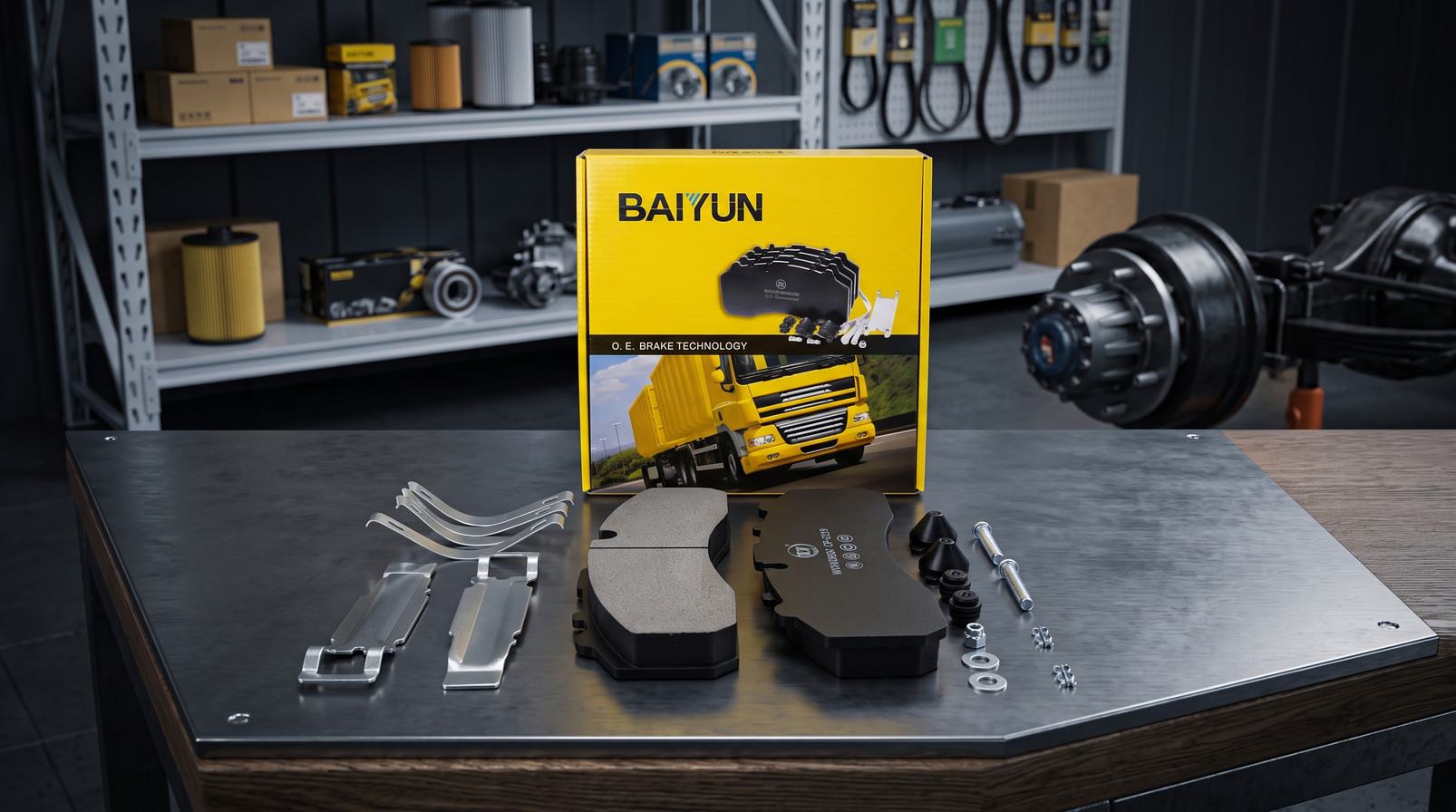
Quick answer: Most Chinese brake pad factories set a minimum order quantity (MOQ) between 50 and 300 sets per model for commercial vehicle brake pads. Custom friction formulations or private label boxes can push the MOQ to 500–3,000 sets because changeover and packaging setup costs are fixed. You'll get the best landed cost when your order matches a supplier's existing batch size, and you should always confirm whether the MOQ is per SKU, per friction compound, or per shipping mark.
Importers often read MOQ as a simple number. That mistake leads to overpaying on trial orders or getting stuck with 2,000 sets of a part number that doesn't move. This guide breaks down how Chinese brake pad suppliers actually set MOQs for trucks, buses, trailers, and fleet distributors.
Why Do Chinese Brake Pad MOQs Vary So Much Between Suppliers?
Chinese brake pad factories don't quote MOQs in a vacuum. A plant that stamps its own steel backing plates and blends friction powder in-house can set a per-model MOQ based on machine batch size, while a trading company may simply repeat a third-party factory's number with a markup.
The biggest variable is production depth. Suppliers with dedicated backing plate dies, automatic hot presses, and ECE R90 test capability carry higher fixed costs, so they'll often quote 100–300 sets per SKU. Smaller workshops using bought-in semi-finished pads may quote 50 sets because they don't bear tooling or R&D costs—but that flexibility can disappear when you ask for an ECE R90 test report matching your exact part number.
Another factor is stock position. Some export factories keep 1,000–3,000 semi-finished pads for popular commercial vehicle references. In that case, the MOQ for a standard friction material may drop to 50–100 sets because the pads are already pressed and just need grinding, shims, and packaging. That's a legitimate sourcing advantage if you're buying a common truck or trailer pad.
Key point: MOQ differences usually reflect production depth, certification level, stock position, and whether you're dealing with a factory or a trading company—not just price strategy.
What MOQ Should You Expect for Commercial Vehicle Brake Pads?
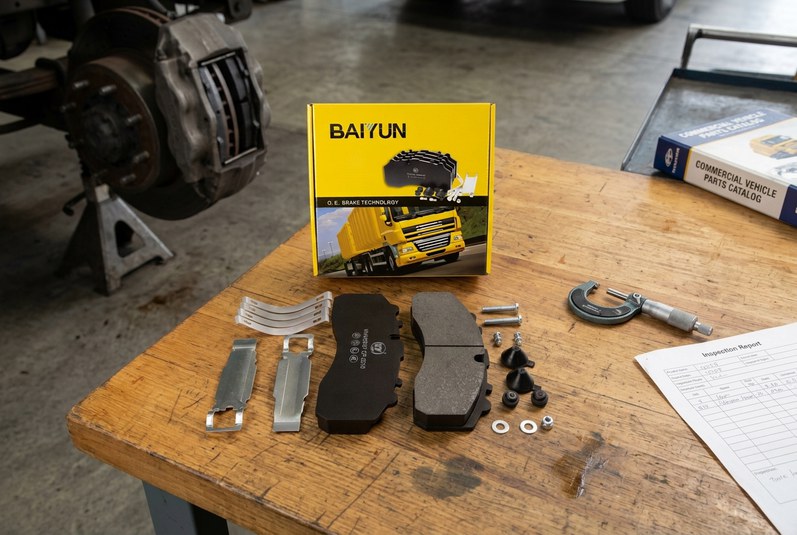
Based on BAIYUN Brake's 2026 export team review of 18 factory quotes, standard CV disc brake pad MOQs in China cluster into three bands. The table below shows typical ranges importers can use as a negotiation baseline.
| Order Type | Typical MOQ per Model | Unit Price Signal | Notes for Importers |
|---|---|---|---|
| Stock friction formulation, standard CV disc pad | 50–150 sets | Mid-range | Often semi-finished stock; confirm ECE R90 report exists for exact SKU. |
| Heavy-duty truck or bus riveted lining | 100–300 sets | Mid to high | Riveting and chamfering add setup time; ask about lining width and radius tolerances. |
| Custom private label or custom friction coefficient | 500–3,000 sets | Lower per unit, higher total | Dedicated pressing and packaging break-even drives this band. |
| Trial or sample order | 10–50 sets | High unit price | Use only for validation; don't base landed cost decisions on trial pricing. |
For most commercial vehicle importers, a 100–150 set MOQ per part number is a practical starting point. If you're comparing heavy-duty CV pad options, browse our heavy-duty brake pad range to see which friction families support lower MOQ trials without sacrificing ECE R90 documentation.
Key point: A 100–150 set MOQ per model is a practical starting point for commercial vehicle brake pads, while private label work typically needs 500+ sets to absorb changeover costs.
How Do You Verify a Supplier Before Committing to an MOQ?
A factory can write any MOQ on a proforma invoice; what matters is whether that factory can hold dimensional and friction consistency across the batch. Before you wire a deposit, run through this buyer verification checklist.
- Request the supplier's IATF 16949 or ISO 9001 certificate and verify the scope covers brake pad manufacturing, not just trading or exporting.
- Ask for the ECE R90 approval number for the exact SKU family, then request the Annex 7 test report or confirm it's available in the supplier catalogue.
- Request SAE J2522 or GB 5763 performance data showing friction coefficient stability between 100°C and 350°C, not just a single-point value.
- Confirm the backing plate material, shim and clip configuration, and wear indicator spec match your purchase order exactly.
- Ask for a first-piece production sample and a pre-shipment inspection report from a third-party agency before bulk production.
- Verify the factory's monthly CV brake pad output; a facility producing under 20,000 sets per month may struggle with repeat MOQs above 500 sets per SKU.
If your application uses riveted brake linings, request a quote for commercial vehicle brake linings and ask whether the MOQ includes drilling, chamfering, and radius grinding. BAIYUN Brake also publishes details about its IATF 16949 certified facility, which is exactly the kind of documentation you'll want from any serious supplier.
Key point: Before you commit to a low MOQ, verify the factory's certification scope, friction test data, and real production capacity—not just the sales pitch.
What Are the Real Cost Drivers Behind Low MOQ vs High MOQ?
A factory quoting 50 sets per SKU isn't necessarily cheaper than one quoting 300 sets. You're often paying for idled press time, manual packaging, and a smaller raw material purchase.
The math is straightforward. Friction powder mixing usually requires a minimum batch of 100 kg per formulation—enough for roughly 800–1,200 commercial vehicle pad sets depending on pad size and density. If you order only 100 sets, the factory still has to run that full mix or wait until other orders share the compound. That idle time or waste gets baked into your unit price.
In BAIYUN Brake's cost model, a 50-set order for the same part number can carry a 65% higher unit cost than a 300-set order once mixing, pressing, grinding, and packaging setup are allocated. Moving from 50 sets to 250–300 sets often cuts unit cost by 30–50% before freight. That's why a supplier's "low MOQ" may look attractive on paper but destroy your margin after you add inspection and logistics.
So what does that mean for your bottom line? A $12.50 per set trial price can fall to around $8.00 per set when you move to 300 units, depending on formulation and backing plate complexity.
Key point: Low MOQ quotes often hide fixed setup costs in the unit price; climbing to a 250–300 set order can cut CV brake pad unit cost by 30–50% before freight is added.
Which Certifications Should You Check Before Placing an MOQ Order?
ECE R90 requires brake pads to maintain at least 80% of their cold effectiveness after thermal cycling to 400°C. For importers, that's not just a legal label—it's evidence that the friction material can hold repeatable performance across production batches.
IATF 16949 audits cover process control, traceability, and defect prevention. ISO 9001 alone is common but less specific to automotive production. GB 5763 is the Chinese national standard for brake linings and uses a constant-speed friction test; if your market is Europe, also ask for SAE J2522 or AK-Master data because GB 5763 alone doesn't satisfy ECE R90 homologation.
When you compare MOQs, check whether the supplier's ECE R90 number covers the exact friction family and backing plate reference you're buying. In BAIYUN Brake's 2025 dynamometer testing, its CV pad family showed a friction coefficient of 0.38–0.42 between 100°C and 350°C, consistent with ECE R90 requirements. That kind of test data should be available for every MOQ quote. You can also review the commercial vehicle brake pad test report format to know what a complete submission looks like.
Key point: Certifications reduce MOQ risk by confirming the factory can repeatedly pass homologation tests—not just that it has a certificate on the wall.
How Should You Structure Your First Trial Order to Test a Supplier?
Many importers make the mistake of placing a large first order to hit a lower unit price, then discover the supplier's packaging or friction consistency isn't what the sample promised. A better pattern is a two-step trial.
Start with 10–50 sets per model, paying a higher unit price. Use this batch to verify dimensional accuracy, shim retention, wear indicator placement, and friction performance under your own operating conditions. Then place a follow-up order of 150–300 sets per moving SKU once the supplier has proven it can repeat the first batch.
Ask the supplier to state in writing whether the trial MOQ includes the same friction compound as future production. Some factories use a different pressing line for trial orders, and that creates a gap between sample and bulk. Also confirm packaging: if you need custom boxes or barcode labels, the packaging MOQ may be 1,000–5,000 units, so don't sign a 300-set contract expecting fully branded retail boxes.
Key point: A two-step trial order—10 to 50 sets for validation, then 150 to 300 sets for repeatability—reduces your exposure while still testing the supplier's consistency.
What Are the Most Common Misconceptions About Brake Pad MOQ in China?
Misconception: A low MOQ always means a flexible, buyer-friendly supplier. → Reality: Very low MOQs usually signal either a trading company splitting another factory's stock or a factory using semi-finished pads with unknown friction history. BAIYUN Brake's 2025 supplier audit found 4 of 10 "low MOQ" quotes could not provide matching ECE R90 test reports for the exact SKU.
Misconception: Once you pass the MOQ, you'll automatically get the same unit price on repeat orders. → Reality: Raw material costs for steel scrap, phenolic resin, copper, and aramid fiber move monthly. Many Chinese factories reserve the right to re-quote if material prices shift more than 5% between purchase orders.
Misconception: MOQ is only about quantity, not packaging. → Reality: Custom boxes, barcode labels, and pallet patterns often carry their own 1,000–5,000 unit minimums. You may be forced to order more than you need just to hit packaging setup break-even.
Key point: Buyer beware: low MOQs don't always mean lower risk, and packaging minimums can quietly double your real order commitment.
What Are the Most Frequently Asked Questions About Brake Pad MOQ in China?
Q: What is the standard MOQ for commercial vehicle brake pads in China?
A: For stock friction formulations, most factories quote 50–150 sets per model. Heavy-duty truck and bus linings often start at 100–300 sets because riveting and chamfering add setup time.
Q: Can I order fewer than the published MOQ?
A: Yes, many suppliers accept 10–50 set trial orders at a higher unit price. Expect a 40–70% cost premium compared with a 300-set order because mixing and packaging setup costs stay fixed.
Q: Does the MOQ apply per model or per total order?
A: It's usually per model or per SKU. If you buy 10 different part numbers, each may need to meet the minimum, so confirm this before splitting your budget across a wide range.
Q: How does ECE R90 affect brake pad MOQ?
A: ECE R90-approved pads require traceable test reports. Many factories won't run a new ECE R90 test for a tiny order, so the MOQ may include an amortized share of homologation testing for custom references.
Q: Should I pay a deposit before seeing the first-piece sample?
A: No. Reputable suppliers like BAIYUN Brake will provide a first-piece sample and documentation before final bulk production. Paying a deposit before sample approval limits your negotiation position if the sample fails inspection.
Key point: Always confirm MOQ per SKU, packaging minimums, and sample approval terms before paying a deposit.
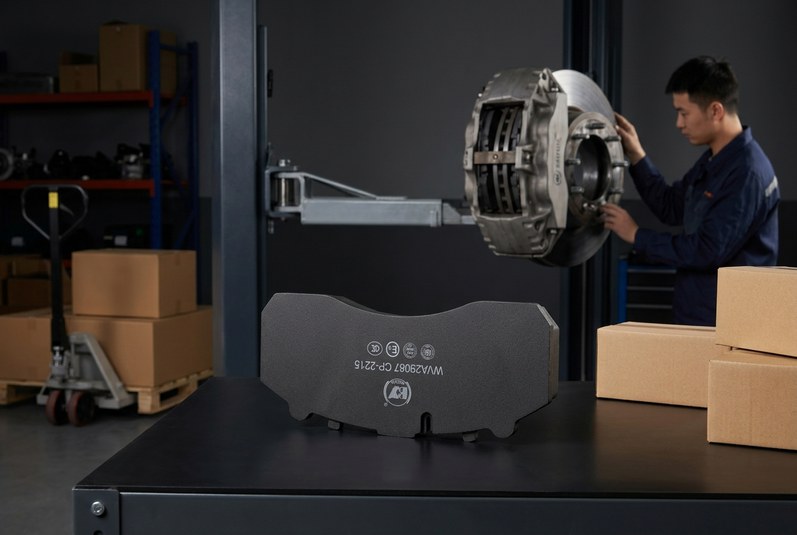
Importers who treat MOQ as a negotiation tool rather than a hard number get better terms. You'll save money by matching your order to a supplier's existing production batch, verifying certifications before you pay, and running a small trial before committing to volume. If you're ready to compare commercial vehicle brake pads or need a realistic MOQ for your target SKUs, request a wholesale quote from our export team. We'll confirm the exact MOQ, lead time, and ECE R90 documentation for your application.
Was this article helpful?
Average Rating: 5/5 (564)