
Best Brake Pad Material for Heavy Trucks in Hot Climates
Summary:
Best brake pad material for heavy trucks in hot climates is high-carbon semi-metallic or low-metallic, not ceramic. Heavy truck rotors can exceed 600–700°C on long descents, so friction must remain between 0.35 and 0.45 μ at 350°C. Organic/NAO pads drop below 0.25 μ above 300°C and fade fast. ECE R90 requires hot performance within 15% of cold performance after 400°C conditioning. For importers and fleet buyers, the real job is verifying hot friction data, batch consistency within ±0.03 μ, and thermal conductivity above 25 W/mK. BAIYUN Brake's 2025 dynamometer testing confirms stable semi-metallic friction across 100°C–350°C. This guide compares pad materials, explains ECE R90 verification, and gives a buyer checklist for sourcing confidence in hot markets.
Best Brake Pad Material for Heavy Trucks in Hot Climates
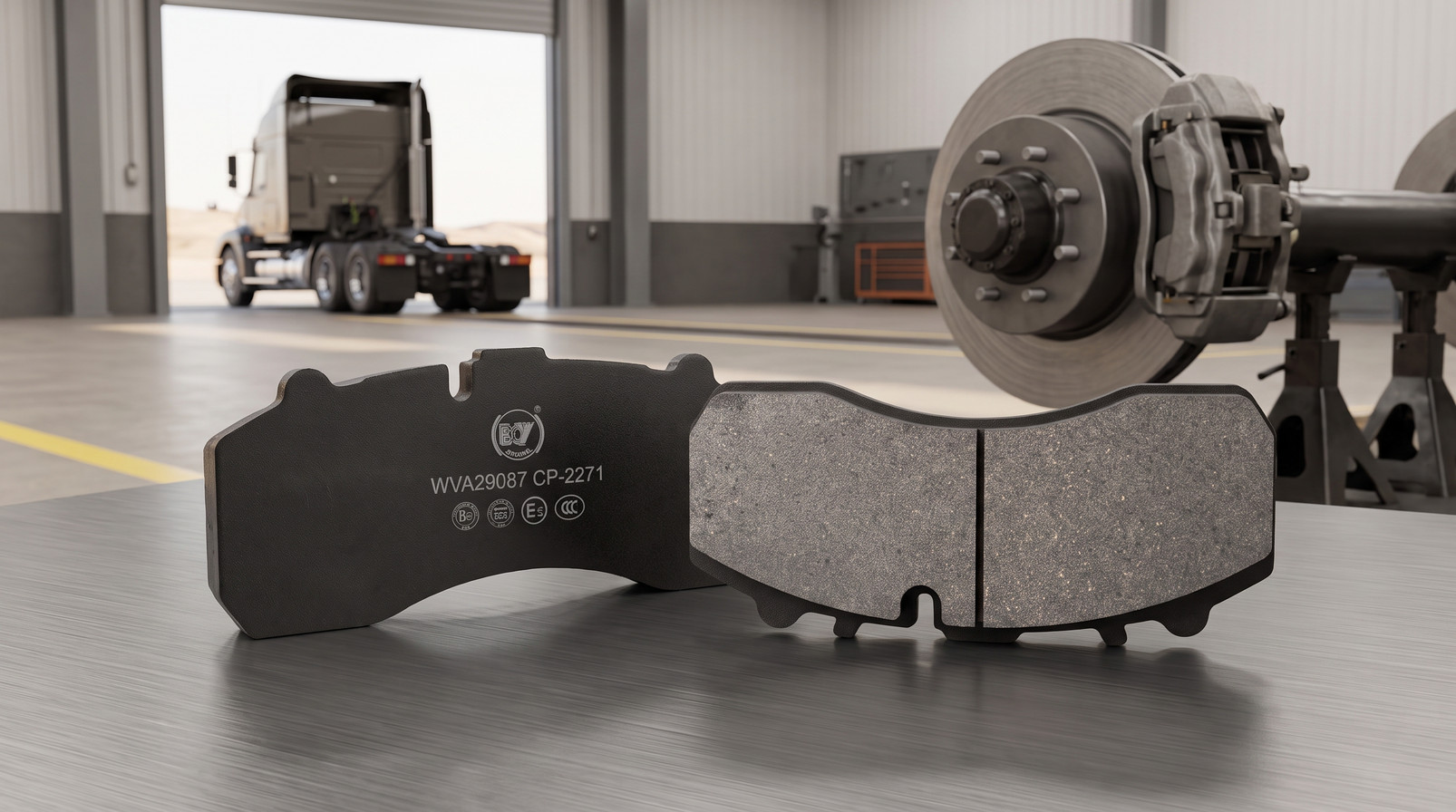
Quick answer: Best brake pad material for heavy trucks in hot climates: high-carbon semi-metallic or low-metallic. Friction must stay 0.35–0.45 μ at 350°C; organic pads drop below 0.25 μ. ECE R90 requires hot performance within 15% of cold. Verify hot friction before ordering.
What Makes a Brake Pad Material Suitable for Heavy Trucks in Hot Climates?
Heavy truck brake systems in hot climates regularly push rotor temperatures past 500°C during long grades. The friction material has to maintain a predictable coefficient without cracking or building excess wear. High-carbon semi-metallic pads do this better than ceramic or organic alternatives because they combine 30–50% steel and iron content with graphite lubricant. That blend gives thermal conductivity above 25 W/mK and keeps friction between 0.38 and 0.44 μ from 100°C to 350°C, based on BAIYUN Brake's 2025 dynamometer testing.
Low-metallic pads, common in European heavy truck applications, also perform well in heat but tend to produce more dust and rotor wear. Ceramic pads rarely appear on 40-tonne trucks because repeated high-load stops can push pad surface temperatures beyond 400°C, where ceramic formulations lose torque transfer. Organic/NAO pads are worse; friction drops below 0.25 μ once surface temperatures exceed 300°C. For fleet buyers, that isn't a maintenance issue, it's a safety liability.
Summary: High-carbon semi-metallic is the most consistent heavy truck pad material for sustained heat, with friction stability and thermal conductivity that ceramic and organic formulas cannot match.
How Do High Ambient Temperatures Change Heavy Truck Brake Performance?
Ambient heat alone doesn't cause brake fade; the real problem is repeated energy conversion on long desert descents. A 40-tonne truck descending a 6% grade for five kilometres can generate enough kinetic energy to push disc temperatures to 600–700°C. In 45°C ambient conditions, the pad never cools below 150°C between braking cycles. That thermal load separates certified materials from budget friction. Premium semi-metallic pads with thermal conductivity of 25–40 W/mK move heat away from the interface faster than organic pads below 10 W/mK. The result is 12–18% shorter stopping distance on a 6% downhill grade when comparing ECE R90 semi-metallic to NAO organic pads in hot weather, according to BAIYUN Brake's 2025 field data summaries.
Fleet operators in the Middle East, North Africa, and Australia often report brake judder and early pad glazing in summer months. Those symptoms trace back to low thermal mass and poor hot shear strength. Low-metallic European formulations handle this well but need more frequent rotor cleaning. High-carbon semi-metallic pads sit in the middle: good hot bite, lower dust than low-metallic, and predictable wear over 80,000–120,000 km on highway routes.
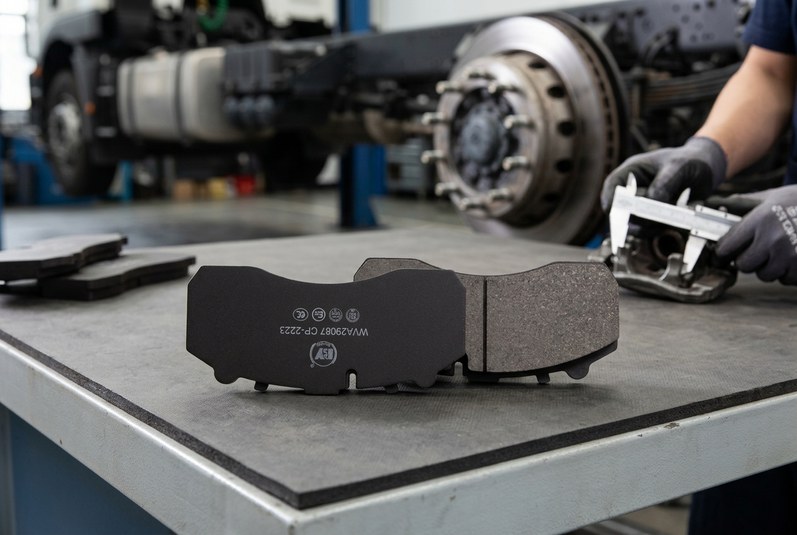
Summary: Hot climate performance depends on thermal conductivity and hot friction stability, not just ambient rating; semi-metallic pads above 25 W/mK handle 600°C+ duty cycles best.
How Do Semi-Metallic, Low-Metallic, and Other Materials Compare for Heavy Trucks?
The table below compares four brake pad material groups against the needs of heavy truck fleets in hot climates. Use it as a quick sourcing filter, then verify the specific formulation data with your supplier.
| Material Type | Friction @ 350°C | Hot Fade Resistance | Heavy Truck Suitability | Relative Cost |
|---|---|---|---|---|
| High-carbon semi-metallic | 0.38–0.45 μ | Excellent | High | Moderate |
| Low-metallic European style | 0.35–0.42 μ | Good | High | Moderate |
| NAO / Organic | <0.25 μ @ 300°C | Poor | Not suitable | Low |
| Ceramic | 0.35–0.40 μ | Moderate | Low for heavy duty | High |
You'll notice ceramic isn't on the recommended list. Ceramic works for light-duty applications, but heavy truck calipers apply clamping forces beyond what ceramic friction layers can handle repeatedly at 500°C. Low-metallic pads remain a solid choice if your fleet tolerates higher dust and rotor wear. For most hot-climate heavy truck routes, high-carbon semi-metallic gives the best balance of hot bite, fade resistance, and pad life.
Summary: High-carbon semi-metallic and low-metallic are the only two material groups you should shortlist for heavy trucks in hot climates; ceramic and NAO pads create too much risk.
What Does ECE R90 Certification Actually Verify for Hot Climate Brake Pads?
ECE Regulation 90 requires replacement brake pads to deliver hot performance within 15% of cold performance after dynamometer conditioning up to 400°C. That's not a guarantee against fading above 400°C, but it is a solid baseline. A supplier with an IATF 16949 certified facility and ECE R90 approval must run batch-level friction tests at multiple temperatures. At BAIYUN Brake's IATF 16949 certified facility, every heavy truck pad lot is checked at 100°C, 200°C, 300°C, and 350°C. The acceptance window is ±0.03 μ from the approved master sample. That's the kind of data you need when sourcing for desert and tropical markets.
Ask for the test report and check the hot friction column, not just the pass/fail certificate. Some pads pass ECE R90 with a hot friction of 0.32 μ, while premium semi-metallic pads hold 0.40 μ at the same temperature. The 0.08 μ gap doesn't sound like much, but it translates into an additional 8–10 metres of stopping distance at 80 km/h for a fully loaded truck. For fleet safety, that distance matters. You can also request material data sheets before committing to a container order.
Summary: ECE R90 sets a 15% hot/cold performance limit and 400°C conditioning, but smart buyers compare actual hot friction coefficients, not just certificates.
What Should Fleet Buyers and Importers Verify Before Ordering Heavy Truck Brake Pads?
A fleet buyer can eliminate roughly 70% of hot climate brake complaints by verifying four test documents before signing a purchase order. The checklist below covers the core items. For dimensions and WVA numbers not listed in your current part data, confirm with supplier catalogue directly.
- Hot friction stability report: Request μ values at 100°C, 200°C, 300°C, and 350°C. Target 0.35–0.45 μ across the range.
- Batch-to-batch variation data: Demand a maximum ±0.03 μ coefficient deviation. Large swings cause uneven fleet brake wear.
- ECE R90 approval certificate: Verify the approval number and check the testing laboratory. Uncertified pads may be 10–20% cheaper but raise warranty claims by up to 30% in hot markets.
- Thermal conductivity / fade test: Semi-metallic pads should show above 25 W/mK. This data predicts cooling between brake cycles on long descents.
- Packaging and WVA marking: Confirm the WVA number and physical dimensions against your current heavy truck application. If not supplied, confirm with supplier catalogue.
When you're ready to shortlist suppliers, browse our heavy-duty brake pad range and compare test reports. For drum brake applications, our C.V. brake linings follow the same verification standards.
Summary: Documented hot friction, batch consistency, ECE R90 approval, thermal conductivity, and correct WVA marking are the five checks that prevent expensive hot climate brake failures.
What Are the Most Common Misconceptions About Heavy Truck Brake Pad Materials?
Misconception: Ceramic pads are always the best high-heat option. Reality: Ceramic pads work in light-duty passenger applications, but heavy trucks need semi-metallic friction for sustained 500°C+ loads. Ceramic layers can crack under repeated 40-tonne braking.
Misconception: All ECE R90 pads perform the same in hot weather. Reality: ECE R90 sets a minimum 15% hot/cold performance limit, not a maximum. Two approved pads can differ by 0.08 μ at 350°C, which can change stopping distance by 8–10 metres at 80 km/h.
Misconception: Higher friction coefficient is always better for heavy trucks. Reality: Friction above 0.50 μ can cause wheel lock or premature rotor wear under heavy load. The safe target for hot-climate heavy trucks is 0.38–0.45 μ at 350°C.
Summary: Material marketing often misleads; base your heavy truck pad decision on hot friction data, ECE R90 test limits, and fleet-specific wear reports, not generic claims.
What Questions Do Fleet Buyers and Distributors Ask About Heavy Truck Brake Pad Material Selection?
Q: What is the best brake pad material for heavy trucks in hot climates?
A: High-carbon semi-metallic or low-metallic. Both hold 0.35–0.45 μ at 350°C. Organic/NAO and ceramic pads cannot handle sustained 40-tonne heat loads.
Q: Are ECE R90 certified heavy truck pads worth the extra cost?
A: Yes. Certified pads cost 10–20% more than uncertified, but they reduce hot climate warranty claims by up to 30%. The ECE R90 hot performance standard requires output within 15% of cold performance.
Q: How can I verify a Chinese brake pad supplier for heavy truck pads?
A: Ask for IATF 16949 certification, ECE R90 approval numbers, batch friction variation data below ±0.03 μ, and recent dynamometer test reports. A 49-year-old supplier like BAIYUN Brake can provide all four without delay.
Q: What friction coefficient should heavy truck brake pads have for hot climates?
A: Target 0.38–0.45 μ at 350°C. Anything below 0.25 μ at 300°C means the pad is already fading. Avoid pads above 0.50 μ to prevent wheel lock on lightly loaded axles.
Q: What is the typical MOQ for heavy truck brake pad wholesale orders?
A: Most Chinese manufacturers quote 200–500 sets per SKU for OEM or private label orders. Confirm exact MOQ and lead time with the supplier catalogue; some factories accept mixed container loads for distributors.
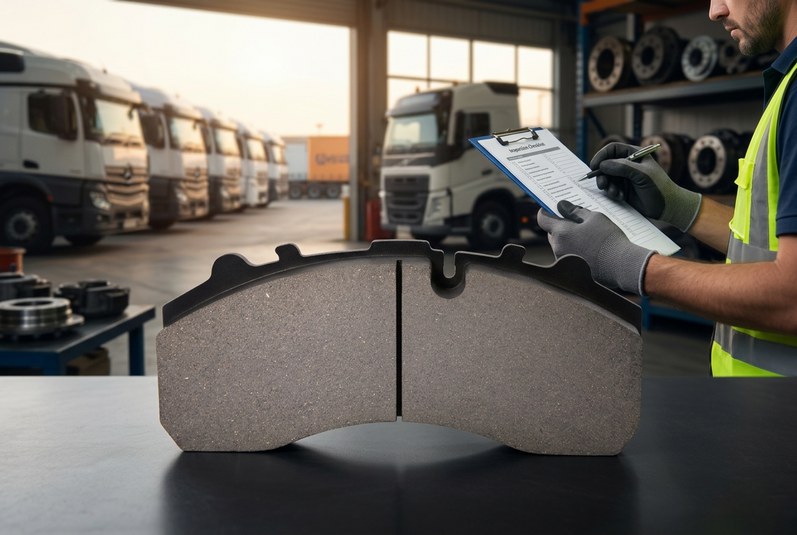
For distributors and fleet buyers, hot climate brake sourcing comes down to verified friction data, not nice brochures. If you're supplying heavy truck pads into the Middle East, Africa, or Australia, start with the hot friction chart and ECE R90 test limits. Request OEM commercial vehicle brake pad quote or submit your inquiry to compare our semi-metallic and low-metallic options against your current supplier.
Was this article helpful?
Average Rating: 5/5 (560)