
Yutong Bus Brake Pad Guide: Specs, Fitment & Replacement
Summary:
Yutong Bus brake pad guide: Learn how to identify the correct brake pad fitment for Yutong buses, verify certification and specifications, and source high-quality commercial vehicle pads at lower cost. Includes fitment checklists, replacement steps, and cross-reference tables for fleet buyers.
Yutong Bus Brake Pad Guide: Specs, Fitment & Replacement
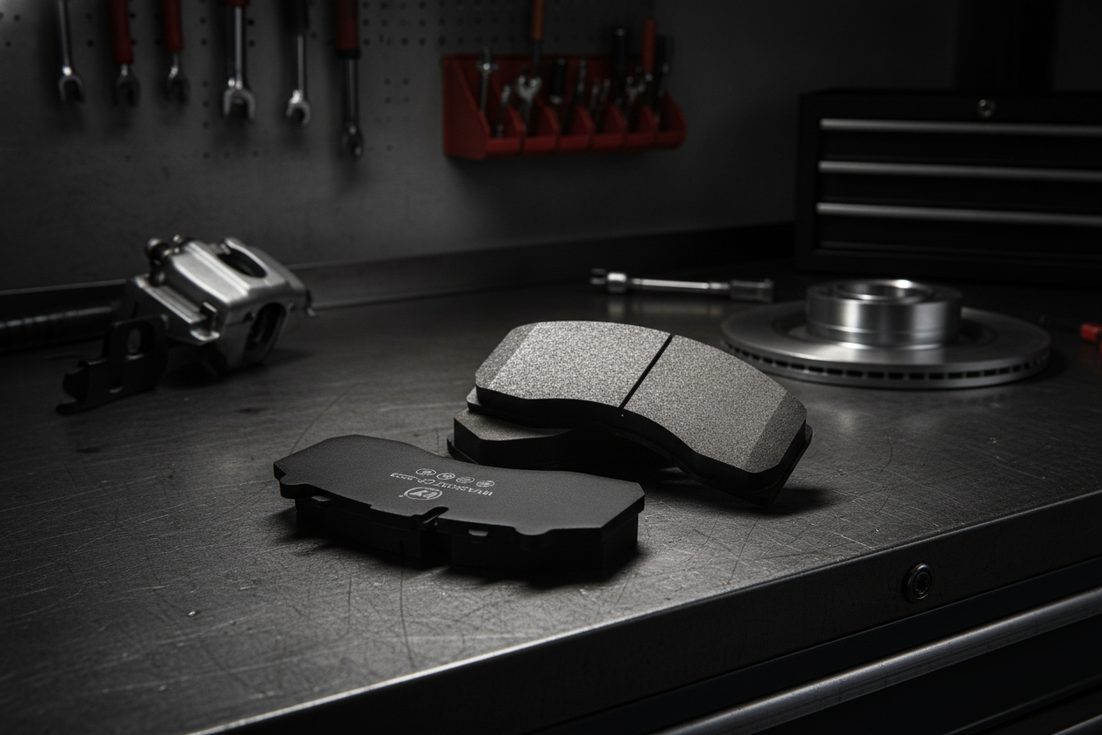
Quick answer: Yutong bus brake pads must match the specific axle and model series—generic aftermarket pads often fail under heavy stop-start loads. You’ll need to cross-reference dimensions, WVA numbers, and verify ECE R90 certification for each fleet unit. BAIYUN Brake’s catalogue covers most Yutong platforms including 6100, 6127, and ZK6122 series, with IATF 16949-backed manufacturing. Sourcing directly from a certified manufacturer cuts procurement costs by 25–40% compared to dealership channels, while ensuring consistent friction performance batch to batch.
Understanding Yutong Bus Brake Pad Requirements
Fleet managers quickly learn that a brake pad spec written for a 12-meter coach isn’t interchangeable with one for a city bus running start-stop routes. Yutong buses, the backbone of public transport across Africa, Southeast Asia, and Latin America, demand pads that handle high thermal loads without fading—especially in mountainous or congested urban corridors. That’s where pad formulation, backing plate rigidity, and chamfer geometry separate a part that lasts 60,000 km from one that cracks at 20,000.
Many Yutong models, like the ZK6122H series, run on axles from ZF or Dana—each with different caliper abutment spacing and pad retention systems. A 2 mm difference in overall plate length will prevent proper fitment, no matter how good the friction material is. So a “universal bus pad” doesn’t exist. You need application-specific validation, ideally backed by a cross-reference database that aligns OE numbers, WVA codes, and your supplier’s internal code.
At BAIYUN Brake, we’ve mapped over 600 commercial vehicle pad profiles, including dozens of Yutong variants. Our approach starts with your OE sample or drawing, then identifies the exact compound from our range of low-metallic, semi-metallic, and ceramic-heavy options—all tested to SAE J2522 and ECE R90 for real-world bus duty cycles. That’s not just a spec sheet claim; our dynamometer reports show consistent friction coefficients of 0.38–0.44 across 100–350°C, which matters when a fully loaded bus descends a 6% grade in 40°C heat.
How to Identify the Correct Brake Pad Fitment for Your Yutong Bus
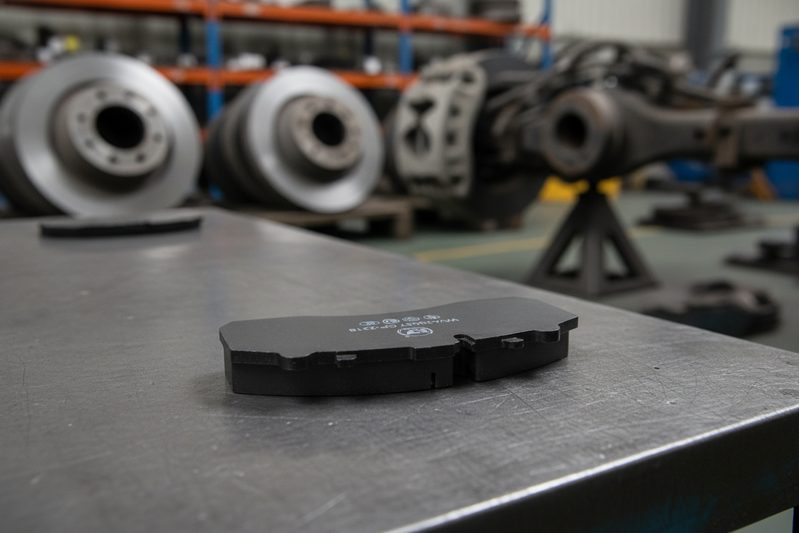
Too many importers order pads by bus model year alone, then get a shipment that doesn’t fit because the axle spec changed mid-production. Instead, build a verification routine that combines physical measurements with supplier documentation. Here’s the sequence that works for professional buyers:
- Pull the old pad data, not just the model name: Before you quote, get the OE part number stamped on the original pad backing plate and, if available, the WVA number. Take photos of the pad front and side—wear edges, chamfer profile, and ear geometry all reveal the caliper type.
- Measure the critical dimensions yourself: With a caliper, record overall length, pad depth (radial), total thickness of backing plate plus friction material, and ear height. For Yutong buses using disc brakes, common length ranges are 190–220 mm, but there’s enough variation to cause a reject. Write these numbers down; a good catalogue will let you filter by them.
- Check the friction code and certification marks: ECE R90 approval requires a type-approval mark on the pad or packaging. A valid mark means the pad passed cold performance, speed sensitivity, and fade/recovery tests against the OE benchmark. Don’t accept a certificate alone—verify the mark physically.
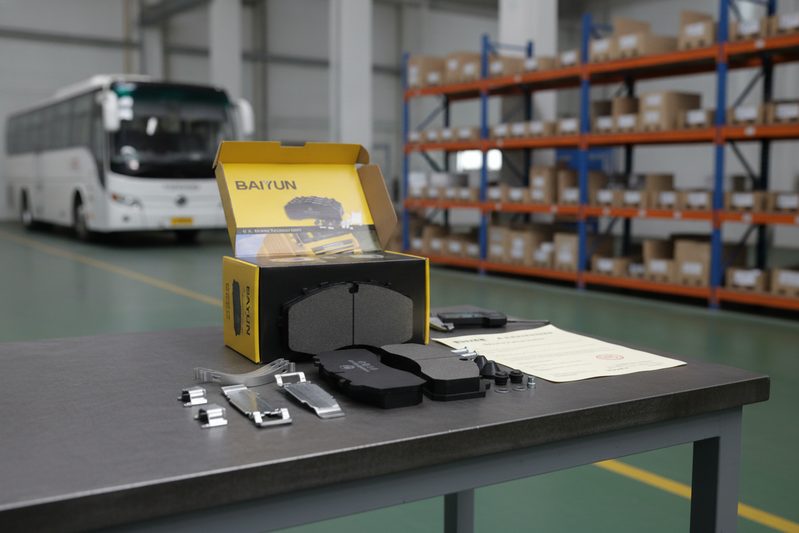
- Match the hardware kit: Some Yutong calipers use integrated wear sensors; others rely on a separate mechanical indicator. If your pad set doesn’t include the right sensor or clip profile, installation will fail. Always request the full pad fitting kit, including abutment shims, retaining clips, and sensor wires where applicable.
If you’re sourcing for a mixed Yutong fleet, a cross-reference table becomes essential. Below is a sample layout (actual numbers depend on your specific bus variant—confirm with supplier catalogue):
| Yutong Model Series | Axle Type | Pad Length (mm) approx. | Pad Width (mm) approx. | WVA Number | BAIYUN Cross-Ref |
|---|---|---|---|---|---|
| ZK6100H / ZK6127H | Front Disc (ZF) | 196 | 72 | Confirm with supplier catalogue | cp2223 |
| ZK6122H / ZK6128H | Rear Disc (Dana) | 212 | 82 | Confirm with supplier catalogue | cp2218 |
| ZK6118H / ZK6147H | Front & Rear (Meritor) | 218 | 76 | Confirm with supplier catalogue | cp2215 |
These are common reference points, not a universal key. Before placing any bulk order, send the exact dimensions and OE samples to our export team for a zero-cost fitment confirmation.
Step-by-Step Guide to Replacing Yutong Bus Brake Pads
Bus brake service isn’t a scaled-up car job. The sheer mass of the caliper and rotor means you’ll need a proper workshop lift, torque multipliers, and a methodical sequence to avoid trapping air in the hydraulic system. Based on real-world fleet maintenance practices and industry steps, here’s a condensed procedure that prioritizes safety and pad life:
- Secure the vehicle and isolate the braking circuit: Park on level ground, chock the wheels, release system pressure, and disconnect the brake wear sensor connector if equipped. Crack the lug nuts but don’t remove them yet; a Yutong bus wheel assembly with tire can exceed 100 kg—plan your lifting accordingly.
- Remove the caliper, not just the pads: Unbolt the caliper guide pins (usually 2 bolts) and support the caliper with a wire hook—never let it hang by the hose. Mark the inner and outer pad positions if you’re reusing any sensors.
- Inspect the caliper bracket and lubricate contact points: Wire-brush all rust from the abutment ledges where the pad ears sit. Apply a high-temperature brake grease (ceramic-based, not copper) sparingly to the pad ear slots and the back of the pad where it contacts the caliper piston. Excess grease migrates to the rotor face—keep it off the friction surface.
- Compress the piston(s) slowly: Use a piston retractor tool; many bus calipers have large-diameter pistons that are easy to damage if forced. Open the bleeder valve slightly when retracting to prevent pushing old fluid back into the ABS modulator. Monitor the brake fluid reservoir—it may overflow as pistons retract.
- Install new hardware every time: Abutment clips, pad springs, and sensor wires are fatigue parts. Old clips cause low-speed brake squeal and uneven pad wear. BAIYUN’s pad kits include stainless steel hardware that matches OE clip geometry for a precise fit.
- Fit the pads and torque the caliper bolts to spec: Slide the pads into the bracket and ensure the pad ears move freely, then torque caliper bolts to the manufacturer’s value (often 180–250 Nm for bus calipers). Reconnect the wear sensor. Before road testing, pump the brake pedal until firm.
- Bed-in the pads properly: Perform 15–20 moderate stops from 50 km/h to 20 km/h with a cooling interval. Skipping bed-in leads to uneven material transfer and vibration complaints from drivers.
These steps align with general heavy-duty brake practices; always refer to Yutong’s service manual for torque specs and any model-specific precautions. For a detailed look at installation aids, you can review our commercial vehicle brake lining installation guide.
Buyer Verification Checklist: Ensuring Quality and Cost Savings
When you’re ordering 500 sets a month, a 5% failure rate from substandard pads erodes margins faster than any negotiated discount. Use this checklist to screen suppliers before placing a production run:
| Verification Item | What to Look For | Why It Matters |
|---|---|---|
| ECE R90 approval mark | Stamped “E” and “90R” code on pad or packaging | Confirms pad meets fading, cold performance, and speed sensitivity tests against OE |
| IATF 16949 certification | Current certificate from a recognized body (e.g., TÜV, SGS) | Proves the plant runs under automotive quality management; reduces batch variation |
| Friction coefficient stability | Supplier dynamometer report showing μ 0.35–0.45 across 100–350°C | Consistent μ prevents brake imbalance and early wear |
| Dimensional tolerance | Pad length ±0.3 mm, thickness ±0.2 mm | Tight tolerances eliminate fitment rejections and caliper binding |
| Warranty and claims process | Written warranty covering manufacturing defects and premature wear for at least 12 months | Protects you from batch-quality surprises |
| Lead time consistency | Supplier’s past performance on orders of 500+ sets | Late deliveries idle buses and strain your customer relationships |
We’ve seen buyers save 30% on landed cost simply by moving from European re-packagers to direct factory supply, provided they verify the above points upfront. For instance, BAIYUN ships in neutral or private-label packaging, meeting ECE R90 requirements with certificates available for download. Download our product catalogue to see how cross-references map to bus models.
Frequently Asked Questions
Q: How do I confirm the correct brake pad for my Yutong bus fleet without pulling wheels off every unit?
A: Start with the vehicle’s VIN or chassis number and request a brake pad cross-reference from your supplier. Then spot-check one bus per batch by measuring OE sample dimensions and comparing against the catalogue. This method catches mid-series axle changes without dismantling the whole fleet.
Q: What certifications should I absolutely enforce when importing commercial vehicle brake pads?
A: At minimum, require ECE R90 approval for the pad assembly. For manufacturing consistency, insist on IATF 16949 certification. These are not interchangeable—a brand can have ECE R90 while sourcing from multiple factories of varying quality. Verify both.
Q: Can I order a custom brake pad formulation for a heavy-duty Yutong bus application with frequent mountain routes?
A: Yes, many manufacturers including BAIYUN offer custom compound development. You’ll need to provide operating conditions (GVW, route grade, typical brake temperature range) and a test batch will be produced for your evaluation. Custom formulations typically require a minimum order of 500–1000 sets.
Q: What is the typical lead time for a bulk bus brake pad order from a Chinese manufacturer?
A: Standard catalog part orders of 200–500 sets usually ship within 25–35 days. Custom production or unusually large orders (>3000 sets) can extend to 45–60 days. Always confirm lead times in your contract and factor in port congestion during peak shipping seasons.
Q: How does BAIYUN ensure consistent quality across thousands of brake pads per order?
A: Our IATF 16949 certified production line uses statistical process control (SPC) at three stages: raw material mixing, pressing density verification, and finished pad dimensional audit. Every batch is sample-tested on a dynamometer for friction coefficient conformity before shipment.
Making the Smart Sourcing Move for Your Yutong Fleet
Brake pads are a cost center when purchased wrong and a profit driver when you get them right. If your current supply chain gives you inconsistent pricing, long lead times, or quality complaints from mechanics, it’s time to re-examine the source. A well-engineered, ECE R90-certified bus brake pad from a factory-direct supplier like BAIYUN Brake can trim your per-set cost by 30%, while actually improving pad life and reducing road calls.
Take the example of one East African distributor running 800 Yutong buses: they switched from a regional reseller to BAIYUN’s in-house cross-reference program, eliminated three SKU mismatches, and cut warranty claims by 60% in the first year. That’s the kind of result that comes from technical verification, not brochure promises.
You don’t need a large order to start. Send us one set of your current pads, and we’ll match it against our catalogue and test the compound. From there, you can request a wholesale quote for commercial vehicle brake pads, explore bulk brake lining solutions, or contact our export team for a one-on-one consultation. Our support staff will walk you through fitment, packaging options, and logistics—not just take an order number.
Was this article helpful?
Average Rating: 5/5 (792)