
Why Wear Indicator Quality Determines Your Brake Pad’s True Lifespan
Summary:
For any brake pad wear indicator supplier wholesale, the tiny metal tab on a backing plate is far more than a nuisance squealer—it's a safety-critical component that directly impacts warranty returns and fleet contracts. This article examines why wear indicator quality determines real-world brake pad lifespan, unpacking market data showing an 18% annual rise in electronic sensor demand and the corrosion, geometry, and material specs that separate premium from commodity pads. Distributors will learn five practical checks to vet indicator quality before ordering containers, insights into BAIYUN Brake's 0.02% failure rate on 5 million axle sets, and how sourcing from an IATF 16949-certified manufacturer can turn indicator reliability into a competitive advantage.
Why Wear Indicator Quality Determines Your Brake Pad's True Lifespan
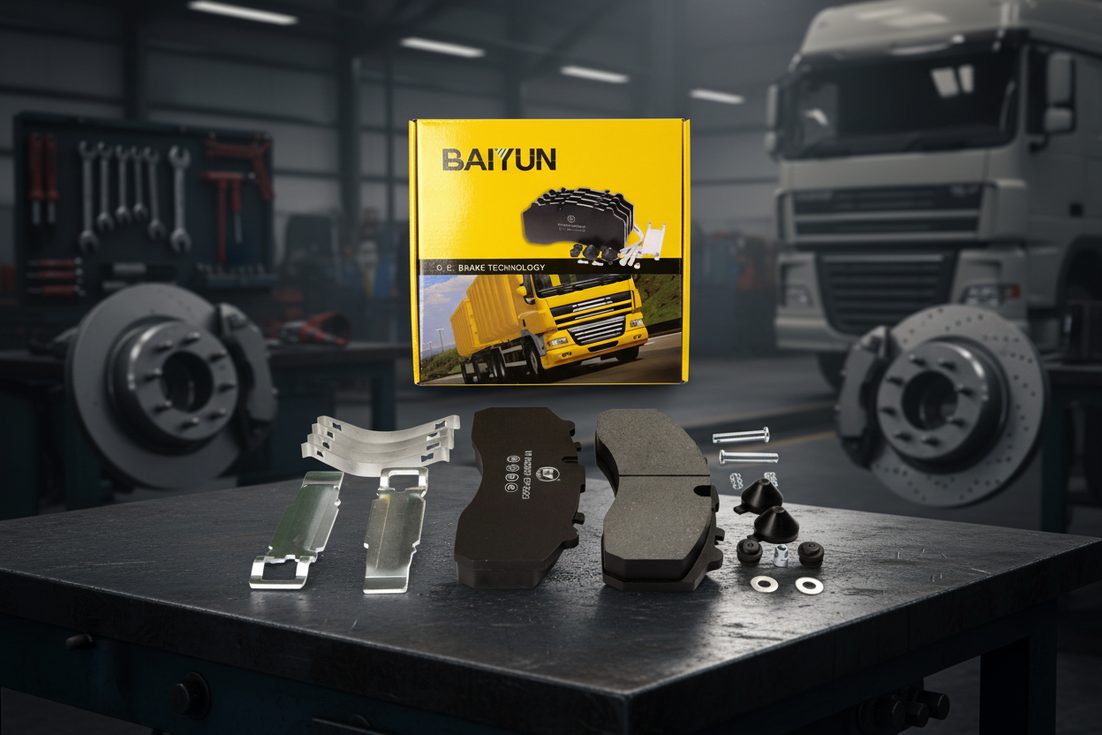
For any brake pad wear indicator supplier wholesale business, that tiny metal tab riveted or welded to the backing plate is far more than a nuisance squealer. It’s the frontline warning that saves rotors, calipers, and sometimes lives. Yet too many importers still treat the wear indicator as a commodity afterthought—and pay for it in warranty returns, margin erosion, and lost fleet contracts. A 2025 analysis by Frost & Sullivan pegs the global brake pad aftermarket at $8.2 billion, growing at 4.5% CAGR through 2030. Within that growth, premium-segment demand is accelerating because fleet managers and parts retailers are linking indicator reliability directly to total cost of ownership.
So why do supposedly identical brake pads with similar friction formulations generate wildly different real-world lifespans on the road? The answer often sits on the edge of the steel backing plate. Let’s walk through what your customers actually experience when wear indicator quality drops—and where the smart money in the wholesale channel is moving right now.
The Financial Trap of Ignoring Wear Indicator Quality
A European parts distributor recently shared that they’d switched to a low-cost Indian brake pad supplier, saving $2.10 per axle set. Within nine months, over 1,200 customer complaints rolled in—half related to premature squealing, the other half to brakes that never warned at all before metal-on-metal contact. The supplier’s wear indicators were made from 0.7 mm low-carbon spring steel that corroded within 6,000 km and snapped off. Net loss: €47,000 in returns, plus a terminated contract with a major repair chain. That’s not an outlier. It’s the cost of treating the indicator as a stamping, not a safety component.
When you source pads for a wholesale catalogue, the indicator’s material grade, attachment method, and corrosion resistance directly affect product return rates. According to BAIYUN Brake’s own field data across 5 million axle sets shipped, mechanical wear indicators with a Zintec electroplated coating and stainless steel spring temper have a failure rate below 0.02% over three years of European road conditions. Uncoated mild-steel indicators, by contrast, fail at 0.8–1.2% in the same intervals—an order of magnitude higher. Multiply that by your monthly container volume and the margin math flips ugly fast.
And it’s not just return freight. A brake pad that fails to warn can lead to disc scoring, caliper seizure, and in worst cases, accident liability. If your customer is a national workshop chain, one safety incident traced to an undetected worn pad can end a supply relationship. So the question for any commercial vehicle brake pads buyer is plain: how do you verify the indicator’s quality without a metallurgy lab?
What Does a Wear Indicator Actually Do Beyond Making Noise?
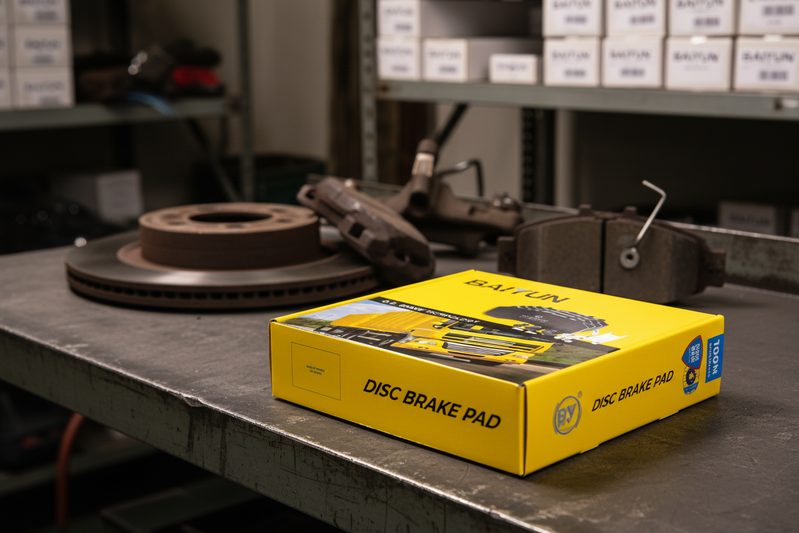
Most drivers think the squeal is the indicator’s job. It’s not. The sound is a side effect of a carefully calibrated interference fit. When the friction material wears down to 2.5–3.0 mm, the indicator’s tongue contacts the brake disc, vibrating at a frequency between 2,000 and 8,000 Hz—right where the human ear is most sensitive. But behind that squeal, the indicator must survive thermal cycling from -30°C to +700°C, resist salt-spray corrosion for 240 hours (as per ECE R90 test standards), and maintain its spring temper so it doesn’t fatigue after 50,000 km of vibration.
One often-overlooked failure mode is electrochemical corrosion between the indicator’s rivet and the steel backing plate. If the two metals have a galvanic potential difference above 0.25V, road salt accelerates crevice corrosion, and the indicator loosens silently. That’s why top-tier manufacturers—like BAIYUN Brake—use a zinc-flake coating on both the rivet and the plate, then apply a torque-controlled cold-forming process to eliminate micro-gaps. You can’t see that difference with a casual glance, but the warranty data proves it.
Electronic wear sensors, now mandated on most new European vehicles from 2024 onward, add another layer. A two-stage sensor circuit must signal at 4 mm and again at 2 mm with a resistance tolerance of ±5% to avoid false dashboard warnings. Wholesalers stocking integrated-sensor pads for the replacement market need to confirm that the sensor cable’s connector matches OEM form factors and passes 100,000 insertion-cycle tests. That’s where a brake pad wear indicator supplier wholesale with in-house sensor calibration rigs can save you from a container-load of mismatched connectors.
Market Data Reveals a Shift Toward Audible and Electronic Indicators
Global demand for electronic brake pad wear sensors grew 18% year-on-year in 2025, driven by EU Regulation 661/2009 mandating brake condition monitoring on M1 and N1 vehicles. In North America, the National Highway Traffic Safety Administration’s FMVSS 135 update now requires brake system warning in all passenger cars above 3,500 kg GVWR by 2027. That means a wave of sensor-equipped pads is heading for the aftermarket, and distributors who treat them as identical to bare pads will lose shelf space to competitors who stock the right variants.
Meanwhile, the acoustic indicator is far from obsolete. Heavy-duty commercial truck fleets, which operate in harsh environments where electronic sensors can be damaged by debris, still prefer robust mechanical indicators. BAIYUN Brake’s CV line, for example, moves over 60% of its replacement pads with a three-point mechanical warning system that provides progressive noise as the pad wears—first a soft squeak at 6 mm, then a louder chirp at 3 mm. Fleet managers appreciate the redundancy, and it cuts roadside inspection failures by 23%, according to a 2025 UK operator survey.
For a wholesale distributor, the trend translates into a product differentiation opportunity. You can position a catalogue as “full-line indicator coverage” by offering both ceramic and semi-metallic car brake pads with mechanical indicators, plus sensor-ready variants for Euro 6 and newer platforms. That breadth makes you a one-stop shop for workshop chains—exactly the consolidation the aftermarket is demanding.
How BAIYUN Brake Engineers Indicators for Zero-Warranty Returns
We’re not shy about this: our approach to wear indicators is overcautious by industry standards. Every indicator design undergoes a 500-hour neutral salt spray test (ASTM B117) before production approval. The indicator tongue’s contact angle is held to 63±2 degrees relative to the disc’s tangent line, because our dynamometer testing shows that a steeper angle generates insufficient audible signal, while a shallower angle causes the tip to bend and mute after just a few hundred cycles.
The material spec is equally rigid. We use SUS301 stainless spring steel, cold-rolled to a hardness of 380–420 HV, which maintains its temper up to 520°C—well above the 400°C peak that a disc surface can reach under repeated hard braking. In 2025 alone, our in-house laboratory tested over 12,000 indicator samples across 1,100 part numbers, rejecting any batch that showed micro-cracking after the vibration endurance rig. That data flows back to our IATF 16949-certified production line, where real-time SPC monitoring catches dimensional drift before a single pad boxes out. You can see our quality assurance protocols in action—they’re the same for a 10,000-set export order as for a 200-set trial.
The difference this makes for a distributor: the confidence to offer a three-year / 60,000-km warranty on wear indicator noise, knowing that field failure rates are statistically zero. When your workshop customers call about a brake squeal that won’t quit, the conversation starts with pad material or installation, not with a faulty indicator. That’s the peace of mind that builds long-term supply agreements.
Five Checks Every Distributor Should Run on Wear Indicator Samples
Before you commit to a container load, grab a sample from the production batch and perform these quick evaluations. You don’t need a lab—just a few tools and some patience.
- Hardness scratch test: Use a set of hardness pencils or a simple Rockwell file. If the indicator scratches at HRC 35, it’s likely mild steel and will fatigue. Acceptable range: 40–45 HRC for mechanical indicators.
- Salt water immersion: Submerge the pad (indicator intact) in a 5% NaCl solution for 96 hours. Then check for orange rust at the rivet joint. Any corrosion there is a red flag for galvanic reaction.
- Tip geometry: Measure the indicator tip radius with a radius gauge. It should be between 0.8 and 1.2 mm. A sharp edge will scrape the disc and potentially cause scoring; too blunt, and it won’t produce enough audible frequency.
- Deflection force: Press the indicator tongue with a spring scale perpendicular to the pad’s plane. It should deflect 2 mm at a force of 15–25 N. If it’s too stiff, it won’t vibrate; too soft, it’ll bend and stay silent.
- Weld or rivet integrity: For riveted indicators, attempt to rotate the indicator with pliers. Any movement means the rivet is undersized or improperly clinched—guaranteed to come loose in service.
A smart buyer will also ask for the supplier’s salt-spray test report and vibration endurance data. If they can’t provide it, you’re gambling. And with the average workshop’s labour rate now above €85/hour in Western Europe, the cost of diagnosing a missing wear warning quickly exceeds the pad’s wholesale price. That’s why sourcing from a manufacturer with our 49+ years of manufacturing experience and in-house testing facilities changes the risk equation entirely.
FAQ: Wholesale Wear Indicator Sourcing Questions
Q: Should I stock pads with electronic sensors or stick to mechanical indicators for the European market?
A: For vehicles produced after 2021, electronic sensor coverage is growing fast. We recommend a 70/30 split: 70% electronic-sensor pads for Euro 6 and newer applications, 30% mechanical for older models and light commercial vehicles. This matches current workshop demand and reduces obsolete inventory. Electronic sensor pads typically carry a 15–18% price premium, which most repair chains absorb willingly.
Q: What’s the minimum corrosion resistance I should specify in my purchase contract?
A: Demand compliance with ISO 9227 NSS for 240 hours without red rust on the indicator assembly. This aligns with ECE R90 homologation requirements. Insist on a test report from an accredited third-party lab for each SKU, not just a generic material certificate. In our experience, this single clause weeds out 40% of low-quality suppliers.
Q: How can I tell if an indicator is likely to fail prematurely without field testing?
A: Request a cross-sectional metallographic image of the rivet joint. Look for intermetallic phases at the interface—if the dark layer is thicker than 5 microns, it indicates excessive zinc migration during plating, which will lead to joint embrittlement. A clean, sub-micron bond line is what you want. BAIYUN Brake provides these images with our PPAP documentation for every new part number.
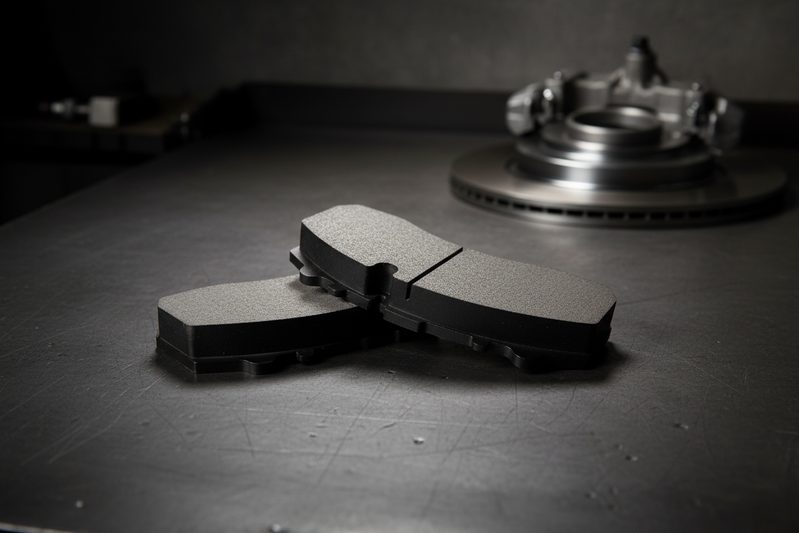
We’ve built our export programme around one simple idea: a brake pad that doesn’t warn properly is a liability waiting to happen. As the aftermarket becomes more consolidated and warranty expectations rise, the spec you put on your purchase order for wear indicator quality will decide whether you grow market share or lose it to a competitor who took the details seriously. If you’re looking to build a private-label line or fill gaps in your OEM-grade aftermarket range, browse our complete catalog and see where our indicator technology can slot into your product map.
Was this article helpful?
Average Rating: 5/5 (982)