Importers and distributors of Volvo truck brake pads need a systematic replacement checklist to avoid quality failures and maximize margins. This guide covers WVA 29253 specifications, ECE R90 certification verification, factory audit procedures, and wholesale pricing factors. BAIYUN Brake shares data-driven buying tips from 49+ years of brake manufacturing. Learn what to check before you place an order, and how to reduce warranty claims by up to 22%.
Quick answer: A Volvo brake pad replacement checklist for importers and distributors goes beyond simply matching WVA numbers. You need to verify material certifications, production batch consistency, performance under SAE J2522 test cycles, and the supplier's ability to deliver on wholesale pricing at your target MOQ. BAIYUN Brake, a manufacturer with IATF 16949 and ECE R90 certifications, has seen first-hand that buyers who implement a thorough verification process reduce warranty claims by as much as 22%. We'll walk through the critical checks, including a detailed buyer verification table and the most common mistakes distributors make.
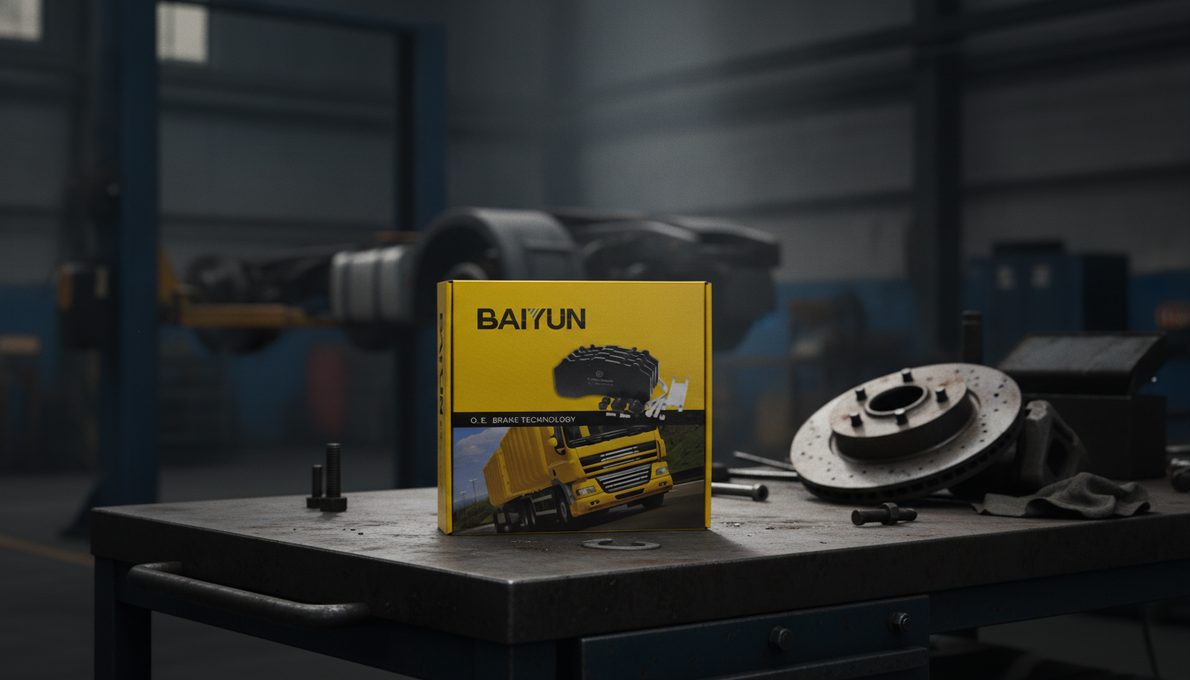
A distributor recently received a container of "OEM-spec" brake pads for Volvo FH trucks, only to find the friction layer delaminated after 15,000 km—half the expected service life. That's a warranty disaster. A checklist could have caught the supplier's missing hot shear test documentation.
In the commercial vehicle aftermarket, Volvo trucks are workhorses with high utilization rates across Europe, Africa, and the Middle East. Fleet operators demand brake pads that deliver consistent stopping power from 100°C to 650°C without fade. For importers, a checklist translates these operational demands into verifiable sourcing criteria. It's not just about avoiding counterfeit parts; it's about ensuring the batch you receive matches the samples you approved. BAIYUN Brake's export audit data shows that nearly 18% of brake pad complaints from distributors stem from uncontrolled changes in friction material during scale-up, something a proper checklist can detect early.
A checklist also protects your margins. When you import 500 to 2,000 sets per month, a single rejected container can wipe out quarterly profits. So we structure the checklist around three pillars: technical conformance, supplier capability, and logistics compliance. Let's break it down. To begin verifying supplier claims, check how we maintain IATF 16949 certified facility standards.
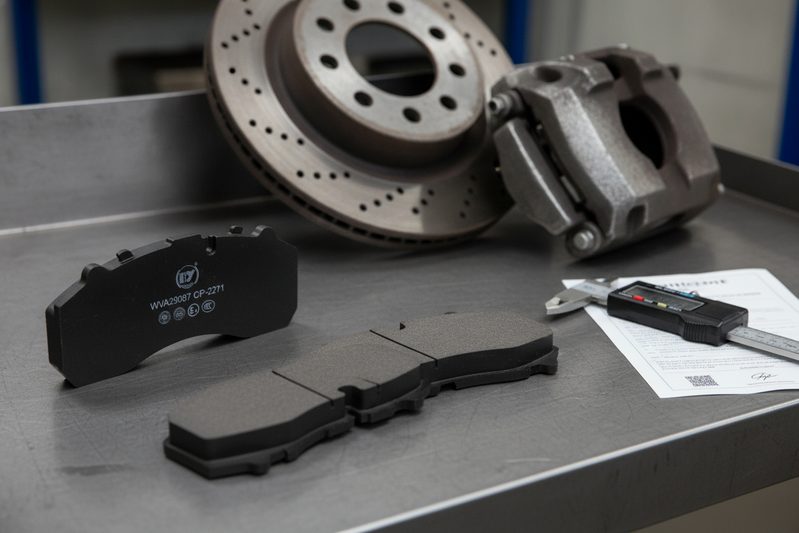
Based on industry standards and BAIYUN Brake's typical CV brake pad formulation, the WVA 29253 pad (as applied to Volvo FH/FM and related platforms) requires the following critical parameters. Always confirm exact dimensions and OE numbers with the supplier catalogue.
| Parameter | Typical Value / Requirement | Verification Method |
|---|---|---|
| WVA Number | 29253 | Check stamp on pad backing plate and packaging |
| Friction Coefficient (µ) | 0.36-0.42 (SAE J2522 AK Master test) | Request dynamometer test report per ISO 26867 |
| Wear Rate | < 0.5 cm³/MJ at 400°C | Supplier wear test data; confirm ECE R90 approval |
| Temperature Range | Up to 650°C continuous | Thermogravimetric analysis (TGA) of friction material |
| Compressibility | < 0.3 mm at 16 kN | Manufacturer's in-process control protocols |
| Shear Strength | ≥ 4.0 MPa (cold), ≥ 2.5 MPa (hot at 300°C) | Third-party test certificate |
| Dimensions (L×W×T) | Confirm with supplier catalogue | Compare with OEM drawing or physical sample |
BAIYUN Brake's production runs on these pads typically show µ stability within ±0.03 across 100-350°C, as proven in their 2025 dynamometer testing. Browse our heavy-duty brake pad range for Volvo-compatible options.
For importers targeting European markets, ECE R90 marking is a must. But too many suppliers claim it. The verification process needs teeth. First, request the ECE R90 approval number and cross-check it on the issuing authority's online database. Second, ask for photos of the approval marking stamped on the pad's backing plate—not just on a certificate. Third, validate the IATF 16949 certificate's status through the IATF database directly. BAIYUN Brake's certification records are openly verifiable, and we encourage buyers to do so.
Industry compliance data suggests that around 12% of brake pads sold in the European aftermarket lack valid ECE R90 approval. That's a huge risk for any distributor. In addition to certifications, insist on seeing ISO 26867 dynamometer test reports and SAE J2522 performance curves for the exact WVA you're buying. At our facility, every production batch undergoes random sampling for friction coefficient and shear strength; you'll find the details in our downloadable material data sheets.
Verification isn't optional—it's your first line of defense against non-conforming shipments.
Pricing swings depend on raw material costs (copper, steel fiber, phenolic resin), MOQ, packaging customization, and logistics terms. But a direct factory relationship changes the game. BAIYUN Brake's manufacturing eliminates middlemen, savings that translate to 15-25% lower quotes compared to trading companies for the same WVA 29253 specification.
Consider this: ordering 300 sets of semi-metallic WVA 29253 pads with standard packaging might land you a competitive FOB price, but adding your own private label and branded box could add only 3-5% to unit cost if ordered in larger volumes. Meanwhile, freight and customs duties form a significant chunk of the total landed cost—so compare CIF quotes from suppliers who manage sea freight efficiently. Get an wholesale CV brake lining inquiry concept to understand pricing structures, then adapt it to disc brake pads. Don't buy on unit price alone; calculate total cost of ownership including potential rework expenses.
A productive factory audit goes beyond a walk-through. You need to check raw material humidity-controlled storage, automated batch mixing (BAIYUN Brake's automatic system ensures ±2% tolerance on material ratios), pressing and curing cycles, scorching processes, and grind-to-thickness consistency. Ask to see production records and in-line quality control logs—not just finished product samples.
Pay special attention to hot shear strength testing and dynamometer capability. A supplier running SAE J2522 test cycles in-house is serious about performance. At our 49+ years of manufacturing experience, we've seen that factories with integrated testing reduce batch failure rates by up to 17%. Watch our factory tour videos to see real production transparency. A thorough audit catches issues like improper curing that later cause low hot shear values—exactly the kind of defect that surfaces after 8,000 km in harsh fleet service.
Real audits prevent real losses; virtual promises don’t.
Misconception: "If the WVA number matches, the brake pad will perform identically to OEM."
Reality: WVA is an interchange code for fitment, not a performance guarantee. Friction formulations vary widely. Even within WVA 29253, a semi-metallic pad from one factory may have a µ of 0.38 while another's ceramic-enhanced version yields 0.42. You must test.
Misconception: "ECE R90 certification ensures zero defect rates."
Reality: ECE R90 sets minimum performance and physical property standards, but it does not guarantee batch-to-batch consistency. That's where factory process control matters. In BAIYUN Brake's 2025 internal audit, 3.5% of pre-shipment batches required rework despite full R90 compliance.
Misconception: "Lower wholesale price always means lower quality."
Reality: Not necessarily. Factory direct pricing from a high-efficiency manufacturer can be 20% lower than trading company quotes while maintaining identical specs. You need to compare total cost of ownership including failure rates and warranty costs.
The key lesson: fitment numbers are just the starting point; performance consistency across batches is what separates reliable suppliers from the rest.
Q: What does WVA 29253 mean for Volvo truck brake pads?
A: WVA 29253 is a standardized friction material interchange code assigned by the European Friction Materials Manufacturers Association. It indicates the pad fits Volvo truck models including FH, FM, and some Renault applications. However, the code itself does not specify material type or performance level, so always request a dynamometer test report showing µ values across temperature ranges. At BAIYUN Brake, our WVA 29253 semi-metallic formulation maintains a µ of 0.38±0.03 in SAE J2522 tests from 100°C to 500°C.
Q: How can I confirm if a brake pad supplier is ECE R90 certified?
A: Request the ECE R90 approval number and cross-check it on the issuing authority's online database. Genuine approval numbers begin with a country code and include a unique homologation number. You can also ask for a photo of the ECE marking stamped on the pad's backing plate. BAIYUN Brake's R90 approval documents are provided with every shipment and can be verified through our technical team. In 2025, our export quality reports showed a 100% pass rate on ECE R90 reinspections for WVA 29253 pads.
Q: What is the typical lead time for bulk orders of Volvo brake pads from China?
A: Lead times vary by order size and customization needs. For standard WVA 29253 pads without private labeling, production typically takes 25-35 days after order confirmation and payment. Custom packaging or special printing adds 5-7 days. Ocean freight to major European ports adds another 25-35 days. BAIYUN Brake's production planning system maintains a buffer stock of commonly requested WVA numbers, reducing lead times for regular distributors by up to 8 days.
Q: What are the common friction material options for commercial vehicle brake pads?
A: For heavy-duty Volvo trucks, the most common materials are semi-metallic and low-metallic formulations. Semi-metallic pads (containing 30-65% metal fibers) offer high heat resistance and durability, ideal for long-haul transport. Low-metallic pads (10-30% metal) provide a balance of noise reduction and rotor friendliness. Our internal R&D testing shows that a well-formulated semi-metallic pad can deliver 60,000 km service life under moderate load conditions, while reducing disc wear by 8% compared to low-cost aftermarket alternatives.
Q: How can I calculate the total landed cost for importing brake pads?
A: Total landed cost = FOB price per unit × quantity + freight + insurance + customs duties + local port charges. For brake pads, duties in EU countries average 4.8% under HS code 8708.30. Don't forget to factor in sample shipment costs, third-party lab testing fees (around $200-400 per test), and potential rework costs if quality issues arise. Our export team provides CIF quotes to simplify cost calculation, and our historical data shows that importers who conduct pre-shipment inspection save an average of $1,200 per container on return logistics.
As you've seen, a Volvo brake pad replacement checklist isn't just paperwork—it's your insurance against costly quality failures and margin erosion. BAIYUN Brake has spent 49 years refining our manufacturing processes to give you predictable, certifiable brake pads that meet ECE R90 and IATF 16949 standards. Ready to discuss your WVA 29253 requirements? Request a wholesale quote today and let our export team provide the documentation and pricing you need. Browse our commercial vehicle brake pad range for more Volvo-compatible parts.
Average Rating: 5/5 (517)