
The Importer’s Guide to Brake Pad Wear Indicator Standards and Specifications
Summary:
Brake pad wear indicator supplier wholesale buyers often overlook the tiny metal clip that can sink a container deal. This guide exposes the common mistakes importers make—from trigger thickness mismatches to missing corrosion tests—and shows how to avoid warranty disasters. Learn what ECE R90 and IATF 16949 really mean for wear indicator quality, the specific data you must demand from your supplier, and why a factory with 49 years of experience can save you from a 12% return rate. Read the full breakdown before you place your next order.
The Importer's Guide to Brake Pad Wear Indicator Standards and Specifications
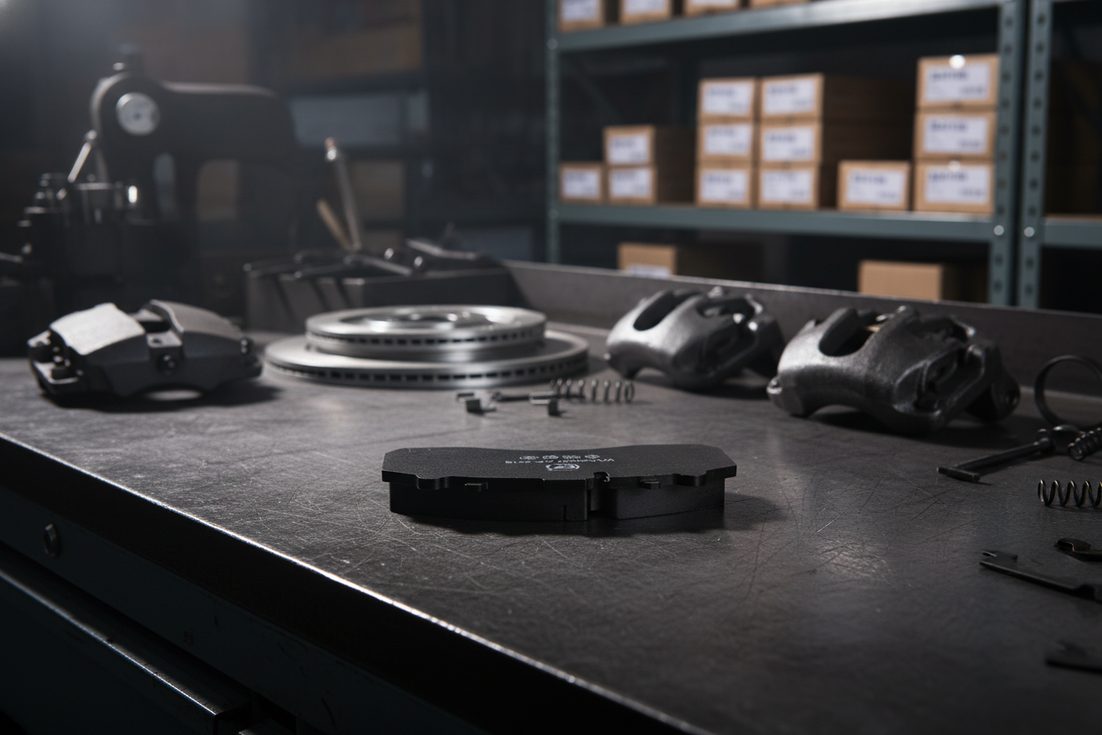
A distributor in Frankfurt ordered 30,000 ceramic brake pad sets from a new Asian supplier. The pads met friction specs. But within three months, 12% of end-user returns cited premature squealing. Turns out, the mechanical wear indicators were bending early—triggering on pads that still had 5mm of friction material. That importer learned the hard way: wear indicators aren’t just a metal tab; they’re a liability if you don’t specify them correctly.
Most importers obsess over friction coefficients and cold μ values. They should. But the tiny clip that screams when the pad’s worn out can cause more warranty pain than the pad compound itself—if you don’t know what to ask your supplier. This guide cuts through the noise. We’ll walk through the standards that matter, the mistakes that trip up even seasoned buyers, and what to look for in a brake pad wear indicator supplier wholesale partner who won’t leave you holding the bag.
What Are Brake Pad Wear Indicators and Why Do They Matter for Importers?
Over 70% of passenger cars sold globally today have some form of wear indicator built into the brake pad. That could be a simple metal spring clip that contacts the disc when friction material drops below a safe thickness. Or it’s an electronic sensor that triggers a dashboard warning light. But here’s the rub: a wear indicator isn’t a universal part. The trigger thickness, the spring temper, the mounting position—all of it varies by vehicle platform and market regulation.
Why does that matter for an importer? Because European distributors expect the indicator to activate at 2mm remaining. North American aftermarket often wants 3mm. And your buyer in the Middle East might reject a container outright if the indicator rusts after six months in a coastal warehouse. A mismatch might seem small, but it’s a warranty bomb. We’ve seen importers lose entire contracts because the indicators squealed at 4mm, flooding their partner’s service bays with needless brake jobs.
Your supplier needs to document exactly when the indicator engages, under what temperatures, and after how many corrosion cycles. At BAIYUN Brake, every pad assembly comes with a trigger-thickness specification sheet, so you’re not guessing. That paper might be the cheapest insurance you’ll ever get.
If you’re sourcing 500–5,000 sets a month, consistency is everything. A deviation of 0.5mm in trigger point across batches can spike return rates by 8–10%, according to aftermarket quality audits. That’s real money lost before you even unpack the next shipment.
Where Do Importers Go Wrong When Specifying Wear Indicators?
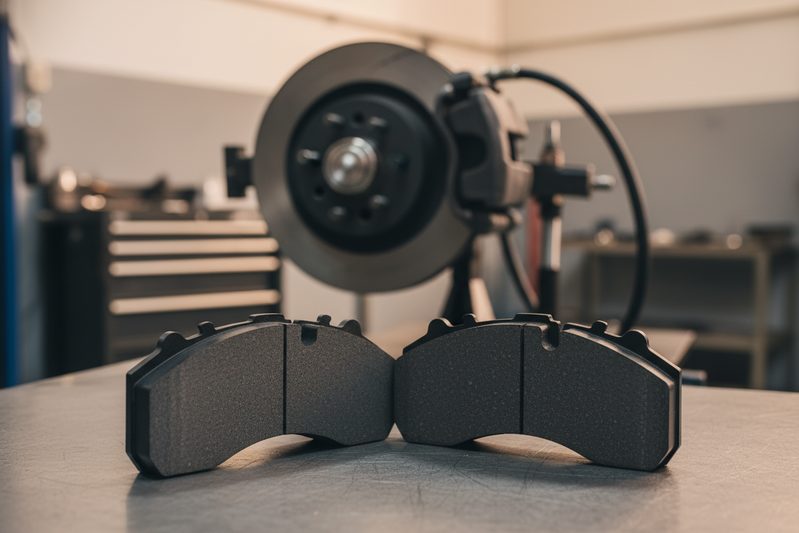
Picture this. Your Chinese supplier delivered pads with wear indicators designed for European disc thickness tolerances, but your Latin American market uses thinner rotors. Result? Early squealing and angry distributors. Or you ordered pads with electronic wear sensors, but the connector wiring gauge doesn’t match the OEM harness. Now you’ve got a container that fits only half the vehicles you thought it would.
Another classic blunder: ignoring the material of the indicator itself. A plain steel clip without proper anti-corrosion treatment will rust and seize within 12 months in humid climates, even if the friction material is top-tier. We recently audited a shipment where the indicators were made from spring steel that lost 40% of its temper after only 50 thermal cycles from -20°C to 400°C. The pads would squeal prematurely in cold mornings, and the importer had no clue why. A proper brake pad composition guide should cover the metal parts, not just the friction material.
Then there’s the paperwork pitfall. Many importers skip requesting dimensional certs for the wear indicator assembly. They get a test report for friction coefficient, maybe a hardness chart, but nothing that proves the clip’s spring force or trigger position remains within OEM spec after heat aging. Without that, you’re exposed to a very expensive guessing game.
Don’t assume your supplier automatically aligns with ECE R90 or local standards either. Some factories test pads to R90 but cut corners on the accessory components. The pad passes the dynamometer, but the indicator fails the real world. That’s a compliance gap that can get your product quickly delisted from EU platforms.
How Do ECE R90 and IATF 16949 Standards Affect Wear Indicator Quality?
ECE R90 doesn’t explicitly mention wear indicators in its test schedule. But the regulation requires that the replacement pad’s performance—including characteristic dimensions and functional safety—matches the original equipment. That’s where the indicator fits. If your OE equivalent had a wear sensor that triggers at a specific residual thickness, an R90‑approved pad must replicate that behavior. At IATF 16949 certified facility like BAIYUN Brake, this is baked into the product development control plan from day one.
IATF 16949 adds another layer. It forces systematic monitoring of all sub-components, including wear clips and sensor wires. Every batch of spring steel must have a certificate of conformance. Every sensor connector must pass pull‑force and continuity tests. That’s not a luxury; it’s a requirement for anyone supplying OEM or tier‑1 aftermarket. An importer working with a supplier outside this framework faces batch‑to‑batch variation that’s almost impossible to trace back after a container leaves the port.
Why does this matter for your bottom line? Because a single non‑conforming wear indicator can taint the whole pallet. European wholesale distributors now demand full‑lot traceability—they want the indicator’s batch number linked to the pad’s production date. Without IATF 16949 traceability systems, you simply can’t provide that, and you risk losing the account to a better‑equipped supplier.
Bottom line: ECE R90 gives you market access; IATF 16949 gives you the reliability to keep it.
What Should Importers Look for in a Reliable Brake Pad Wear Indicator Supplier?
Start with the factory audit. Not the glossy brochure—the actual process. Walk the line and check if wear indicators are installed manually or by automated pressing stations. Manual assembly is fine if quality checks are robust, but we’ve seen operations where workers bend clips with pliers to “adjust” them on the fly. That kind of variability is a ticking clock for your warranty.
Ask for salt spray test results specifically for the indicator metal, not just the backing plate. A good supplier will have data showing less than 10% red rust after 96 hours of neutral salt spray. BAIYUN Brake, for instance, uses high‑carbon spring steel with a zinc‑flake coating on commercial vehicle pads, achieving over 120 hours without red rust—crucial if your market includes Nordic winters or tropical ports.
Also, demand statistical process control (SPC) charts for the indicator’s activation thickness across at least 30 consecutive batches. A reliable supplier will show a CpK above 1.33—meaning the process is tight enough that even natural variation won’t push the trigger point outside your spec limit. If they can’t provide that, walk away. It’s not worth the risk when you’re reselling under your own brand. To see how a certified supplier manages these requirements, get OEM passenger car brake pad pricing and request the corresponding PPAP documentation.
Finally, check their R&D depth. A factory that only copies samples won’t understand why a 0.2mm adjustment to the clip’s preload matters. BAIYUN Brake, with over 49 years of friction science, has in‑house teams that can re‑engineer wear indicator geometry for specific market needs while maintaining full regulatory compliance. That’s the difference between getting a product that works in Barcelona and one that fails in Bogotá.
How Can Importers Avoid Costly Warranty and Compliance Issues?
Document everything before the first container ships. You need a boundary sample—a pad with the wear indicator just at the trigger point—signed by both you and the supplier. Keep it. When a dispute arises (and it will), that physical reference settles arguments instantly.
Second, implement a random batch inspection protocol that includes functional testing of the wear indicator. Buy a simple fixture that measures the indicator’s spring force at the activation gap; it costs less than €500 and pays for itself after one avoided recall. At the factory, BAIYUN Brake already does this on every shift, so your third‑party inspector can simply verify the records.
Third, don’t treat wear indicators as an afterthought in your contract. Explicitly state the acceptable trigger thickness range, corrosion resistance requirements, and the test standard (ISO 9227 for salt spray, for example). Make it a pass‑or‑fail clause. You’ll be surprised how quickly factories tighten their processes when your PO makes it clear that 1% deviation means a refused shipment.
If you’re uncertain where to start, brake pad technical specifications from an experienced manufacturer are your blueprint. These sheets should include full wear indicator data, not only friction material graphs. Compare three different suppliers’ data side‑by‑side, and the gaps appear fast.
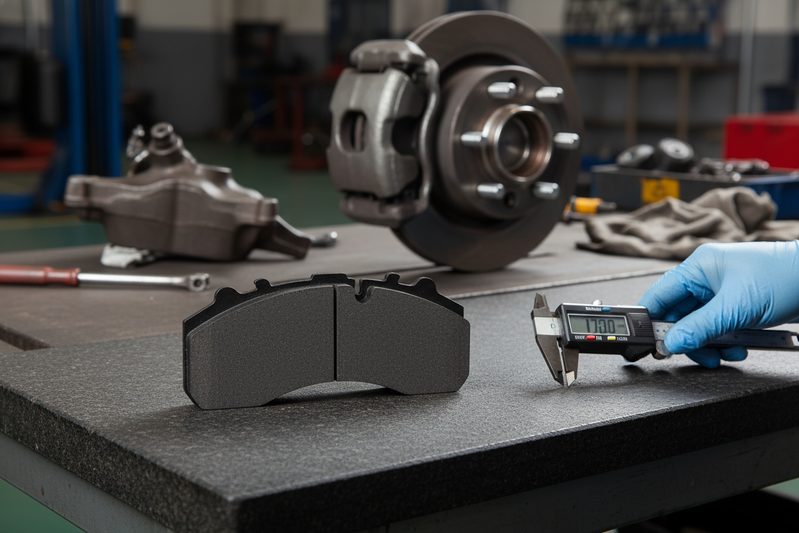
Frankly, the price gap between certified pads with validated wear indicators and uncertified ones rarely justifies the warranty risk. A single return costs you more than the margin on twenty pads. Play the long game, and your distributor network will thank you with repeat orders.
If you’re ready to cut the warranty noise and source wear indicators that your customers can trust, get in touch. Browse our commercial vehicle brake pad range for heavy‑duty applications, or submit your inquiry to our sales team for a custom OEM quote that covers passenger car and niche segments.
Frequently Asked Questions
Q: What is the standard trigger thickness for a mechanical brake pad wear indicator?
A: Most mechanical indicators activate between 2mm and 3mm of remaining friction material. However, this varies by vehicle manufacturer—some European platforms trigger at 2mm, while many North American designs set the alert point at 3mm. At BAIYUN Brake, every pad specification sheet lists the exact trigger thickness and tolerance (±0.3mm) to eliminate guesswork for importers.
Q: Do I need to stock separate part numbers for pads with wear sensors versus without?
A: Absolutely. The aftermarket demands both variants because many drivers prefer the simpler mechanical clip over a sensor that can throw dashboard errors. BAIYUN Brake’s product line clearly differentiates pads equipped with mechanical clips, electronic wear sensors, and bare designs, so you can segment your inventory for maximum coverage without redundant stock.
Q: How can I verify a supplier’s wear indicator consistency across large production runs?
A: Request statistical process control (SPC) data for at least 30 consecutive batches, showing the activation thickness of the indicator. A reliable supplier will demonstrate a process capability index (CpK) above 1.33—meaning that natural variation stays well within the specification limits. BAIYUN Brake routinely provides this data as part of its IATF 16949 documentation package.
Was this article helpful?
Average Rating: 5/5 (1004)