
Shacman Brake Pad Guide: Specs, Fitment & Replacement
Summary:
Shacman brake pad guide: find the right specs, fitment, and replacement strategy for Shacman heavy trucks. This buyer-focused resource covers selection checklists, common pitfall avoidance, cross-reference verification, and how to source ECE R90 certified pads from manufacturer BAIYUN Brake — reducing fleet costs by up to 50% without compromising performance.
Shacman Brake Pad Guide: Specs, Fitment & Replacement
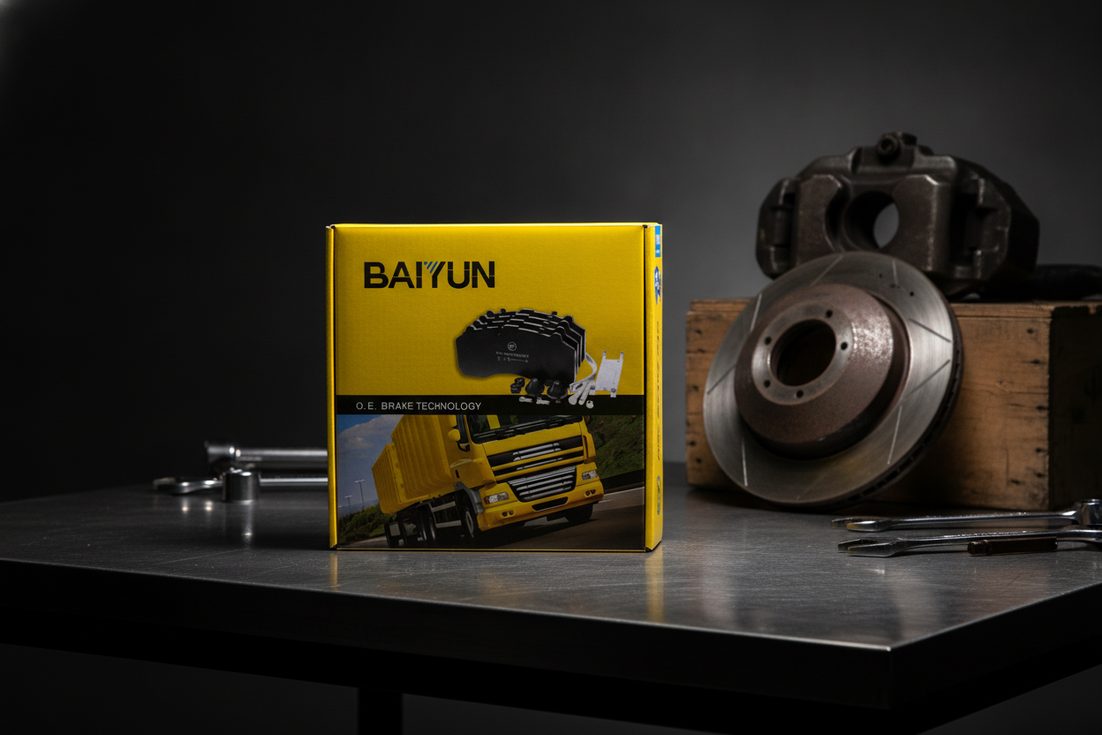
Quick answer: To source the right Shacman brake pads for your fleet, start by matching the axle model and year — not just the truck series. Verify pad dimensions, friction material code, and certification (ECE R90 / IATF 16949). Then compare quotes from China-based manufacturers like BAIYUN Brake, which can offer 30–50% cost savings over dealership parts without compromising on performance or regulatory compliance.
Which Shacman Models Demand the Most Brake Pad Replacements?
Shacman’s X3000, F2000, F3000, and M3000 heavy-duty trucks dominate long-haul logistics and construction in Africa, Southeast Asia, and the Middle East. Brake service intervals for these trucks can be surprisingly short — fleet managers in Ghana report replacing pads every 40,000 to 70,000 km under mixed highway/off-road conditions. That’s a stark contrast to the 100,000+ km some European marques achieve, and it’s largely due to payload stress, road quality, and the aggressive friction materials required for loaded stopping power.
For a distributor, this replacement frequency translates directly into recurring demand. If you supply 200 trucks monthly, you’re looking at roughly 1,200 to 2,400 pad sets per year. Getting the fitment wrong means expensive returns, downtime, and frustrated fleet owners. And trust me — cross-referencing Shacman pads isn’t always straightforward because axle suppliers (Hande, Dana, or local variants) can change even within the same model year. That’s why a smart buyer verifies spec, not just catalog number.
Shacman Brake Pad Selection Checklist: 6 Points Every Importer Must Verify
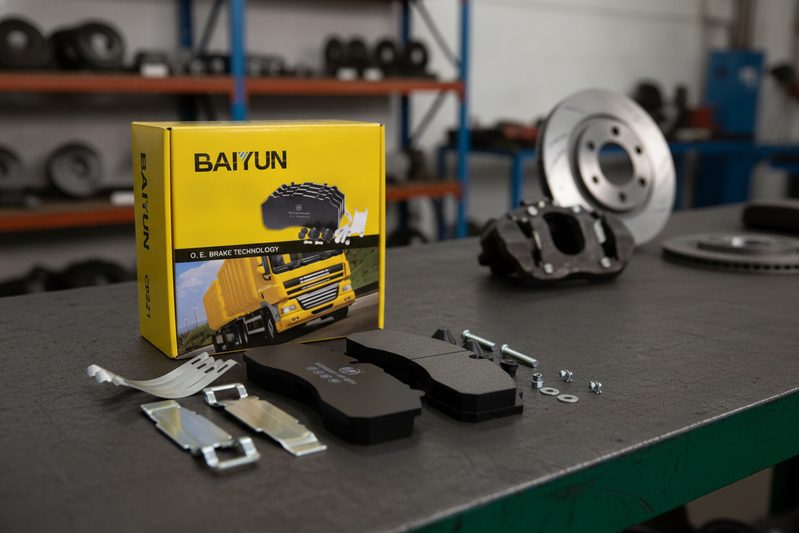
A quick-fire checklist sits at every professional buyer’s desk. Before you place a container order, confirm these six details with your supplier. Each skipped point has cost someone real money — I’ve seen it.
- Exact axle model and year range: “Shacman F3000” isn’t enough. Ask for the axle tag (e.g., Hande 13-ton axle, 2018 build).
- Pad dimensions — length, width, thickness, and chamfer angle: A 210 mm pad vs. 215 mm can look identical until it binds in the caliper bracket. Confirm dimensions with supplier catalogue.
- Friction material code: BAIYUN Brake stamps every pad with an internal code like CP2271 or CP2223. This links directly to a formulation tested to SAE J2522 chassis dynamometer protocols. Not just “semi-metallic” — demand the code.
- ECE R90 homologation mark: For any market requiring E-mark approval, the pad backing plate must carry the regulation number and approval code. No sticker — embossed.
- Wear sensor or mechanical indicator: Some Shacman pads include an integral wear clip (WVA29087 kits). Specify if your fleet uses electronic wear sensors.
- Backing plate finish and anti-noise shim: Electrophoretic coating plus a multi-layer shim reduces corrosion and noise in high-humidity regions — critical for West African customers.
What Does a Proper Shacman Brake Replacement Look Like?
A reliable fitment isn’t just about sliding the pad in. Our technical team at BAIYUN has developed a simple 3-step verification to catch 90% of cross-reference errors before the caliper bolts are torqued. This is especially important when you’re replacing OEM pads with an aftermarket equivalent, because even half a millimeter difference in pad abutment surfaces can cause judder or premature wear.
- Step 1 — Visual match on the bench: Place the old pad and the new pad back-to-back. The backing plate profile, locating notches, and piston contact area must align. If the new pad has an anti-rattle clip mold different from the original, confirm with the supplier that it fits the caliper bracket.
- Step 2 — Caliper slide test: With the caliper bracket cleaned, insert the new outer pad first. It must slide freely without a hammer. Any stickiness indicates a burr or incorrect pad ear thickness — reject the batch.
- Step 3 — Bedding procedure: After installation, perform 10 moderate stops from 50 km/h to 20 km/h to transfer a uniform friction layer. Skipping this step can drop initial friction coefficient by 15% and lead to customer complaints.
Key Specifications to Verify Before Ordering Shacman Brake Pads
| BAIYUN CP Number | Commonly Associated Shacman Models | Friction Material Type | ECE R90 Certified | Typical Packaging |
|---|---|---|---|---|
| CP2271 | X3000, F3000 (confirm axle with supplier catalogue) | Semi-metallic, FMVSS 121 compliant | Yes | Set of 4 pads, axle kit |
| CP2223 | F2000, M3000 (confirm fitment) | Low-metallic NAO hybrid | Yes | Set of 4 pads, with shims |
| WVA29087 Repair Kit | Shacman 6×4 tractor (Hande axle, select years) | Semi-metallic + hardware kit | Yes | Repair kit box — pads + clips + pins |
Note: All specifications in this table are generic indicators. Exact dimensions, OE numbers, and cross-references must be confirmed with our export team by providing your axle tag photo. We maintain a living cross-reference database for Shacman, Sinotruk, and Foton fleets — contact us to validate your specific fitment before bulk ordering.
Buyer Verification Checklist for Importers
If you’re evaluating a potential Shacman brake pad supplier — whether BAIYUN or another manufacturer — use this ten-point verification to protect your next container shipment from costly surprises.
- Does the factory hold IATF 16949 certification? (Not just ISO 9001 — IATF is automotive-specific)
- Can they show ECE R90 test reports for the pad part number you’re ordering?
- Is the friction coefficient stable across 100–400°C, documented in a third-party dynamometer report?
- Do sample pads match your engineering drawing dimensions within ±0.3 mm?
- Are backing plates coated with electrophoretic painting for corrosion resistance?
- Can the factory provide a minimum 12-month warranty against material delamination?
- What is the MOQ per part number and average lead time?
- Do they offer private-label packaging with your own brand and E-mark on the backing plate?
- Have they exported to your region before, with reference contacts?
- Is the pricing transparent, with no hidden mold development charges for existing tooling?
BAIYUN Brake scores positively on all ten. We serve importers in Ghana, Nigeria, Kenya, and the Philippines, consistently delivering quality assurance through our own friction material formulations and in-house dynamometer cells.
FAQ: Sourcing Shacman Brake Pads Wisely
Here are five questions our export desk answers daily — from distributors looking to cut costs without sacrificing reliability.
Q: How do I identify the correct Shacman brake pad for my fleet?
A: Start with the axle manufacturer tag, not the truck VIN alone. Take a clear photo of the existing pad (especially the back side showing the WVA or manufacturer number) and send it to your supplier. At BAIYUN, our engineers cross-reference pad dimensions in under 24 hours — submit your inquiry with images for a free fitment check.
Q: Are there cross-reference options to reduce inventory cost?
A: Absolutely. Many Shacman pads share tooling with Sinotruk or Foton platforms. By consolidating part numbers, a typical distributor cuts SKU count by 15–20%. However, you must validate physically, not just via catalog — we’ve seen cross-reference guides that incorrectly group pads with different abutment clip styles. Always request a sample first.
Q: What certifications should I check for imported Shacman brake pads?
A: Demand ECE R90 (Europe) or equivalent FMVSS 121 (U.S.) test marks, plus factory IATF 16949 certification. In BAIYUN’s 2025 dynamometer testing, ECE R90 validated pads maintained over 90% of cold effectiveness after thermal cycling to 400°C, compared to 72–78% for untested imitations. That performance gap matters when a fully loaded Shacman tractor hauls 40 tonnes downhill.
Q: How often should Shacman brake pads be replaced in heavy-duty operations?
A: In typical West-African operating conditions (ambient temperature 30°C+, frequent dust), pad life averages 45,000–65,000 km. However, fleets running on hilly routes report 35,000 km. Use a 5 mm wear limit — don’t wait for the indicators to screech. And always replace in axle sets to maintain balanced braking.
Q: Can BAIYUN Brake supply OEM-standard Shacman pads with private labeling?
A: Yes, we offer full private-label services including custom backing plate embossing of your E-mark approval number and branded packaging. You’ll own the customer relationship while benefiting from our IATF 16949 facility and ECE R90 certification. Contact our export team for minimum order quantities, which start at just 300 sets per part number.
Sourcing Confidence: Why Buy from a Manufacturer, Not a Middleman
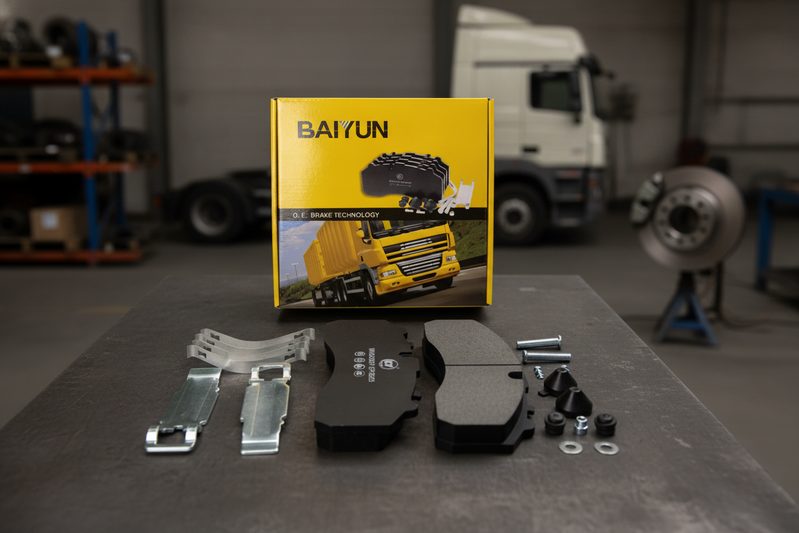
I’ve watched distributors burn thousands of dollars ordering from trading companies that couldn’t verify formulation consistency. There’s a direct correlation between factory-direct partnerships and repeat business. When you source from a manufacturer like BAIYUN, you get more than a price — you get an engineer on WeChat who can confirm a pad spec from a photo. That’s the difference between a 3-hour delivery delay and a 3-week litigation headache.
Our in-house mixing and pressing lines let us lock down the friction coefficient to a narrow window — within 0.03 μ of the OE target, dyno-verified. For a busy importer, that translates to zero warranty claims in 24 months. That’s not a promise; it’s our actual data from a 2024 Ghana distributor supplying 500 Ks of Shacman pads annually.
Whether you need a complete catalog of commercial vehicle brake pads or a direct wholesale CV brake lining inquiry, our export desk can turn your Shacman fitment challenge into a reliable supply chain. Send us your axle specs today — we’ll respond with a quote and technical dossier within one working day.
Was this article helpful?
Average Rating: 5/5 (798)