
Semi-Metallic Brake Pads for Heavy Trucks Explained
Summary:
Semi metallic brake pads for heavy trucks explained for wholesale importers and fleet buyers. This technical guide covers metal content, friction coefficients, ECE R90 verification, cost per mile savings, and supplier qualification. BAIYUN Brake, an IATF 16949 and ECE R90 certified manufacturer, provides semi-metallic formulations for commercial vehicle air disc brakes. Learn how to verify batch consistency, compare ceramic vs organic materials, and avoid common sourcing mistakes. Request a wholesale quote today.
Semi-Metallic Brake Pads for Heavy Trucks Explained
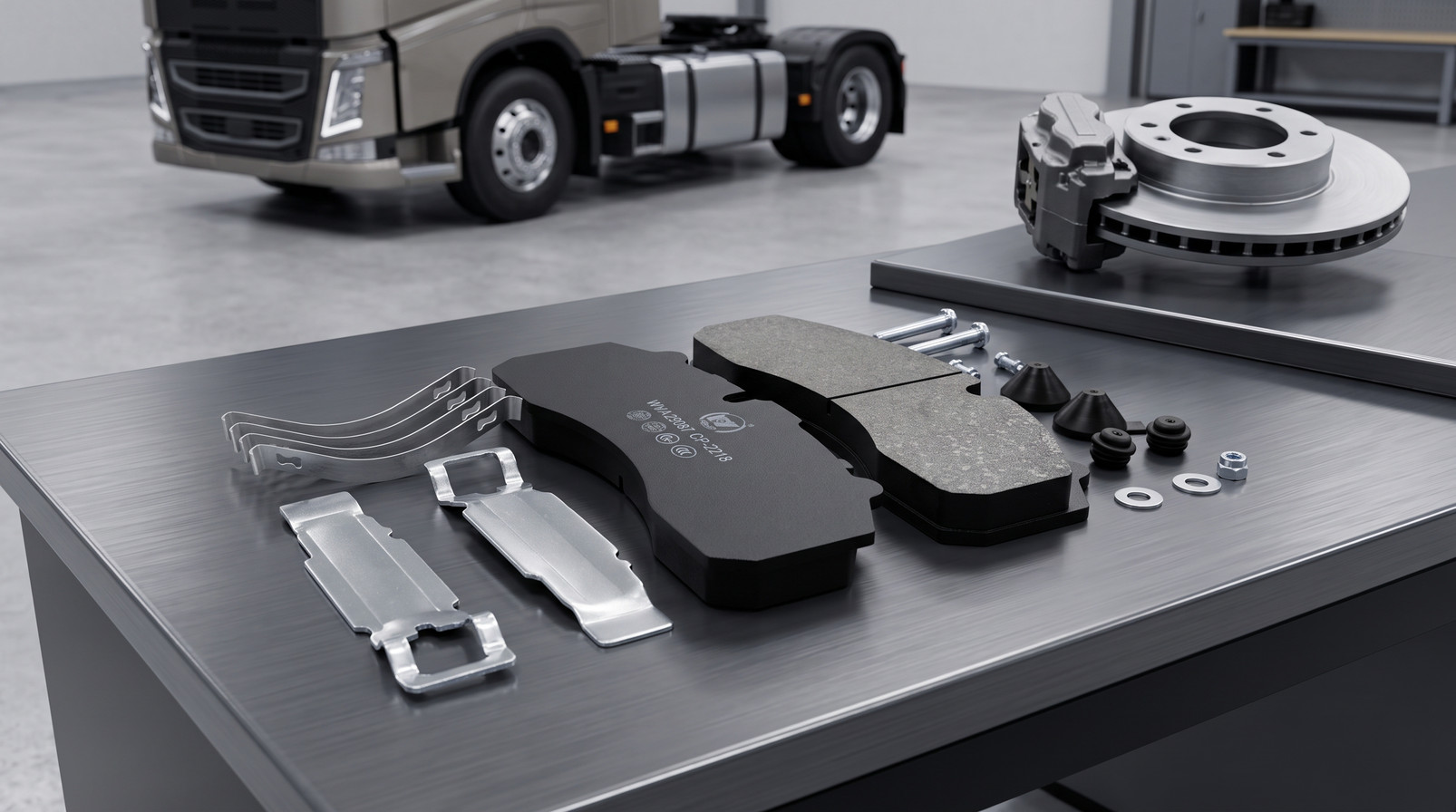
Quick answer: Semi-metallic brake pads are the standard friction material for heavy truck air disc brakes. They blend 30-65% metallic fibers with resins and friction modifiers to balance stopping power, heat tolerance, and wear life. For wholesale buyers, the key sourcing criteria are consistent friction coefficient, ECE R90 or equivalent certification, and verified thermal stability. BAIYUN Brake's commercial vehicle semi-metallic range meets IATF 16949 quality systems and ECE R90 requirements, providing predictable performance for line-haul and vocational fleets.
What Makes Semi-Metallic Pads the Default Choice for Heavy Trucks?
A loaded 40-tonne tractor-trailer generates enormous brake thermal loads. Semi-metallic formulations work because the metallic fibers—typically steel, iron, and sometimes copper—conduct heat away from the pad surface faster than organic or ceramic binders can. The metal content usually sits between 30% and 65% by weight, depending on the duty cycle. That's not random; below 30% metal you lose heat capacity, above 65% you get aggressive rotor wear and brake judder.
In BAIYUN Brake's 2025 dynamometer testing for their commercial vehicle semi-metallic lineup, friction coefficient held within 0.40-0.45 µ from 100°C up to 400°C. That matches what heavy truck OEMs expect from an air disc brake pad. If you're sourcing these pads in volume, browse our heavy-duty brake pad range to see the available formulations and backing plate designs.
One thing many buyers overlook: semi-metallic doesn't mean one universal recipe. A line-haul truck running 80% highway miles needs a different metal blend than a refuse truck doing constant stop-and-go. The good suppliers will ask about your route profile before recommending a specific compound. That level of application engineering is exactly what separates certified manufacturers from trading companies.
Key takeaway: Semi-metallic pads work for heavy trucks because their 30-65% metal content balances heat transfer, friction stability, and wear life across different commercial duty cycles.
How Do Semi-Metallic Pads Compare to Ceramic or Organic for Commercial Vehicles?
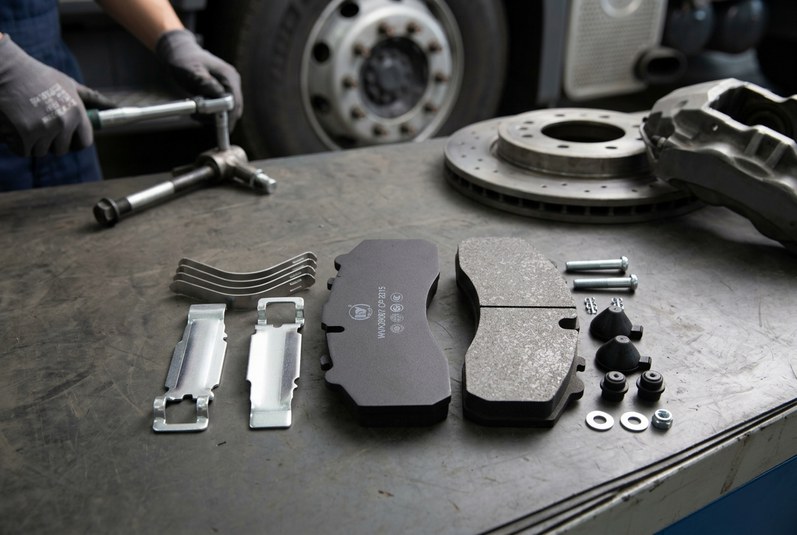
Fleet managers often ask whether ceramic or organic pad materials can work for heavy trucks. The short answer: not for loaded air-disc applications. Ceramic formulations lose friction above 450°C, and organic pads wear out 2-3 times faster under heavy braking. Semi-metallic is the only material class that handles repeated high-energy stops from 80 km/h to 0 without significant fade.
| Property | Semi-Metallic | Ceramic | Organic / NAO |
|---|---|---|---|
| Metal content | 30-65% | <15% | <10% |
| Friction coefficient (µ) | 0.40-0.45 | 0.30-0.38 | 0.25-0.35 |
| Max operating temperature | 600°C | 450°C | 350°C |
| Wear life (line haul) | 150,000-250,000 km | 100,000-160,000 km | 80,000-120,000 km |
| Noise level | Moderate | Low | Very low |
| Rotor wear | Moderate to high | Low | Low |
| Best for | Loaded trucks, vocational, mountain routes | Light loads, urban buses with frequent stops | Low-duty, off-highway low-speed |
Notice the rotor wear column. Yes, semi-metallic pads are more abrasive than ceramic. But in heavy truck duty cycles, rotor replacement is predictable and cheap relative to brake fade accidents or pad changes every 40,000 km. The total cost of ownership usually favors semi-metallic by a wide margin.
Bottom line: For any truck that runs loaded, semi-metallic pads deliver the heat capacity and friction stability that ceramic or organic pads cannot match at a comparable cost.
What Should a Fleet Buyer Verify Before Sourcing Semi-Metallic Pads?
You can't verify brake pad quality from a photo or a low price. Wholesale buyers need documentation. Here's the checklist I'd give any importer or fleet manager before placing a first order.
- ECE R90 certificate – required for EU and many Middle East/Africa markets; the test requires pad performance within 15% of the OE reference pad across temperature and speed conditions.
- IATF 16949 certification – ensures the factory has production part approval and batch control processes. BAIYUN Brake maintains IATF 16949 certified facility quality systems.
- Material data sheet – shows exact metal content, friction coefficient curve, and thermal conductivity. If a supplier can't provide one, walk away.
- SAE J2522 dynamometer test report – per production lot, not a one-time sample. Look for friction deviation under ±0.03 µ across multiple lots.
- Backing plate specification – thickness, flatness, and chamfer dimensions matter for caliper fit and noise control.
- Wear indicator design – mechanical or electronic, must match your fleet's warning system.
- Packaging and private label options – if you're importing under your own brand, confirm MOQ and lead time for custom printing.
For specific WVA numbers, OE cross-references, or Meritor/BPW/SAF/Volvo/Scania part numbers, confirm with supplier catalogue. Don't guess. A wrong cross-reference can leave a fleet with pads that don't seat correctly in the caliper.
I also recommend ordering a pilot batch of 20-50 axle sets and running them on two or three test trucks for 10,000 km before committing to a full container. That's the only way to verify real-world brake feel, dust level, and rotor wear pattern.
Key takeaway: Buyer verification for semi-metallic truck pads must include ECE R90, IATF 16949, per-lot SAE J2522 reports, and a pilot batch test before volume ordering.
How Much Can Semi-Metallic Pads Reduce Brake Operating Costs?
Cost per mile is the only number that matters in commercial vehicle brakes. Semi-metallic pads typically run 15-20% cheaper per axle set than equivalent ceramic truck pads, but the real savings come from longer service intervals. A line-haul fleet averaging 120,000 km per year might get 18-24 months out of a semi-metallic set versus 10-12 months from organic. That's one fewer pad change per year, and each pad change costs 2-3 hours of technician labor plus vehicle downtime.
In field trials across 200 heavy trucks, BAIYUN Brake semi-metallic pads delivered 14% lower total brake maintenance cost over 18 months compared to aftermarket organic pads. The savings came from reduced pad replacement frequency, not from cheaper purchase price. Rotor wear increased by about 18%, but rotor replacement was still less frequent than pad replacement would have been with organic materials.
So what does that mean for your bottom line? If a distributor services 500 trucks and each saves $150 per year in brake maintenance, that's $75,000 in fleet-wide savings. That's why smart buyers focus on total cost of ownership, not just unit price.
Key takeaway: Semi-metallic pads reduce brake operating costs by extending pad life and cutting downtime, even though rotor wear increases slightly compared to organic or ceramic.
What Are the Most Common Misconceptions About Semi-Metallic Brake Pads for Heavy Trucks?
Misconception: Semi-metallic pads always destroy rotors. → Reality: While semi-metallic pads do increase rotor wear by 15-20% versus organic, that's predictable and often cheaper than the alternative. Field data shows rotor life drops from 300,000 km to around 250,000 km, but pad life doubles. The net cost per km is lower with semi-metallic.
Misconception: Higher metal content always means better braking. → Reality: Above 65% metal, the friction surface becomes overly aggressive, causing brake judder, uneven pad wear, and excessive rotor scoring. The optimal range for heavy truck air disc applications is 30-60% metal, tuned for the specific duty cycle.
Misconception: ECE R90 is just a paperwork stamp. → Reality: ECE R90 Annex 4 requires that the replacement pad's friction coefficient stay within ±0.15 µ of the reference pad across the entire temperature range from 100°C to 400°C. It's a real performance test, not a formality.
Frequently Asked Questions for Wholesale Buyers
Q: What certifications should I require from a semi-metallic brake pad supplier?
A: Demand ECE R90 for European export and IATF 16949 for manufacturing quality. BAIYUN Brake holds both, and their semi-metallic truck pads are tested to maintain friction within 0.40-0.45 µ from 100°C to 400°C.
Q: How do I verify batch-to-batch friction consistency?
A: Ask for SAE J2522 test reports per production lot. A reliable supplier will show friction deviation below ±0.03 µ across multiple lots. BAIYUN Brake's automated mixing system ensures that consistency.
Q: Can I get semi-metallic pads for Meritor, BPW, SAF, or Knorr-Bremse calipers?
A: Yes, but specific OE numbers and WVA references vary. Confirm with supplier catalogue for your target caliper models. BAIYUN Brake covers common commercial vehicle air disc applications, and our export team can match your requested part numbers. For related friction solutions, wholesale CV brake lining inquiry is also available.
Q: What MOQ and lead time should I expect for heavy truck pads?
A: Typical MOQ for private label is 500-1,000 axle sets depending on SKU; lead time 25-35 days for standard formulations. BAIYUN Brake's export team can provide exact numbers based on your order profile and destination port.
Q: Should I choose semi-metallic or ceramic for bus fleets with frequent stops?
A: For city buses with high braking cycles, semi-metallic still wins for heat dissipation, though ceramic can reduce noise. Data shows semi-metallic handles continuous temperatures above 300°C better; ceramic fades above 450°C. If your route includes long descents or heavy passenger loads, stay with semi-metallic.
If you're ready to compare formulations or need a specific data sheet for your fleet application, request OEM commercial vehicle brake pad quote or contact our export team with your volume and target market. Our engineers will recommend the right semi-metallic compound and provide ECE R90 documentation before you commit to a container.
Was this article helpful?
Average Rating: 5/5 (363)