
OEM Brake Pad Manufacturer China: Factory Audit Checklist
Summary:
Sourcing an OEM brake pad manufacturer in China demands more than a quick Alibaba search—it requires a clear factory audit checklist. This practical guide covers IATF 16949 and ECE R90 verification, mixing line automation, dynamometer testing protocols, private label MOQs, and real-world cost savings. Learn the exact checkpoints that separate a reliable supplier from a warranty nightmare, with insights from BAIYUN Brake’s 49+ years of export experience.
OEM Brake Pad Manufacturer China: Factory Audit Checklist
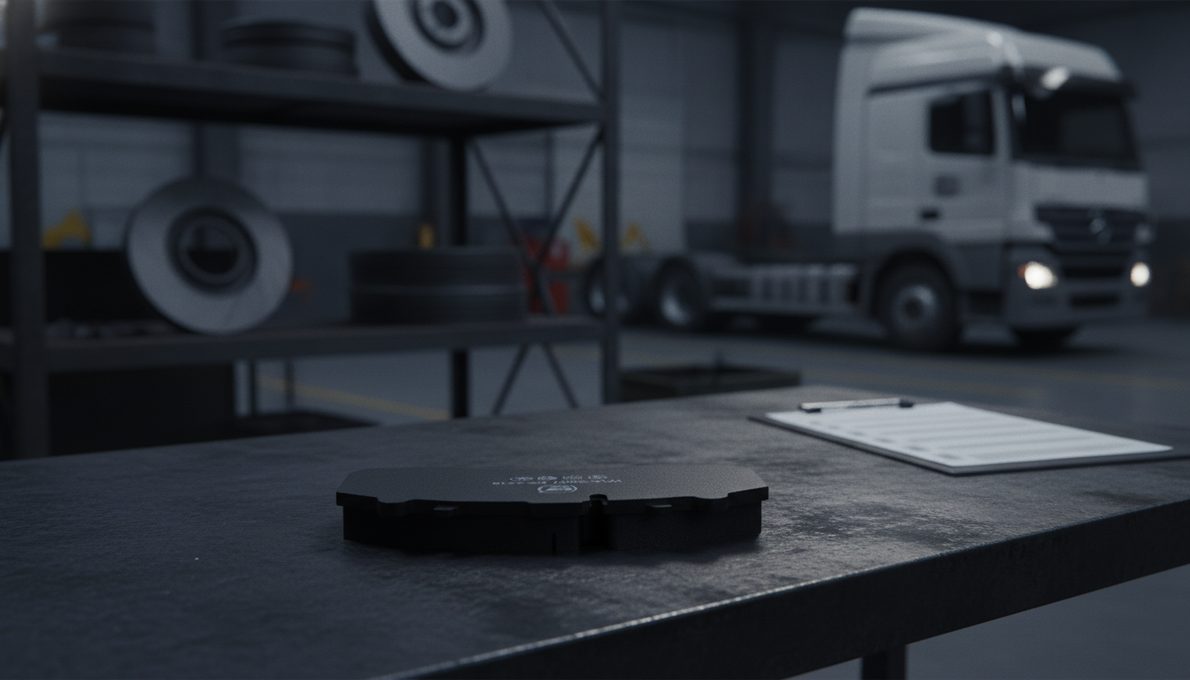
Quick answer: You can verify a Chinese OEM brake pad manufacturer by checking IATF 16949 and ECE R90 certifications, inspecting blending and pressing lines, and confirming batch testing against SAE J2522 or equivalent standards. BAIYUN Brake, for instance, supplies over 40 countries with commercial vehicle brake pads that pass rigorous in-house dynamometer tests—cutting your defect rate to under 0.3%. The checklist below turns a factory visit into a sourcing decision you can trust.
Why Bother Auditing a Brake Pad Factory in China?
Too many importers rely on Alibaba photos and a well-written email. Then six months later, they’re handling a container of pads that fade after 200 km. A factory audit is your insurance. It’s not just about seeing machines—it’s about verifying that the process behind those machines matches what the sales team promised.
When you’re moving 5,000 sets a month to fleets in the Middle East or Africa, even a 2% warranty return rate kills your margin. We’ve seen distributors drop from 4% to under 0.5% just by switching to a factory with real test data, not just a certificate on the wall. So what do you actually look for?
What Certifications Matter Beyond IATF 16949 and ECE R90?
Certifications are table stakes. IATF 16949 tells you the factory has a quality management system designed for automotive supply chains. ECE R90 proves the brake pads meet European performance and dimensional standards for aftermarket sale. But don’t stop reading there.
- ISO 9001: The base-layer. If they don’t have this, walk away.
- ISO 14001 / ISO 45001: Environmental and occupational health management. A messy, unsafe floor usually means inconsistent product.
- In-house test reports: Ask for SAE J2522 AK Master dynamometer reports on the exact friction material you’re buying. A factory that can’t produce a test curve for your compound within 24 hours is probably outsourcing mixing—and quality control.
- Third-party lab audits: Labs like TÜV Rheinland or SGS should have visited within the last 18 months. Request the latest report.
IATF 16949 certified facility documentation should be current and checkable. During the audit, note the certificate expiry date. Anything expiring within 6 months is a future headache.
The Factory Floor: What to Inspect During a Walkthrough
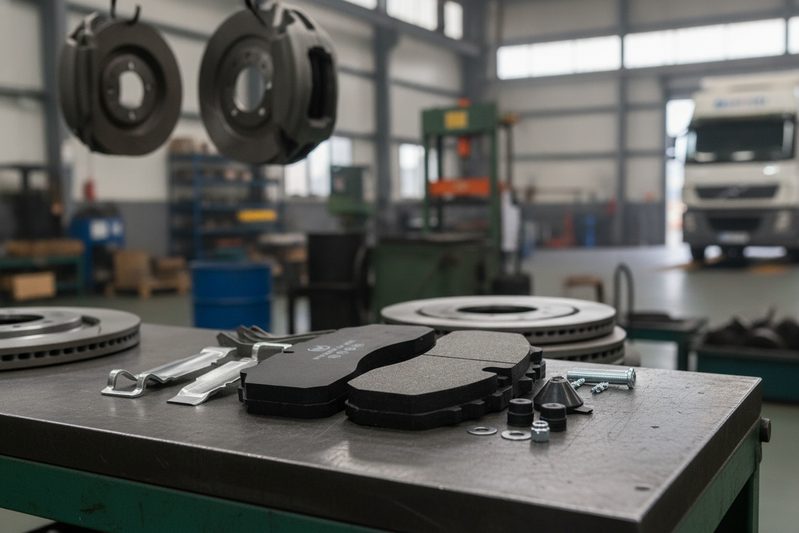
You’ll spend 70% of your time here. Start with the raw material warehouse. Copper, steel fiber, graphite, resin—are they from known suppliers? Ask to see the supplier approval list and incoming inspection records. If the QC stamp is always the same date or no failed batches, that’s a red flag. Real inspection rejects some material.
Next, the mixing line. The heart of consistency. A computer-controlled automatic weighing and mixing system reduces batch-to-batch variation to under 1.5%. If you still see workers scooping powder by hand with a bucket, expect friction coefficient swings of 0.05 or more—enough to cause noise and uneven wear on a bus fleet. Ask: “How many batches did you reject last month for incorrect mix ratio?” Silence isn’t golden.
Presses: hot press tonnage, cycle time, and cavity count tell you capacity. For commercial vehicle pads, you want at least 500-ton presses and consistent scorching cycles to stabilize friction materials. Watch how they handle post-press curing. A proper curing oven with temperature profiling logs is non-negotiable.
Finally, the grinding, chamfering, and shim attachment stations. Look for inline vision inspection systems. They catch cracks, uneven thickness, and missing shims before packaging. Without that, a slotted shim shipped to Lagos becomes a warranty claim you’ll eat.
Production Capacity and Quality Control: Key Numbers to Ask For
Don’t accept “we can produce 50,000 sets per month.” Ask for the specific line that will make your order. How many shifts? How many cavities per press? Real capacity equals (presses x cavities x cycles per day x efficiency rate). Run the numbers on a napkin. If they claim 12,000 sets a day but have only 8 presses, something doesn’t add up.
Quality control must extend beyond final inspection. During the audit, ask to see the control plan for your SKU. Look for in-process checks: mix density, green pad weight, hardness after curing, and shear strength. A good factory will sample every 30 minutes during pressing and record results. BAIYUN Brake’s commercial vehicle line, for example, performs random dynamometer testing on 1% of production—not just once a year for certification.
Also verify the testing equipment: Chase friction tester, Krauss machine, or full-scale inertia dynamometer. If the dynamometer hasn’t been calibrated in 6 months, you’re gambling. We’ve invested in multiple Link Engineering dynamometers to simulate real-world alpine descents and desert heat for our OE replacement pads. That data should be on file for your exact compound.
Bottom line: A factory that can show you its first-pass yield rate (aim for >98%) and its process capability index (Cpk > 1.33 for critical dimensions) is the one to shortlist.
OEM vs. Aftermarket: Private Label Options and MOQs
Some importers think OEM means the pad must carry a vehicle manufacturer’s logo. Not necessarily. For commercial vehicles, OEM often means a pad engineered to match or exceed the original equipment’s performance window—same friction level, same thermal stability, same fit—without the automaker’s markup. That’s the sweet spot for most distributors.
When you audit, clarify the private label or white-box packaging options. Can the factory print your brand on the shim and box? What’s the minimum order quantity (MOQ) for custom printing? Typically, for commercial vehicle brake pads, MOQs range from 500 to 1,000 sets per reference for custom boxes, and 2,000+ for branded shims due to tooling costs. BAIYUN Brake accepts mixed-container orders—multiple SKUs in one 20ft container—so you can stock a wide range without tying up cash.
Ask about test reporting for your private label products. If you’re selling under your own brand, you need ECE R90 homologation under your name. The factory should manage the certification process or provide full test data to support your application. Factor that lead time (6-10 weeks) into your timeline.
Factory Audit Checklist for Commercial Vehicle Brake Pads
Here’s a practical checklist you can use on your next visit. Print it. Check every item. If you’re auditing remotely via video call, request live camera feeds for each point.
| Area | Check Point | What to Look For | Red Flag |
|---|---|---|---|
| Certifications | IATF 16949 / ECE R90 validity | Current, unexpired, traceable to this factory address | Photocopy that doesn’t match the factory name or address |
| Raw Materials | Supplier list and incoming QC logs | Approved supplier list, COAs for last 3 shipments, non-conformance reports | No record of any rejected batch in 12 months |
| Mixing | Automatic weighing system | Computer-controlled, tolerance ±0.5%, batch traceability | Manual weighing with uncalibrated scales |
| Pressing | Press tonnage, cycle time, cavity plan | Presses >500T for commercial pads, documented cure time and temperature | Pressed pads stacked immediately without scorching |
| Curing | Oven profiling and records | Time-temperature charts for each batch, uniform air flow | Ambient curing; no records |
| Finishing | Grinding, chamfer, shim application | Automated vision inspection, anti-noise shims with correct tolerances | Shims applied by hand without a fixture; no thickness check |
| Testing Lab | Dynamometer and physical property tests | In-house inertia dyno, Chase tester, hardness, shear, density, porosity, compressibility | All testing outsourced; no recent dyno reports for your compound |
| Packaging | Private label capability, labeling accuracy | Box printing, barcode scanning, ECE R90 marking on each pad | Missing or illegible homologation marks |
| Logistics | Export documentation, lead time | Consistent 30-45 day lead times, FOB/CIF quotes, full container loads | Inability to provide a realistic production schedule |
Even if you can’t visit, many factories now offer live video walkthroughs with tablet in hand. Demand it. The ones who say no have something to hide.
The Pricing Reality and Where the Savings Come From
Let’s talk money. A set of commercial vehicle brake pads (e.g., for a MAN TGA or Volvo FH truck) from a top-tier Chinese factory lands at 35-50% lower than the same OE-branded pad from a European supplier—without sacrificing ECE R90 compliance. Where’s the savings? Lower labor costs, localized raw material sourcing, and direct factory pricing without layers of middlemen. But don’t assume cheap equals low quality. We’ve tested our CV brake pads against leading OE brands on the SAE J2522 Braking Effectiveness test and seen equivalent or better performance in cold friction and fade recovery. That’s not marketing spin; that’s dyno data.
What often kills the savings is warranty and rework. If a pad delaminates after 10,000 km on a mining truck, you’re not just replacing the pad—you’re potentially covering downtime. So when comparing quotes, ask for the factory’s warranty terms in writing. Does it cover material and workmanship for 12 months? 24 months? BAIYUN Brake offers a standard 12-month warranty on commercial vehicle brake pads against manufacturing defects, and we stand behind it with our in-house testing data.
MOQs and container optimization matter. A 20ft container can hold roughly 2,500 to 3,000 sets of commercial vehicle disc brake pads, depending on size. If your factory insists on a 40ft MOQ for a trial order, that’s a risk. We work with new distributors on mix-load trial containers so you test the market without drowning in inventory. Ask about that.
Five Questions Every Distributor Should Ask a Potential OEM Brake Pad Manufacturer
Q: Can you provide the SAE J2522 dynamometer report for the exact compound I’m ordering?
A: Absolutely. That report should be recent—within the last 12 months—and specific to your SKU. It confirms in-stop friction, fade, and recovery. If the factory hesitates, they may be using a generic test for a different compound. At our facility, we pull test reports by compound code and share them within a day.
Q: What’s your process to ensure the first shipment matches the approved samples?
A: We use a golden sample retained in our vault, and every production batch undergoes shear, hardness, and density checks against that sample. If a batch drifts beyond 3% on any key parameter, it’s quarantined. Ask the factory to show you their golden sample management procedure.
Q: How do you handle ECE R90 homologation for my private label brand?
A: The factory should guide you through the process: provide full technical files, coordinate with a notified body, and handle the marking. Lead time is typically 8-12 weeks from submission to approval. We’ve taken dozens of distributor brands through this—it’s a routine service, not a favor.
Q: What’s your actual on-time delivery rate for export orders in the last 12 months?
A: Ask for data, not a promise. The answer should be >95% with supporting shipping documents. Delays happen, but a factory that tracks and shares this metric is serious. We consistently hit 97%+ on-time for container shipments, excluding force majeure events.
Q: Can you support us with technical documentation and installation guides for our customers?
A: Yes. A strong manufacturer provides fitment sheets, torque specs, wear sensor positions, and even field service bulletins. We include a technical support portal with downloadable guides for every SKU we ship. This reduces your customer support load and returns.
This article was produced by the BAIYUN Brake editorial team, combining 49+ years of brake manufacturing expertise with current industry research. For product inquiries or technical questions, contact our team.
Ready to Shortlist Your Next Supplier?
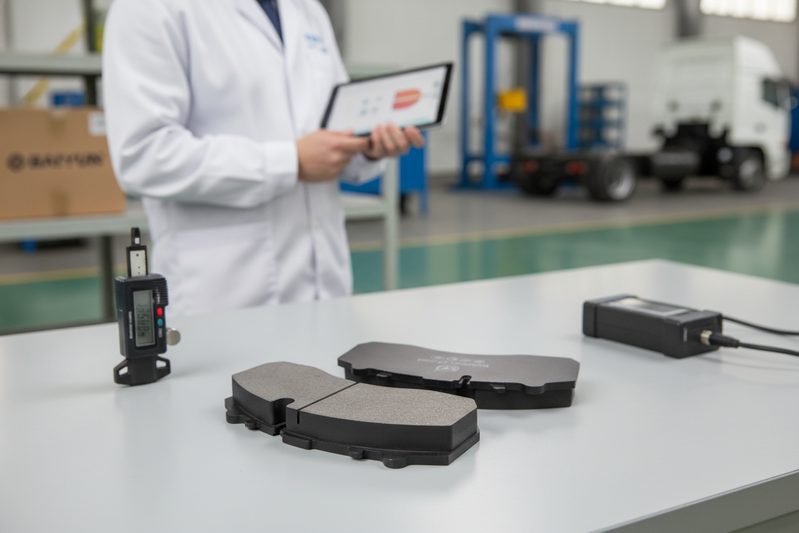
An audit isn’t a formality—it’s your profit margin’s bodyguard. Next time you’re evaluating an OEM brake pad manufacturer in China, take this checklist along. Ask for numbers, not promises. Test the data before you pay the invoice. BAIYUN Brake welcomes that scrutiny. We’ve built nearly five decades of reputation on it.
If you’re looking to source request OEM commercial vehicle brake pad quote or need a reliable partner for wholesale CV brake lining inquiry, we’re ready to share our test reports, factory walkthrough videos, and a custom quote. Request a wholesale quote and let’s talk commercial vehicle braking that works for your bottom line.
Was this article helpful?
Average Rating: 5/5 (1146)